
Section 2 Strengths of Acids and Bases Strong

Section 2 Strengths of Acids and Bases Strong and Weak Acids and Bases • The strength of an acid or base depends on how many acid or base particles form into ions in water. • When a strong acid dissolves in water, nearly all the acid molecules form into ions. • When a weak acid dissolves in water, only a small fraction of the molecules dissolve in water.
Section 2 Strengths of Acids and Bases Strong and Weak Acids and Bases • Ions in solution can conduct an electric current. • The ability of a solution to conduct a current can be demonstrated using a lightbulb connected to a battery with leads placed in the solution.
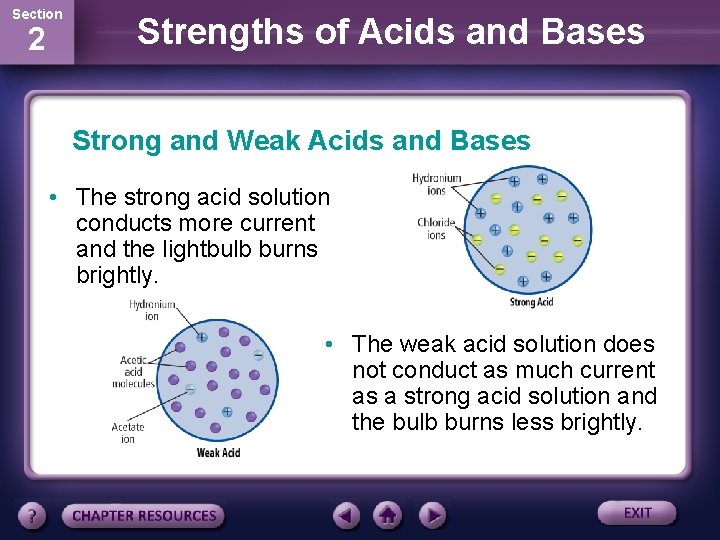
Section 2 Strengths of Acids and Bases Strong and Weak Acids and Bases • The strong acid solution conducts more current and the lightbulb burns brightly. • The weak acid solution does not conduct as much current as a strong acid solution and the bulb burns less brightly.
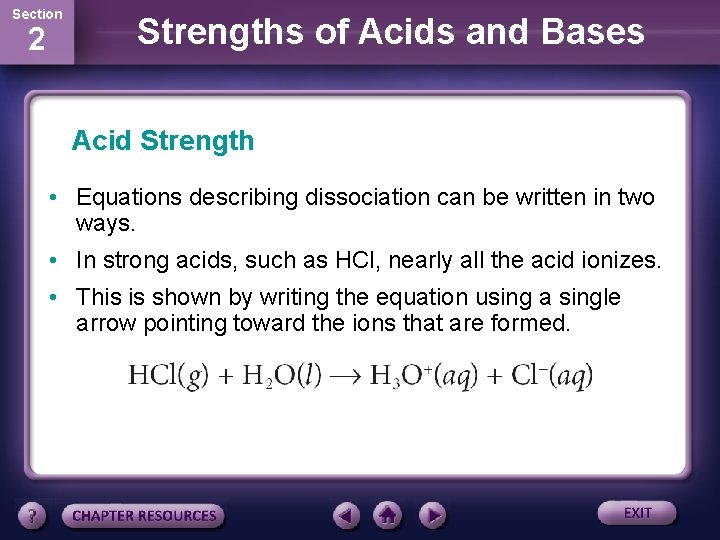
Section 2 Strengths of Acids and Bases Acid Strength • Equations describing dissociation can be written in two ways. • In strong acids, such as HCl, nearly all the acid ionizes. • This is shown by writing the equation using a single arrow pointing toward the ions that are formed.

Section 2 Strengths of Acids and Bases Acid Strength • Equations describing the ionization of weak acids, such as acetic acid, are written using double arrows pointing in opposite directions. • This means that only some of the CH 3 COOH ionizes and the reaction does not go to completion.
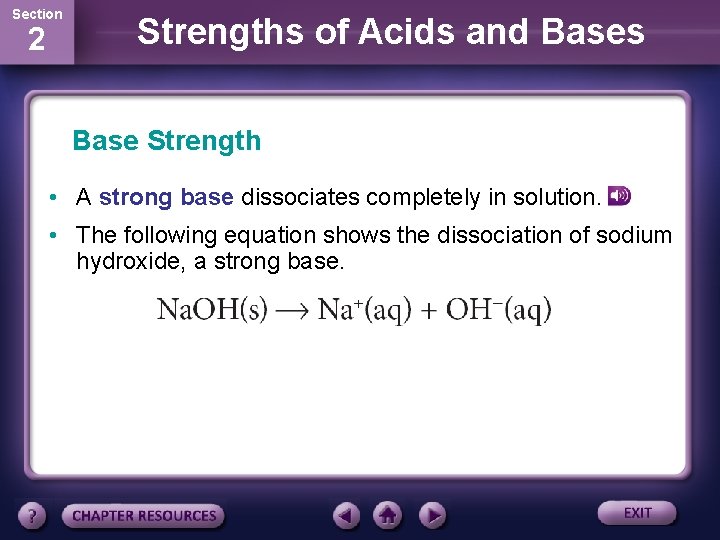
Section 2 Strengths of Acids and Bases Base Strength • A strong base dissociates completely in solution. • The following equation shows the dissociation of sodium hydroxide, a strong base.

Section 2 Strengths of Acids and Bases Base Strength • This dissociation of ammonia, which is a weak base, is shown using double arrows to indicate that not all the ammonia ionizes. • A weak base is one that does not dissociate completely.
Section 2 Strengths of Acids and Bases Strength and Concentration • The terms strong and weak are used to classify acids and bases. • The terms refer to the ease with which an acid ionizes or base dissociates in solution. • Strong acids and bases ionize or dissociate completely; weak acids and bases ionize or dissociate only partially.
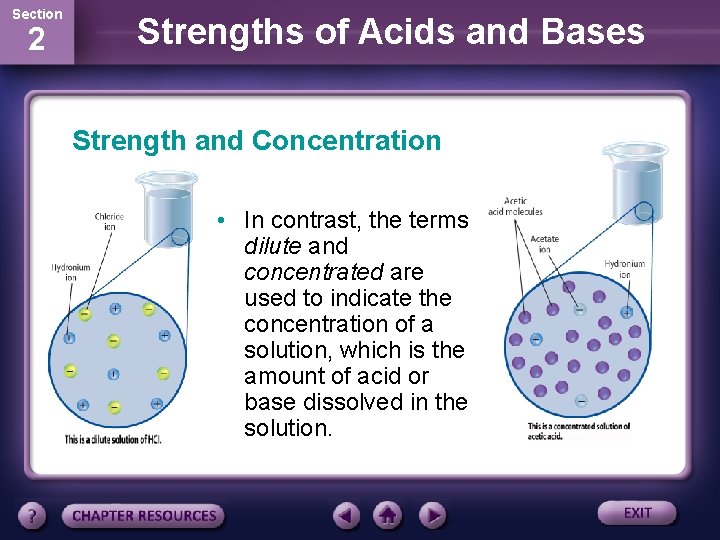
Section 2 Strengths of Acids and Bases Strength and Concentration • In contrast, the terms dilute and concentrated are used to indicate the concentration of a solution, which is the amount of acid or base dissolved in the solution.
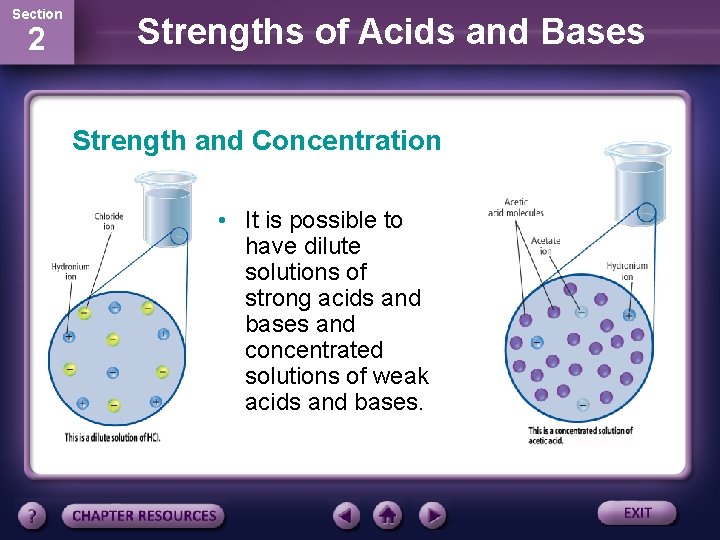
Section 2 Strengths of Acids and Bases Strength and Concentration • It is possible to have dilute solutions of strong acids and bases and concentrated solutions of weak acids and bases.
Section 2 Strengths of Acids and Bases p. H of a Solution • The p. H of a solution is a measure of the concentration of H+ ions in it. • The greater the H+ concentration is, the lower the p. H is and the more acidic the solution is. • The p. H measures how acidic or basic a solution is.
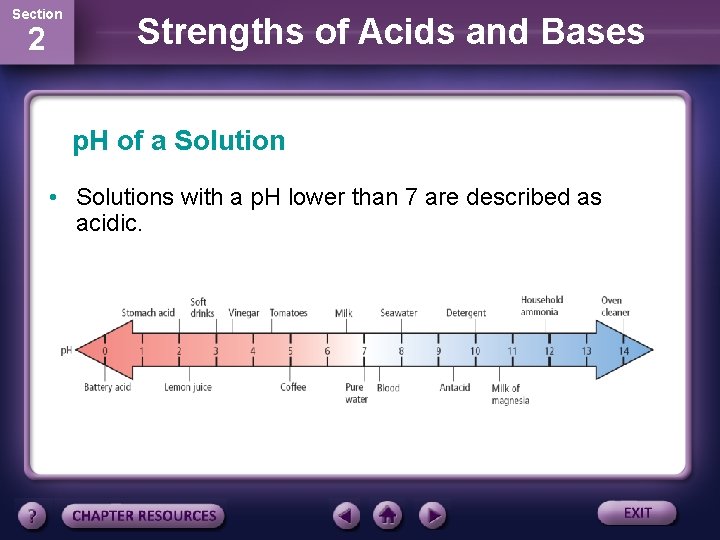
Section 2 Strengths of Acids and Bases p. H of a Solution • Solutions with a p. H lower than 7 are described as acidic.
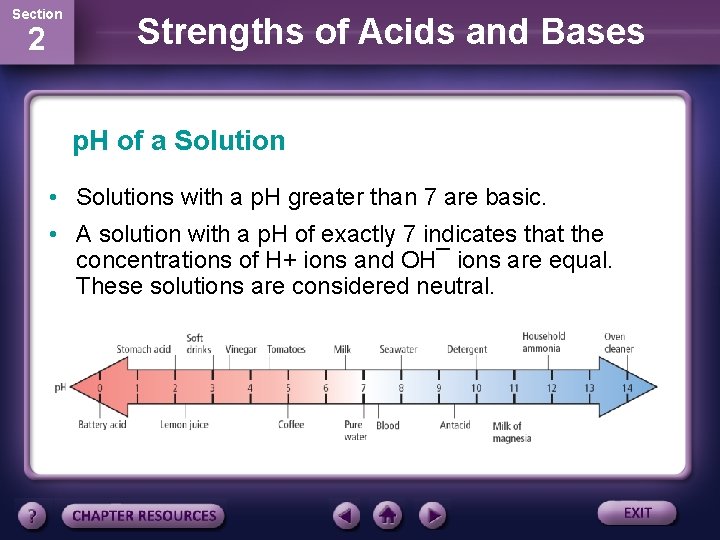
Section 2 Strengths of Acids and Bases p. H of a Solution • Solutions with a p. H greater than 7 are basic. • A solution with a p. H of exactly 7 indicates that the concentrations of H+ ions and OH¯ ions are equal. These solutions are considered neutral.
Section 2 Strengths of Acids and Bases p. H of a Solution • One way to determine p. H is by using a universal indicator paper. • This paper undergoes a color change in the presence of H 3 O+ ions and OH‾ ions in solution. • The final color of the p. H paper is matched with colors in a chart to find the p. H.
Section 2 Strengths of Acids and Bases p. H of a Solution • An instrument called a p. H meter is another tool to determine the p. H of a solution. • This meter is operated by immersing the electrodes in the solution to be tested and reading the dial.
Section 2 Strengths of Acids and Bases Blood p. H • In order to carry out its many functions properly, the p. H of blood must remain between 7. 0 and 7. 8. • The main reason for this is that enzymes, the protein molecules that act as catalysts for many reactions in the body, cannot work outside this p. H range.
Section 2 Strengths of Acids and Bases Blood p. H • Your blood contains compounds called buffers that enable small amounts of acids or bases to be absorbed without harmful effects. • Buffers are solutions containing ions that react with additional acids or bases to minimize their effects on p. H.
Section 2 Section Check Question 1 What is the difference between a strong acid and a weak acid? Answer In strong acids, nearly all the acid molecules dissociate into ions. In weak acids, a small fraction of the molecules dissolve in water.
Section 2 Section Check Question 2 What is the difference between the terms “strength” and “concentration”? Answer Strength refers to the ease with which an acid ionizes or base dissociates in solution. Concentration is the amount of an acid or base dissolved in the solution.
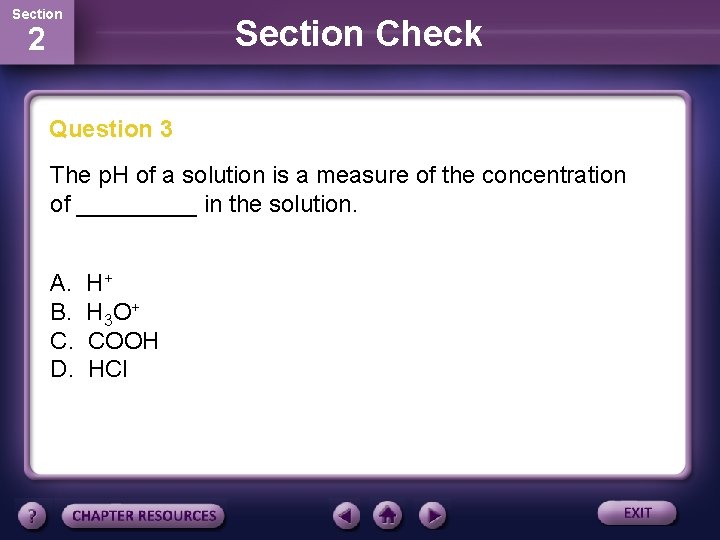
Section Check 2 Question 3 The p. H of a solution is a measure of the concentration of _____ in the solution. A. B. C. D. H+ H 3 O + COOH HCl
Section 2 Section Check Answer The answer is A, the greater the H+ concentration, the lower the p. H and the more acidic the solution.
- Slides: 21