
Section 2 Modern Classification systems have changed over
- Slides: 18
Section 2: Modern Classification systems have changed over time as information has increased. K What I Know W What I Want to Find Out L What I Learned
Essential Questions • • • What are the similarities and differences between species concepts? What are the methods used to reveal phylogeny? How is a cladogram constructed? Copyright © Mc. Graw-Hill Education Modern Classification
Vocabulary Review New • • • evolution Copyright © Mc. Graw-Hill Education phylogeny character molecular clock cladistics cladogram Modern Classification
Determining Species Typological species concept • The concept of what determines a species has changed through time. • Aristotle and Linnaeus used the typological species concept – each species a distinctly different group of organisms based on physical similarities. • Based on the idea that species are unchanging, distinct, and natural types. Copyright © Mc. Graw-Hill Education Modern Classification
Determining Species Biological species concept • The biological species concept defines a species as a group of organisms that is able to interbreed and produce fertile offspring in a natural setting. • Does not account for extinct species or species that reproduce asexually. Copyright © Mc. Graw-Hill Education Modern Classification
Determining Species Phylogenetic species concept • Phylogeny is the evolutionary history of a species. • The phylogenetic species concept defines a species as a cluster of organisms that is distinct from other clusters and shows evidence of a pattern of ancestry and descent. Copyright © Mc. Graw-Hill Education Modern Classification
Species Concepts Interactive Table FPO Add link interactive table from page 491(Table 2) here. Copyright © Mc. Graw-Hill Education Modern Classification
Characters • To classify a species, scientists construct patterns of descent by using characters – inherited features that vary among species. • Characters can be morphological or biochemical. Copyright © Mc. Graw-Hill Education Modern Classification
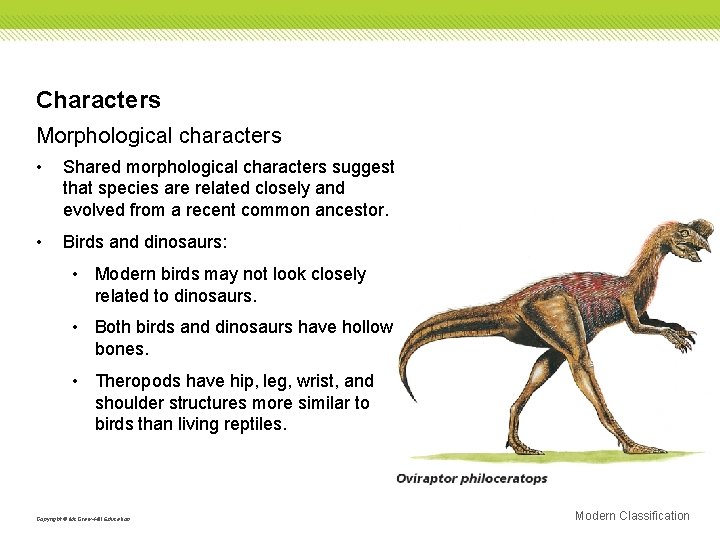
Characters Morphological characters • Shared morphological characters suggest that species are related closely and evolved from a recent common ancestor. • Birds and dinosaurs: • Modern birds may not look closely related to dinosaurs. • Both birds and dinosaurs have hollow bones. • Theropods have hip, leg, wrist, and shoulder structures more similar to birds than living reptiles. Copyright © Mc. Graw-Hill Education Modern Classification
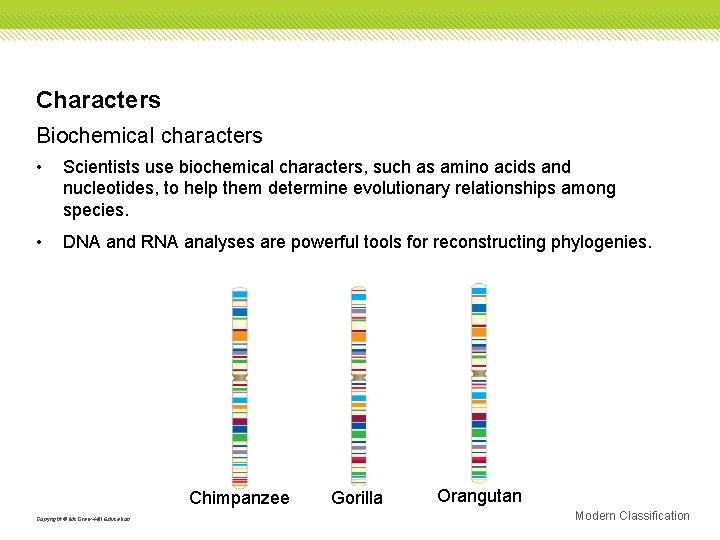
Characters Biochemical characters • Scientists use biochemical characters, such as amino acids and nucleotides, to help them determine evolutionary relationships among species. • DNA and RNA analyses are powerful tools for reconstructing phylogenies. Chimpanzee Copyright © Mc. Graw-Hill Education Gorilla Orangutan Modern Classification
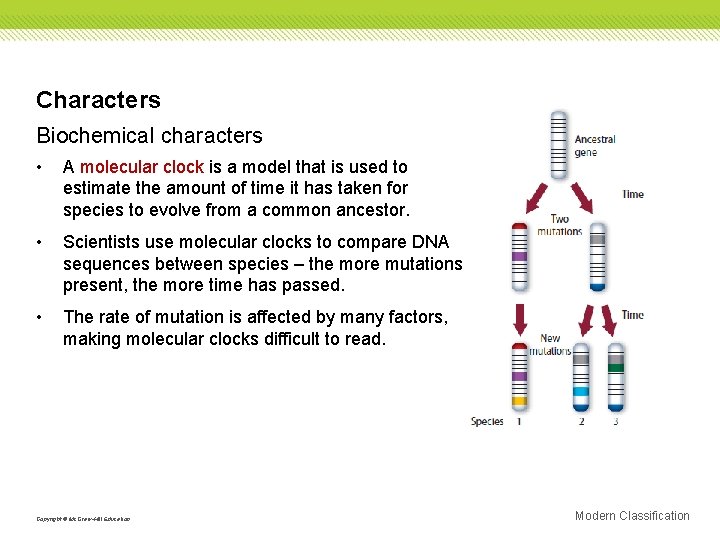
Characters Biochemical characters • A molecular clock is a model that is used to estimate the amount of time it has taken for species to evolve from a common ancestor. • Scientists use molecular clocks to compare DNA sequences between species – the more mutations present, the more time has passed. • The rate of mutation is affected by many factors, making molecular clocks difficult to read. Copyright © Mc. Graw-Hill Education Modern Classification
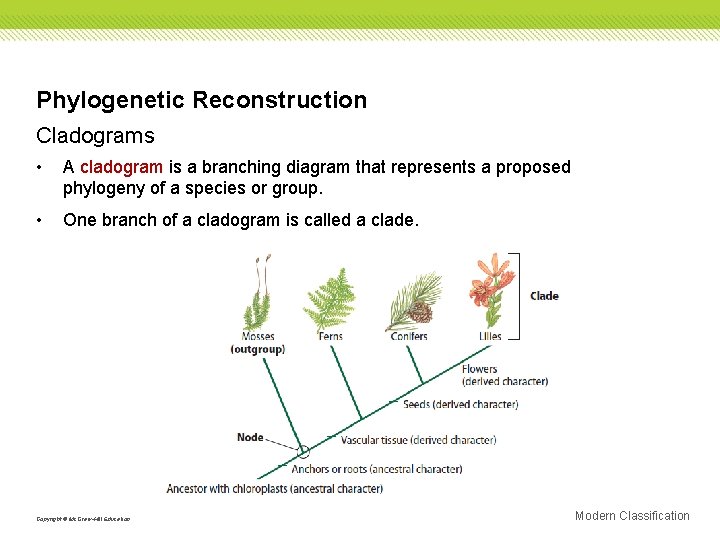
Phylogenetic Reconstruction Character types • Cladistics classifies organisms based on the order that they diverged from a common ancestor. • Scientists consider two main types of characters when doing cladistic analyses: • Ancestral characters are found within the entire line of descent of a group of organisms. • Derived characters are only found after a split from the descendent line. Copyright © Mc. Graw-Hill Education Modern Classification
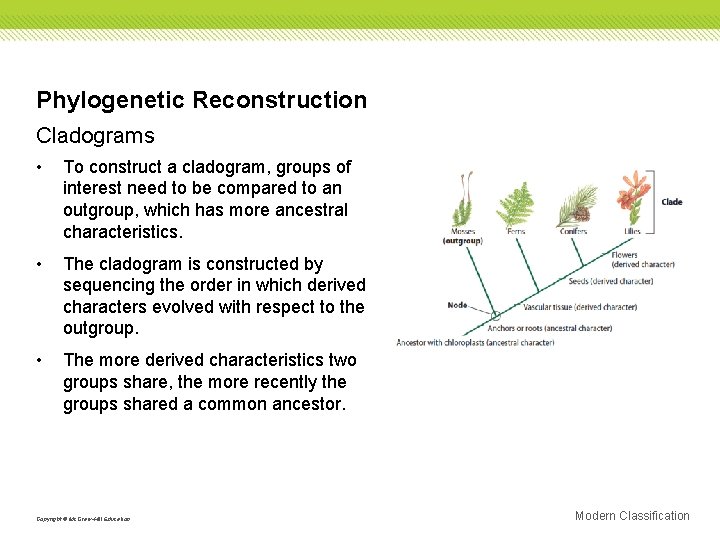
Phylogenetic Reconstruction Cladograms • A cladogram is a branching diagram that represents a proposed phylogeny of a species or group. • One branch of a cladogram is called a clade. Copyright © Mc. Graw-Hill Education Modern Classification
Phylogenetic Reconstruction Cladograms • To construct a cladogram, groups of interest need to be compared to an outgroup, which has more ancestral characteristics. • The cladogram is constructed by sequencing the order in which derived characters evolved with respect to the outgroup. • The more derived characteristics two groups share, the more recently the groups shared a common ancestor. Copyright © Mc. Graw-Hill Education Modern Classification
Constructing a Cladogram Animation FPO Add link to animation from page 496 (figure 11) here. Copyright © Mc. Graw-Hill Education Modern Classification
Visualizing the Tree of Life Animation FPO Add link to animation from page 497 (Figure 12) here. Copyright © Mc. Graw-Hill Education Modern Classification
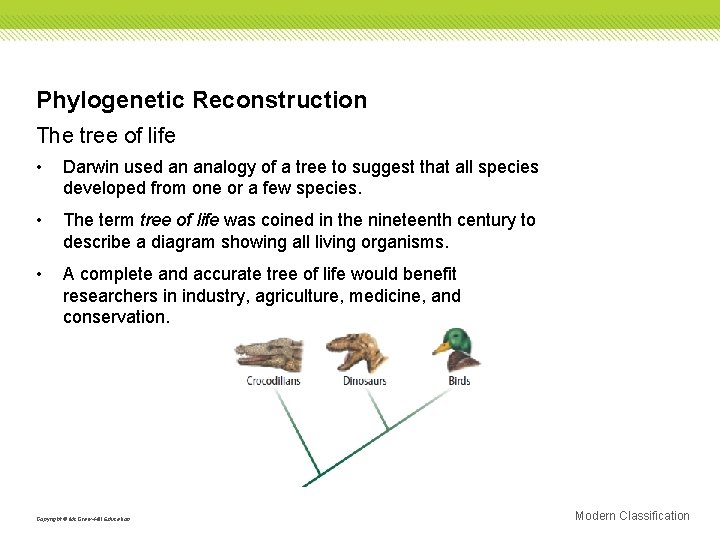
Phylogenetic Reconstruction The tree of life • Darwin used an analogy of a tree to suggest that all species developed from one or a few species. • The term tree of life was coined in the nineteenth century to describe a diagram showing all living organisms. • A complete and accurate tree of life would benefit researchers in industry, agriculture, medicine, and conservation. Copyright © Mc. Graw-Hill Education Modern Classification
Review Essential Questions • • • What are the similarities and differences between species concepts? What are the methods used to reveal phylogeny? How is a cladogram constructed? Vocabulary • • phylogeny character Copyright © Mc. Graw-Hill Education • • molecular clock cladistics • cladogram Modern Classification