
SECTION 2 IONIC AND COVALENT BONDING KEY IDEAS

SECTION 2: IONIC AND COVALENT BONDING
KEY IDEAS � Why do atoms form bonds? � How do ionic bonds form? � What do atoms joined by covalent bonds share? � What gives metals their distinctive properties? � How are polyatomic ions similar to other ions?
KEY TERMS Ionic bond Covalent bond Metallic bond Polyatomic ion
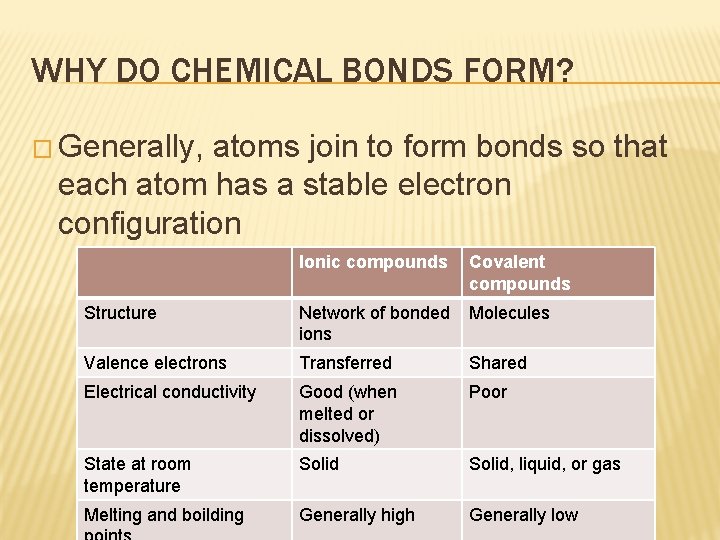
WHY DO CHEMICAL BONDS FORM? � Generally, atoms join to form bonds so that each atom has a stable electron configuration Ionic compounds Covalent compounds Structure Network of bonded ions Molecules Valence electrons Transferred Shared Electrical conductivity Good (when melted or dissolved) Poor State at room temperature Solid, liquid, or gas Melting and boilding Generally high Generally low
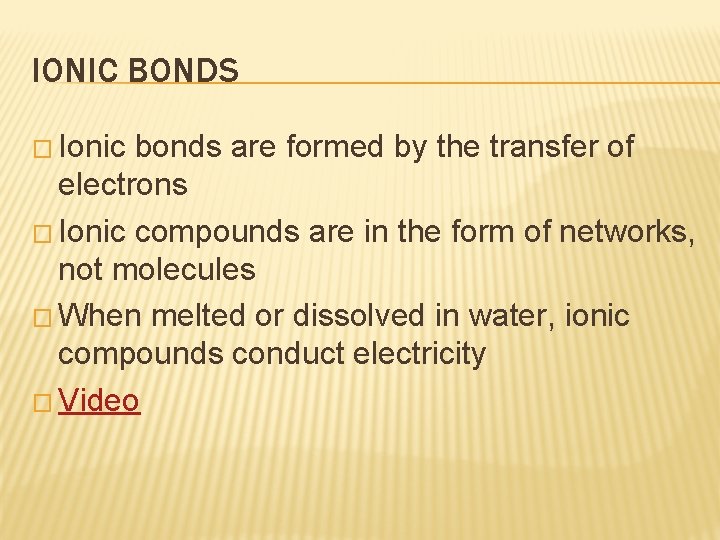
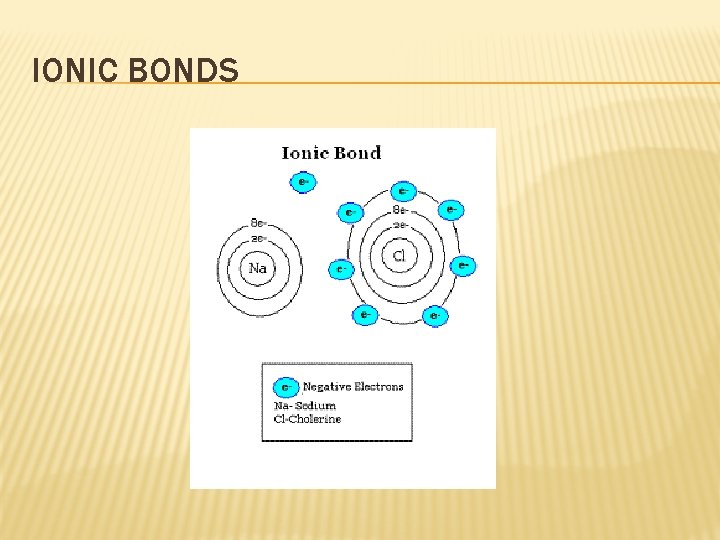
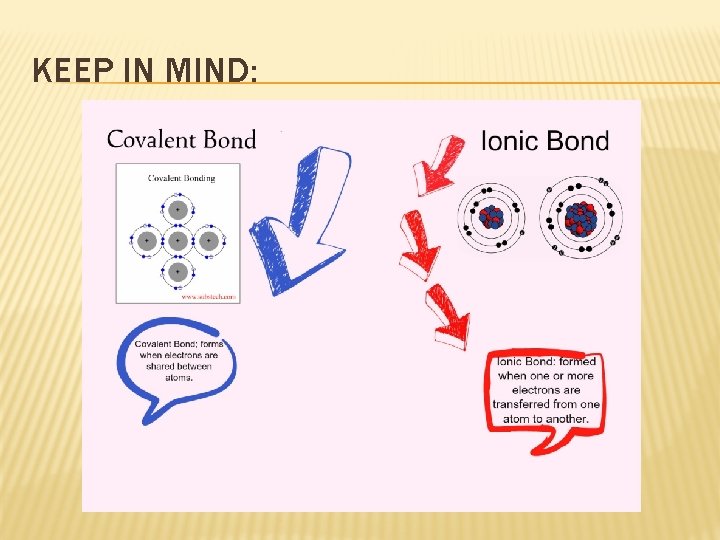
IONIC BONDS � Ionic bonds are formed by the transfer of electrons � Ionic compounds are in the form of networks, not molecules � When melted or dissolved in water, ionic compounds conduct electricity � Video
IONIC BONDS
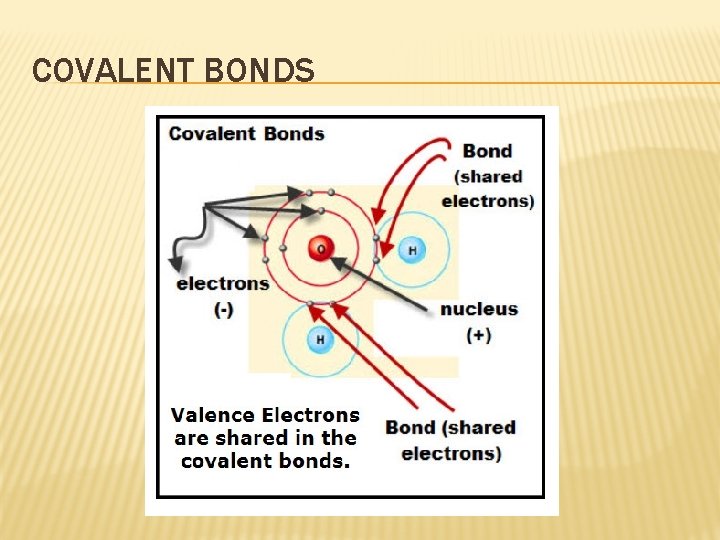
COVALENT BONDS �A bond formed when atoms share one or more pairs of electrons � Can be solids, liquids, or gases � Atoms may share more than one pair of electrons � Atoms do not always share electrons equally.
COVALENT BONDS
METALLIC BONDS � Formed by the attraction between positively charged metal ions and the electrons around them. � Metals are flexible and conduct electric current well because their atoms and electrons can move freely throughout a metal’s packed structure. � Electron can move freely between metal atoms.
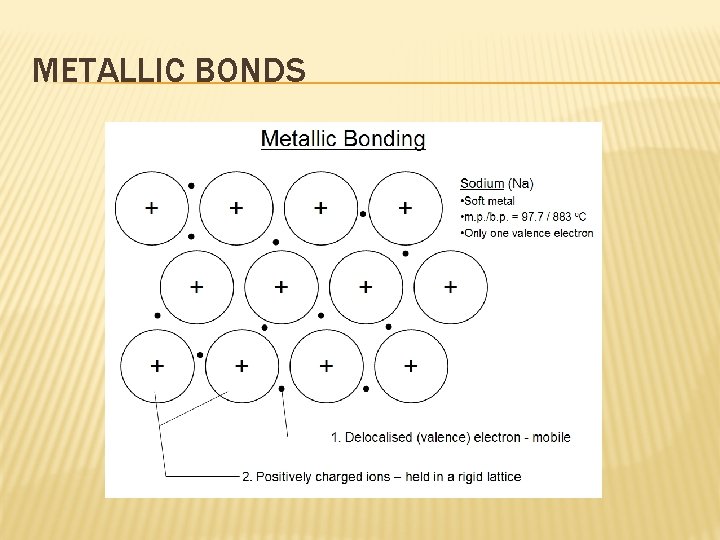
METALLIC BONDS
POLYATOMIC IONS � An ion made of two or more atoms � Acts as a single unit in a compound, just as ions that consist of a single atom do � There are several common polyatomic ions (baking soda, ammonium nitrate and sulfate) � Parentheses group the atoms of a polyatomic ion � Some names relate to the oxygen content of the anion. � Video
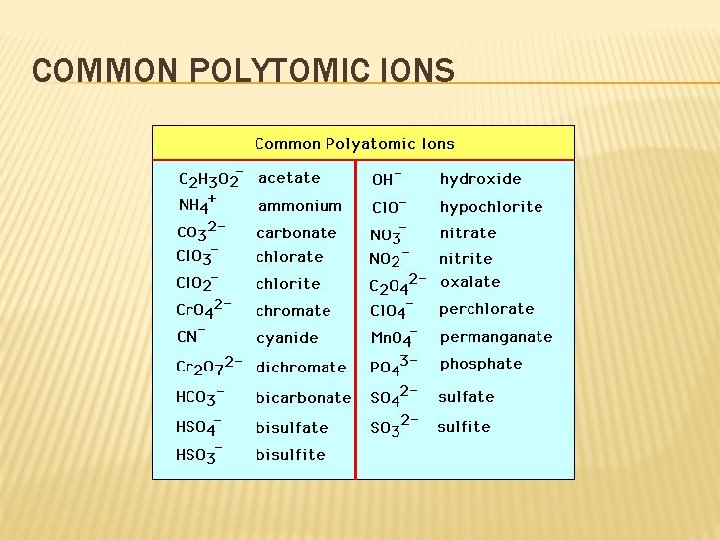
COMMON POLYTOMIC IONS
KEEP IN MIND:
- Slides: 13