
Section 2 Evidence of Evolution Multiple lines of

- Slides: 21
Section 2: Evidence of Evolution Multiple lines of evidence support theory of evolution. K What I Know W What I Want to Find Out L What I Learned
• • 7(A) Analyze and evaluate how evidence of common ancestry among groups is provided by the fossil record, biogeography, and homologies, including anatomical, molecular, and developmental. 1(A) Demonstrate safe practices during laboratory and field investigations. 2(B) Know that hypotheses are tentative and testable statements that must be capable of being supported or not supported by observational evidence. Hypotheses of durable explanatory power which have been tested over a wide variety of conditions are incorporated into theories. 2(C) Know scientific theories are based on natural and physical phenomena and are capable of being tested by multiple independent researchers. Unlike hypotheses, scientific theories are well-established and highly-reliable explanations, but they may be subject to change as new areas of science and new technologies are developed. Copyright © Mc. Graw-Hill Education Evidence of Evolution
• • • 2(F) Collect and organize qualitative and quantitative data and make measurements with accuracy and precision using tools such as calculators, spreadsheet software, data-collecting probes, computers, standard laboratory glassware, microscopes, various prepared slides, stereoscopes, metric rulers, electronic balances, gel electrophoresis apparatuses, micropipettors, hand lenses, Celsius thermometers, hot plates, lab notebooks or journals, timing devices, cameras, Petri dishes, lab incubators, dissection equipment, meter sticks, and models, diagrams, or samples of biological specimens or structures. 3(A) In all fields of science, analyze, evaluate, and critique scientific explanations by using empirical evidence, logical reasoning, and experimental and observational testing, including examining all sides of scientific evidence of those scientific explanations, so as to encourage critical thinking by the student. 7(C) Analyze and evaluate how natural selection produces change in populations, not individuals. Copyright © Mc. Graw-Hill Education Evidence of Evolution
• • • 7(D) Analyze and evaluate how the elements of natural selection, including inherited variation, the potential of a population to produce more offspring than can survive, and a finite supply of environmental resources, result in differential reproductive success. 7(E) Analyze and evaluate the relationship of natural selection to adaptation and to the development of diversity in and among species. 12(B) Compare variations and adaptations of organisms in different ecosystems. Copyright © Mc. Graw-Hill Education Evidence of Evolution
Essential Questions • • • How do fossils provide evidence of evolution? How does morphology provide evidence of evolution? How does biochemistry provide evidence of evolution? Copyright © Mc. Graw-Hill Education Evidence of Evolution
Vocabulary Review New • • • fossil Copyright © Mc. Graw-Hill Education derived trait ancestral trait homologous structure vestigial structure analogous structure embryo biogeography fitness camouflage mimicry Evidence of Evolution
Support for Evolution • The theory of evolution states that all organisms on Earth have descended from a single ancestor. • Recall that theories provide explanations for natural phenomena based on observation. • Darwin’s On the Origin of Species demonstrated how evolution might happen, and evidence of its occurrence. Copyright © Mc. Graw-Hill Education Evidence of Evolution
Support for Evolution • Evidence for evolution comes from: • The fossil record • Comparative anatomy • Comparative embryology • Comparative biochemistry • Geographic distribution Copyright © Mc. Graw-Hill Education Evidence of Evolution
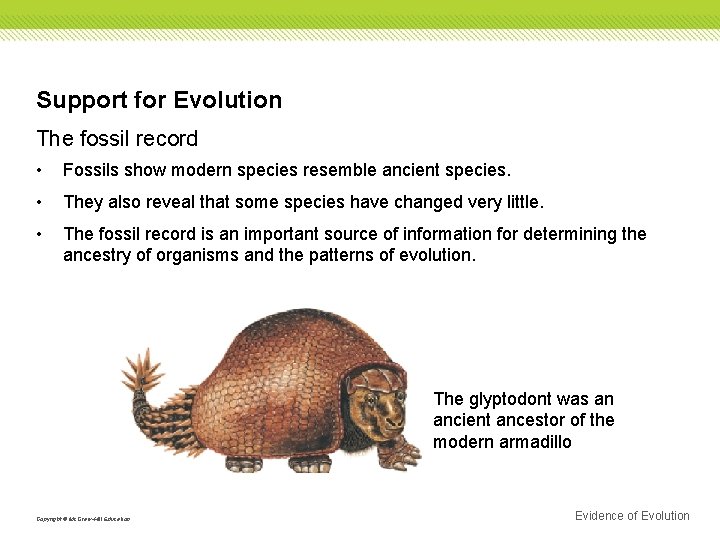
Support for Evolution The fossil record • Fossils show modern species resemble ancient species. • They also reveal that some species have changed very little. • The fossil record is an important source of information for determining the ancestry of organisms and the patterns of evolution. The glyptodont was an ancient ancestor of the modern armadillo Copyright © Mc. Graw-Hill Education Evidence of Evolution
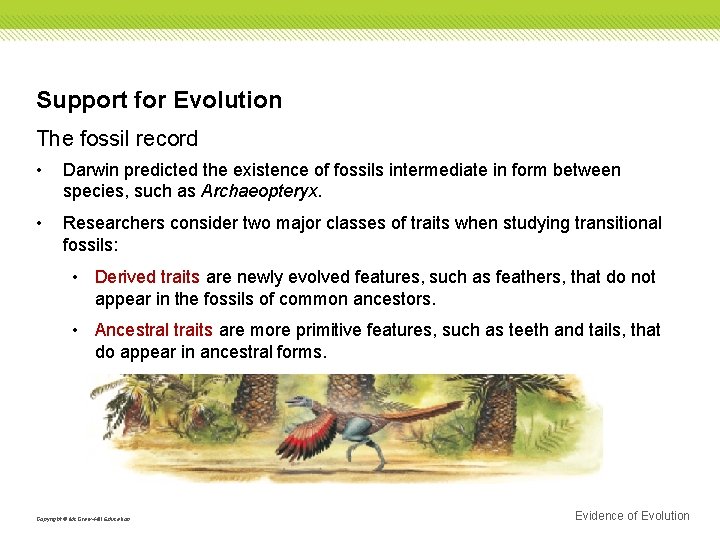
Support for Evolution The fossil record • Darwin predicted the existence of fossils intermediate in form between species, such as Archaeopteryx. • Researchers consider two major classes of traits when studying transitional fossils: • Derived traits are newly evolved features, such as feathers, that do not appear in the fossils of common ancestors. • Ancestral traits are more primitive features, such as teeth and tails, that do appear in ancestral forms. Copyright © Mc. Graw-Hill Education Evidence of Evolution
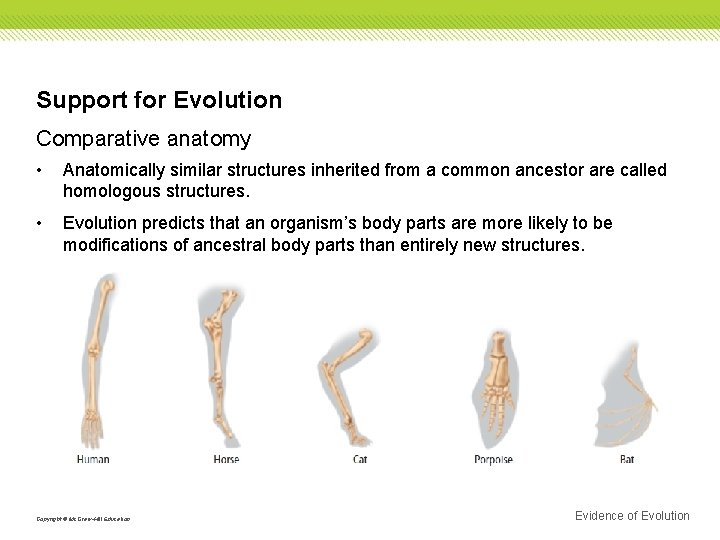
Support for Evolution Comparative anatomy • Anatomically similar structures inherited from a common ancestor are called homologous structures. • Evolution predicts that an organism’s body parts are more likely to be modifications of ancestral body parts than entirely new structures. Copyright © Mc. Graw-Hill Education Evidence of Evolution
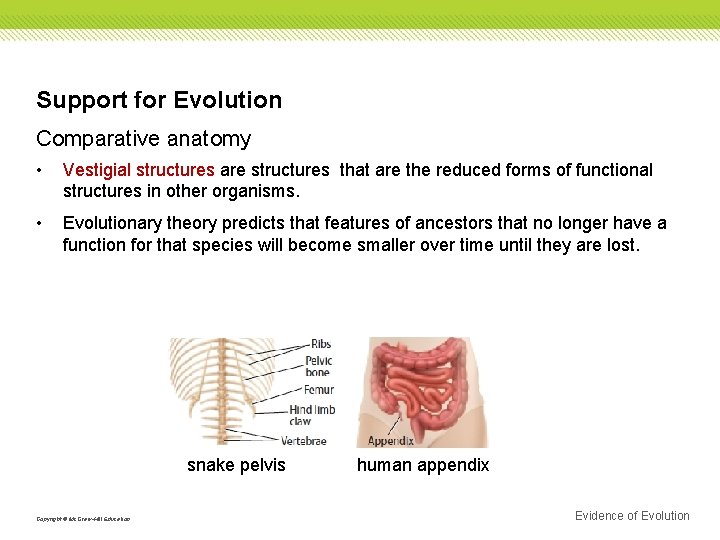
Support for Evolution Comparative anatomy • Vestigial structures are structures that are the reduced forms of functional structures in other organisms. • Evolutionary theory predicts that features of ancestors that no longer have a function for that species will become smaller over time until they are lost. snake pelvis Copyright © Mc. Graw-Hill Education human appendix Evidence of Evolution
Vestigial Structures Animation FPO Add link interactive table from page 425 (Table 2) here. Copyright © Mc. Graw-Hill Education Evidence of Evolution
Support for Evolution Comparative anatomy • Analogous structures can be used for the same purpose and be superficially similar in construction, but are not inherited from a common ancestor. • Analogous structures show that functionally similar features can evolve independently under similar conditions. Copyright © Mc. Graw-Hill Education Evidence of Evolution
Support for Evolution Comparative embryology • An embryo is an early, pre-birth stage of an organism’s development. • Vertebrate embryos exhibit homologous structures during phases of development that become totally different structures in the adult forms. Copyright © Mc. Graw-Hill Education Evidence of Evolution
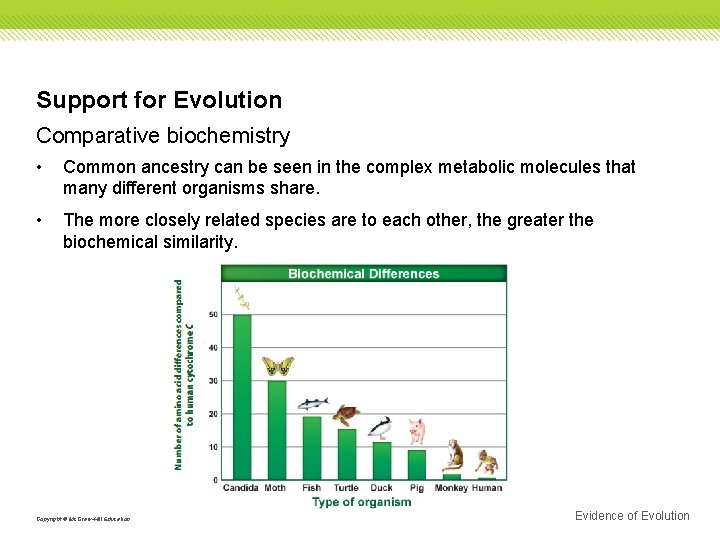
Support for Evolution Comparative biochemistry • Common ancestry can be seen in the complex metabolic molecules that many different organisms share. • The more closely related species are to each other, the greater the biochemical similarity. Copyright © Mc. Graw-Hill Education Evidence of Evolution
Support for Evolution Geographic distribution • The distribution of plants and animals that Darwin were what first suggested evolution to him. • The distribution of plants and animals around the world is studied in the field of biogeography. • Evolution is linked to migration patterns, climate, and geological forces (such as plate tectonics). Copyright © Mc. Graw-Hill Education Evidence of Evolution
Adaptation Types of adaptations • An adaptation is a trait shaped by natural selection that increases an organism’s reproductive success. • Fitness is a measure of the relative contribution an individual trait makes to the next generation. • The better an organism is adapted to its environment, the greater its chances of survival and reproductive success. Copyright © Mc. Graw-Hill Education Evidence of Evolution
Adaptation Types of adaptations • Camouflage is a suite of morphological adaptations that allow an organism to blend into its environment. • Mimicry is a type of morphological adaptation where a species evolves to resemble another species. • Antimicrobial resistance develops in some bacteria in response to sub-lethal exposure to antibiotics. Copyright © Mc. Graw-Hill Education Evidence of Evolution
Adaptation Consequences of adaptations • Not all features of an organism are necessarily adaptive. • Some features are consequences of other evolved characteristics. • Helplessness of human babies: humans give birth at a much early developmental stage than other primates. • May be a consequence of larger brain size and upright posture Copyright © Mc. Graw-Hill Education Evidence of Evolution
Review Essential Questions • • • How do fossils provide evidence of evolution? How does morphology provide evidence of evolution? How does biochemistry provide evidence of evolution? Vocabulary • • derived trait • ancestral trait • homologous structure • vestigial structure Copyright © Mc. Graw-Hill Education analogous structure embryo biogeography • • • fitness camouflage mimicry Evidence of Evolution