
Section 2 Combining Matter Atoms combine through electric
Section 2: Combining Matter Atoms combine through electric forces, forming molecules and compounds. K What I Know W What I Want to Find Out L What I Learned
Essential Questions • What are the different types of chemical bonds that unite atoms to form compounds? • How is the nature of chemical bonds that hold compounds together related to the physical structures of compounds? • What are the different types of mixtures and solutions? Copyright © Mc. Graw-Hill Education Combining Matter
Vocabulary Review New • • • ion Copyright © Mc. Graw-Hill Education compound chemical bond covalent bond molecule ionic bond metallic bond chemical reaction solution acid base Combining Matter
Compounds • • A compound is a substance that is composed of atoms of two or more different elements that are chemically combined. Compounds have different properties from the elements of which they are composed. Copyright © Mc. Graw-Hill Education Combining Matter
Compounds Chemical formulas • Compounds are represented by chemical formulas that include the symbol for each element followed by a subscript number showing the number of atoms of that element in the compound. Copyright © Mc. Graw-Hill Education Combining Matter
Covalent Bonds • A state of stability is achieved by some elements by forming chemical bonds. A chemical bond is the force that holds together the elements in a compound. • The attraction of two atoms for a shared pair of electrons that holds the atoms together is called a covalent bond. Copyright © Mc. Graw-Hill Education Combining Matter
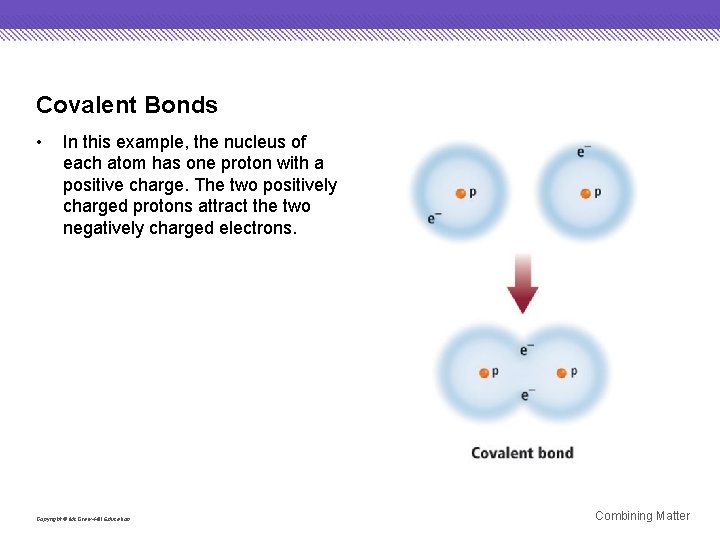
Covalent Bonds • In this example, the nucleus of each atom has one proton with a positive charge. The two positively charged protons attract the two negatively charged electrons. Copyright © Mc. Graw-Hill Education Combining Matter
Covalent Bonds Molecules • A molecule is composed of two or more atoms held together by covalent bonds. • A compound comprised of molecules is called a molecular compound. Copyright © Mc. Graw-Hill Education Combining Matter
Covalent Bonds Polar molecules • Molecules held together by covalent bonds may not share electrons equally, resulting in the electrons spending more time near one atom than another. This unequal sharing results in polar molecules. Copyright © Mc. Graw-Hill Education Combining Matter
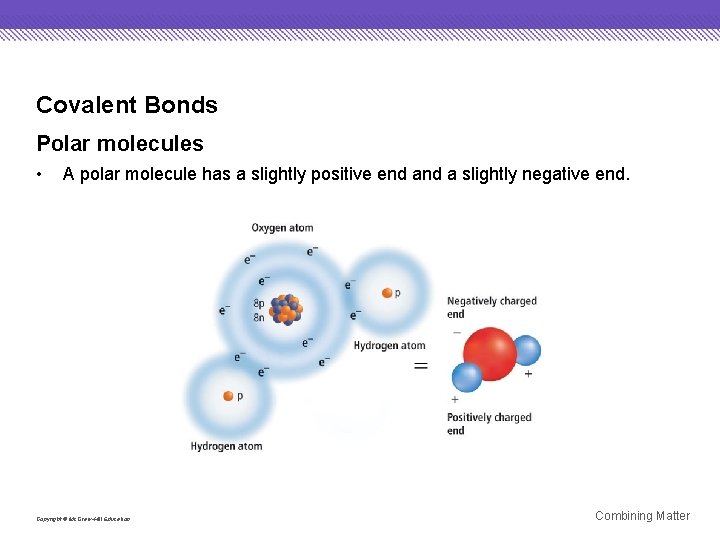
Covalent Bonds Polar molecules • A polar molecule has a slightly positive end a slightly negative end. Copyright © Mc. Graw-Hill Education Combining Matter
Ionic Bonds • An ionic bond is the attractive force between two ions of opposite charge. • Compounds formed by ionic bonds are called ionic compounds. Copyright © Mc. Graw-Hill Education Combining Matter
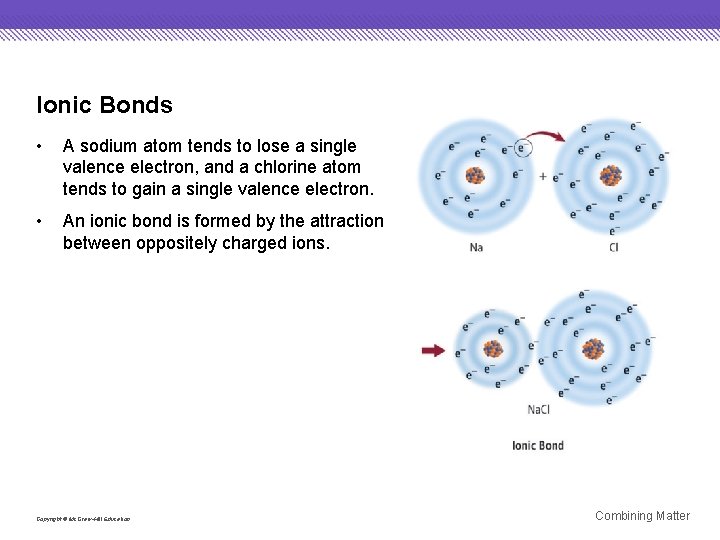
Ionic Bonds • A sodium atom tends to lose a single valence electron, and a chlorine atom tends to gain a single valence electron. • An ionic bond is formed by the attraction between oppositely charged ions. Copyright © Mc. Graw-Hill Education Combining Matter
Ionic Bonds Go to your Connect. ED resources to play Animation: Ionic Bonding. Copyright © Mc. Graw-Hill Education Combining Matter
Metallic Bonding • In a metallic bond, the positive ions of the metal are held together by the attraction to the negative electrons moving among them. Copyright © Mc. Graw-Hill Education Combining Matter
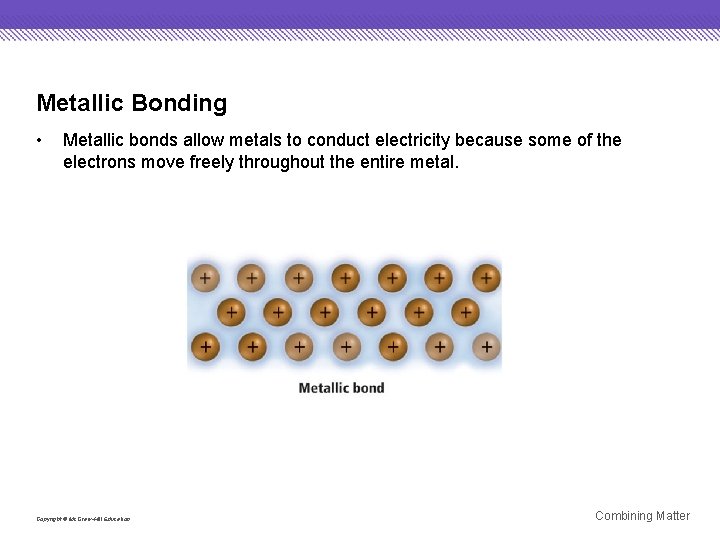
Metallic Bonding • Metallic bonds allow metals to conduct electricity because some of the electrons move freely throughout the entire metal. Copyright © Mc. Graw-Hill Education Combining Matter
Electron Flow Go to your Connect. ED resources to play Animation: Electron Flow. Copyright © Mc. Graw-Hill Education Combining Matter
Metallic Bonding • When a force is applied to a metal, some of the electrons are pushed aside. This allows the metal ions to move past each other, thus deforming or changing the shape of the metal. Copyright © Mc. Graw-Hill Education Combining Matter
Visualizing Bonds • Atoms gain stability by sharing, gaining, or losing electrons to form ions and molecules. The properties of metals can be explained by metallic bonds. Copyright © Mc. Graw-Hill Education Combining Matter

Visualizing Bonds Go to your Connect. ED resources to play Animation: Visualizing Bonds. Copyright © Mc. Graw-Hill Education Combining Matter
Chemical Reactions • The change of one or more compounds into other compounds is called a chemical reaction. • Chemical reactions are described by chemical equations. Copyright © Mc. Graw-Hill Education Combining Matter
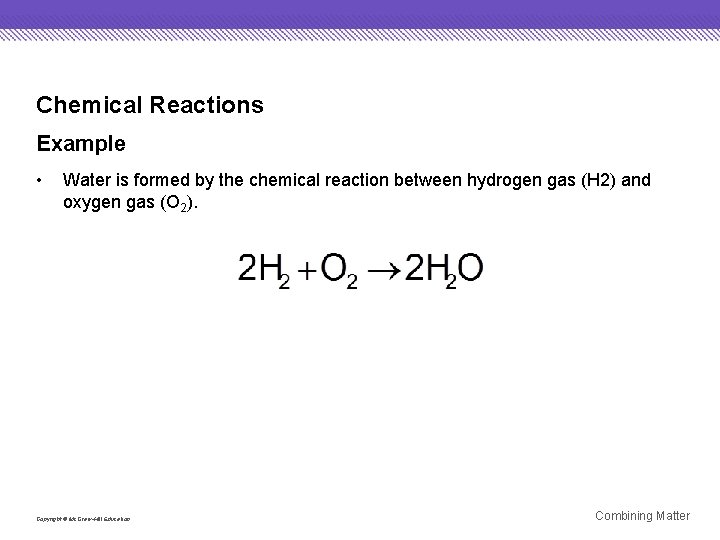
Chemical Reactions Example • Water is formed by the chemical reaction between hydrogen gas (H 2) and oxygen gas (O 2). Copyright © Mc. Graw-Hill Education Combining Matter
Chemical Reactions • When you write a chemical equation, you must balance the equation by showing an equal number of atoms for each element on each side of the equation. Therefore, the same amount of matter is present both before and after the reaction. Copyright © Mc. Graw-Hill Education Combining Matter
Mixtures and Solutions • A mixture is a combination of two or more components that retain their identities. • When a mixture’s components are easily recognizable, it is called a heterogeneous mixture. • In a homogeneous mixture, also called a solution, the component particles cannot be distinguished, even though they still retain their original properties. A solution can be liquid, gaseous, or solid. Copyright © Mc. Graw-Hill Education Combining Matter
Mixtures and Solutions Acids • An acid is a solution containing a substance that produces hydrogen ions (H+) in water. • The p. H scale is based on the amount of hydrogen ions in a solution. Copyright © Mc. Graw-Hill Education Combining Matter
p. H Scale Go to your Connect. ED resources to play Animation: p. H Scale. Copyright © Mc. Graw-Hill Education Combining Matter
Mixtures and Solutions Bases • When a solution produces hydroxide ions (OH–) in water, the solution is called a base. Copyright © Mc. Graw-Hill Education Combining Matter
Acids and Bases Go to your Connect. ED resources to play Brain. POP: Acids and Bases. Copyright © Mc. Graw-Hill Education Combining Matter
Review Essential Questions • What are the different types of chemical bonds that unite atoms to form compounds? • How is the nature of chemical bonds that hold compounds together related to the physical structures of compounds? • What are the different types of mixtures and solutions? Vocabulary • compound • chemical bond • covalent bond • molecule Copyright © Mc. Graw-Hill Education • ionic bond • metallic bond • chemical reaction • solution • acid • base Combining Matter
- Slides: 28