
Section 2 Basic f MRI Physics Other Resources
Section 2 Basic f. MRI Physics
Other Resources These slides were condensed from several excellent online sources. I have tried to give credit where appropriate. If you would like a more thorough introductory review of MR physics, I suggest the following: Robert Cox’s slideshow, (f)MRI Physics with Hardly Any Math, and his book chapters online. http: //afni. nimh. nih. gov/afni/edu/ See “Background Information on MRI” section Mark Cohen’s intro Basic MR Physics slides http: //porkpie. loni. ucla. edu/BMD_HTML/Shared. Code/Misc. Shared. html Douglas Noll’s Primer on MRI and Functional MRI http: //www. bme. umich. edu/~dnoll/primer 2. pdf For a more advanced tutorial, see: Joseph Hornak’s Web Tutorial, The Basics of MRI http: //www. cis. rit. edu/htbooks/mri-main. htm
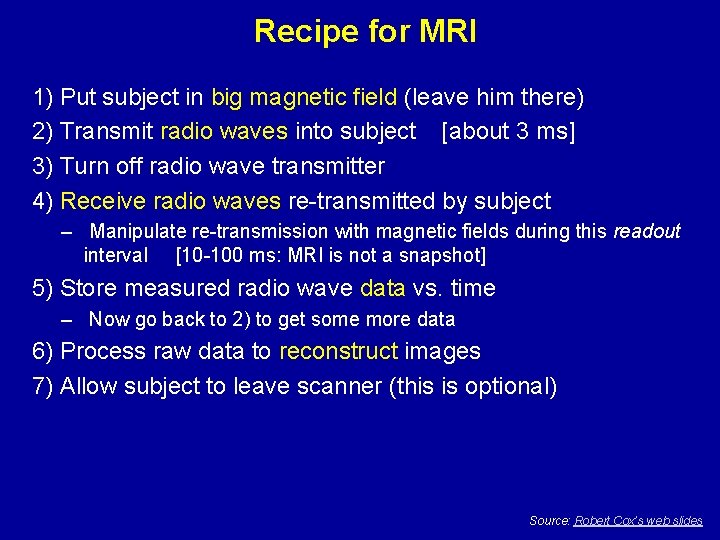
Recipe for MRI 1) Put subject in big magnetic field (leave him there) 2) Transmit radio waves into subject [about 3 ms] 3) Turn off radio wave transmitter 4) Receive radio waves re-transmitted by subject – Manipulate re-transmission with magnetic fields during this readout interval [10 -100 ms: MRI is not a snapshot] 5) Store measured radio wave data vs. time – Now go back to 2) to get some more data 6) Process raw data to reconstruct images 7) Allow subject to leave scanner (this is optional) Source: Robert Cox’s web slides
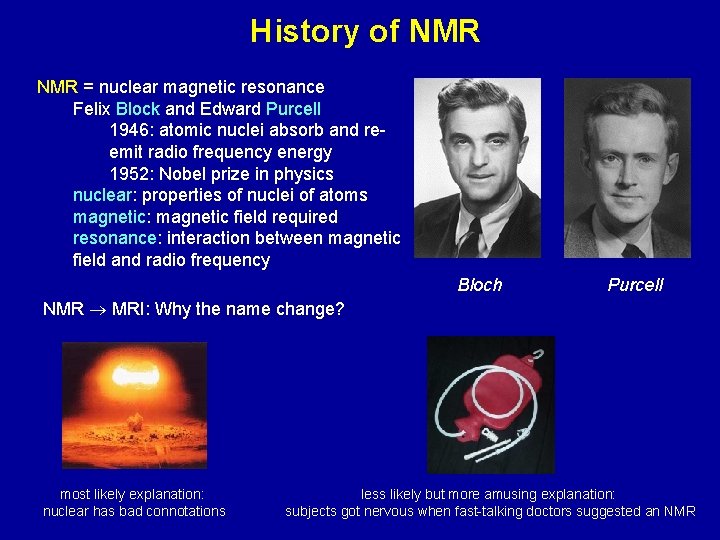
History of NMR = nuclear magnetic resonance Felix Block and Edward Purcell 1946: atomic nuclei absorb and reemit radio frequency energy 1952: Nobel prize in physics nuclear: properties of nuclei of atoms magnetic: magnetic field required resonance: interaction between magnetic field and radio frequency Bloch Purcell NMR MRI: Why the name change? most likely explanation: nuclear has bad connotations less likely but more amusing explanation: subjects got nervous when fast-talking doctors suggested an NMR
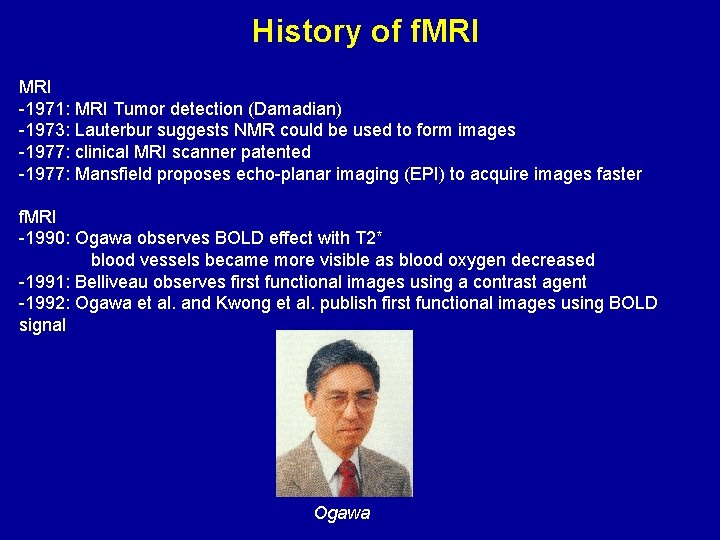
History of f. MRI -1971: MRI Tumor detection (Damadian) -1973: Lauterbur suggests NMR could be used to form images -1977: clinical MRI scanner patented -1977: Mansfield proposes echo-planar imaging (EPI) to acquire images faster f. MRI -1990: Ogawa observes BOLD effect with T 2* blood vessels became more visible as blood oxygen decreased -1991: Belliveau observes first functional images using a contrast agent -1992: Ogawa et al. and Kwong et al. publish first functional images using BOLD signal Ogawa
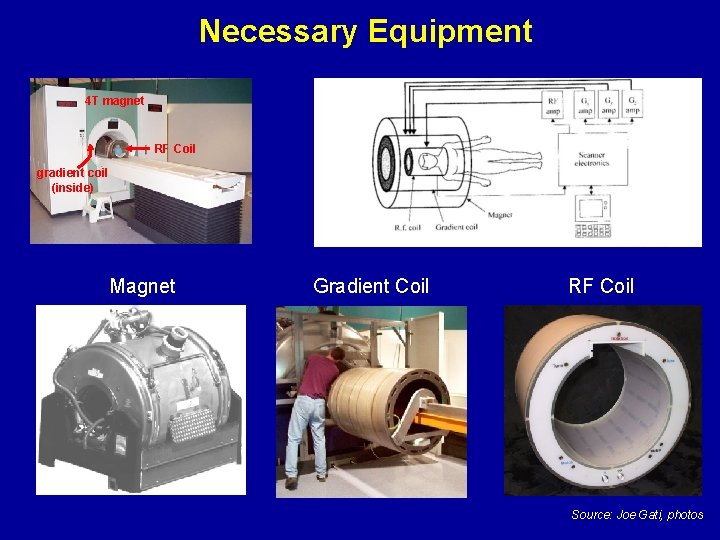
Necessary Equipment 4 T magnet RF Coil gradient coil (inside) Magnet Gradient Coil RF Coil Source: Joe Gati, photos
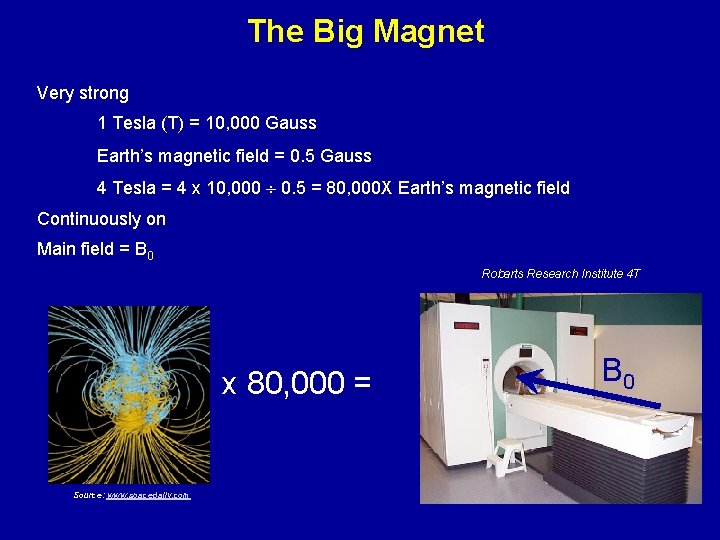
The Big Magnet Very strong 1 Tesla (T) = 10, 000 Gauss Earth’s magnetic field = 0. 5 Gauss 4 Tesla = 4 x 10, 000 0. 5 = 80, 000 X Earth’s magnetic field Continuously on Main field = B 0 Robarts Research Institute 4 T x 80, 000 = Source: www. spacedaily. com B 0

Magnet Safety The whopping strength of the magnet makes safety essential. Things fly – Even big things! Source: www. howstuffworks. com Source: http: //www. simplyphysics. com/ flying_objects. html Screen subjects carefully Make sure you and all your students & staff are aware of hazzards Develop stratetgies for screening yourself every time you enter the magnet Do the metal macarena!
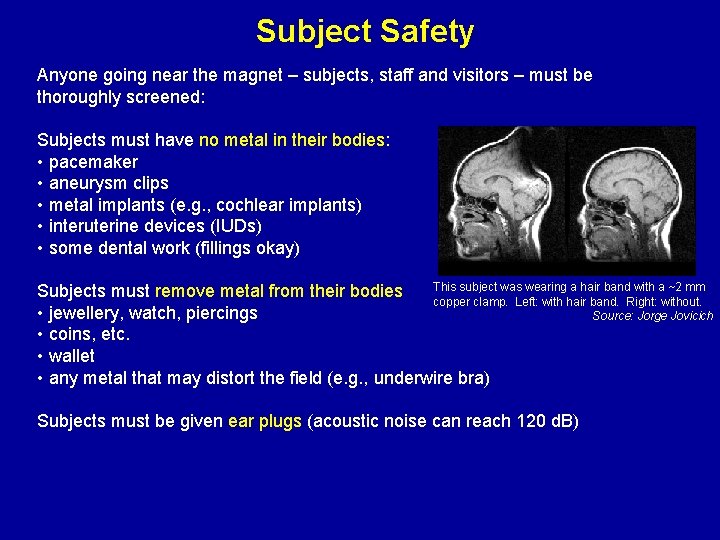
Subject Safety Anyone going near the magnet – subjects, staff and visitors – must be thoroughly screened: Subjects must have no metal in their bodies: • pacemaker • aneurysm clips • metal implants (e. g. , cochlear implants) • interuterine devices (IUDs) • some dental work (fillings okay) This subject was wearing a hair band with a ~2 mm Subjects must remove metal from their bodies copper clamp. Left: with hair band. Right: without. • jewellery, watch, piercings Source: Jorge Jovicich • coins, etc. • wallet • any metal that may distort the field (e. g. , underwire bra) Subjects must be given ear plugs (acoustic noise can reach 120 d. B)
Protons Can measure nuclei with odd number of neutrons 1 H, 13 C, 19 F, 23 Na, 31 P 1 H (proton) abundant: high concentration in human body high sensitivity: yields large signals
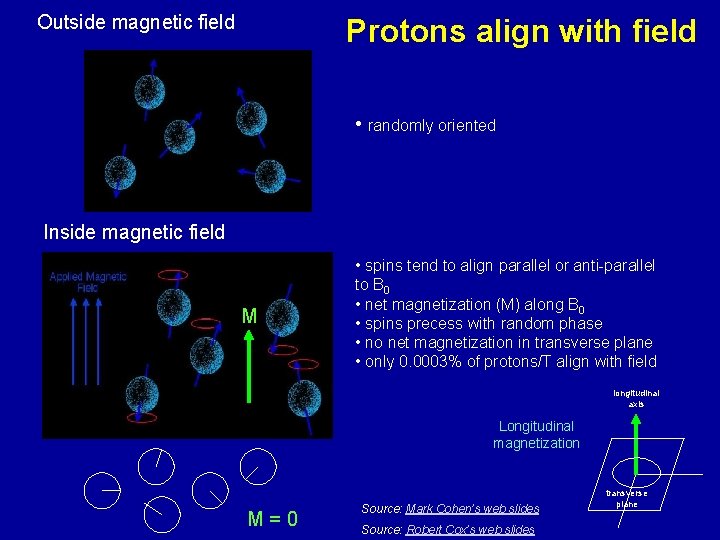
Outside magnetic field Protons align with field • randomly oriented Inside magnetic field M • spins tend to align parallel or anti-parallel to B 0 • net magnetization (M) along B 0 • spins precess with random phase • no net magnetization in transverse plane • only 0. 0003% of protons/T align with field longitudinal axis Longitudinal magnetization M=0 Source: Mark Cohen’s web slides Source: Robert Cox’s web slides transverse plane
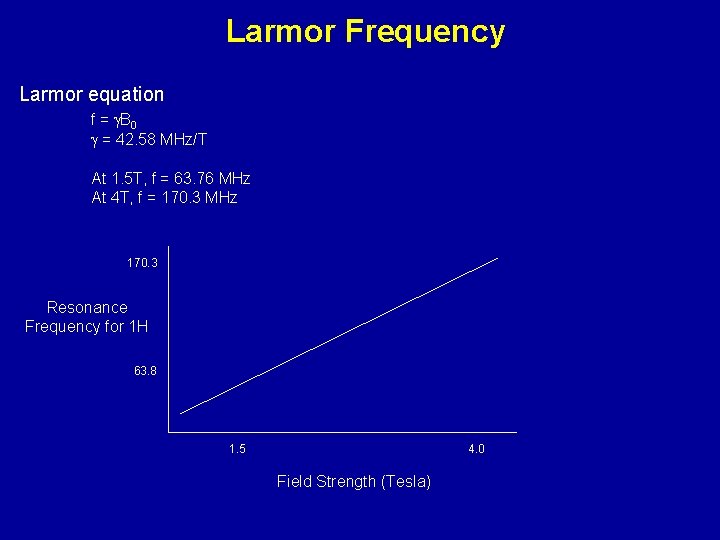
Larmor Frequency Larmor equation f = B 0 = 42. 58 MHz/T At 1. 5 T, f = 63. 76 MHz At 4 T, f = 170. 3 MHz 170. 3 Resonance Frequency for 1 H 63. 8 1. 5 4. 0 Field Strength (Tesla)
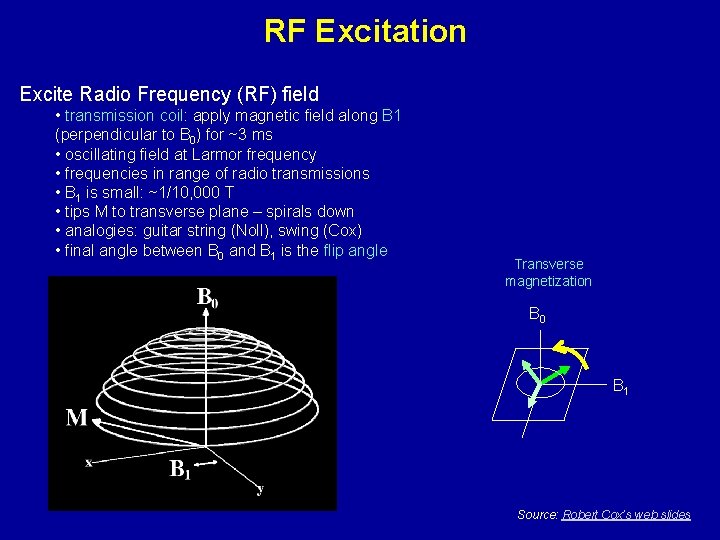
RF Excitation Excite Radio Frequency (RF) field • transmission coil: apply magnetic field along B 1 (perpendicular to B 0) for ~3 ms • oscillating field at Larmor frequency • frequencies in range of radio transmissions • B 1 is small: ~1/10, 000 T • tips M to transverse plane – spirals down • analogies: guitar string (Noll), swing (Cox) • final angle between B 0 and B 1 is the flip angle Transverse magnetization B 0 B 1 Source: Robert Cox’s web slides
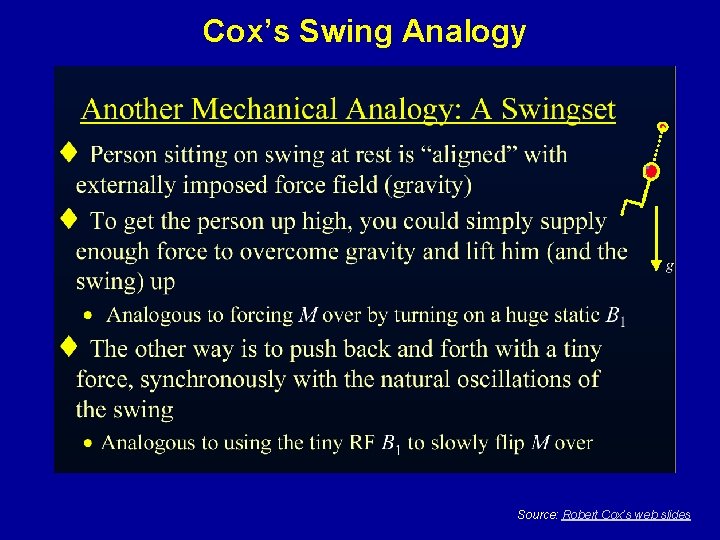
Cox’s Swing Analogy Source: Robert Cox’s web slides
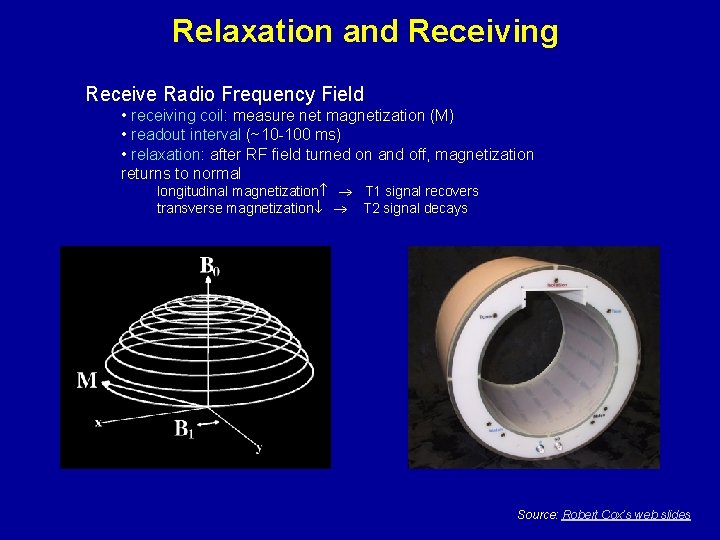
Relaxation and Receiving Receive Radio Frequency Field • receiving coil: measure net magnetization (M) • readout interval (~10 -100 ms) • relaxation: after RF field turned on and off, magnetization returns to normal longitudinal magnetization T 1 signal recovers transverse magnetization T 2 signal decays Source: Robert Cox’s web slides
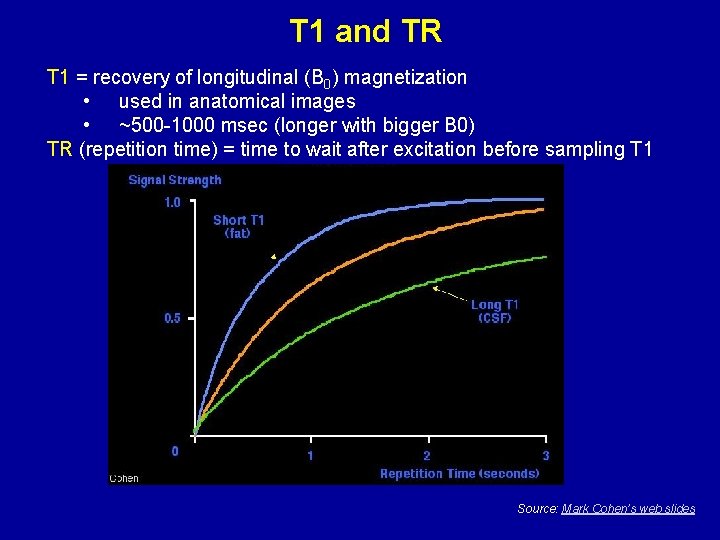
T 1 and TR T 1 = recovery of longitudinal (B 0) magnetization • used in anatomical images • ~500 -1000 msec (longer with bigger B 0) TR (repetition time) = time to wait after excitation before sampling T 1 Source: Mark Cohen’s web slides
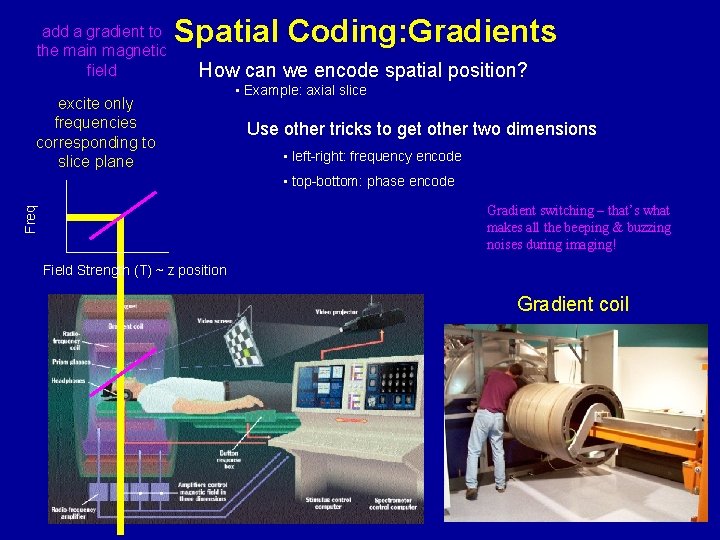
add a gradient to the main magnetic field Spatial Coding: Gradients How can we encode spatial position? excite only frequencies corresponding to slice plane • Example: axial slice Use other tricks to get other two dimensions • left-right: frequency encode • top-bottom: phase encode Freq Gradient switching – that’s what makes all the beeping & buzzing noises during imaging! Field Strength (T) ~ z position Gradient coil
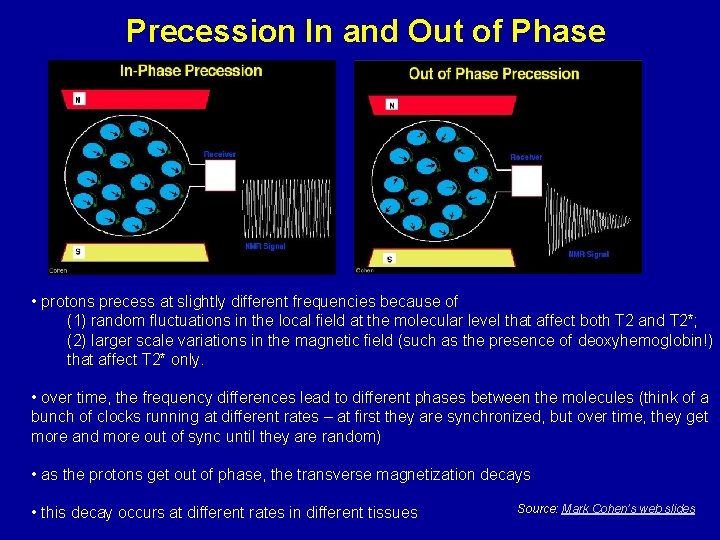
Precession In and Out of Phase • protons precess at slightly different frequencies because of (1) random fluctuations in the local field at the molecular level that affect both T 2 and T 2*; (2) larger scale variations in the magnetic field (such as the presence of deoxyhemoglobin!) that affect T 2* only. • over time, the frequency differences lead to different phases between the molecules (think of a bunch of clocks running at different rates – at first they are synchronized, but over time, they get more and more out of sync until they are random) • as the protons get out of phase, the transverse magnetization decays • this decay occurs at different rates in different tissues Source: Mark Cohen’s web slides
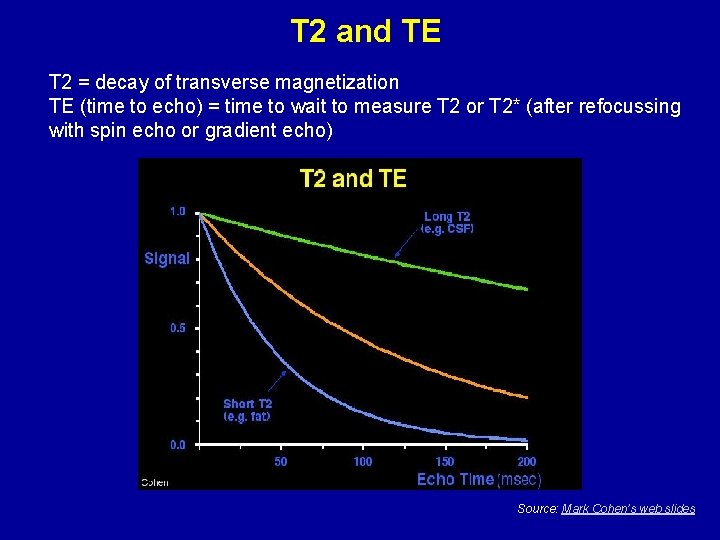
T 2 and TE T 2 = decay of transverse magnetization TE (time to echo) = time to wait to measure T 2 or T 2* (after refocussing with spin echo or gradient echo) Source: Mark Cohen’s web slides
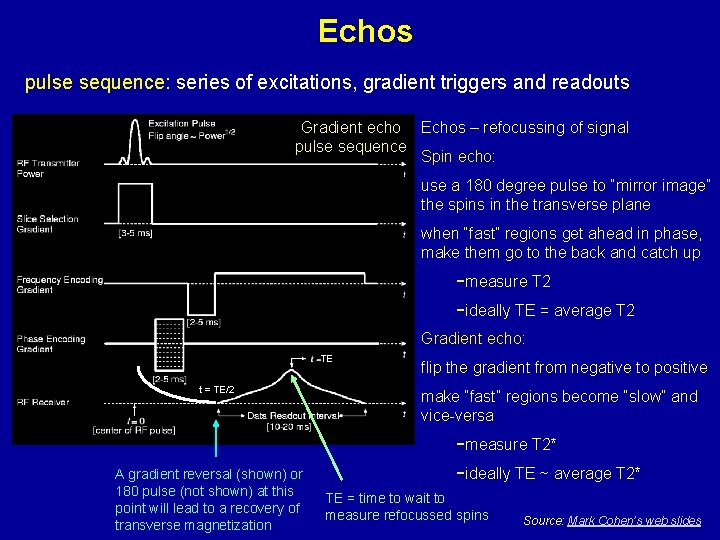
Echos pulse sequence: series of excitations, gradient triggers and readouts Gradient echo Echos – refocussing of signal pulse sequence Spin echo: use a 180 degree pulse to “mirror image” the spins in the transverse plane when “fast” regions get ahead in phase, make them go to the back and catch up -measure T 2 -ideally TE = average T 2 Gradient echo: flip the gradient from negative to positive t = TE/2 A gradient reversal (shown) or 180 pulse (not shown) at this point will lead to a recovery of transverse magnetization make “fast” regions become “slow” and vice-versa -measure T 2* -ideally TE ~ average T 2* TE = time to wait to measure refocussed spins Source: Mark Cohen’s web slides
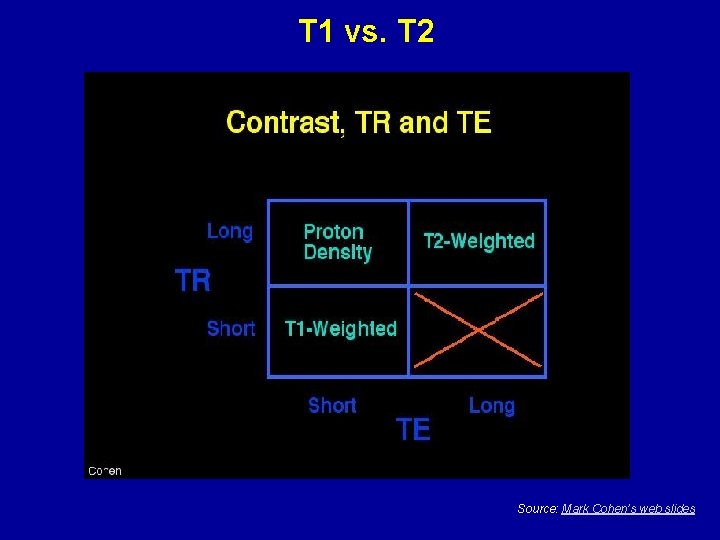
T 1 vs. T 2 Source: Mark Cohen’s web slides
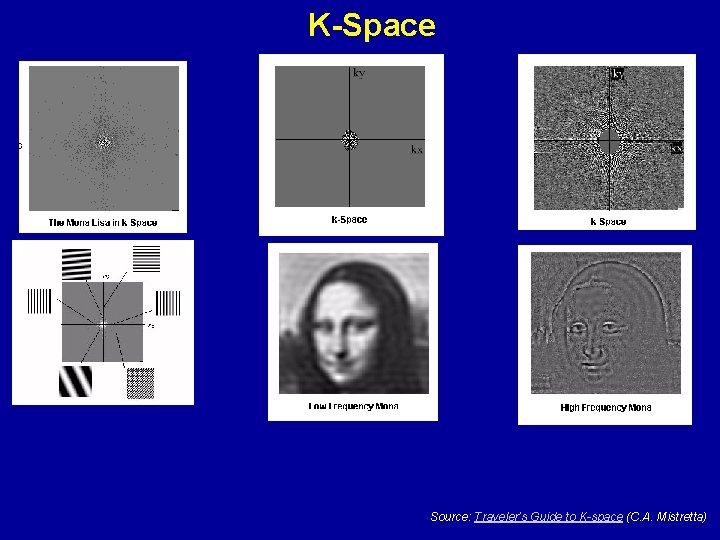
K-Space Source: Traveler’s Guide to K-space (C. A. Mistretta)
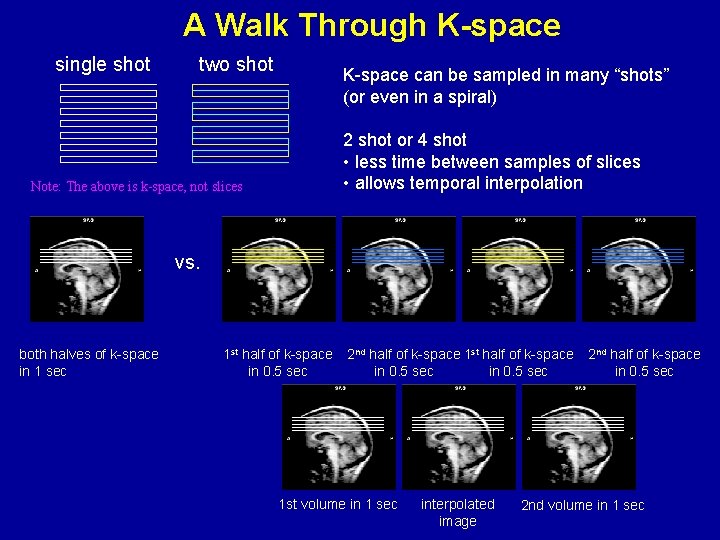
A Walk Through K-space single shot two shot K-space can be sampled in many “shots” (or even in a spiral) 2 shot or 4 shot • less time between samples of slices • allows temporal interpolation Note: The above is k-space, not slices vs. both halves of k-space in 1 sec 1 st half of k-space in 0. 5 sec 2 nd half of k-space 1 st half of k-space in 0. 5 sec 1 st volume in 1 sec interpolated image 2 nd half of k-space in 0. 5 sec 2 nd volume in 1 sec
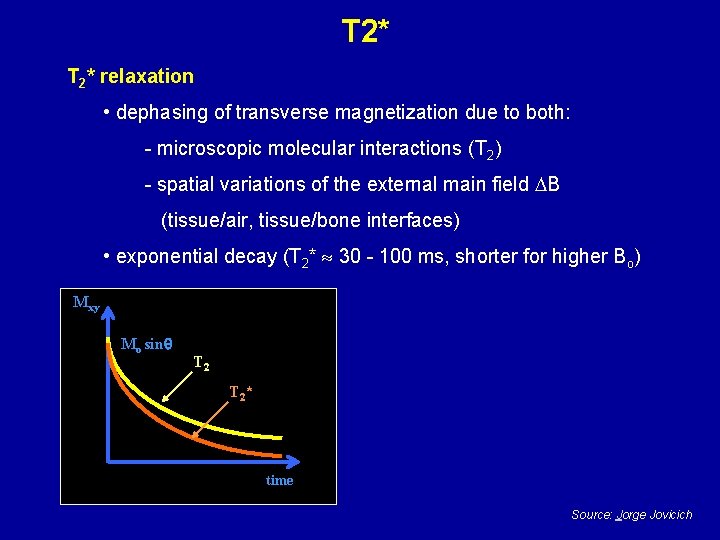
T 2* relaxation • dephasing of transverse magnetization due to both: - microscopic molecular interactions (T 2) - spatial variations of the external main field B (tissue/air, tissue/bone interfaces) • exponential decay (T 2* 30 - 100 ms, shorter for higher Bo) Mxy Mo sin T 2* time Source: Jorge Jovicich
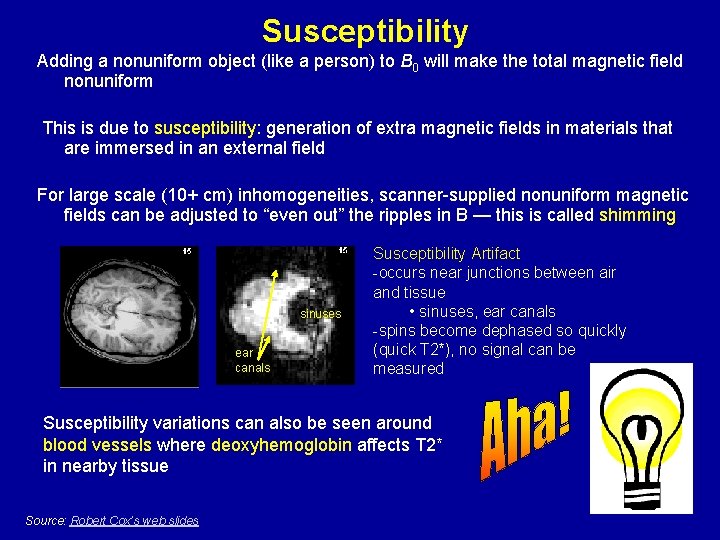
Susceptibility Adding a nonuniform object (like a person) to B 0 will make the total magnetic field nonuniform This is due to susceptibility: generation of extra magnetic fields in materials that are immersed in an external field For large scale (10+ cm) inhomogeneities, scanner-supplied nonuniform magnetic fields can be adjusted to “even out” the ripples in B — this is called shimming sinuses ear canals Susceptibility Artifact -occurs near junctions between air and tissue • sinuses, ear canals -spins become dephased so quickly (quick T 2*), no signal can be measured Susceptibility variations can also be seen around blood vessels where deoxyhemoglobin affects T 2* in nearby tissue Source: Robert Cox’s web slides
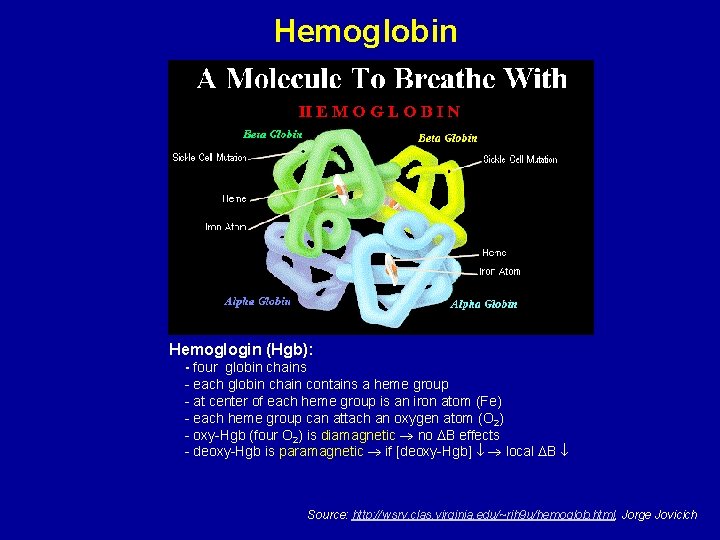
Hemoglobin Hemoglogin (Hgb): - four globin chains - each globin chain contains a heme group - at center of each heme group is an iron atom (Fe) - each heme group can attach an oxygen atom (O 2) - oxy-Hgb (four O 2) is diamagnetic no B effects - deoxy-Hgb is paramagnetic if [deoxy-Hgb] local B Source: http: //wsrv. clas. virginia. edu/~rjh 9 u/hemoglob. html, Jorge Jovicich
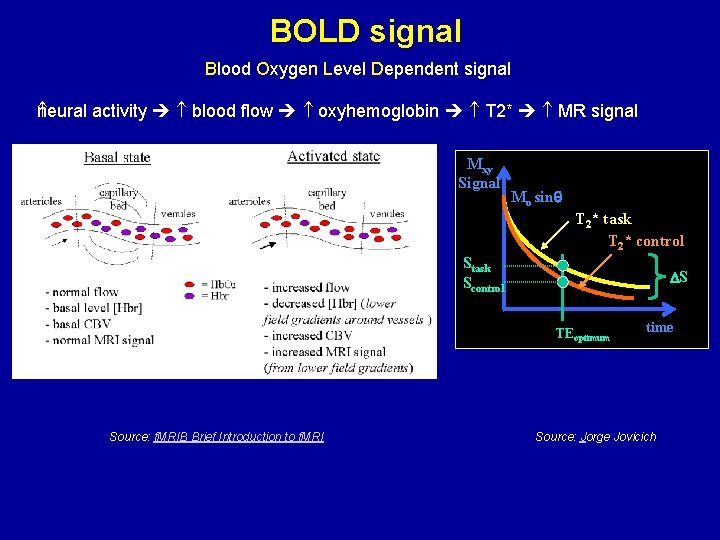
BOLD signal Blood Oxygen Level Dependent signal neural activity blood flow oxyhemoglobin T 2* MR signal Mxy Signal Mo sin T 2* task T 2* control Stask Scontrol S TEoptimum Source: f. MRIB Brief Introduction to f. MRI time Source: Jorge Jovicich
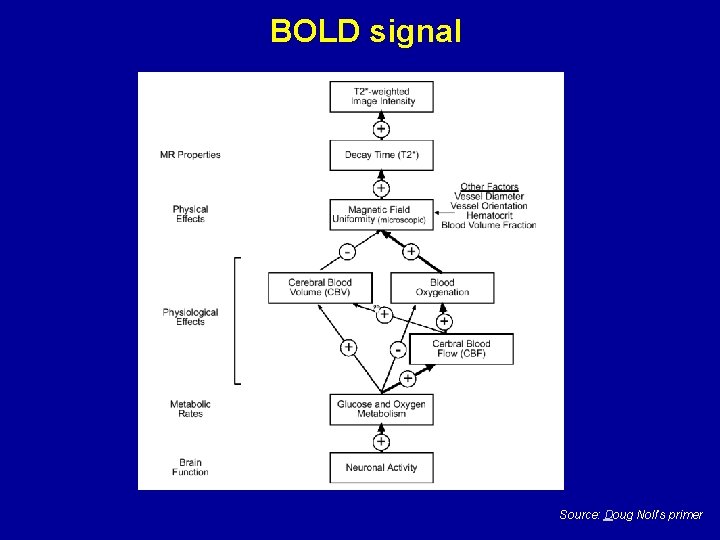
BOLD signal Source: Doug Noll’s primer
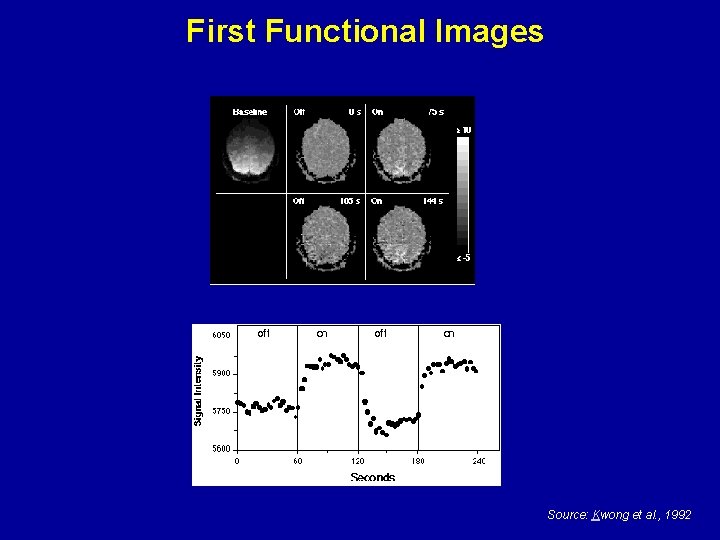
First Functional Images Source: Kwong et al. , 1992
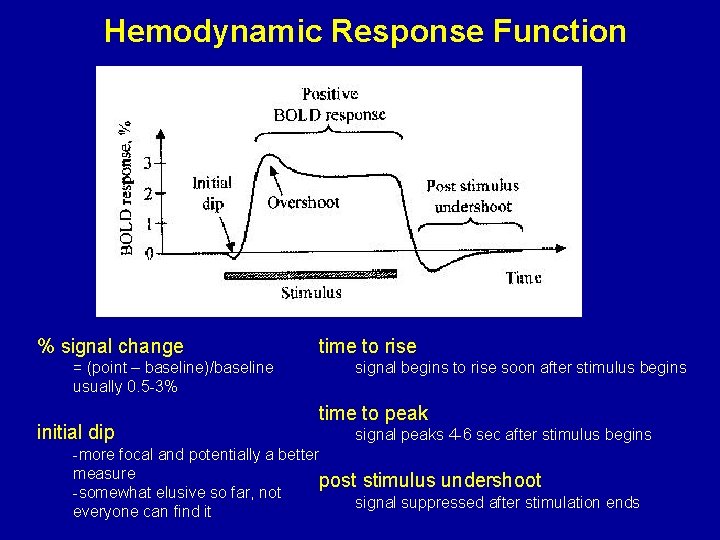
Hemodynamic Response Function % signal change = (point – baseline)/baseline usually 0. 5 -3% initial dip time to rise signal begins to rise soon after stimulus begins time to peak signal peaks 4 -6 sec after stimulus begins -more focal and potentially a better measure post stimulus undershoot -somewhat elusive so far, not signal suppressed after stimulation ends everyone can find it
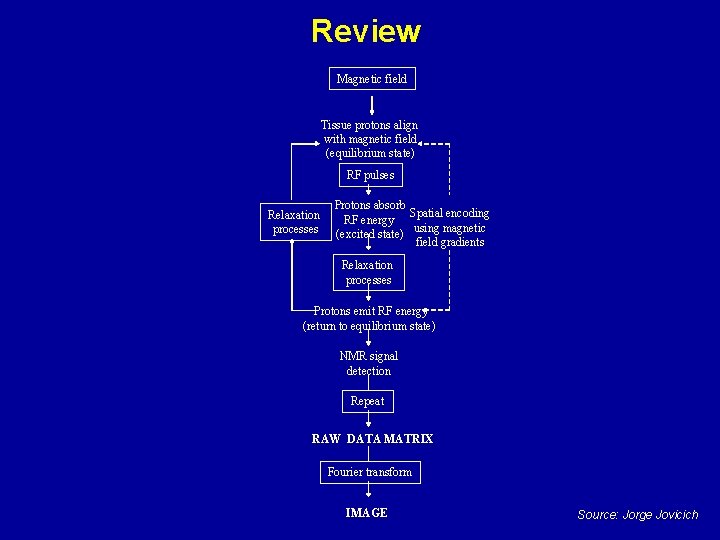
Review Magnetic field Tissue protons align with magnetic field (equilibrium state) RF pulses Relaxation processes Protons absorb Spatial encoding RF energy using magnetic (excited state) field gradients Relaxation processes Protons emit RF energy (return to equilibrium state) NMR signal detection Repeat RAW DATA MATRIX Fourier transform IMAGE Source: Jorge Jovicich
- Slides: 32