
Section 2 Acceleration A Accelerationchange in velocity divided
- Slides: 11
Section 2 Acceleration
A. Acceleration—change in velocity divided by the time for the change to occur; it can include an object’s speeding up, slowing down, and/or changing direction.
B. Acceleration can be calculated if you know how an object’s velocity has changed during a given time period.
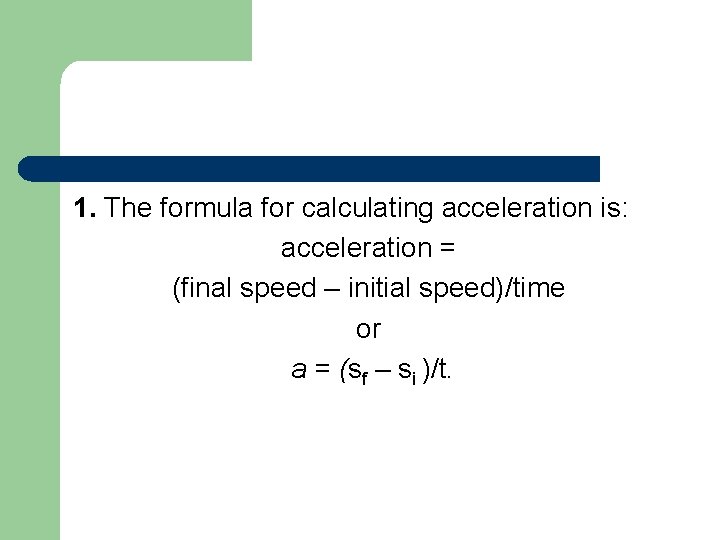
1. The formula for calculating acceleration is: acceleration = (final speed – initial speed)/time or a = (sf – si )/t.
a. The unit of acceleration is distance divided by time squared [meters per second squared (m/s 2 )]
b. Acceleration is positive when an object speeds up and negative when an object slows down. (2 m/s 2 means it’s speeding up 2 m/s each second) ( -3 m/s 2 means it’s slowing down 3 m/s each second)
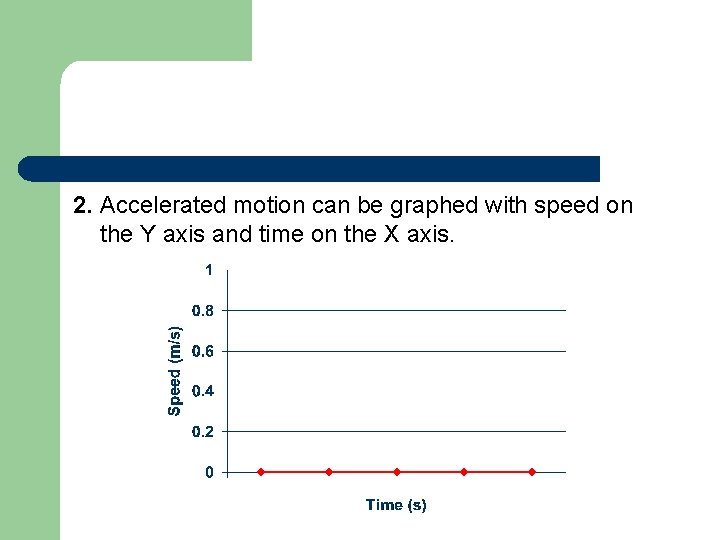
2. Accelerated motion can be graphed with speed on the Y axis and time on the X axis.
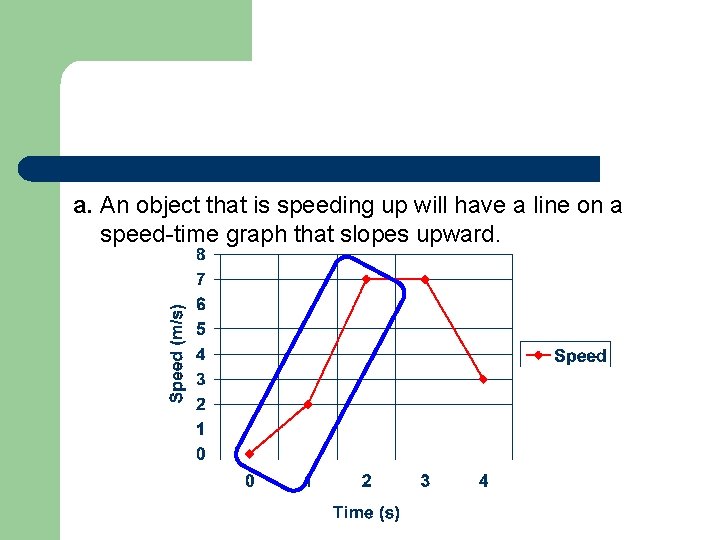
a. An object that is speeding up will have a line on a speed-time graph that slopes upward.
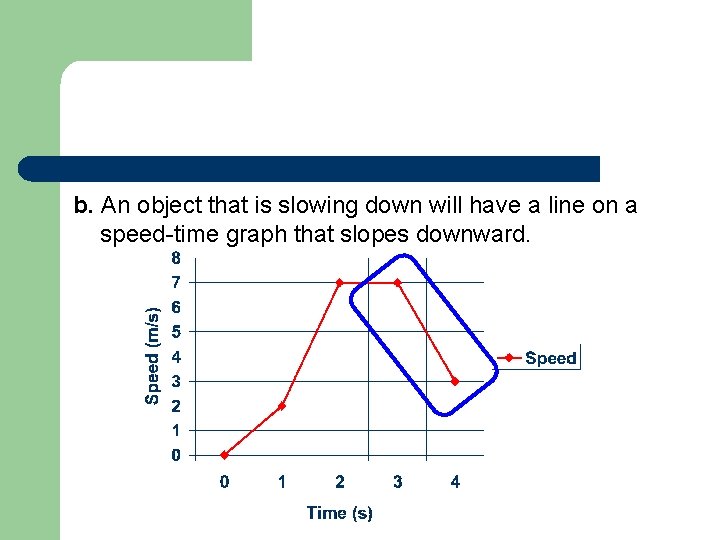
b. An object that is slowing down will have a line on a speed-time graph that slopes downward.
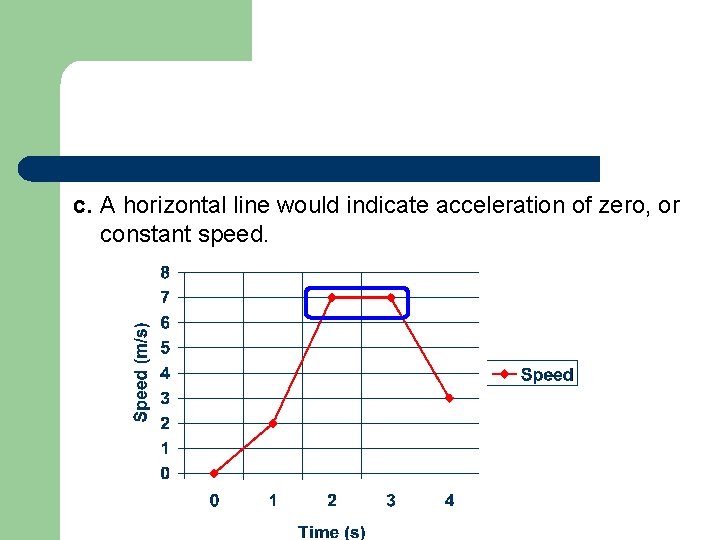
c. A horizontal line would indicate acceleration of zero, or constant speed.
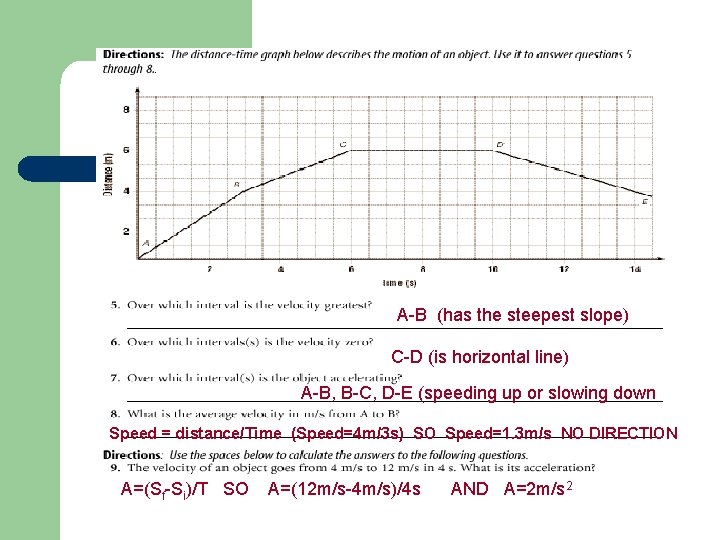
anning A-B (has the steepest slope) C-D (is horizontal line) A-B, B-C, D-E (speeding up or slowing down Speed = distance/Time (Speed=4 m/3 s) SO Speed=1. 3 m/s NO DIRECTION A=(Sf-Si)/T SO A=(12 m/s-4 m/s)/4 s AND A=2 m/s 2