
Section 2 3 Expressing Your Emotions Objectives Identify
Section 2. 3 Expressing Your Emotions Objectives Identify four primary emotions and three learned emotions. Explain why it is important to recognize your emotions. Distinguish helpful from harmful coping strategies. Slide 1 of 21
Section 2. 3 Expressing Your Emotions Myth It is always healthy to “let your feelings out. ” Fact Some ways of expressing your emotions are positive and constructive. Other ways of expressing emotions are negative and destructive. Slide 2 of 21
Section 2. 3 Expressing Your Emotions Primary Emotions • An emotion is a reaction to a situation that involves your mind, body, and behavior. • Primary emotions are emotions that are expressed by people in all cultures. • Examples of primary emotions are • happiness • sadness • anger • fear Slide 3 of 21

Section 2. 3 Expressing Your Emotions Happiness • Happiness is a normal response to pleasant events in one’s life. • Feeling happy helps you feel good about yourself. • Make a list of the things you enjoy. Slide 4 of 21
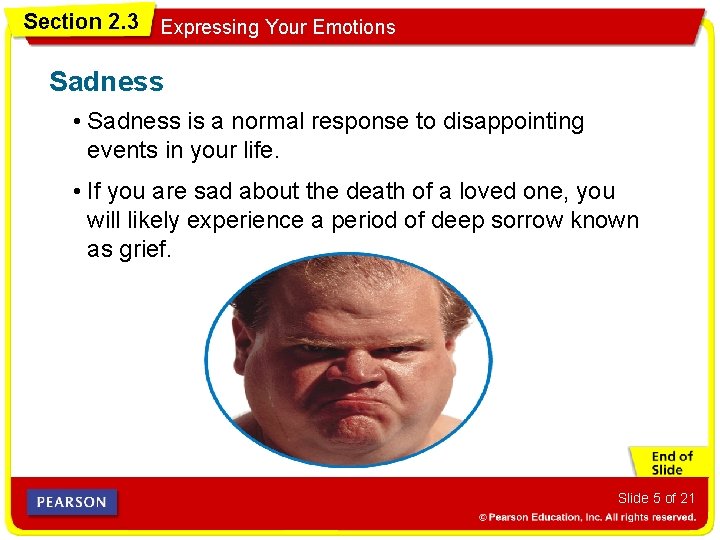
Section 2. 3 Expressing Your Emotions Sadness • Sadness is a normal response to disappointing events in your life. • If you are sad about the death of a loved one, you will likely experience a period of deep sorrow known as grief. Slide 5 of 21

Section 2. 3 Expressing Your Emotions Anger • Feelings of anger can range from mild resentment to intense rage. • Anger is helpful when it provides you with the energy necessary to try to change things. • People who tend to express anger in negative ways may hurt themselves and others. Slide 6 of 21
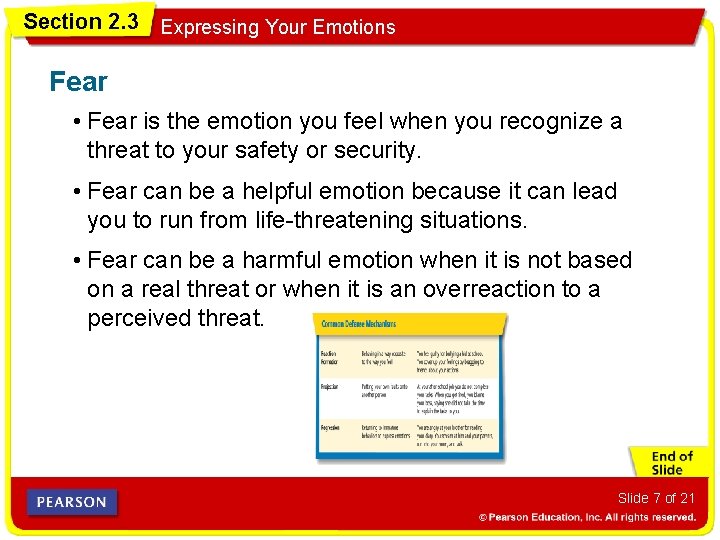
Section 2. 3 Expressing Your Emotions Fear • Fear is the emotion you feel when you recognize a threat to your safety or security. • Fear can be a helpful emotion because it can lead you to run from life-threatening situations. • Fear can be a harmful emotion when it is not based on a real threat or when it is an overreaction to a perceived threat. Slide 7 of 21
Section 2. 3 Expressing Your Emotions Learned Emotions • Some emotions are not expressed in the same way by all people. These emotions are called social emotions, or learned emotions. • Examples of learned emotions are • love • guilt • shame Slide 8 of 21
Section 2. 3 Expressing Your Emotions Love • What do love between family members, love between friends, and romantic love have in common? • All are marked by deep feelings of affection and concern. • You can feel love toward places and things, as well as toward people. • The capacity to give and receive love is essential for mental health. Slide 9 of 21
Section 2. 3 Expressing Your Emotions Guilt and Shame • Guilt can be a helpful emotion. • Guilt can stop you from doing something you know is wrong, or it can make you take action to correct something you’ve done. • Shame is different from guilt because it focuses on the person rather than the action. • Shame can be harmful because it lowers self-esteem. Slide 10 of 21
Section 2. 3 Expressing Your Emotions Recognizing your emotions is the important first step toward dealing with them in healthful ways. • Name the emotion you are feeling. • Determine what triggered the emotion. • Think back to past times that you felt the same way. Slide 11 of 21

Section 2. 3 Expressing Your Emotions Coping With Your Emotions • A coping strategy is a way of dealing with an uncomfortable or unbearable feeling or situation. • Coping strategies are helpful when they improve a situation or allow a person to handle a situation in a better way. • Coping strategies are harmful when they make a situation worse or a person is less able to handle a situation. Slide 12 of 21
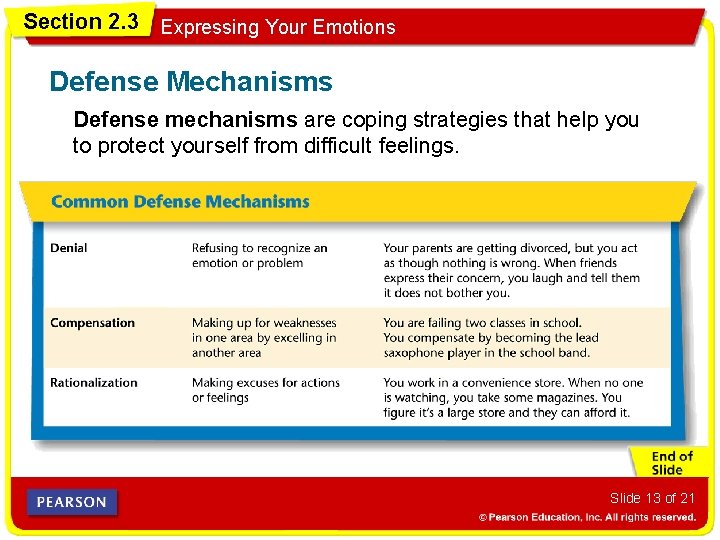
Section 2. 3 Expressing Your Emotions Defense Mechanisms Defense mechanisms are coping strategies that help you to protect yourself from difficult feelings. Slide 13 of 21
Section 2. 3 Expressing Your Emotions Helpful Ways of Coping • People react in many different ways to their own strong feelings. • Helpful coping strategies • Confront the situation head-on. If possible, take action to improve the situation. • Release your built-up energy by exercising, cleaning your room, or being active in some other way. • Take a break by reading a book, listening to music, taking a walk, writing in your journal, or otherwise relaxing. • Talk through your feelings with a family member, friend, counselor, or other trusted person. Sometimes, just talking about your feelings will help you see things more clearly. Slide 14 of 21
Section 2. 3 Expressing Your Emotions Harmful Ways of Coping • People may respond in unhealthy ways to intense emotions. • Using alcohol or other drugs is an example of a harmful coping strategy. • Withdrawing from friends and family is another. Slide 15 of 21
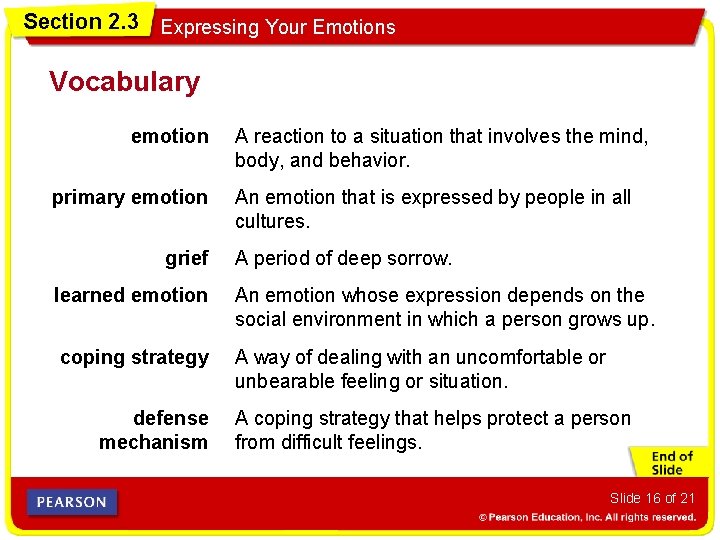
Section 2. 3 Expressing Your Emotions Vocabulary emotion primary emotion grief A reaction to a situation that involves the mind, body, and behavior. An emotion that is expressed by people in all cultures. A period of deep sorrow. learned emotion An emotion whose expression depends on the social environment in which a person grows up. coping strategy A way of dealing with an uncomfortable or unbearable feeling or situation. defense mechanism A coping strategy that helps protect a person from difficult feelings. Slide 16 of 21
- Slides: 16