
Section 2 3 Algebra 2 Polynomial Equations Monomials
Section 2. 3 Algebra 2 Polynomial Equations
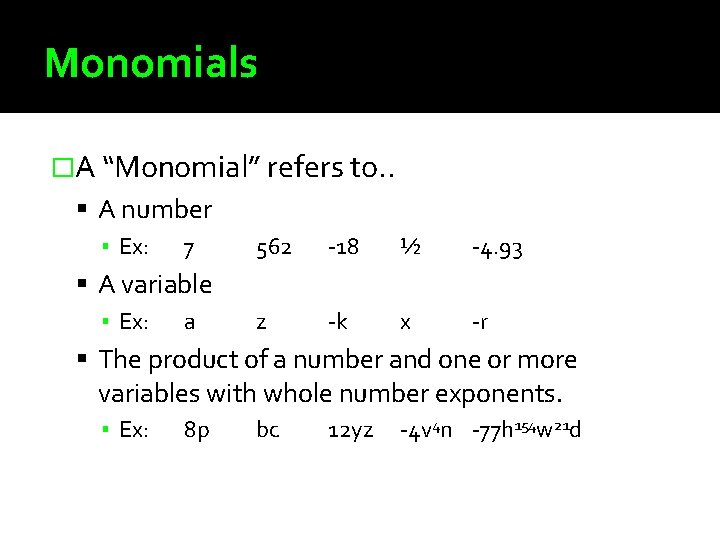
Monomials �A “Monomial” refers to. . A number ▪ Ex: 7 562 -18 ½ -4. 93 A variable ▪ Ex: a z -k x -r The product of a number and one or more variables with whole number exponents. ▪ Ex: 8 p bc 12 yz -4 v 4 n -77 h 154 w 21 d
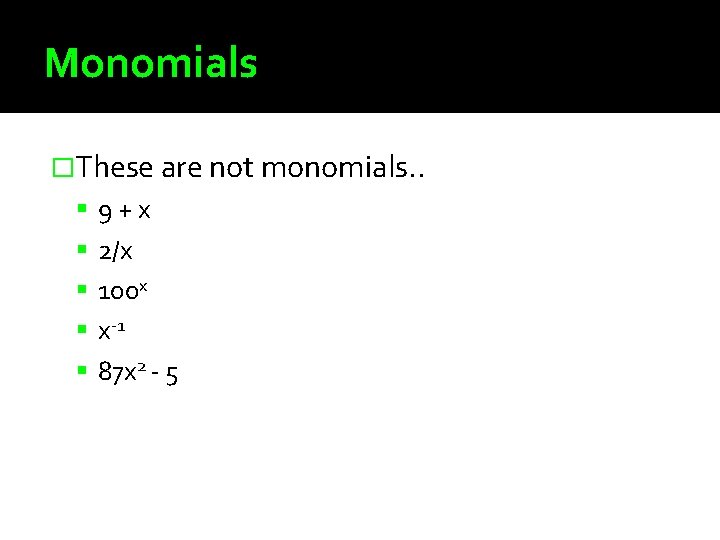
Monomials �These are not monomials. . 9+x 2/x 100 x x-1 87 x 2 - 5
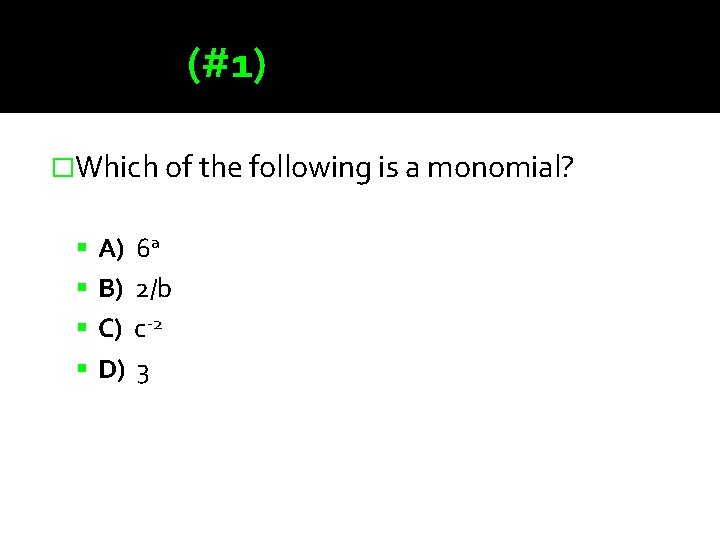
(#1) �Which of the following is a monomial? A) 6 a B) 2/b C) c-2 D) 3

(#2) �Which of the following is not a monomial? A) f + 1 B) 4 k C) 5 a 2 b D) 1
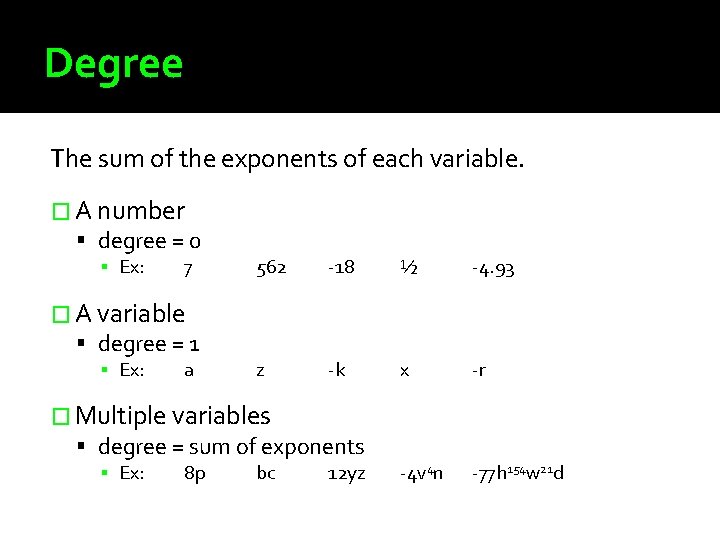
Degree The sum of the exponents of each variable. � A number degree = 0 ▪ Ex: 7 � A variable degree = 1 ▪ Ex: a 562 -18 ½ -4. 93 z -k x -r -4 v 4 n -77 h 154 w 21 d � Multiple variables degree = sum of exponents ▪ Ex: 8 p bc 12 yz
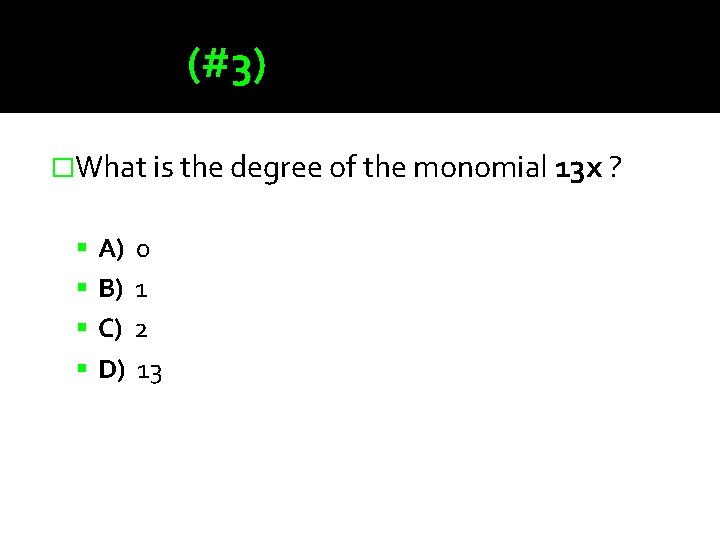
(#3) �What is the degree of the monomial 13 x ? A) 0 B) 1 C) 2 D) 13
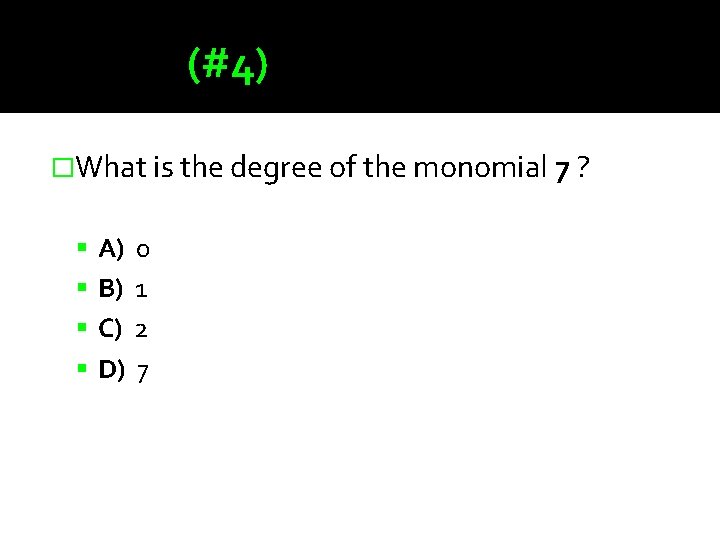
(#4) �What is the degree of the monomial 7 ? A) 0 B) 1 C) 2 D) 7
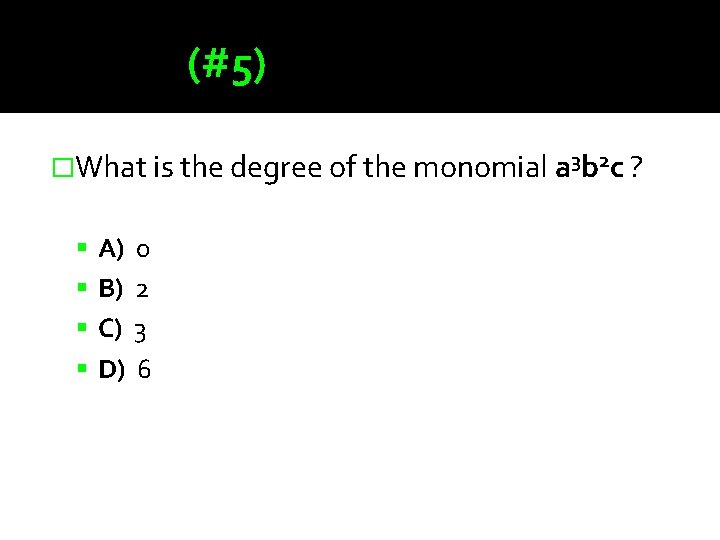
(#5) �What is the degree of the monomial a 3 b 2 c ? A) 0 B) 2 C) 3 D) 6
Polynomial �Umbrella term �Refers to a monomial or sum of monomials �Some polynomials have special names Depend on the # of terms �Polynomials have a degree too

Binomial �Type of polynomial �Consists of two monomials �These are binomials x+1 a+b 15 x 2 – 15 (yz + 3)
Trinomial �Type of polynomial �Consists of three monomials �These are trinomials x 2 + x + 1 4 m 3 + h -6 a 2 + ab + b 2 uv + wx + yz
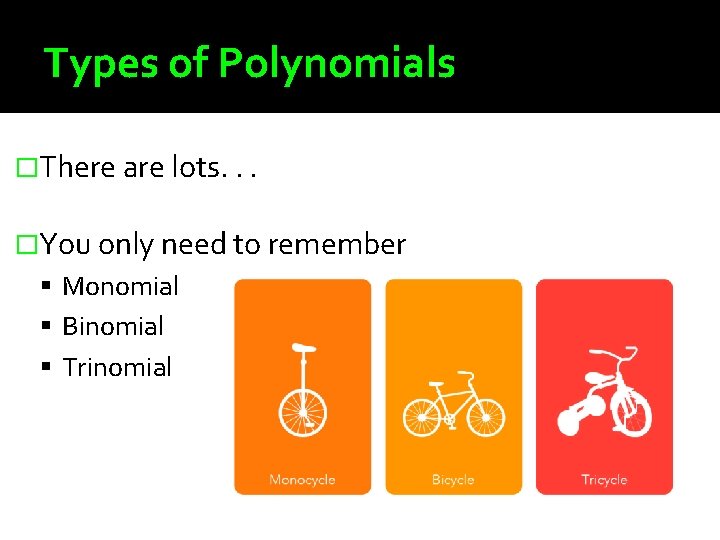
Types of Polynomials �There are lots. . . �You only need to remember Monomial Binomial Trinomial
(#6) �Which of the following is a binomial? A) 1 B) x + 1 C) x 2 + x + 1 D) x 3 + x 2 + x + 1
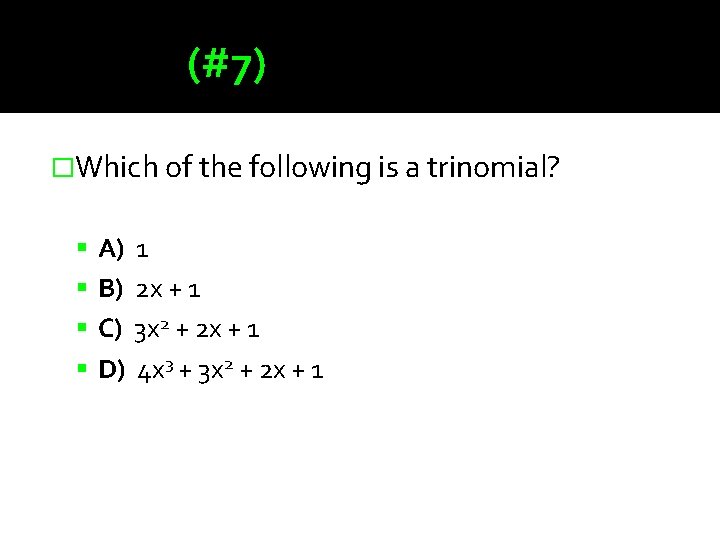
(#7) �Which of the following is a trinomial? A) 1 B) 2 x + 1 C) 3 x 2 + 2 x + 1 D) 4 x 3 + 3 x 2 + 2 x + 1
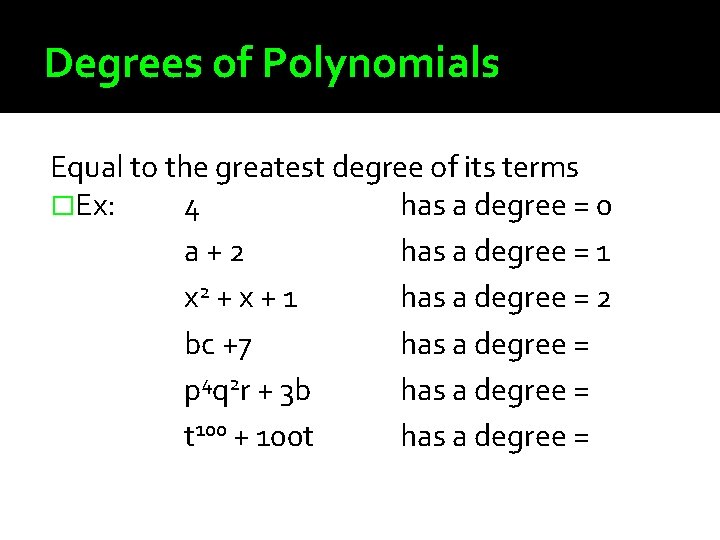
Degrees of Polynomials Equal to the greatest degree of its terms �Ex: 4 has a degree = 0 a+2 has a degree = 1 x 2 + x + 1 has a degree = 2 bc +7 has a degree = p 4 q 2 r + 3 b has a degree = t 100 + 100 t has a degree =
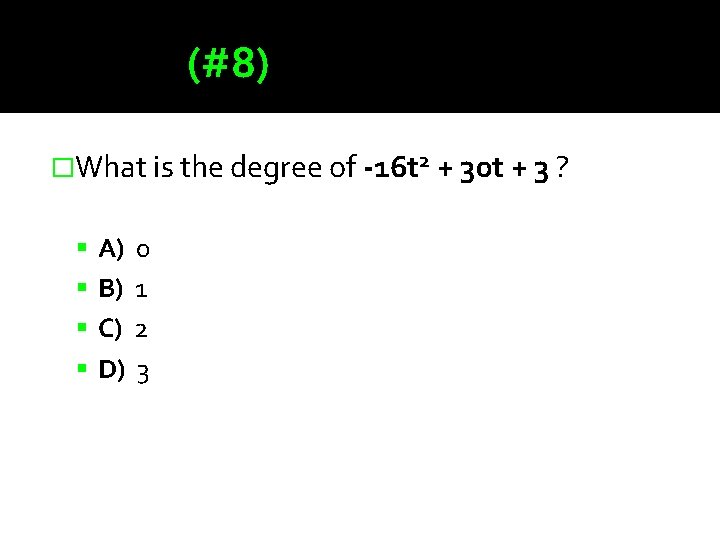
(#8) �What is the degree of -16 t 2 + 30 t + 3 ? A) 0 B) 1 C) 2 D) 3
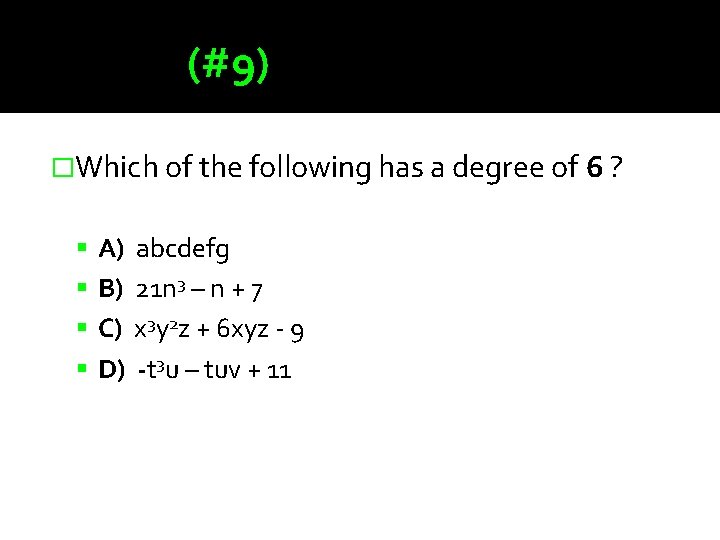
(#9) �Which of the following has a degree of 6 ? A) abcdefg B) 21 n 3 – n + 7 C) x 3 y 2 z + 6 xyz - 9 D) -t 3 u – tuv + 11
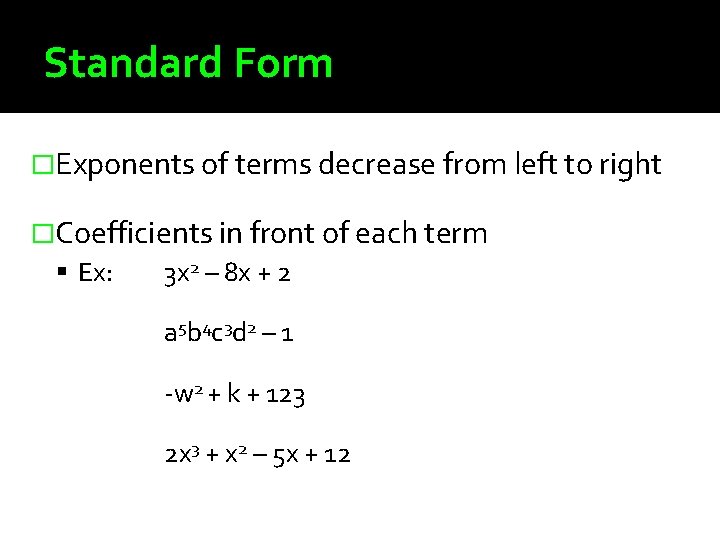
Standard Form �Exponents of terms decrease from left to right �Coefficients in front of each term Ex: 3 x 2 – 8 x + 2 a 5 b 4 c 3 d 2 – 1 -w 2 + k + 123 2 x 3 + x 2 – 5 x + 12
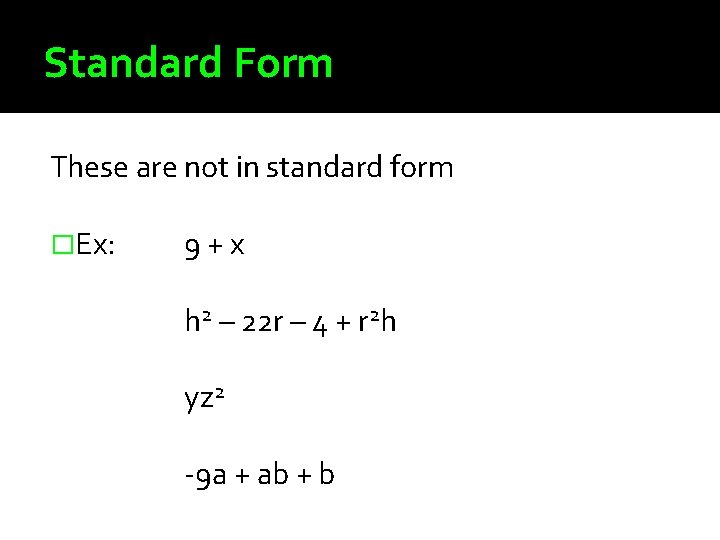
Standard Form These are not in standard form �Ex: 9+x h 2 – 22 r – 4 + r 2 h yz 2 -9 a + ab + b
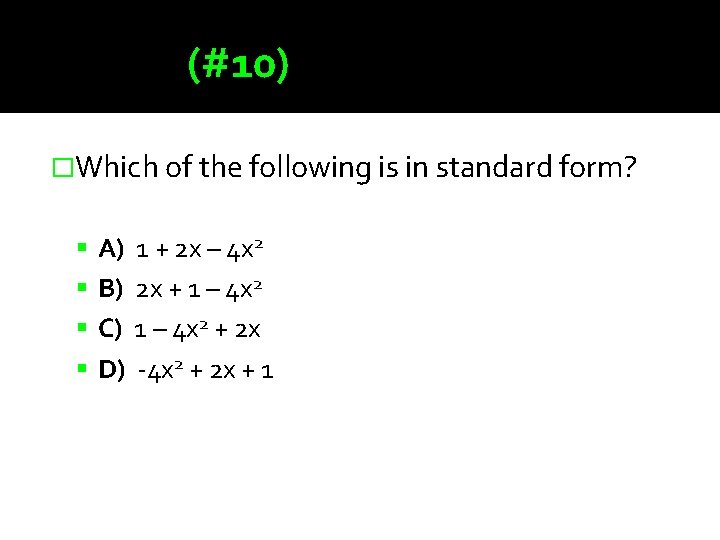
(#10) �Which of the following is in standard form? A) 1 + 2 x – 4 x 2 B) 2 x + 1 – 4 x 2 C) 1 – 4 x 2 + 2 x D) -4 x 2 + 2 x + 1
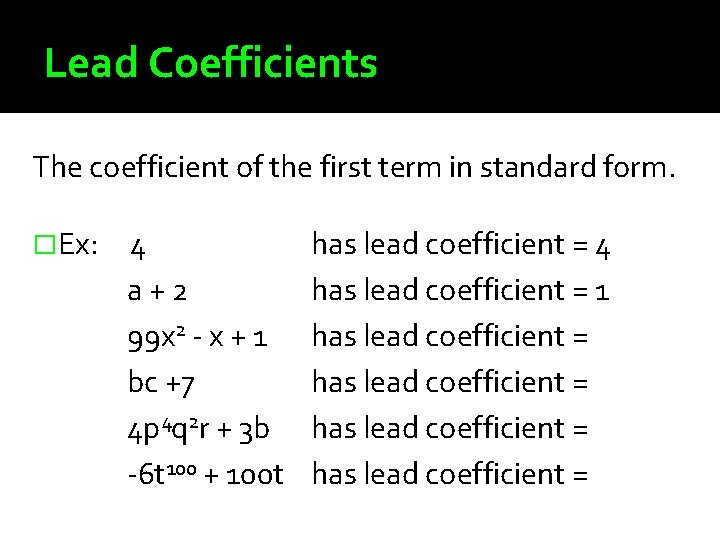
Lead Coefficients The coefficient of the first term in standard form. �Ex: 4 a+2 99 x 2 - x + 1 bc +7 4 p 4 q 2 r + 3 b -6 t 100 + 100 t has lead coefficient = 4 has lead coefficient = 1 has lead coefficient =
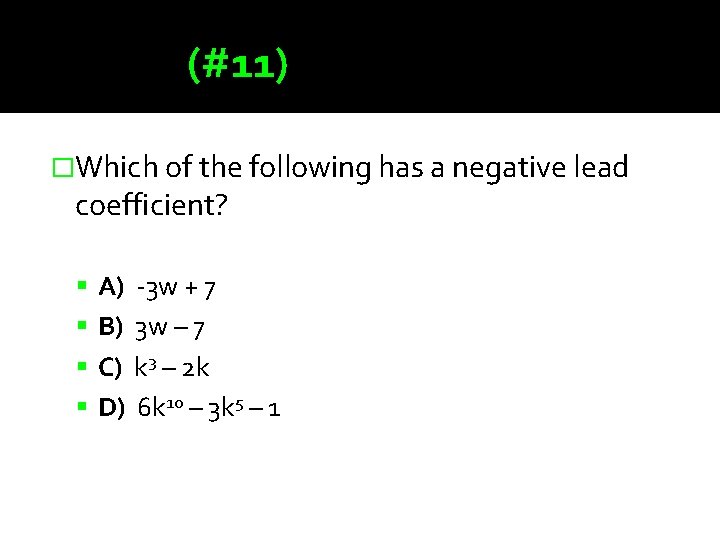
(#11) �Which of the following has a negative lead coefficient? A) -3 w + 7 B) 3 w – 7 C) k 3 – 2 k D) 6 k 10 – 3 k 5 – 1
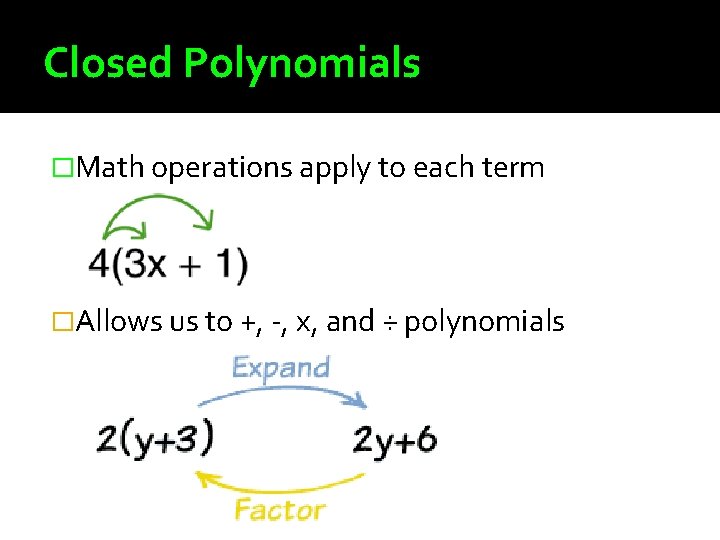
Closed Polynomials �Math operations apply to each term �Allows us to +, -, x, and ÷ polynomials
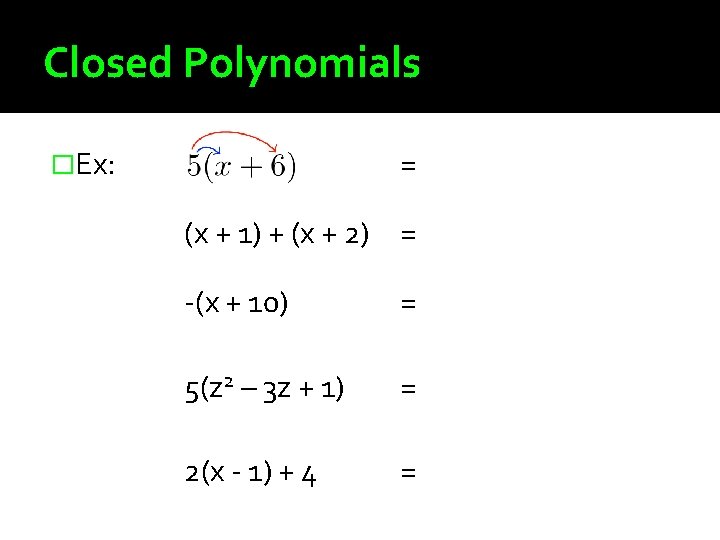
Closed Polynomials �Ex: = (x + 1) + (x + 2) = -(x + 10) = 5(z 2 – 3 z + 1) = 2(x - 1) + 4 =
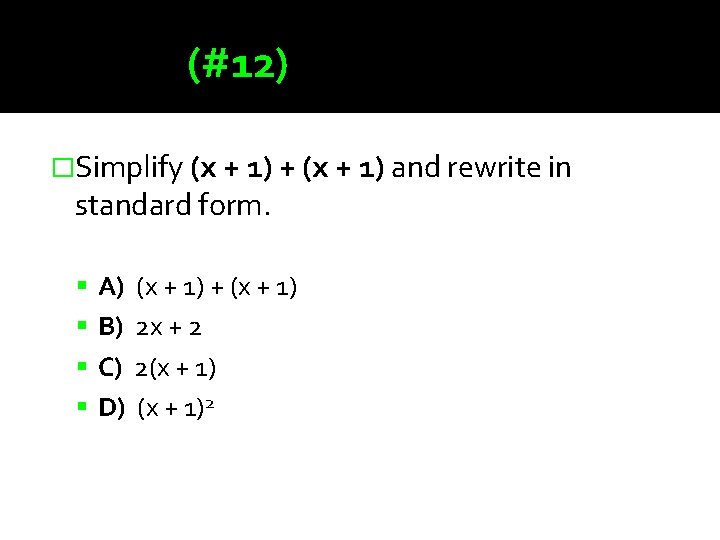
(#12) �Simplify (x + 1) + (x + 1) and rewrite in standard form. A) (x + 1) + (x + 1) B) 2 x + 2 C) 2(x + 1) D) (x + 1)2
(#13) �Simplify (2 x + 3) – (x + 5) and rewrite in standard form. A) -1 B) 10 C) x + 8 D) x - 2
(#14) �Simplify 7(b + 2) and rewrite in standard form. A) 14 + 7 b B) 7 b + 14 C) (b + 2)7 D) b 2 + 49
(#15) �Simplify -2(m – v) and rewrite in standard form. A) m – v – 2 B) -m + v C) -2 m + 2 v D) -v + 2 m
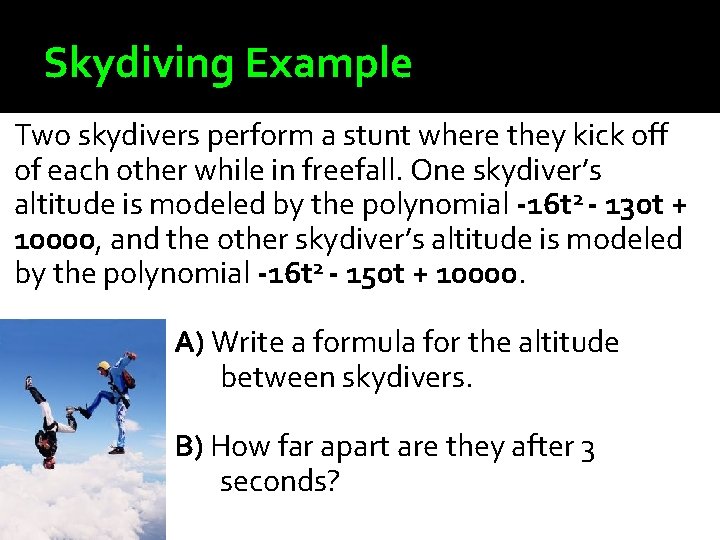
Skydiving Example Two skydivers perform a stunt where they kick off of each other while in freefall. One skydiver’s altitude is modeled by the polynomial -16 t 2 - 130 t + 10000, and the other skydiver’s altitude is modeled by the polynomial -16 t 2 - 150 t + 10000. A) Write a formula for the altitude between skydivers. B) How far apart are they after 3 seconds?
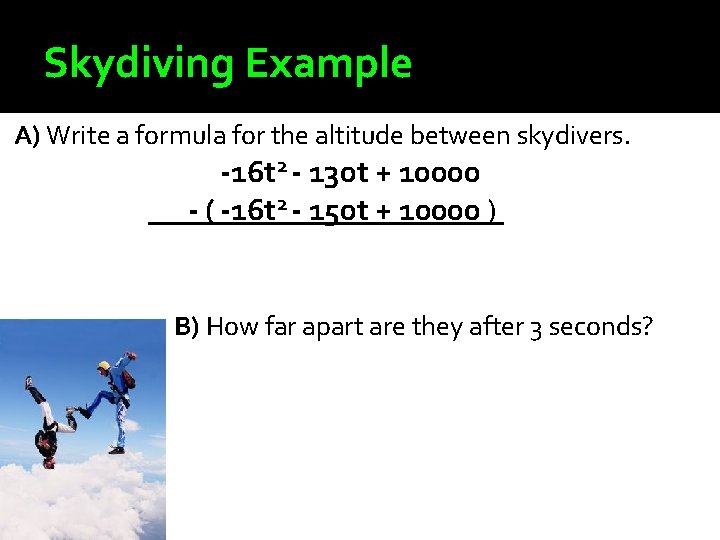
Skydiving Example A) Write a formula for the altitude between skydivers. -16 t 2 - 130 t + 10000 - ( -16 t 2 - 150 t + 10000 ) B) How far apart are they after 3 seconds?
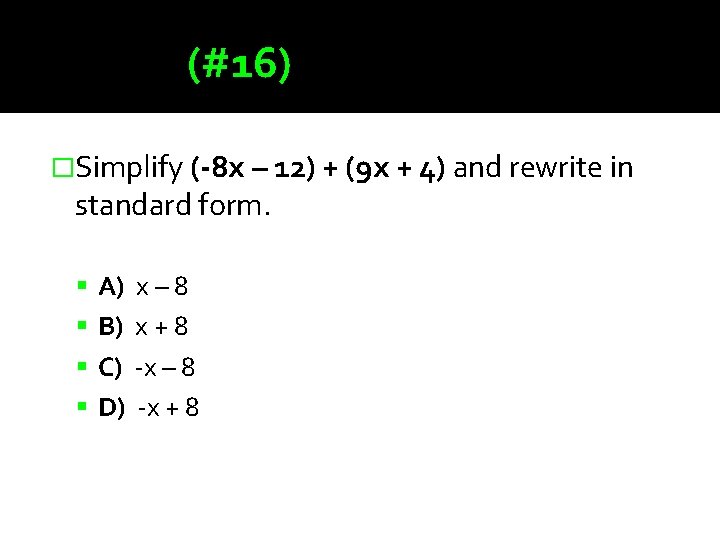
(#16) �Simplify (-8 x – 12) + (9 x + 4) and rewrite in standard form. A) x – 8 B) x + 8 C) -x – 8 D) -x + 8
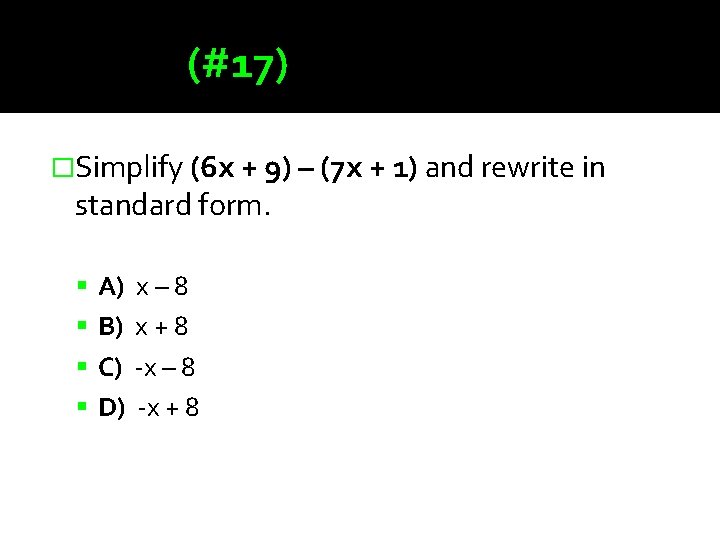
(#17) �Simplify (6 x + 9) – (7 x + 1) and rewrite in standard form. A) x – 8 B) x + 8 C) -x – 8 D) -x + 8
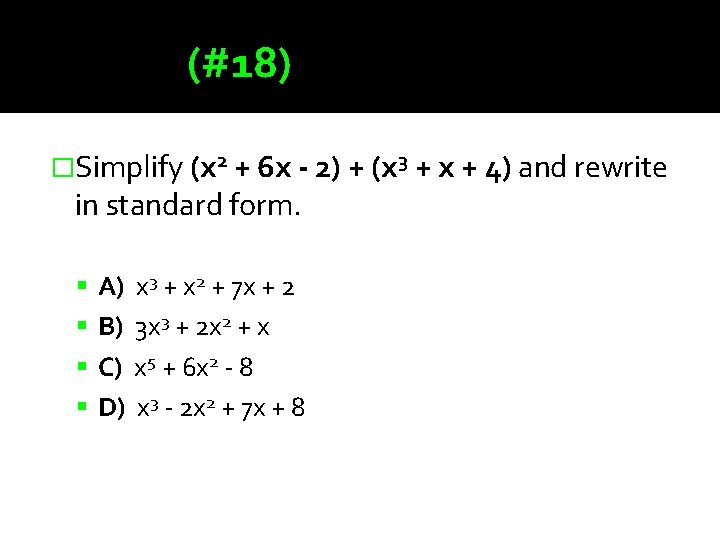
(#18) �Simplify (x 2 + 6 x - 2) + (x 3 + x + 4) and rewrite in standard form. A) x 3 + x 2 + 7 x + 2 B) 3 x 3 + 2 x 2 + x C) x 5 + 6 x 2 - 8 D) x 3 - 2 x 2 + 7 x + 8
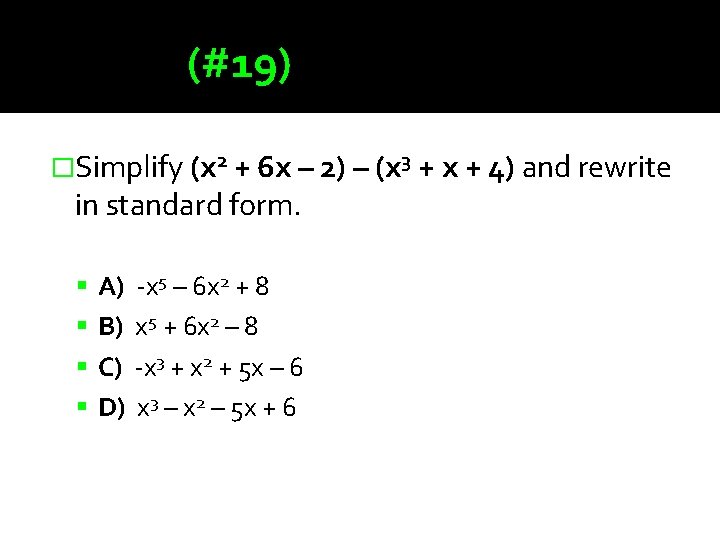
(#19) �Simplify (x 2 + 6 x – 2) – (x 3 + x + 4) and rewrite in standard form. A) -x 5 – 6 x 2 + 8 B) x 5 + 6 x 2 – 8 C) -x 3 + x 2 + 5 x – 6 D) x 3 – x 2 – 5 x + 6
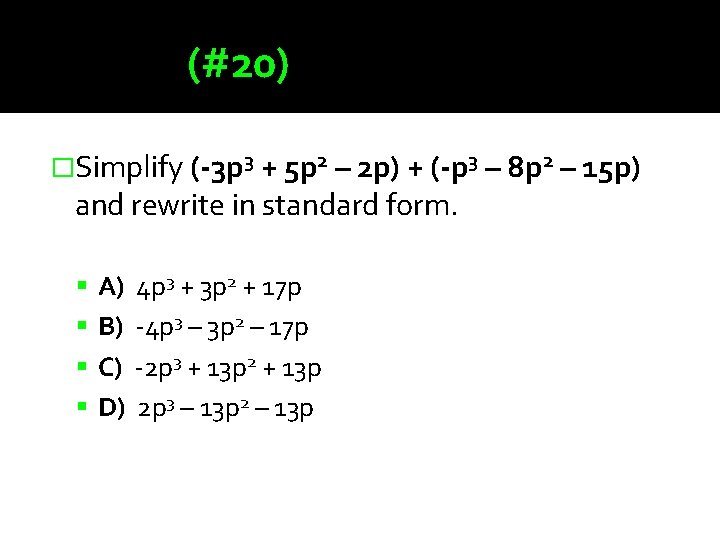
(#20) �Simplify (-3 p 3 + 5 p 2 – 2 p) + (-p 3 – 8 p 2 – 15 p) and rewrite in standard form. A) 4 p 3 + 3 p 2 + 17 p B) -4 p 3 – 3 p 2 – 17 p C) -2 p 3 + 13 p 2 + 13 p D) 2 p 3 – 13 p 2 – 13 p
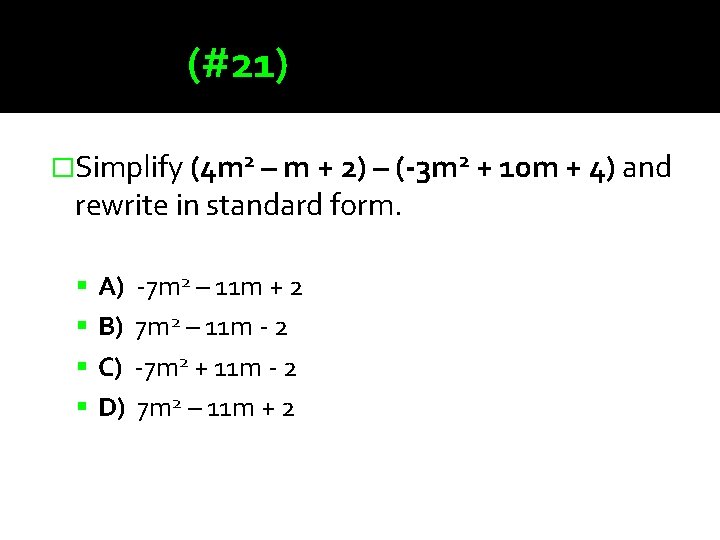
(#21) �Simplify (4 m 2 – m + 2) – (-3 m 2 + 10 m + 4) and rewrite in standard form. A) -7 m 2 – 11 m + 2 B) 7 m 2 – 11 m - 2 C) -7 m 2 + 11 m - 2 D) 7 m 2 – 11 m + 2
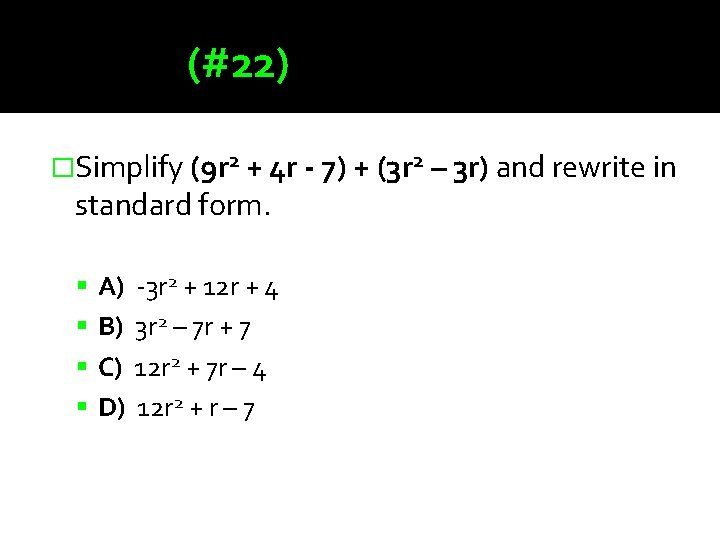
(#22) �Simplify (9 r 2 + 4 r - 7) + (3 r 2 – 3 r) and rewrite in standard form. A) -3 r 2 + 12 r + 4 B) 3 r 2 – 7 r + 7 C) 12 r 2 + 7 r – 4 D) 12 r 2 + r – 7
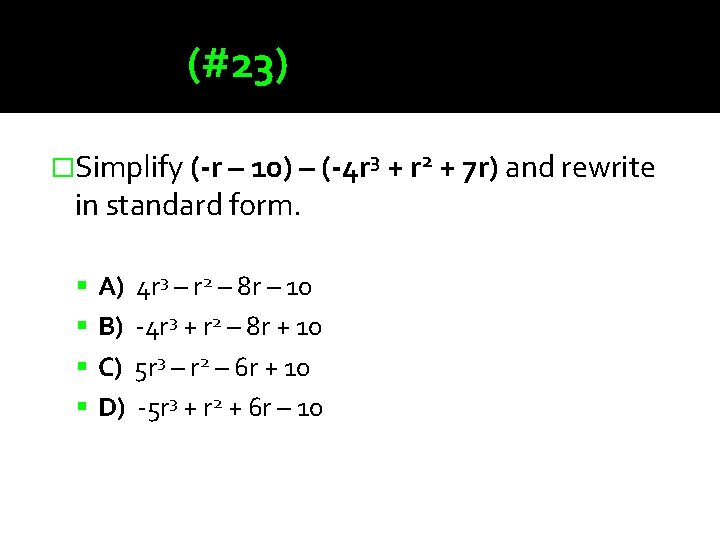
(#23) �Simplify (-r – 10) – (-4 r 3 + r 2 + 7 r) and rewrite in standard form. A) 4 r 3 – r 2 – 8 r – 10 B) -4 r 3 + r 2 – 8 r + 10 C) 5 r 3 – r 2 – 6 r + 10 D) -5 r 3 + r 2 + 6 r – 10
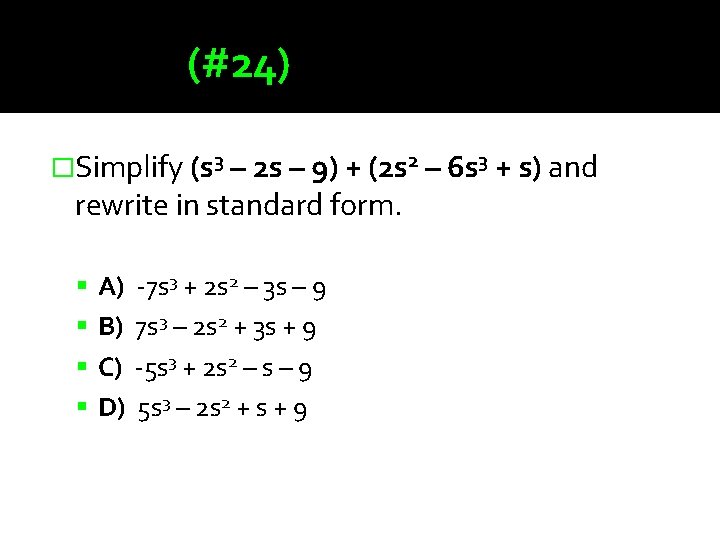
(#24) �Simplify (s 3 – 2 s – 9) + (2 s 2 – 6 s 3 + s) and rewrite in standard form. A) -7 s 3 + 2 s 2 – 3 s – 9 B) 7 s 3 – 2 s 2 + 3 s + 9 C) -5 s 3 + 2 s 2 – s – 9 D) 5 s 3 – 2 s 2 + s + 9
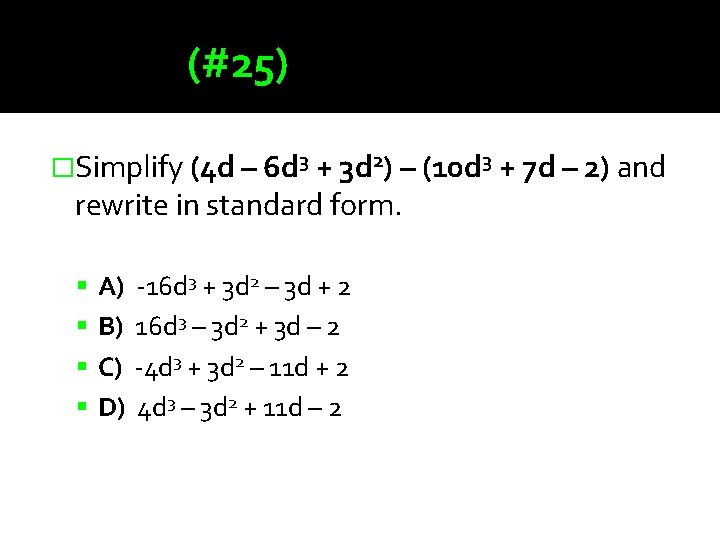
(#25) �Simplify (4 d – 6 d 3 + 3 d 2) – (10 d 3 + 7 d – 2) and rewrite in standard form. A) -16 d 3 + 3 d 2 – 3 d + 2 B) 16 d 3 – 3 d 2 + 3 d – 2 C) -4 d 3 + 3 d 2 – 11 d + 2 D) 4 d 3 – 3 d 2 + 11 d – 2
- Slides: 41