
Section 2 2 Notes Linear Relations and Functions
- Slides: 8
Section 2. 2 Notes: Linear Relations and Functions
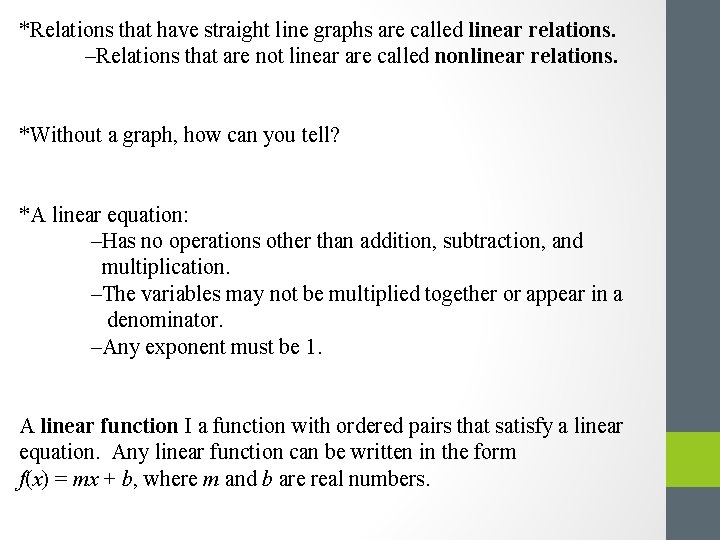
*Relations that have straight line graphs are called linear relations. –Relations that are not linear are called nonlinear relations. *Without a graph, how can you tell? *A linear equation: –Has no operations other than addition, subtraction, and multiplication. –The variables may not be multiplied together or appear in a denominator. –Any exponent must be 1. A linear function I a function with ordered pairs that satisfy a linear equation. Any linear function can be written in the form f(x) = mx + b, where m and b are real numbers.
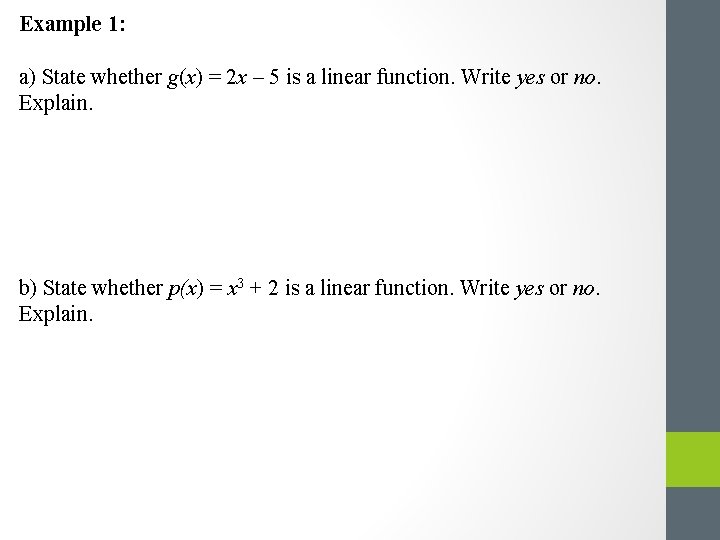
Example 1: a) State whether g(x) = 2 x – 5 is a linear function. Write yes or no. Explain. b) State whether p(x) = x 3 + 2 is a linear function. Write yes or no. Explain.
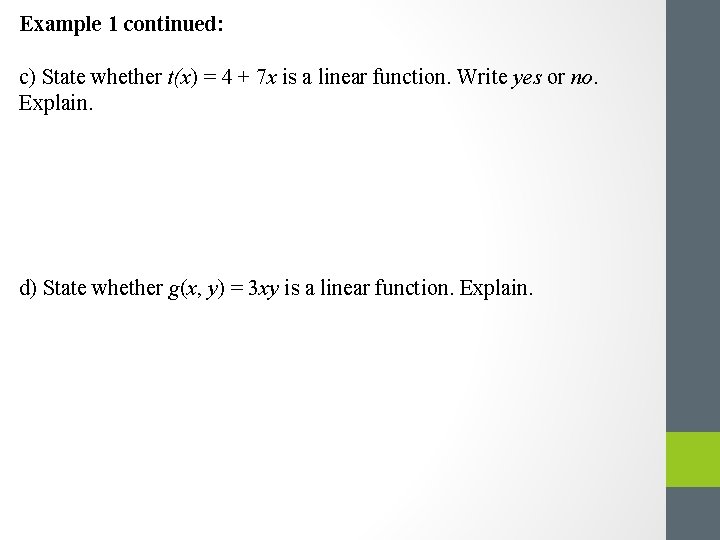
Example 1 continued: c) State whether t(x) = 4 + 7 x is a linear function. Write yes or no. Explain. d) State whether g(x, y) = 3 xy is a linear function. Explain.
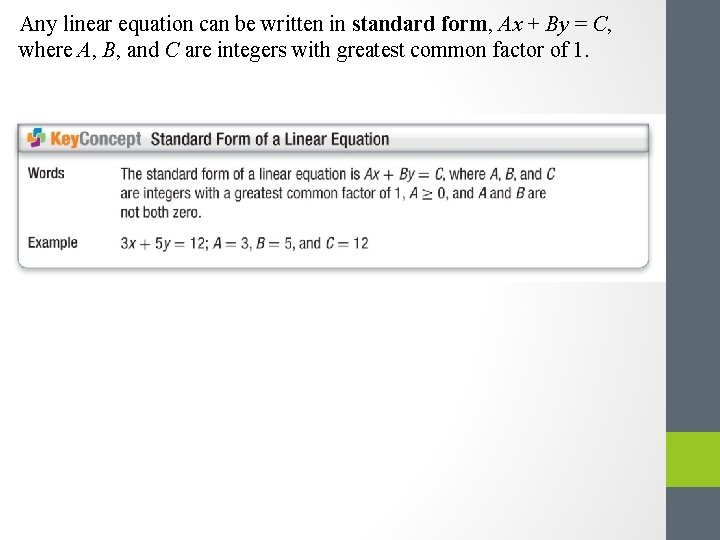
Any linear equation can be written in standard form, Ax + By = C, where A, B, and C are integers with greatest common factor of 1.
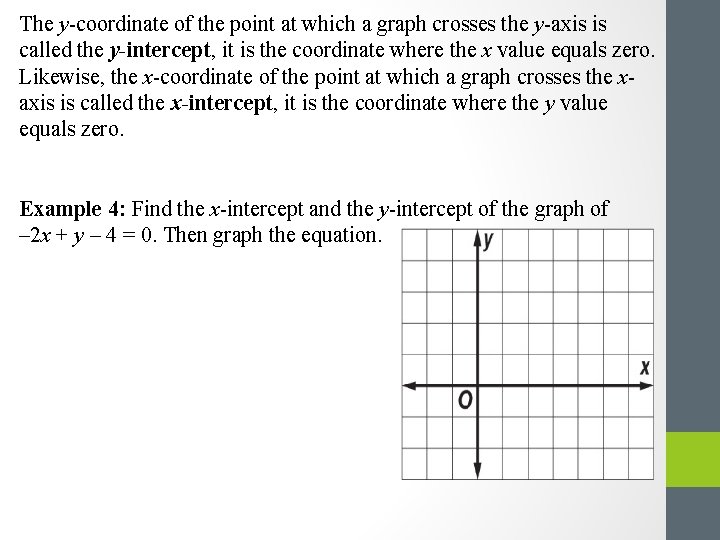
The y-coordinate of the point at which a graph crosses the y-axis is called the y-intercept, it is the coordinate where the x value equals zero. Likewise, the x-coordinate of the point at which a graph crosses the xaxis is called the x-intercept, it is the coordinate where the y value equals zero. Example 4: Find the x-intercept and the y-intercept of the graph of – 2 x + y – 4 = 0. Then graph the equation.