
Section 2 1 Numbers Objectives Compare and identify
Section 2. 1 Numbers

Objectives • Compare and identify number systems. • Identify properties of real numbers, and use their properties to perform operations with rational numbers.
Real Numbers • REAL NUMBERS are used in everyday life to describe quantities: • Example: Age, miles per gallon, container size, population, etc.
Real Numbers • Real numbers can be written in so many ways! Examples: 9, 0, 4/3, 0. 555…, 28. 21, π, √ 2
Important subsets of Real Numbers Natural numbers, N {1, 2, 3, 4, …} Known as the counting numbers Whole numbers, W {0, 1, 2, 3, 4, …} Set of integers, I {…, -3, -2, -1, 0, 1, 2, 3, …}
Two Kinds of Real Numbers • Rational Numbers • Irrational Numbers
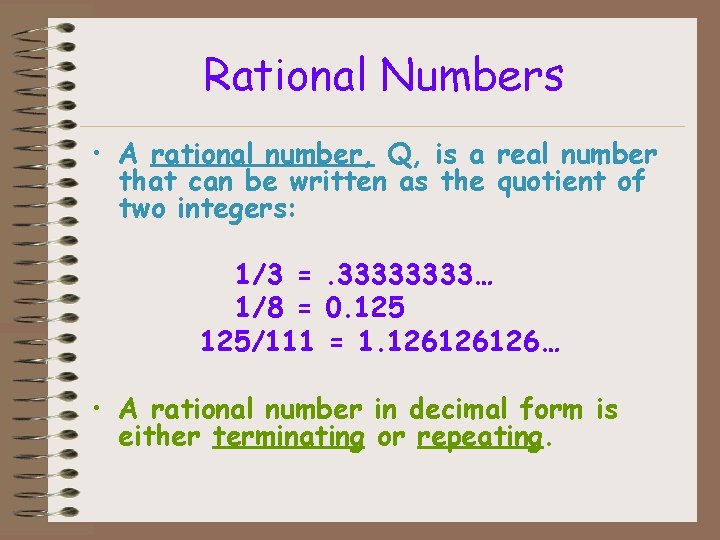
Rational Numbers • A rational number, Q, is a real number that can be written as the quotient of two integers: 1/3 =. 3333… 1/8 = 0. 125/111 = 1. 126126126… • A rational number in decimal form is either terminating or repeating.
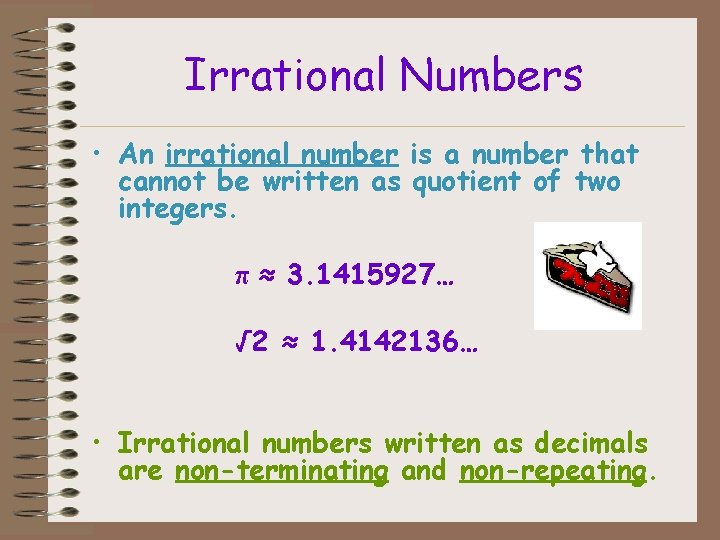
Irrational Numbers • An irrational number is a number that cannot be written as quotient of two integers. π ≈ 3. 1415927… √ 2 ≈ 1. 4142136… • Irrational numbers written as decimals are non-terminating and non-repeating.
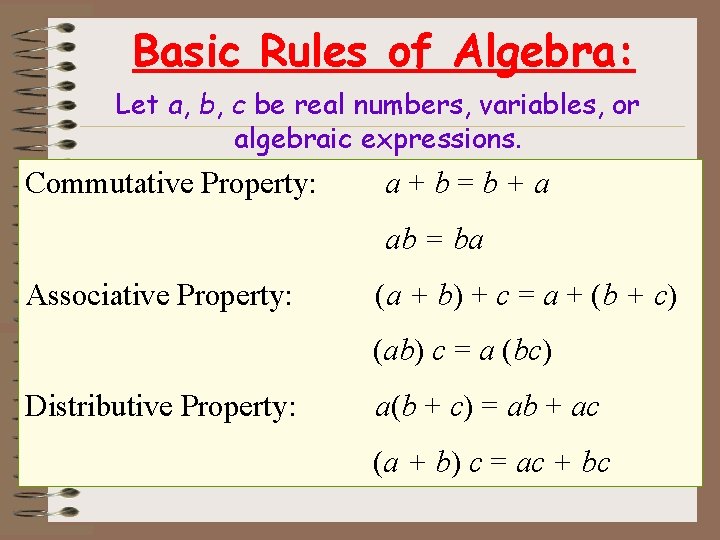
Basic Rules of Algebra: Let a, b, c be real numbers, variables, or algebraic expressions. Commutative Property: a+b=b+a ab = ba Associative Property: (a + b) + c = a + (b + c) (ab) c = a (bc) Distributive Property: a(b + c) = ab + ac (a + b) c = ac + bc
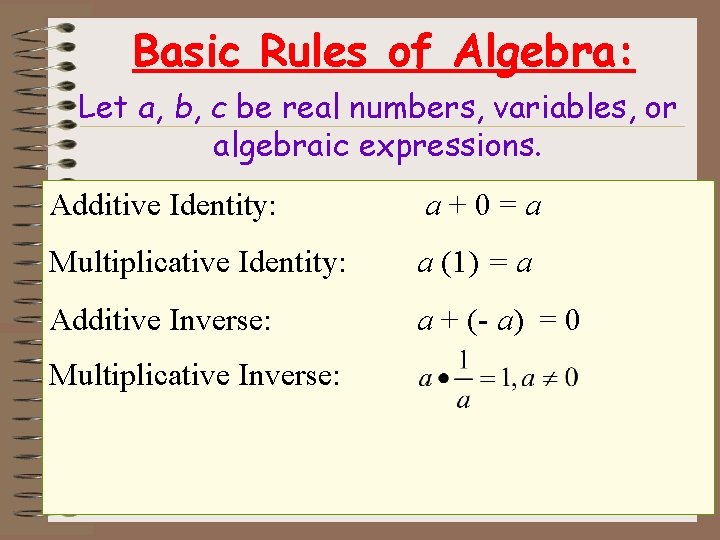
Basic Rules of Algebra: Let a, b, c be real numbers, variables, or algebraic expressions. Additive Identity: a+0=a Multiplicative Identity: a (1) = a Additive Inverse: a + (- a) = 0 Multiplicative Inverse:
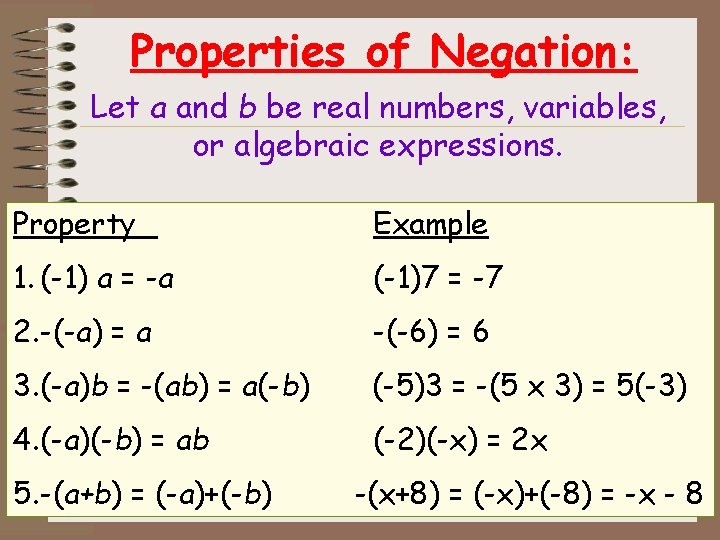
Properties of Negation: Let a and b be real numbers, variables, or algebraic expressions. Property Example 1. (-1) a = -a (-1)7 = -7 2. -(-a) = a -(-6) = 6 3. (-a)b = -(ab) = a(-b) (-5)3 = -(5 x 3) = 5(-3) 4. (-a)(-b) = ab (-2)(-x) = 2 x 5. -(a+b) = (-a)+(-b) -(x+8) = (-x)+(-8) = -x - 8
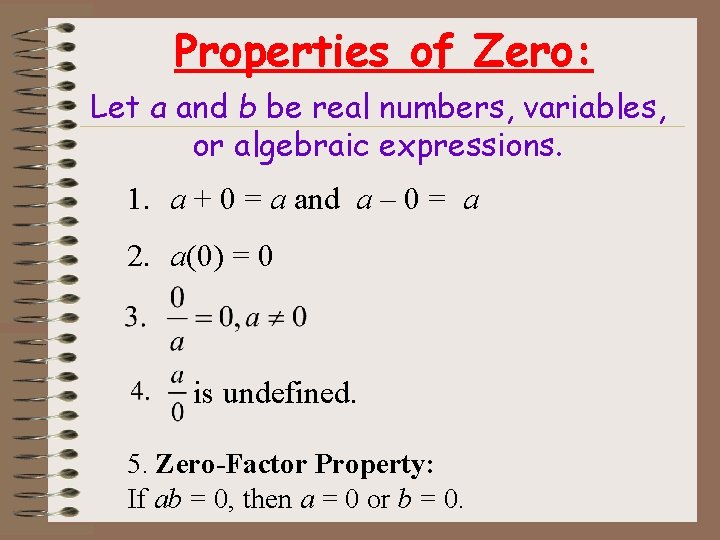
Properties of Zero: Let a and b be real numbers, variables, or algebraic expressions. 1. a + 0 = a and a – 0 = a 2. a(0) = 0 is undefined. 5. Zero-Factor Property: If ab = 0, then a = 0 or b = 0.
Classwork: Properties Drill Homework: Worksheet - Identify The Properties of Mathematics
Now working with fractions.
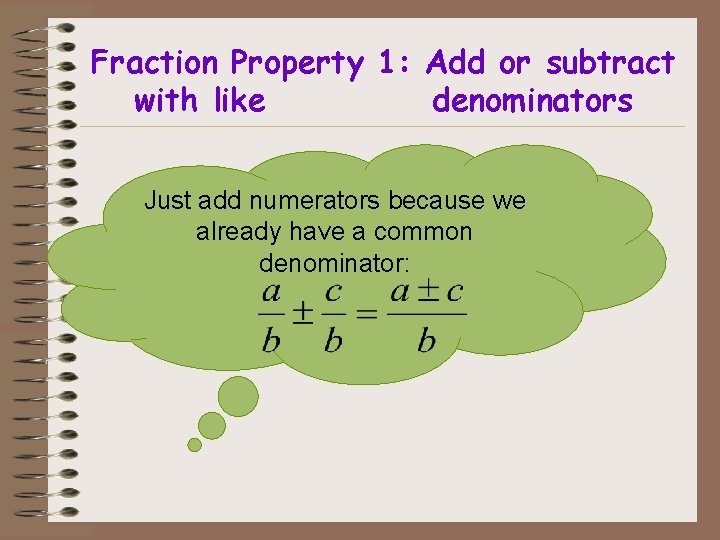
Fraction Property 1: Add or subtract with like denominators Just add numerators because we already have a common denominator:
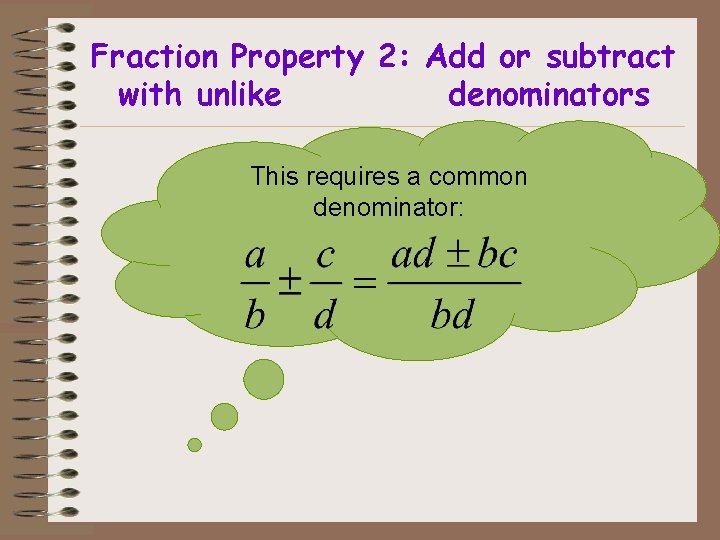
Fraction Property 2: Add or subtract with unlike denominators This requires a common denominator:
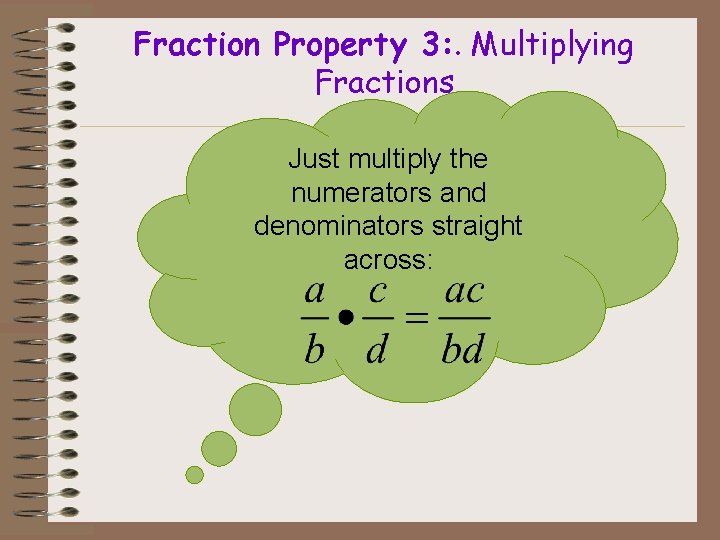
Fraction Property 3: . Multiplying Fractions Just multiply the numerators and denominators straight across:

Fraction Property 4: Dividing Fractions To divide, multiply by the reciprocal:

Example 1: •
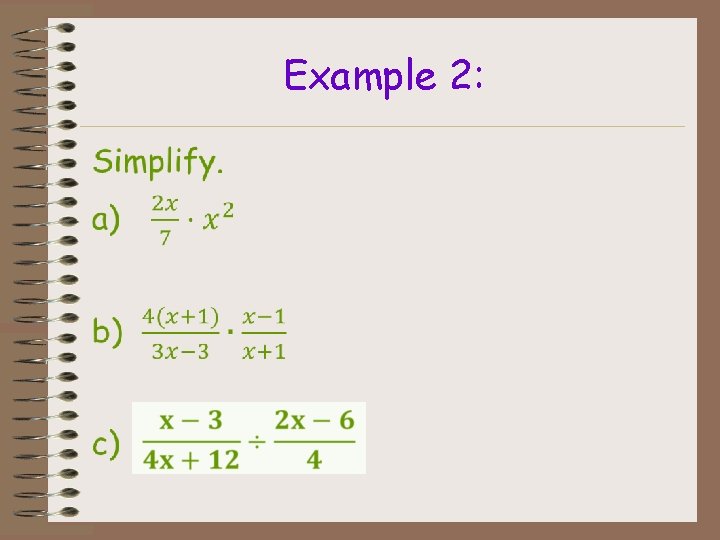
Example 2: •
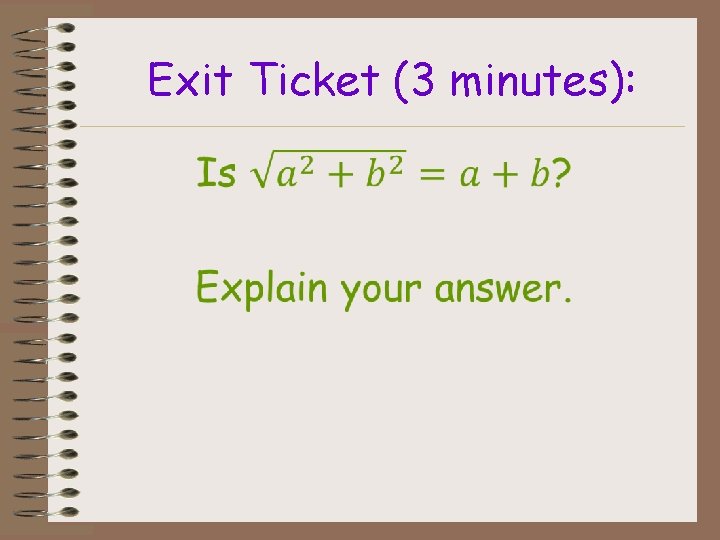
Exit Ticket (3 minutes): •
Homework: • Practice and Apply Worksheet 2. 1
- Slides: 22