
Section 18 3 The Female Reproductive System Objectives
Section 18. 3 The Female Reproductive System Objectives Describe three functions of the female reproductive system. Summarize the stages of the menstrual cycle. Identify five ways to keep the female reproductive system healthy. Slide 1 of 29

Section 18. 3 The Female Reproductive System Structure and Function • The reproductive cells in females are called eggs or ova (singular, ovum). • The functions of the female reproductive system are 1 -to produce sex hormones 2 -to ripen eggs 3 - “baby maker” or to provide a nourishing environment in which a fertilized egg can develop into a baby Slide 2 of 29
Section 18. 3 The Female Reproductive System Ovaries • The reproductive glands in which eggs are produced are called ovaries. • The sex hormone estrogen activates certain physical changes at puberty. • Progesterone activates changes to a woman’s reproductive system before and during pregnancy. 2. Once puberty begins, one of the ovaries releases a ripened egg about once every month in a process called ovulation. Slide 3 of 29
Section 18. 3 The Female Reproductive System Fallopian Tubes 1. Fallopian tubes (fuh LOH pee un) are passageways that carry eggs away from the ovaries. • When the ovary releases an egg during ovulation, the fingerlike ends of the fallopian tube draw the egg into the tube. 2. The fallopian tubes are where fertilization usually occurs. Slide 4 of 29
Section 18. 3 The Female Reproductive System Uterus 1. The uterus is a hollow, muscular, pear-shaped organ. 2. In the uterus, a fertilized egg can develop and grow. • When a baby is ready to be born, the cervix expands to allow the baby to pass through. Slide 5 of 29
Section 18. 3 The Female Reproductive System Vagina 1. The vagina, or birth canal, is a hollow, muscular passage leading from the uterus to the outside of the body. 2. Sperm enter a woman’s body through the vagina. • The walls of the vagina are very elastic, which allows it to expand dramatically during childbirth. Slide 6 of 29
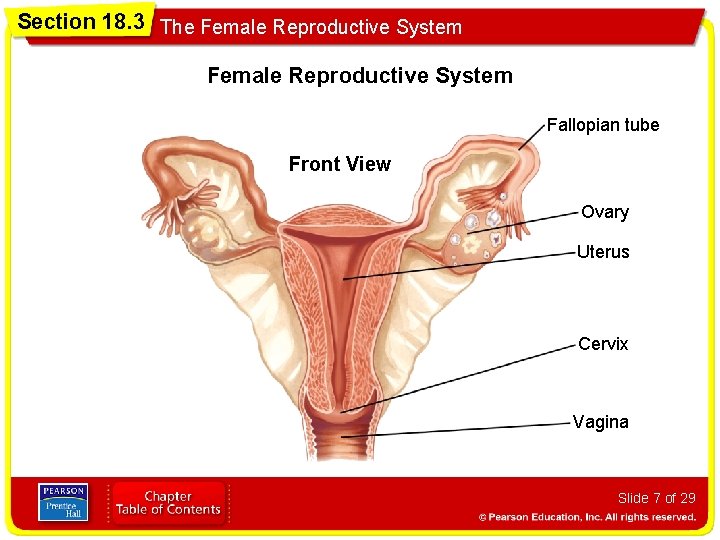
Section 18. 3 The Female Reproductive System Fallopian tube Front View Ovary Uterus Cervix Vagina Slide 7 of 29
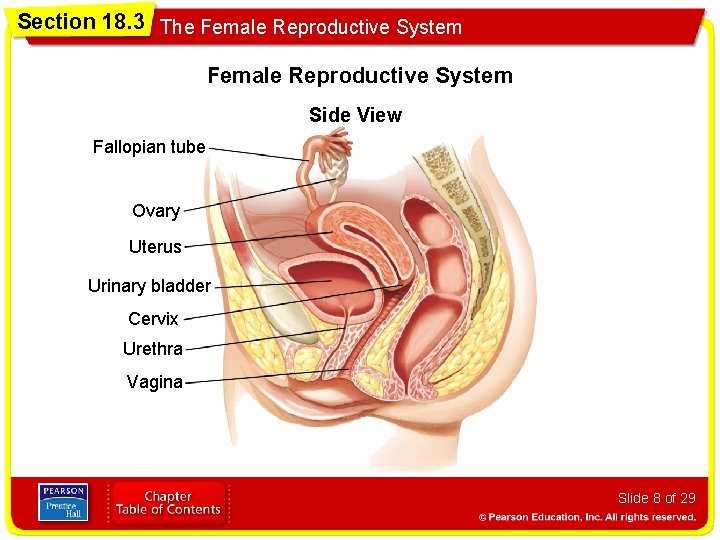
Section 18. 3 The Female Reproductive System Side View Fallopian tube Ovary Uterus Urinary bladder Cervix Urethra Vagina Slide 8 of 29

Section 18. 3 The Female Reproductive System The Menstrual Cycle • Women usually ripen only one mature egg cell each month during a process called the menstrual cycle (MEN stroo ul). • During the menstrual cycle, an ovary releases a mature egg. • The egg travels to the uterus. • If the egg is not fertilized, the uterine lining is shed and a new cycle begins. Slide 9 of 29
Section 18. 3 The Female Reproductive System Factors Affecting the Menstrual Cycle • On average, a woman’s menstrual cycle lasts 28 days. • Factors such as diet, stress, exercise, and weight gain or loss also affect the menstrual cycle. • The menstrual cycle may be irregular at times, especially during puberty. • During menopause, the ovaries slow down their hormone production and no longer release mature eggs. Slide 10 of 29
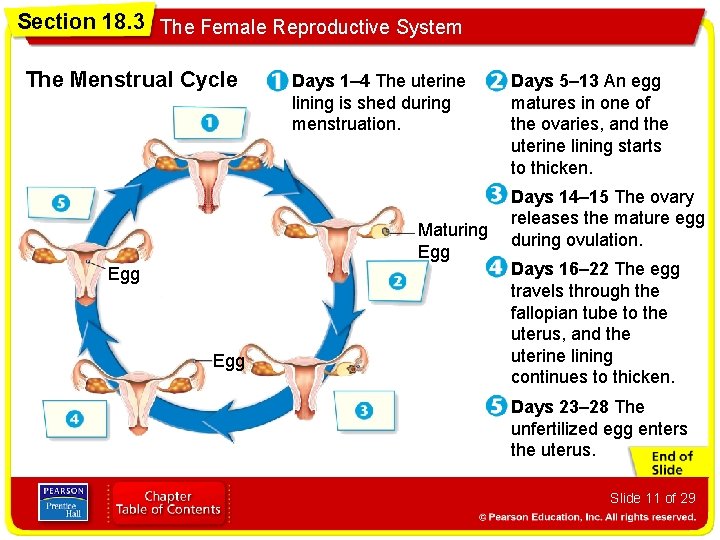
Section 18. 3 The Female Reproductive System The Menstrual Cycle Days 1– 4 The uterine lining is shed during menstruation. Maturing Egg Egg Days 5– 13 An egg matures in one of the ovaries, and the uterine lining starts to thicken. Days 14– 15 The ovary releases the mature egg during ovulation. Days 16– 22 The egg travels through the fallopian tube to the uterus, and the uterine lining continues to thicken. Days 23– 28 The unfertilized egg enters the uterus. Slide 11 of 29
Section 18. 3 The Female Reproductive System Menstrual Discomfort • Cramps are caused by contractions of the uterus. • Premenstrual syndrome, or PMS, is marked by nervous tension, mood swings, headaches, bloating, and irritability. • The dramatic change in hormone levels that occurs before menstruation begins may cause PMS. Slide 12 of 29
Section 18. 3 The Female Reproductive System Toxic Shock Syndrome • This syndrome is caused by a bacterial infection. • Symptoms of toxic shock syndrome include • a sudden high fever • a rash • vomiting • diarrhea • dizziness • To decrease the risk of toxic shock syndrome, women should use tampons with the lowest possible absorbency for their needs and change tampons often. Slide 13 of 29
Section 18. 3 The Female Reproductive System Cleanliness • One important health habit is cleanliness, including daily washing of the external vaginal area. • Cleanliness is especially important during menstruation, as is the regular changing of sanitary pads or tampons. “Normal washing every 36 hours” Slide 14 of 29
Section 18. 3 The Female Reproductive System Sexual Abstinence • A number of serious infections can result from sexual contact. • The only way to eliminate your risk of sexually transmitted infections is to abstain from sexual activity. “The only 100% not to get an STD” Slide 15 of 29
Section 18. 3 The Female Reproductive System Prompt Treatment for Infections • Many women experience vaginitis, a vaginal infection caused by yeast, bacteria, or other microorganisms. • Symptoms include • a thick discharge • odors • vaginal itching • a burning sensation during urination “See a doctor” Slide 16 of 29
Section 18. 3 The Female Reproductive System Self-Exams • Symptoms of vaginitis, sores on the genitals, or any unusual pain in the abdomen require a medical exam. • A woman should consult a doctor • if she notices heavier bleeding than normal during menstruation • if she notices bleeding at times between her regular periods • For the early detection of breast cancer, all women, including teens, should perform a monthly breast selfexamination. “Should be done once a month” Slide 17 of 29
Section 18. 3 The Female Reproductive System Medical Checkups • In a Pap smear, a sample of cells is taken from the cervix and examined under a microscope. • A mammogram is an X-ray of the breast that can help detect breast cancer. • Ovarian cysts are growths on the ovary. • Endometriosis This is a condition in which tissue from the lining of the uterus—the endometrium—grows outside the uterus, in the pelvic cavity. “If Sexual active every 6 months, If not once a year” Slide 18 of 29
- Slides: 18