
Section 18 2 Modern Evolutionary Classification CHAPTER 18


- Slides: 14
Section 18 -2: Modern Evolutionary Classification CHAPTER 18: CLASSIFICATION
EVOLUTIONARY CLASSIFICATION � Phylogeny – the study of how living and extinct organisms are related to one another � Phylogentic systematics, or evolutionary classification � Species grouped into larger categories reflecting lines of evolutionary descent � Organisms placed into higher taxa based on relationship – larger taxon, further common ancestor
CLADES � Clade – a group of species tha includes a single common ancestor and all descendants of that ancestor, living and extinct � Must be a monophyletic group – all species from common ancestor � Cladistic analysis - how are clades related
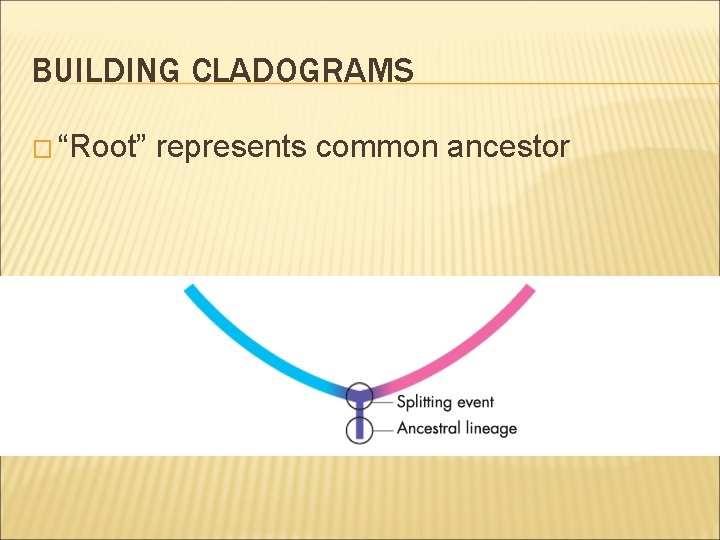
CLADOGRAMS � Linked clades that illustrate how groups of organisms are related by showing how evolutionary lines (lineages) branched off from common ancestors � Speciation causes an ancestral lineage to branch into 2 new lineages at a node � Node is last point at which new lineages share common ancestor
BUILDING CLADOGRAMS � “Root” represents common ancestor
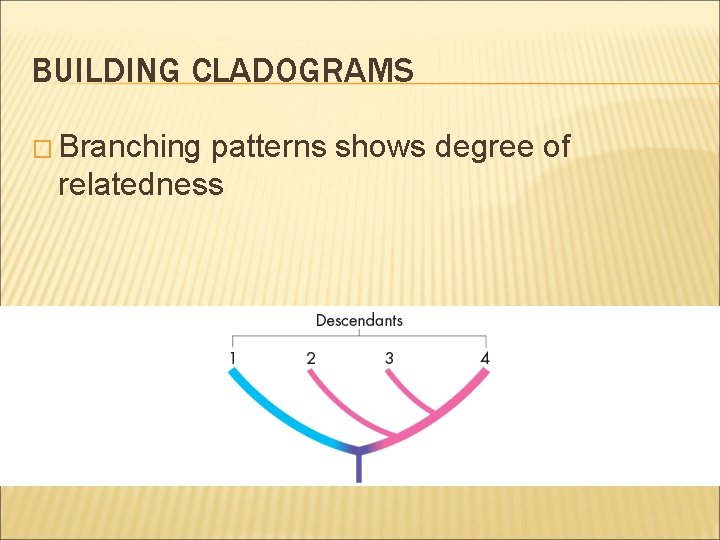
BUILDING CLADOGRAMS � Branching patterns shows degree of relatedness
BUILDING CLADOGRAMS � Current hypotheses - evolutionary relationships among vertebrates
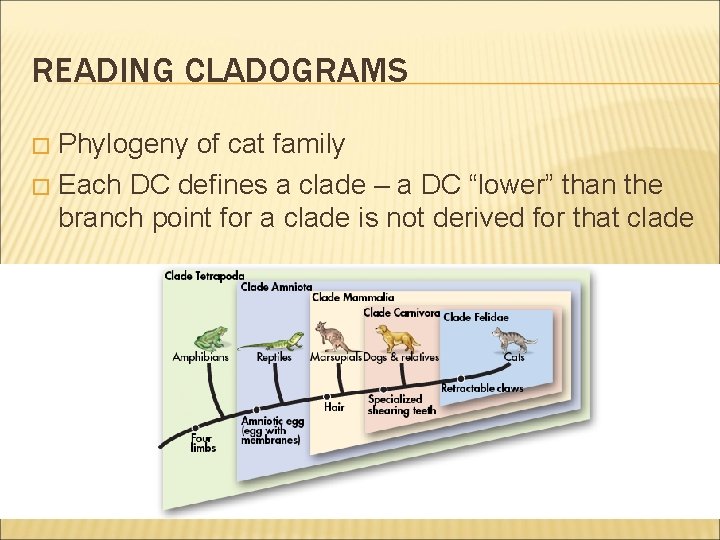
DERIVED CHARACTERISTICS � Cladistics focuses on derived characteristics – a trait that arose in the most recent ancestor of a particular lineage and was passed along to its descendants � Depends on level of grouping � Four limbs is a DC for clade Tetrapoda � Hair is a DC for clade Mammalia – not four limbs
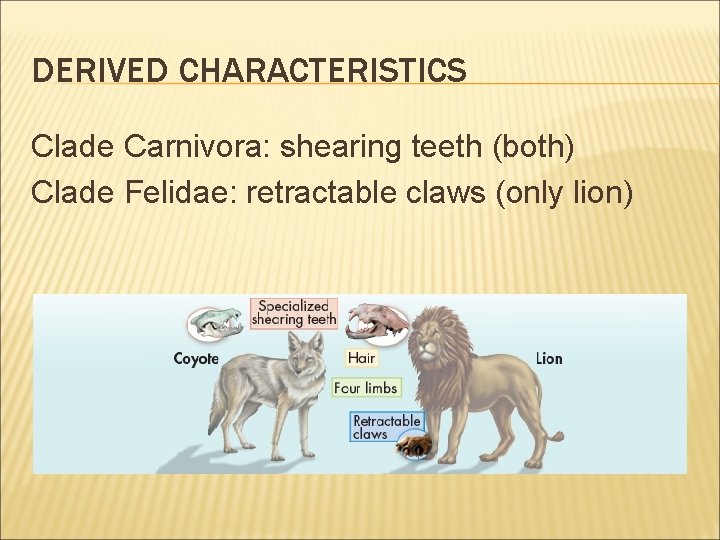
DERIVED CHARACTERISTICS Clade Carnivora: shearing teeth (both) Clade Felidae: retractable claws (only lion)
LOSING TRAITS � Absence of a trait is not a derived characteristic � Whales and snakes have lost tetrapod characteristic of four limbs, but are not closely related
READING CLADOGRAMS Phylogeny of cat family � Each DC defines a clade – a DC “lower” than the branch point for a clade is not derived for that clade �
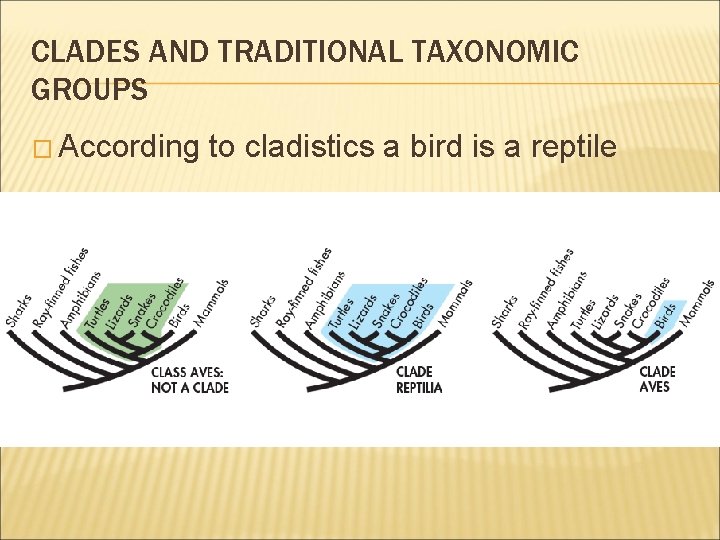
CLADES AND TRADITIONAL TAXONOMIC GROUPS � Clade must be monophyletic � Many traditional taxonomic groups form valid clades – Linnaen class Mammalia = clade Mammalia � Birds and reptiles descend from common ancestor, but Linnaen class Reptilia does not include birds
CLADES AND TRADITIONAL TAXONOMIC GROUPS � According to cladistics a bird is a reptile
DNA IN CLASSIFICATION � Homologies in genes used to determine evolutionary relationships � Changes in shared genes are derived characteristics � Using DNA makes evolutionary trees more accurate � Vultures, pandas