
Section 17 More Equations with Restricted Solutions Questions
- Slides: 22
Section 17 More Equations with Restricted Solutions Questions about homework? Submit homework! 12/30/2021 MATH 106, Section 17 1
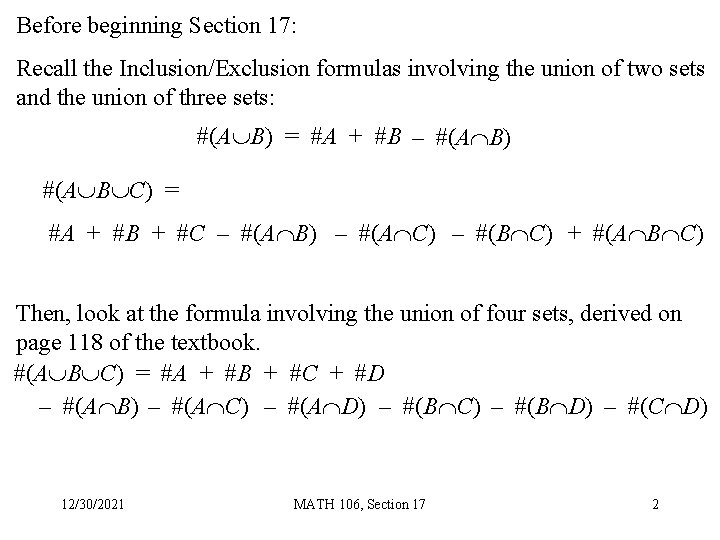
Before beginning Section 17: Recall the Inclusion/Exclusion formulas involving the union of two sets and the union of three sets: #(A B) = #A + #B – #(A B) #(A B C) = #A + #B + #C – #(A B) – #(A C) – #(B C) + #(A B C) Then, look at the formula involving the union of four sets, derived on page 118 of the textbook. #(A B C) = #A + #B + #C + #D – #(A B) – #(A C) – #(A D) – #(B C) – #(B D) – #(C D) 12/30/2021 MATH 106, Section 17 2
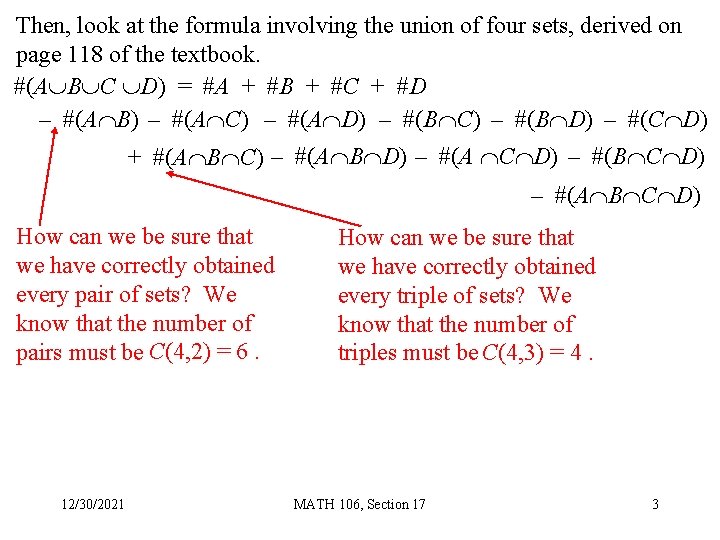
Then, look at the formula involving the union of four sets, derived on page 118 of the textbook. #(A B C D) = #A + #B + #C + #D – #(A B) – #(A C) – #(A D) – #(B C) – #(B D) – #(C D) + #(A B C) – #(A B D) – #(A C D) – #(B C D) – #(A B C D) How can we be sure that we have correctly obtained every pair of sets? We know that the number of pairs must be C(4, 2) = 6. 12/30/2021 How can we be sure that we have correctly obtained every triple of sets? We know that the number of triples must be C(4, 3) = 4. MATH 106, Section 17 3
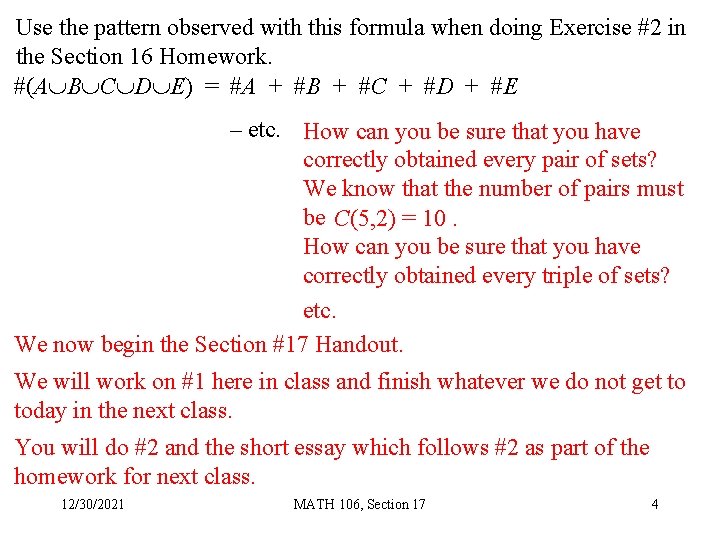
Use the pattern observed with this formula when doing Exercise #2 in the Section 16 Homework. #(A B C D E) = #A + #B + #C + #D + #E – etc. How can you be sure that you have correctly obtained every pair of sets? We know that the number of pairs must be C(5, 2) = 10. How can you be sure that you have correctly obtained every triple of sets? etc. We now begin the Section #17 Handout. We will work on #1 here in class and finish whatever we do not get to today in the next class. You will do #2 and the short essay which follows #2 as part of the homework for next class. 12/30/2021 MATH 106, Section 17 4
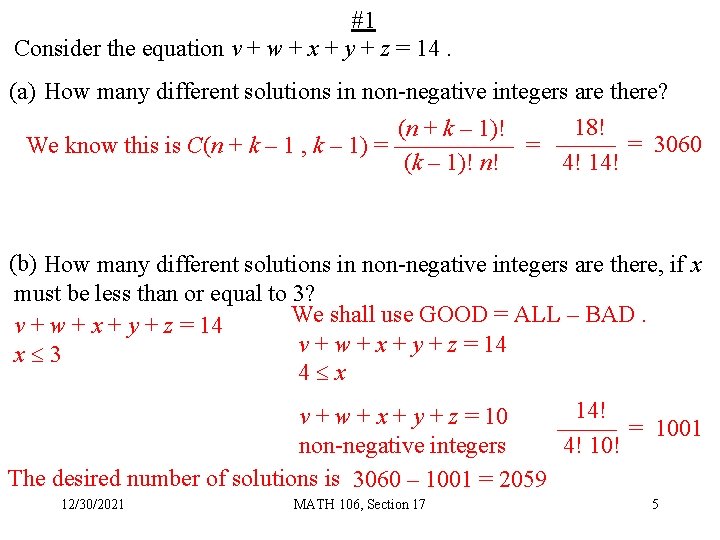
#1 Consider the equation v + w + x + y + z = 14. (a) How many different solutions in non-negative integers are there? 18! (n + k – 1)! We know this is C(n + k – 1 , k – 1) = ————— = ——– = 3060 4! 14! (k – 1)! n! (b) How many different solutions in non-negative integers are there, if x must be less than or equal to 3? We shall use GOOD = ALL – BAD. v + w + x + y + z = 14 x 3 4 x 14! v + w + x + y + z = 10 ——– = 1001 4! 10! non-negative integers The desired number of solutions is 3060 – 1001 = 2059 12/30/2021 MATH 106, Section 17 5
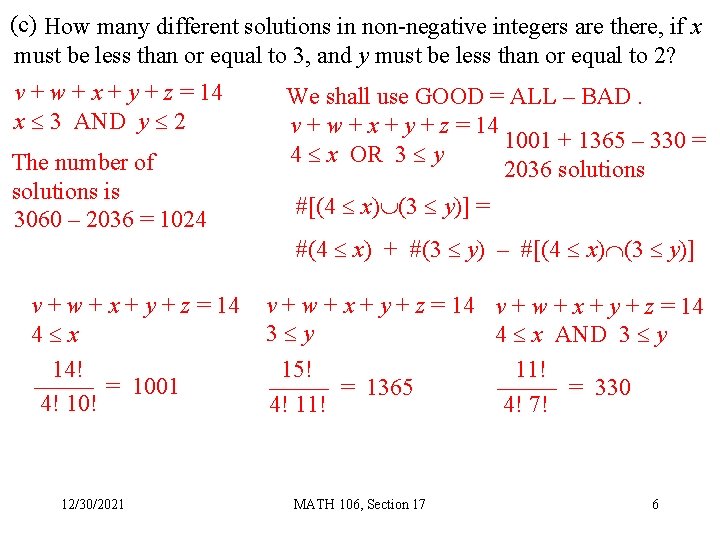
(c) How many different solutions in non-negative integers are there, if x must be less than or equal to 3, and y must be less than or equal to 2? v + w + x + y + z = 14 x 3 AND y 2 The number of solutions is 3060 – 2036 = 1024 We shall use GOOD = ALL – BAD. v + w + x + y + z = 14 1001 + 1365 – 330 = 4 x OR 3 y 2036 solutions #[(4 x) (3 y)] = #(4 x) + #(3 y) – #[(4 x) (3 y)] v + w + x + y + z = 14 4 x 14! ——– = 1001 4! 10! 12/30/2021 v + w + x + y + z = 14 3 y 4 x AND 3 y 15! 11! ——– = 1365 ——– = 330 4! 11! 4! 7! MATH 106, Section 17 6
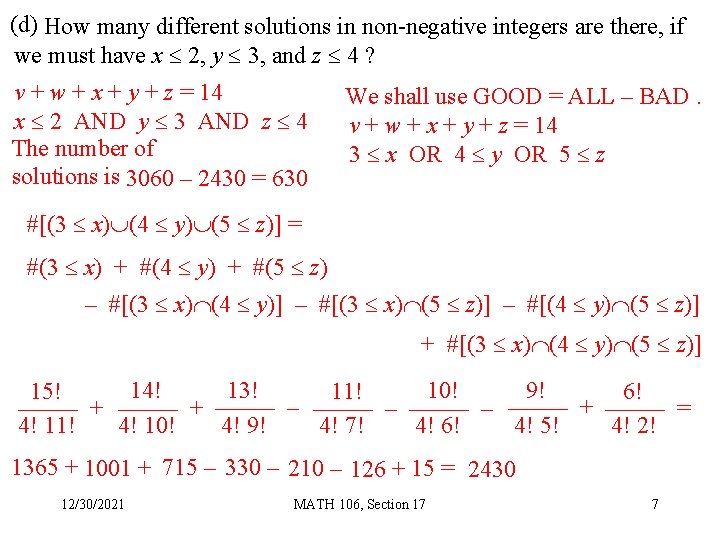
(d) How many different solutions in non-negative integers are there, if we must have x 2, y 3, and z 4 ? v + w + x + y + z = 14 x 2 AND y 3 AND z 4 The number of solutions is 3060 – 2430 = 630 We shall use GOOD = ALL – BAD. v + w + x + y + z = 14 3 x OR 4 y OR 5 z #[(3 x) (4 y) (5 z)] = #(3 x) + #(4 y) + #(5 z) – #[(3 x) (4 y)] – #[(3 x) (5 z)] – #[(4 y) (5 z)] + #[(3 x) (4 y) (5 z)] 13! 9! 14! 10! 15! 11! 6! ——– + ——– – ——– + ——– = 4! 9! 4! 5! 4! 10! 4! 6! 4! 11! 4! 7! 4! 2! 1365 + 1001 + 715 – 330 – 210 – 126 + 15 = 2430 12/30/2021 MATH 106, Section 17 7
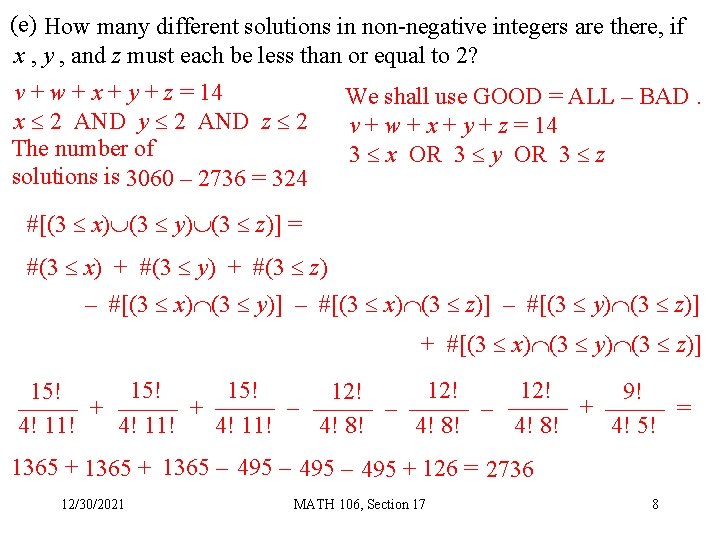
(e) How many different solutions in non-negative integers are there, if x , y , and z must each be less than or equal to 2? v + w + x + y + z = 14 x 2 AND y 2 AND z 2 The number of solutions is 3060 – 2736 = 324 We shall use GOOD = ALL – BAD. v + w + x + y + z = 14 3 x OR 3 y OR 3 z #[(3 x) (3 y) (3 z)] = #(3 x) + #(3 y) + #(3 z) – #[(3 x) (3 y)] – #[(3 x) (3 z)] – #[(3 y) (3 z)] + #[(3 x) (3 y) (3 z)] 15! 12! 9! ——– + ——– – ——– + ——– = 4! 11! 4! 8! 4! 5! 1365 + 1365 – 495 + 126 = 2736 12/30/2021 MATH 106, Section 17 8
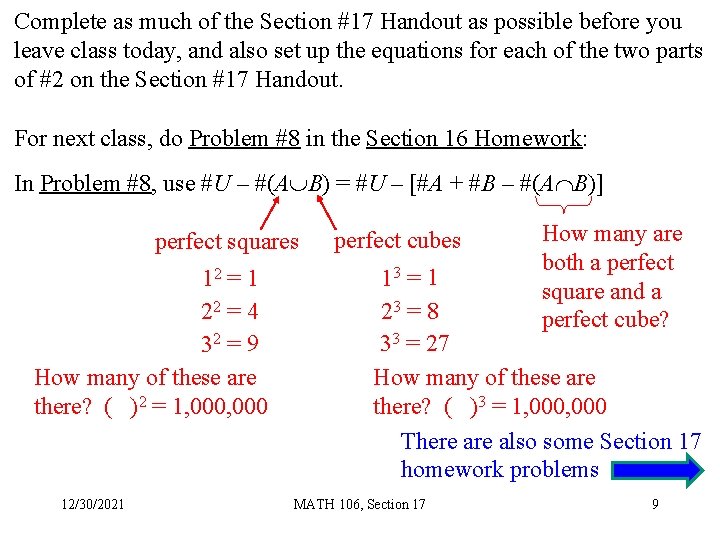
Complete as much of the Section #17 Handout as possible before you leave class today, and also set up the equations for each of the two parts of #2 on the Section #17 Handout. For next class, do Problem #8 in the Section 16 Homework: In Problem #8, use #U – #(A B) = #U – [#A + #B – #(A B)] perfect squares 12 = 1 22 = 4 32 = 9 How many of these are there? ( )2 = 1, 000 12/30/2021 perfect cubes How many are both a perfect square and a perfect cube? 13 = 1 23 = 8 33 = 27 How many of these are there? ( )3 = 1, 000 There also some Section 17 homework problems MATH 106, Section 17 9
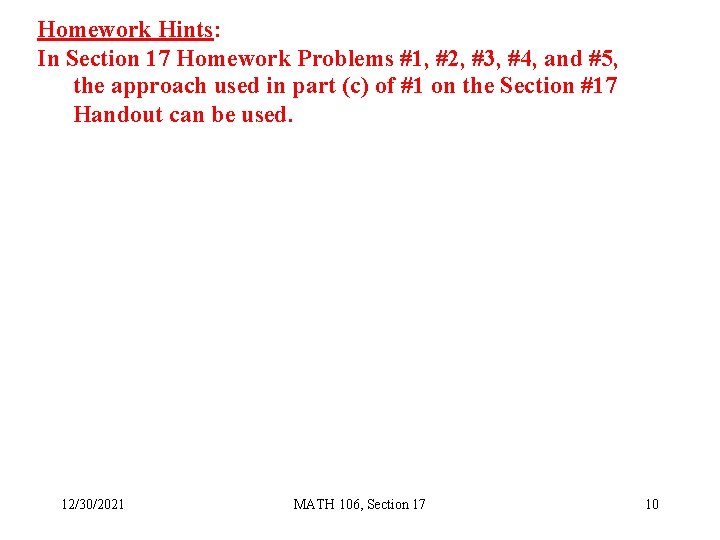
Homework Hints: In Section 17 Homework Problems #1, #2, #3, #4, and #5, the approach used in part (c) of #1 on the Section #17 Handout can be used. 12/30/2021 MATH 106, Section 17 10
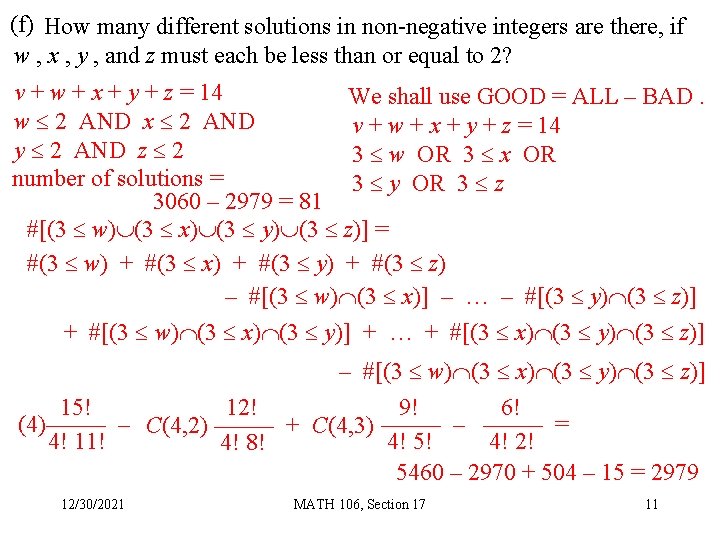
(f) How many different solutions in non-negative integers are there, if w , x , y , and z must each be less than or equal to 2? v + w + x + y + z = 14 We shall use GOOD = ALL – BAD. w 2 AND x 2 AND v + w + x + y + z = 14 y 2 AND z 2 3 w OR 3 x OR number of solutions = 3 y OR 3 z 3060 – 2979 = 81 #[(3 w) (3 x) (3 y) (3 z)] = #(3 w) + #(3 x) + #(3 y) + #(3 z) – #[(3 w) (3 x)] – … – #[(3 y) (3 z)] + #[(3 w) (3 x) (3 y)] + … + #[(3 x) (3 y) (3 z)] – #[(3 w) (3 x) (3 y) (3 z)] 15! 6! 9! 12! (4)——– – C(4, 2) ——– + C(4, 3) ——– – ——– = 4! 11! 4! 2! 4! 5! 4! 8! 5460 – 2970 + 504 – 15 = 2979 12/30/2021 MATH 106, Section 17 11
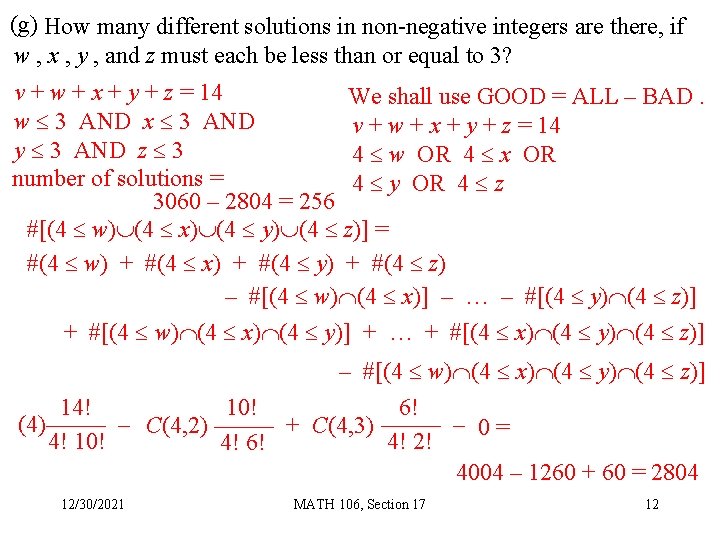
(g) How many different solutions in non-negative integers are there, if w , x , y , and z must each be less than or equal to 3? v + w + x + y + z = 14 We shall use GOOD = ALL – BAD. w 3 AND x 3 AND v + w + x + y + z = 14 y 3 AND z 3 4 w OR 4 x OR number of solutions = 4 y OR 4 z 3060 – 2804 = 256 #[(4 w) (4 x) (4 y) (4 z)] = #(4 w) + #(4 x) + #(4 y) + #(4 z) – #[(4 w) (4 x)] – … – #[(4 y) (4 z)] + #[(4 w) (4 x) (4 y)] + … + #[(4 x) (4 y) (4 z)] – #[(4 w) (4 x) (4 y) (4 z)] 14! 6! 10! (4)——– – C(4, 2) ——– + C(4, 3) ——– – 0 = 4! 10! 4! 2! 4! 6! 4004 – 1260 + 60 = 2804 12/30/2021 MATH 106, Section 17 12
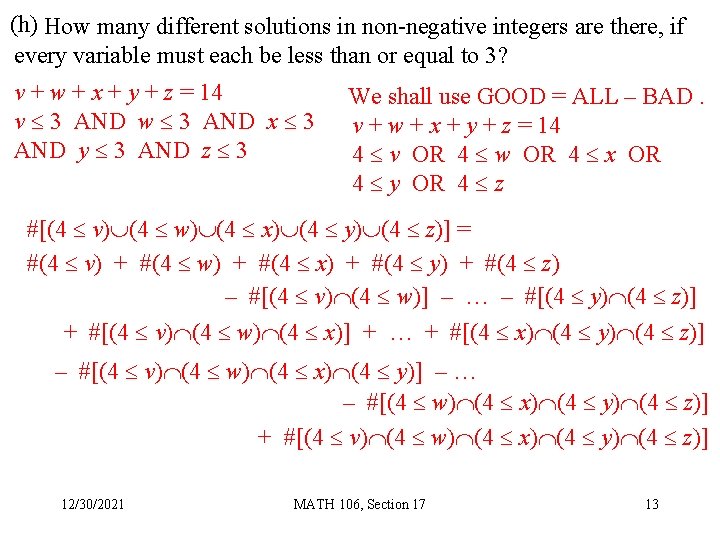
(h) How many different solutions in non-negative integers are there, if every variable must each be less than or equal to 3? v + w + x + y + z = 14 v 3 AND w 3 AND x 3 AND y 3 AND z 3 We shall use GOOD = ALL – BAD. v + w + x + y + z = 14 4 v OR 4 w OR 4 x OR 4 y OR 4 z #[(4 v) (4 w) (4 x) (4 y) (4 z)] = #(4 v) + #(4 w) + #(4 x) + #(4 y) + #(4 z) – #[(4 v) (4 w)] – … – #[(4 y) (4 z)] + #[(4 v) (4 w) (4 x)] + … + #[(4 x) (4 y) (4 z)] – #[(4 v) (4 w) (4 x) (4 y)] – … – #[(4 w) (4 x) (4 y) (4 z)] + #[(4 v) (4 w) (4 x) (4 y) (4 z)] 12/30/2021 MATH 106, Section 17 13
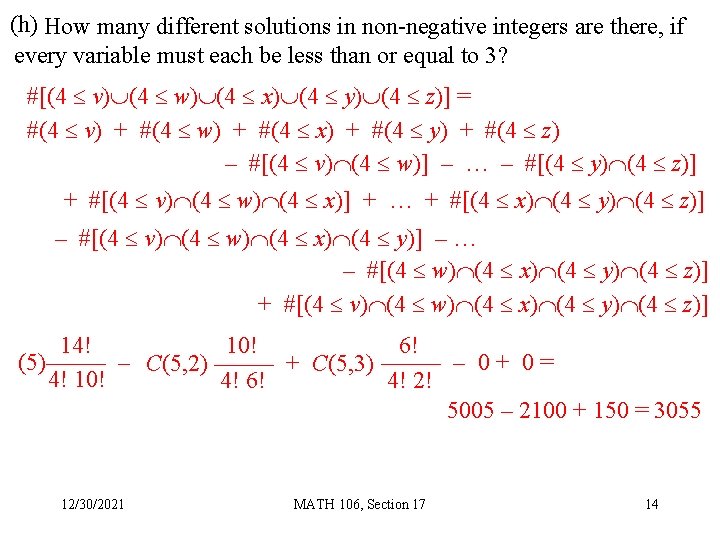
(h) How many different solutions in non-negative integers are there, if every variable must each be less than or equal to 3? #[(4 v) (4 w) (4 x) (4 y) (4 z)] = #(4 v) + #(4 w) + #(4 x) + #(4 y) + #(4 z) – #[(4 v) (4 w)] – … – #[(4 y) (4 z)] + #[(4 v) (4 w) (4 x)] + … + #[(4 x) (4 y) (4 z)] – #[(4 v) (4 w) (4 x) (4 y)] – … – #[(4 w) (4 x) (4 y) (4 z)] + #[(4 v) (4 w) (4 x) (4 y) (4 z)] 14! 6! 10! (5)——– – C(5, 2) ——– + C(5, 3) ——– – 0 + 0 = 4! 10! 4! 2! 4! 6! 5005 – 2100 + 150 = 3055 12/30/2021 MATH 106, Section 17 14
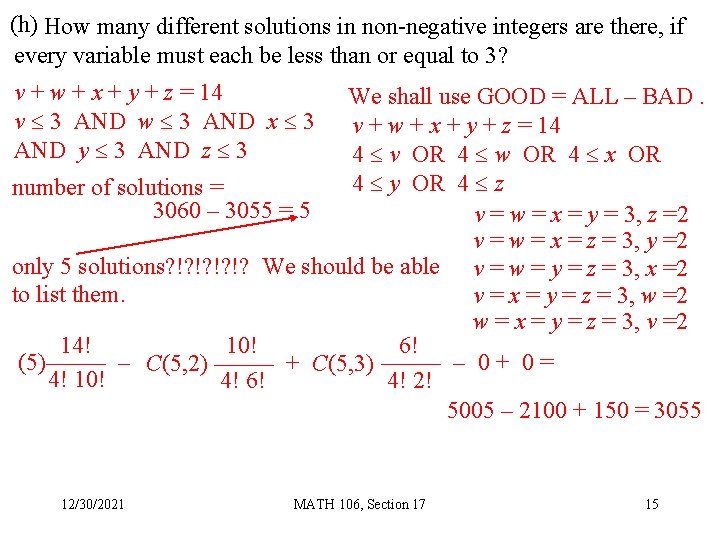
(h) How many different solutions in non-negative integers are there, if every variable must each be less than or equal to 3? v + w + x + y + z = 14 v 3 AND w 3 AND x 3 AND y 3 AND z 3 We shall use GOOD = ALL – BAD. v + w + x + y + z = 14 4 v OR 4 w OR 4 x OR 4 y OR 4 z number of solutions = 3060 – 3055 = 5 v = w = x = y = 3, z =2 v = w = x = z = 3, y =2 only 5 solutions? !? !? We should be able v = w = y = z = 3, x =2 to list them. v = x = y = z = 3, w =2 w = x = y = z = 3, v =2 14! 6! 10! (5)——– – C(5, 2) ——– + C(5, 3) ——– – 0 + 0 = 4! 10! 4! 2! 4! 6! 5005 – 2100 + 150 = 3055 12/30/2021 MATH 106, Section 17 15
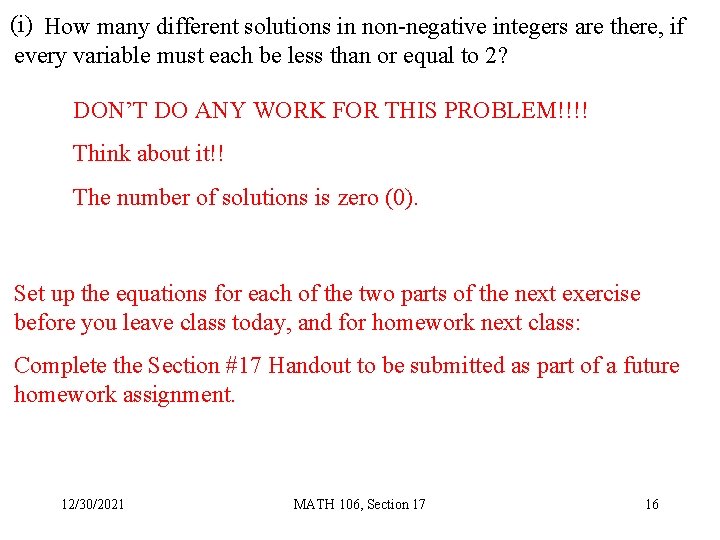
(i) How many different solutions in non-negative integers are there, if every variable must each be less than or equal to 2? DON’T DO ANY WORK FOR THIS PROBLEM!!!! Think about it!! The number of solutions is zero (0). Set up the equations for each of the two parts of the next exercise before you leave class today, and for homework next class: Complete the Section #17 Handout to be submitted as part of a future homework assignment. 12/30/2021 MATH 106, Section 17 16
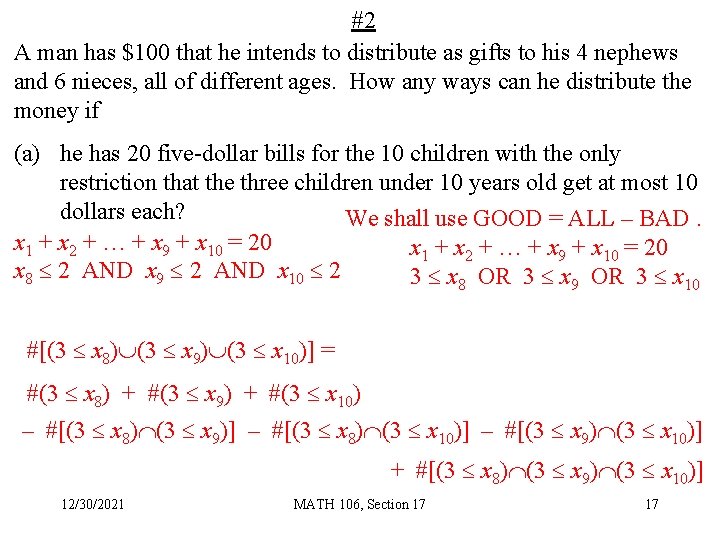
#2 A man has $100 that he intends to distribute as gifts to his 4 nephews and 6 nieces, all of different ages. How any ways can he distribute the money if (a) he has 20 five-dollar bills for the 10 children with the only restriction that the three children under 10 years old get at most 10 dollars each? We shall use GOOD = ALL – BAD. x 1 + x 2 + … + x 9 + x 10 = 20 x 8 2 AND x 9 2 AND x 10 2 3 x 8 OR 3 x 9 OR 3 x 10 #[(3 x 8) (3 x 9) (3 x 10)] = #(3 x 8) + #(3 x 9) + #(3 x 10) – #[(3 x 8) (3 x 9)] – #[(3 x 8) (3 x 10)] – #[(3 x 9) (3 x 10)] + #[(3 x 8) (3 x 9) (3 x 10)] 12/30/2021 MATH 106, Section 17 17
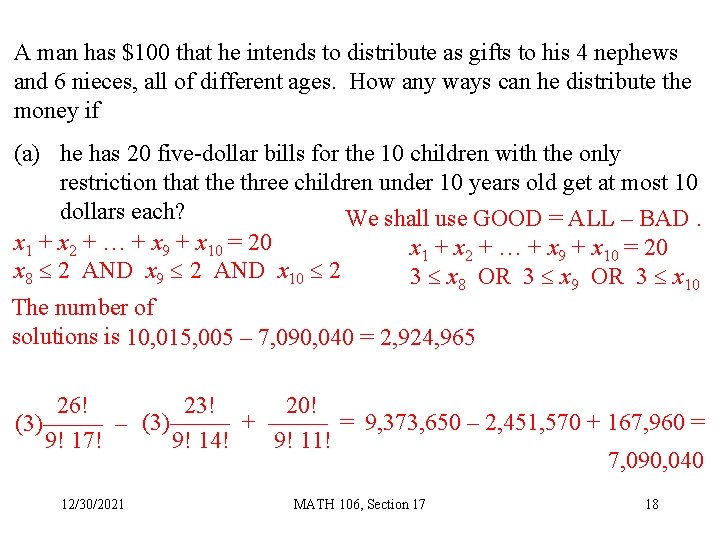
A man has $100 that he intends to distribute as gifts to his 4 nephews and 6 nieces, all of different ages. How any ways can he distribute the money if (a) he has 20 five-dollar bills for the 10 children with the only restriction that the three children under 10 years old get at most 10 dollars each? We shall use GOOD = ALL – BAD. x 1 + x 2 + … + x 9 + x 10 = 20 x 8 2 AND x 9 2 AND x 10 2 3 x 8 OR 3 x 9 OR 3 x 10 The number of solutions is 10, 015, 005 – 7, 090, 040 = 2, 924, 965 23! 20! 26! (3)——– – (3)——– + ——– = 9, 373, 650 – 2, 451, 570 + 167, 960 = 9! 14! 9! 11! 9! 17! 7, 090, 040 12/30/2021 MATH 106, Section 17 18
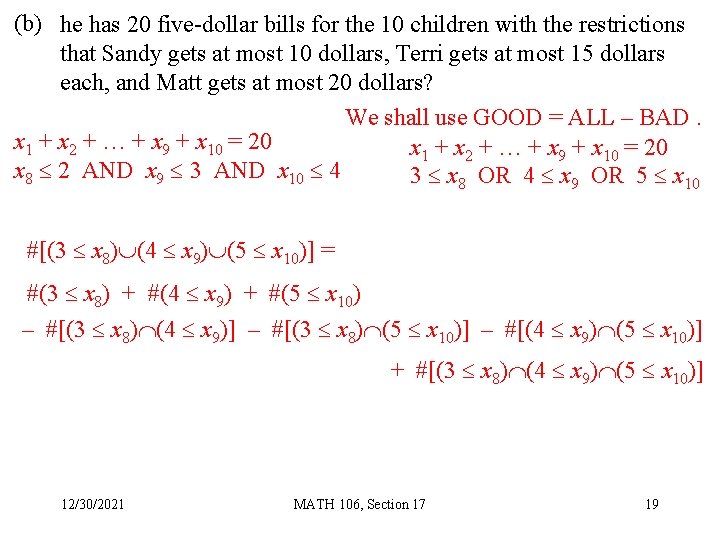
(b) he has 20 five-dollar bills for the 10 children with the restrictions that Sandy gets at most 10 dollars, Terri gets at most 15 dollars each, and Matt gets at most 20 dollars? We shall use GOOD = ALL – BAD. x 1 + x 2 + … + x 9 + x 10 = 20 x 8 2 AND x 9 3 AND x 10 4 3 x 8 OR 4 x 9 OR 5 x 10 #[(3 x 8) (4 x 9) (5 x 10)] = #(3 x 8) + #(4 x 9) + #(5 x 10) – #[(3 x 8) (4 x 9)] – #[(3 x 8) (5 x 10)] – #[(4 x 9) (5 x 10)] + #[(3 x 8) (4 x 9) (5 x 10)] 12/30/2021 MATH 106, Section 17 19
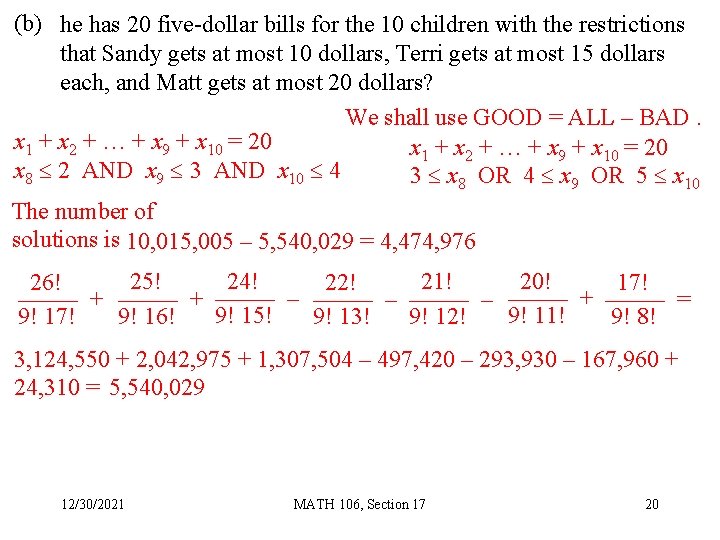
(b) he has 20 five-dollar bills for the 10 children with the restrictions that Sandy gets at most 10 dollars, Terri gets at most 15 dollars each, and Matt gets at most 20 dollars? We shall use GOOD = ALL – BAD. x 1 + x 2 + … + x 9 + x 10 = 20 x 8 2 AND x 9 3 AND x 10 4 3 x 8 OR 4 x 9 OR 5 x 10 The number of solutions is 10, 015, 005 – 5, 540, 029 = 4, 474, 976 24! 20! 25! 21! 26! 22! 17! ——– + ——– – ——– + ——– = 9! 15! 9! 11! 9! 16! 9! 12! 9! 17! 9! 13! 9! 8! 3, 124, 550 + 2, 042, 975 + 1, 307, 504 – 497, 420 – 293, 930 – 167, 960 + 24, 310 = 5, 540, 029 12/30/2021 MATH 106, Section 17 20
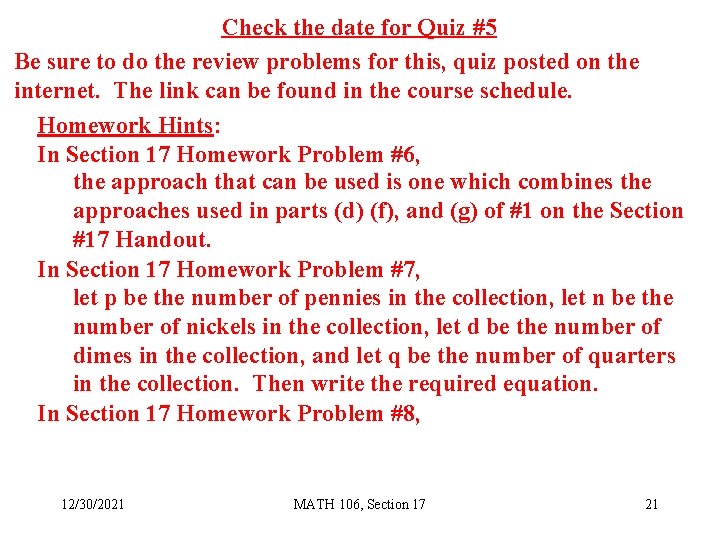
Check the date for Quiz #5 Be sure to do the review problems for this, quiz posted on the internet. The link can be found in the course schedule. Homework Hints: In Section 17 Homework Problem #6, the approach that can be used is one which combines the approaches used in parts (d) (f), and (g) of #1 on the Section #17 Handout. In Section 17 Homework Problem #7, let p be the number of pennies in the collection, let n be the number of nickels in the collection, let d be the number of dimes in the collection, and let q be the number of quarters in the collection. Then write the required equation. In Section 17 Homework Problem #8, 12/30/2021 MATH 106, Section 17 21
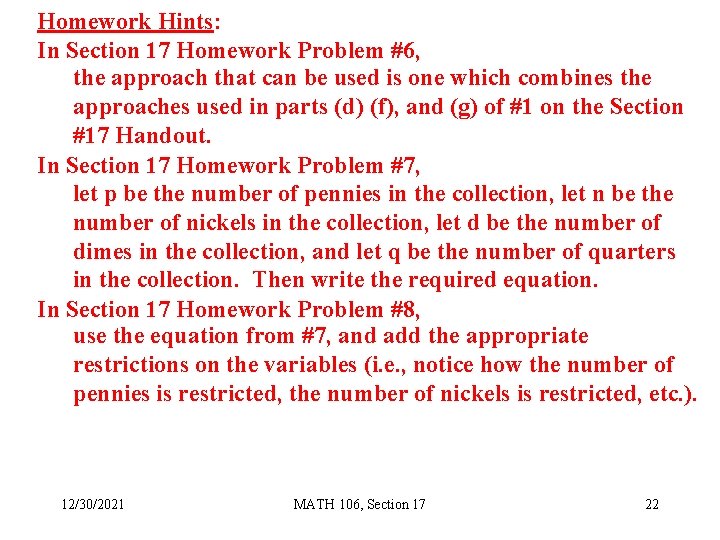
Homework Hints: In Section 17 Homework Problem #6, the approach that can be used is one which combines the approaches used in parts (d) (f), and (g) of #1 on the Section #17 Handout. In Section 17 Homework Problem #7, let p be the number of pennies in the collection, let n be the number of nickels in the collection, let d be the number of dimes in the collection, and let q be the number of quarters in the collection. Then write the required equation. In Section 17 Homework Problem #8, use the equation from #7, and add the appropriate restrictions on the variables (i. e. , notice how the number of pennies is restricted, the number of nickels is restricted, etc. ). 12/30/2021 MATH 106, Section 17 22