
Section 17 2 Line Integrals LINE INTEGRALS Let



- Slides: 24
Section 17. 2 Line Integrals
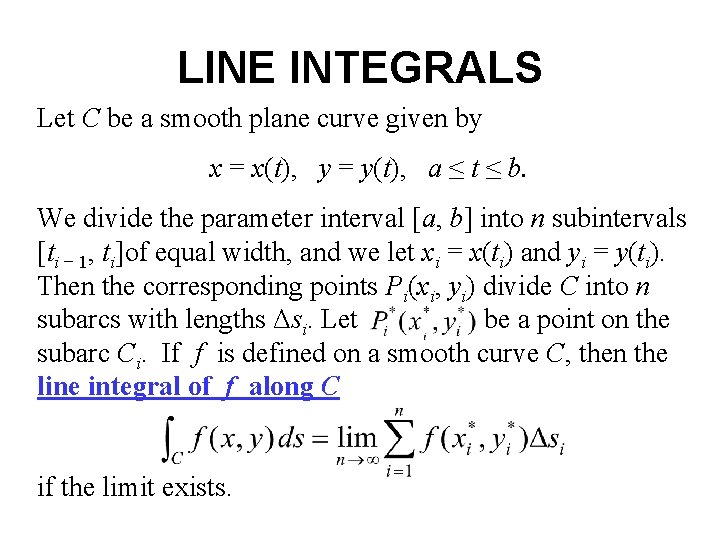
LINE INTEGRALS Let C be a smooth plane curve given by x = x(t), y = y(t), a ≤ t ≤ b. We divide the parameter interval [a, b] into n subintervals [ti − 1, ti]of equal width, and we let xi = x(ti) and yi = y(ti). Then the corresponding points Pi(xi, yi) divide C into n subarcs with lengths Δsi. Let be a point on the subarc Ci. If f is defined on a smooth curve C, then the line integral of f along C if the limit exists.
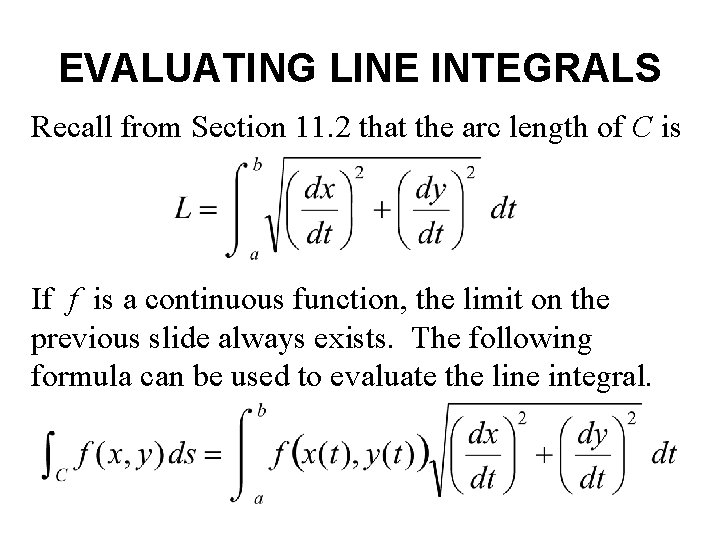
EVALUATING LINE INTEGRALS Recall from Section 11. 2 that the arc length of C is If f is a continuous function, the limit on the previous slide always exists. The following formula can be used to evaluate the line integral.
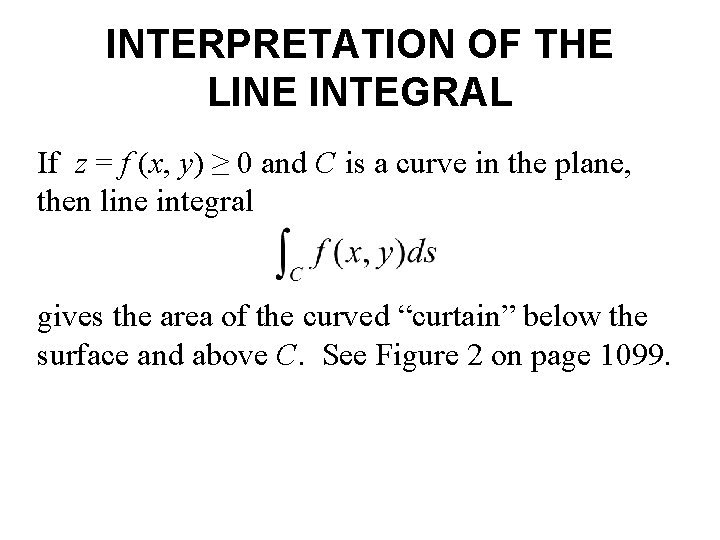
INTERPRETATION OF THE LINE INTEGRAL If z = f (x, y) ≥ 0 and C is a curve in the plane, then line integral gives the area of the curved “curtain” below the surface and above C. See Figure 2 on page 1099.
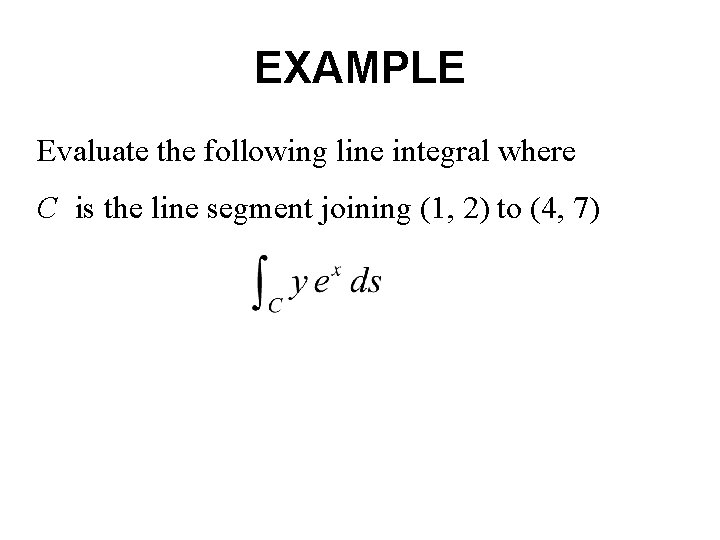
EXAMPLE Evaluate the following line integral where C is the line segment joining (1, 2) to (4, 7)
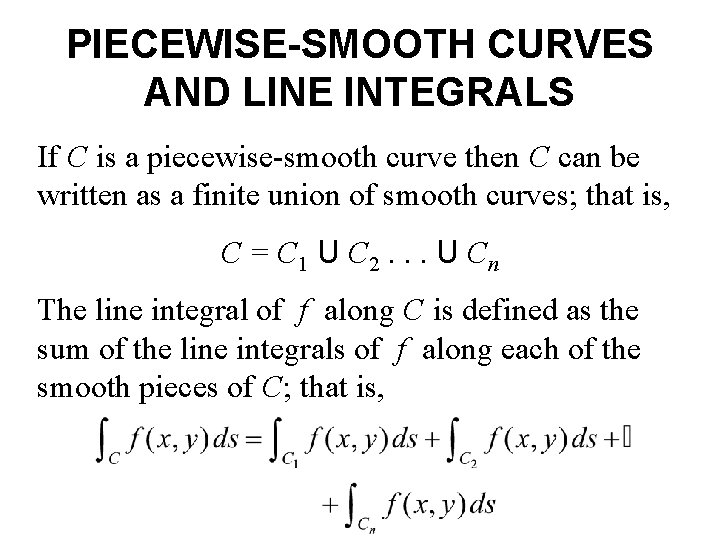
PIECEWISE-SMOOTH CURVES AND LINE INTEGRALS If C is a piecewise-smooth curve then C can be written as a finite union of smooth curves; that is, C = C 1 U C 2. . . U Cn The line integral of f along C is defined as the sum of the line integrals of f along each of the smooth pieces of C; that is,
EXAMPLE Evaluate where C is the piecewise- smooth curve formed by the boundary region bounded by y = x and y = x 2.
AN INTERPRETATION OF THE LINE INTEGRAL Suppose that ρ(x, y) represents the density of a thin wire that is shaped like the plane curve C. The mass of the wire is given by The center of mass of the wire is given by
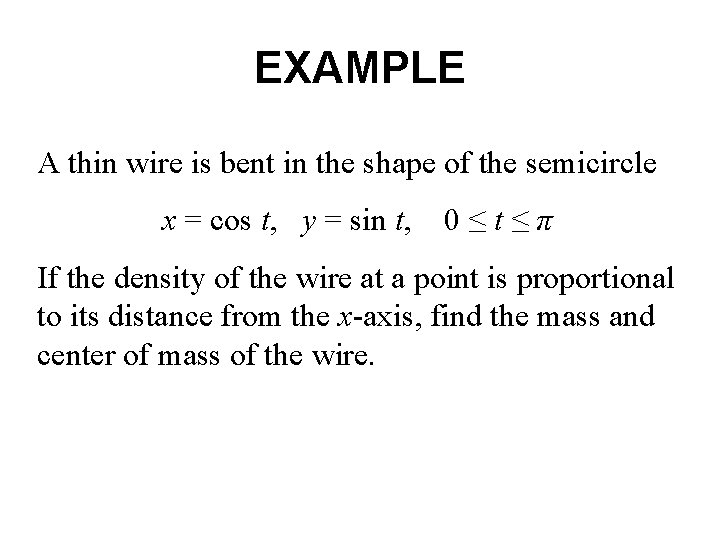
EXAMPLE A thin wire is bent in the shape of the semicircle x = cos t, y = sin t, 0≤t≤π If the density of the wire at a point is proportional to its distance from the x-axis, find the mass and center of mass of the wire.
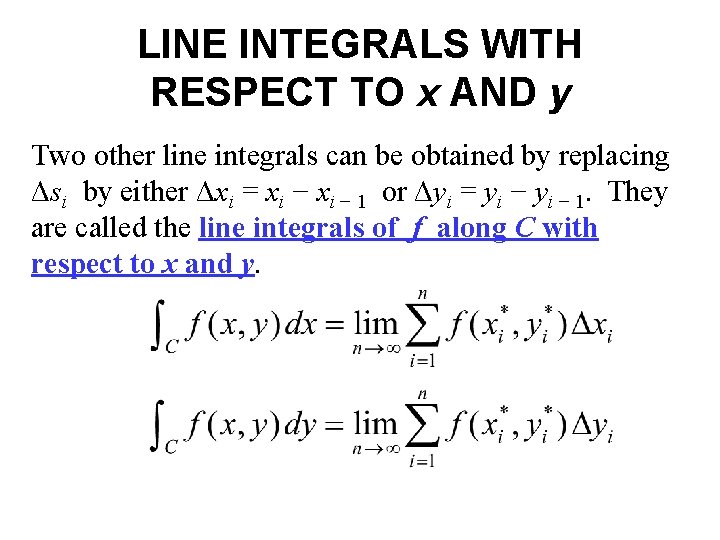
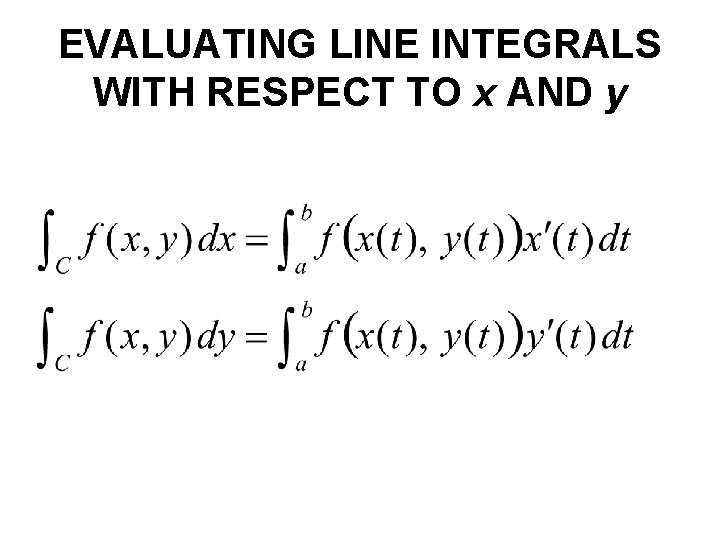
LINE INTEGRALS WITH RESPECT TO x AND y Two other line integrals can be obtained by replacing Δsi by either Δxi = xi − 1 or Δyi = yi − 1. They are called the line integrals of f along C with respect to x and y.
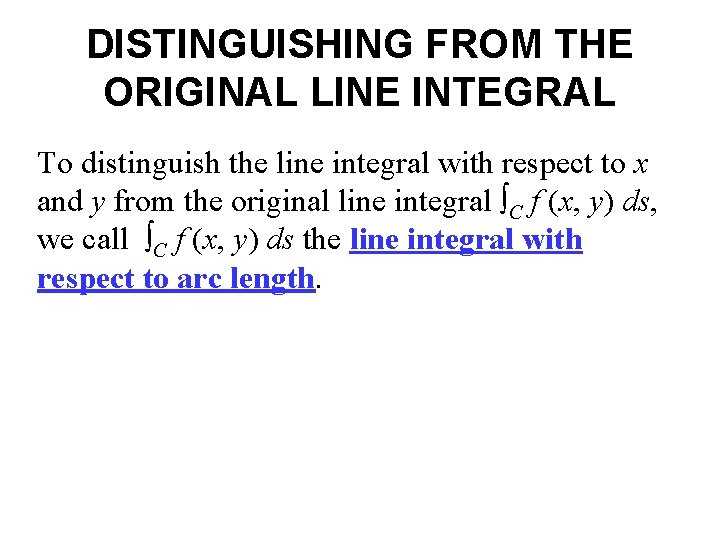
DISTINGUISHING FROM THE ORIGINAL LINE INTEGRAL To distinguish the line integral with respect to x and y from the original line integral ∫C f (x, y) ds, we call ∫C f (x, y) ds the line integral with respect to arc length.
EVALUATING LINE INTEGRALS WITH RESPECT TO x AND y
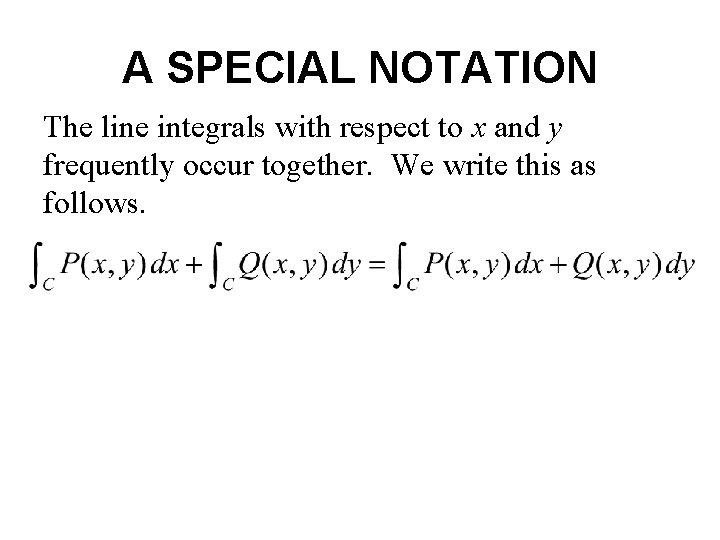
A SPECIAL NOTATION The line integrals with respect to x and y frequently occur together. We write this as follows.
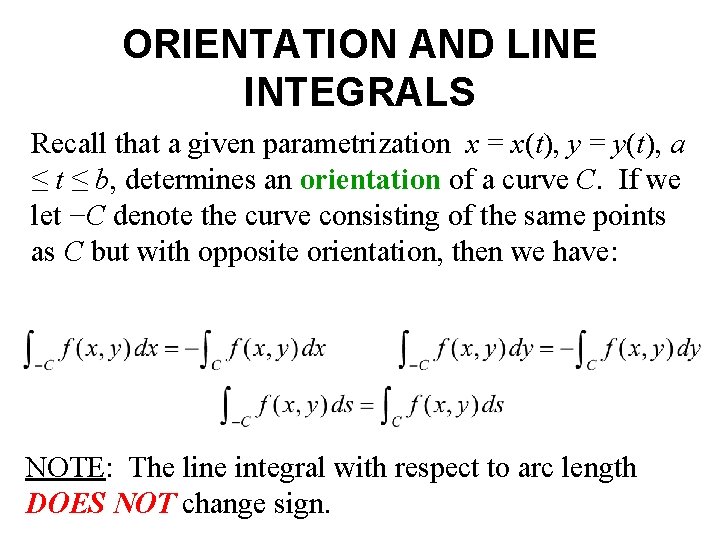
ORIENTATION AND LINE INTEGRALS Recall that a given parametrization x = x(t), y = y(t), a ≤ t ≤ b, determines an orientation of a curve C. If we let −C denote the curve consisting of the same points as C but with opposite orientation, then we have: NOTE: The line integral with respect to arc length DOES NOT change sign.
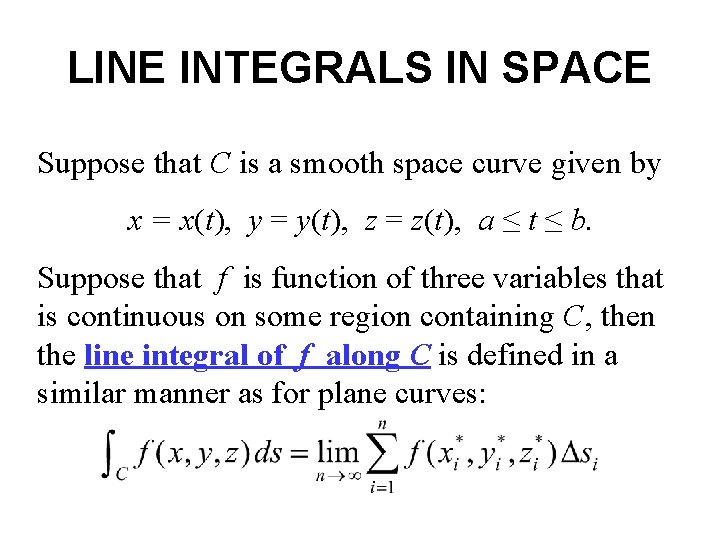
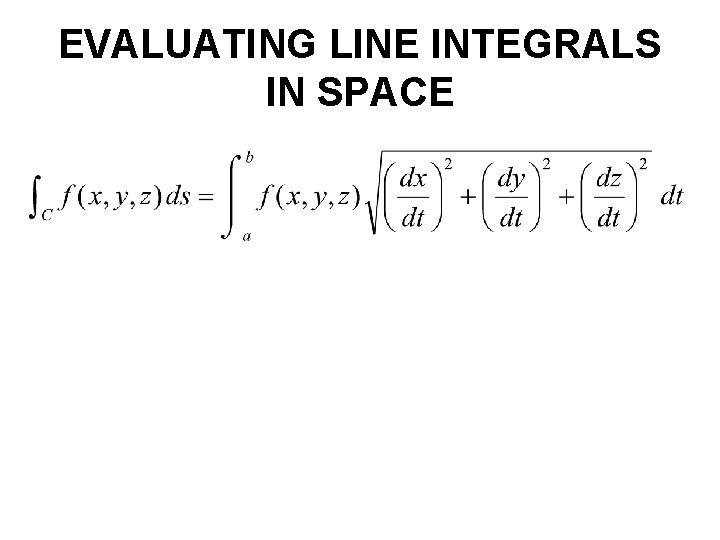
LINE INTEGRALS IN SPACE Suppose that C is a smooth space curve given by x = x(t), y = y(t), z = z(t), a ≤ t ≤ b. Suppose that f is function of three variables that is continuous on some region containing C, then the line integral of f along C is defined in a similar manner as for plane curves:
EVALUATING LINE INTEGRALS IN SPACE
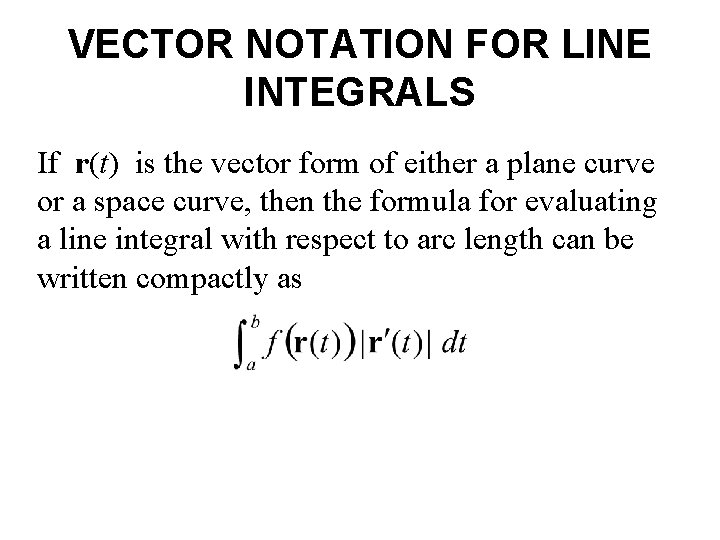
VECTOR NOTATION FOR LINE INTEGRALS If r(t) is the vector form of either a plane curve or a space curve, then the formula for evaluating a line integral with respect to arc length can be written compactly as
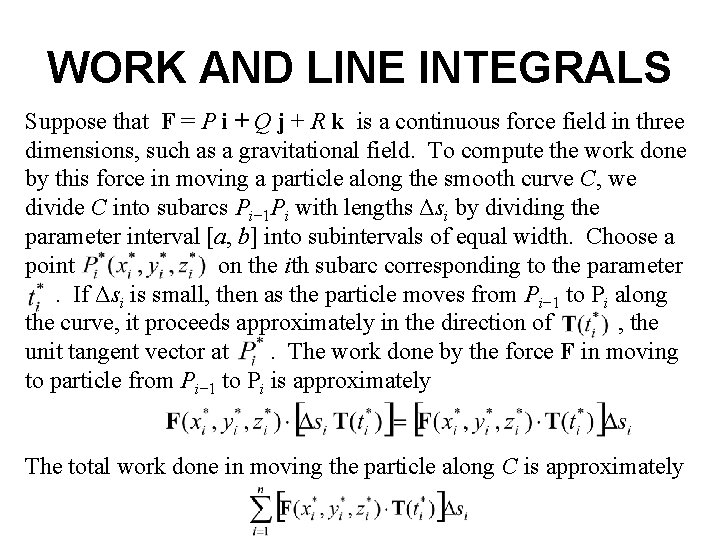
WORK AND LINE INTEGRALS Suppose that F = P i + Q j + R k is a continuous force field in three dimensions, such as a gravitational field. To compute the work done by this force in moving a particle along the smooth curve C, we divide C into subarcs Pi− 1 Pi with lengths Δsi by dividing the parameter interval [a, b] into subintervals of equal width. Choose a point on the ith subarc corresponding to the parameter. If Δsi is small, then as the particle moves from Pi− 1 to Pi along the curve, it proceeds approximately in the direction of , the unit tangent vector at. The work done by the force F in moving to particle from Pi− 1 to Pi is approximately The total work done in moving the particle along C is approximately
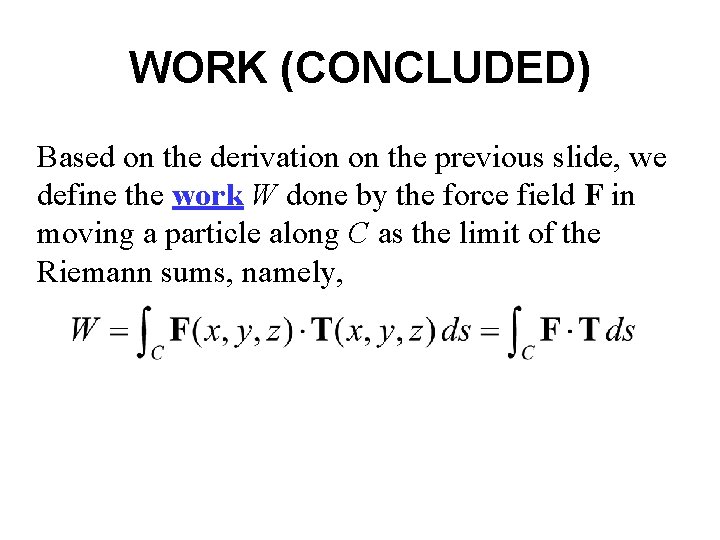
WORK (CONCLUDED) Based on the derivation on the previous slide, we define the work W done by the force field F in moving a particle along C as the limit of the Riemann sums, namely,
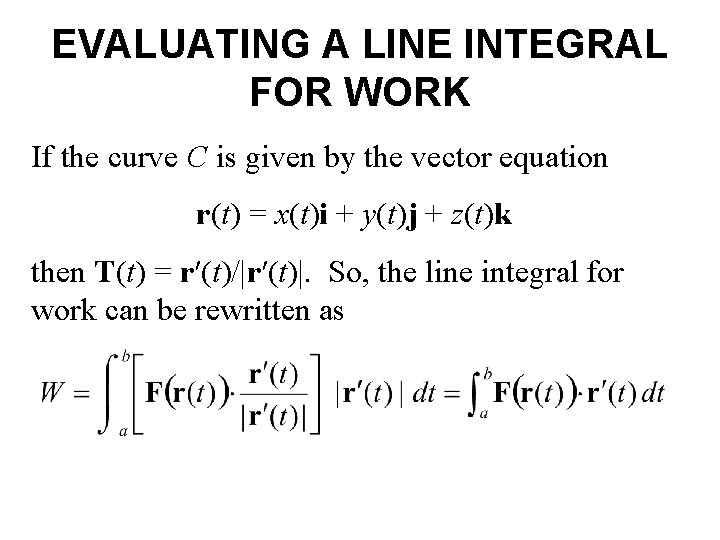
EVALUATING A LINE INTEGRAL FOR WORK If the curve C is given by the vector equation r(t) = x(t)i + y(t)j + z(t)k then T(t) = r′(t)/|r′(t)|. So, the line integral for work can be rewritten as
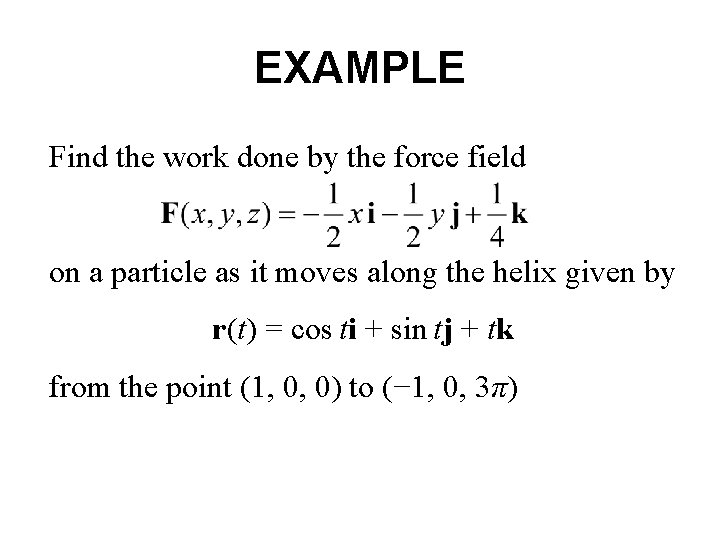
EXAMPLE Find the work done by the force field on a particle as it moves along the helix given by r(t) = cos ti + sin tj + tk from the point (1, 0, 0) to (− 1, 0, 3π)
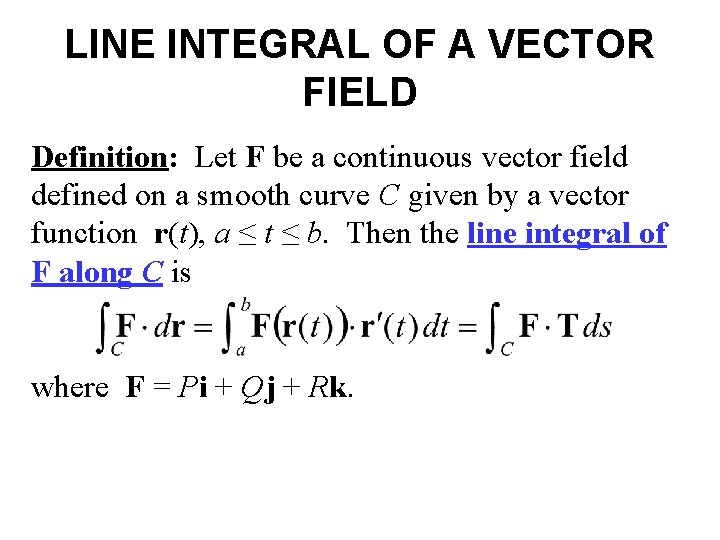
LINE INTEGRAL OF A VECTOR FIELD Definition: Let F be a continuous vector field defined on a smooth curve C given by a vector function r(t), a ≤ t ≤ b. Then the line integral of F along C is where F = Pi + Qj + Rk.
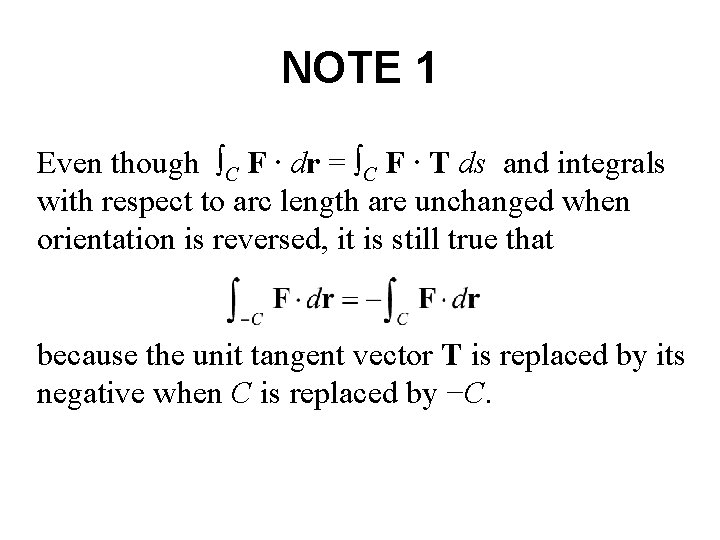
NOTE 1 Even though ∫C F ∙ dr = ∫C F ∙ T ds and integrals with respect to arc length are unchanged when orientation is reversed, it is still true that because the unit tangent vector T is replaced by its negative when C is replaced by −C.
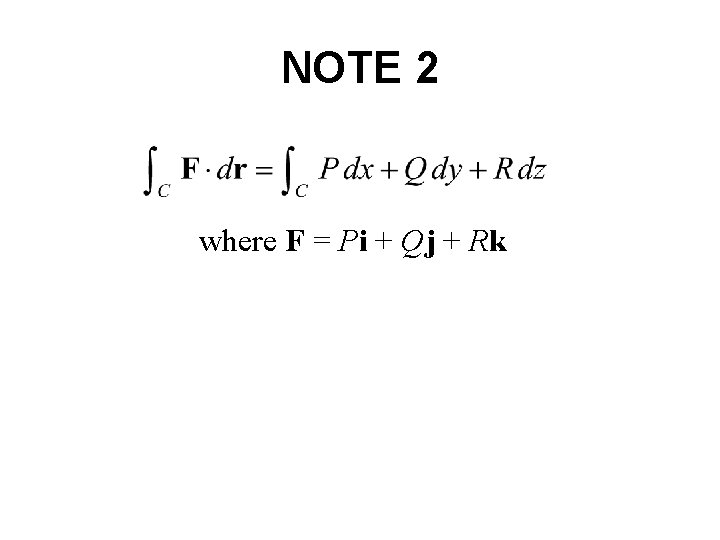
NOTE 2 where F = Pi + Qj + Rk