
Section 17 1 Reaction Rates and Equilibrium Objectives
Section 17. 1 Reaction Rates and Equilibrium Objectives 1. To understand the collision model of chemical reactions 2. To understand activation energy 3. To understand how a catalyst speeds up a chemical reaction 4. To explore reactions with reactants or products in different phases 5. To learn how equilibrium is established 6. To learn about the characteristics of chemical equilibrium
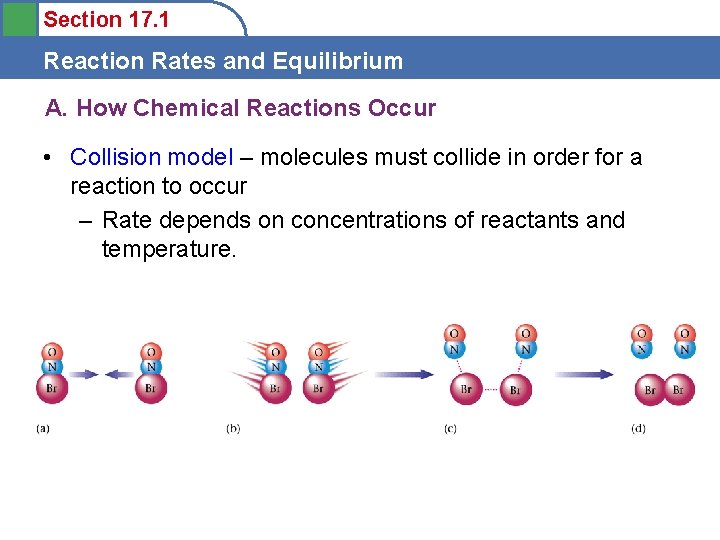
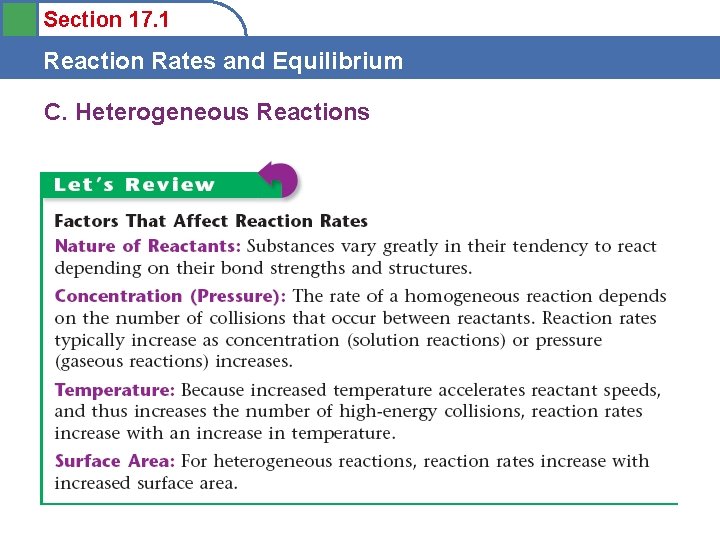
Section 17. 1 Reaction Rates and Equilibrium A. How Chemical Reactions Occur • Collision model – molecules must collide in order for a reaction to occur – Rate depends on concentrations of reactants and temperature.
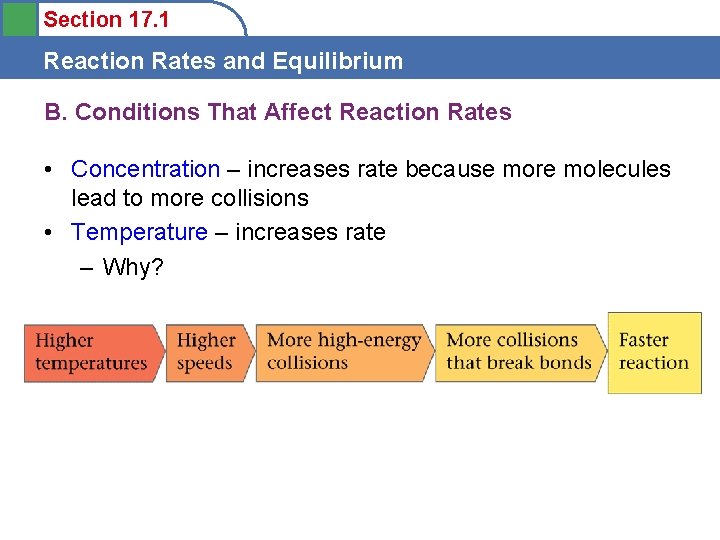
Section 17. 1 Reaction Rates and Equilibrium B. Conditions That Affect Reaction Rates • Concentration – increases rate because more molecules lead to more collisions • Temperature – increases rate – Why?
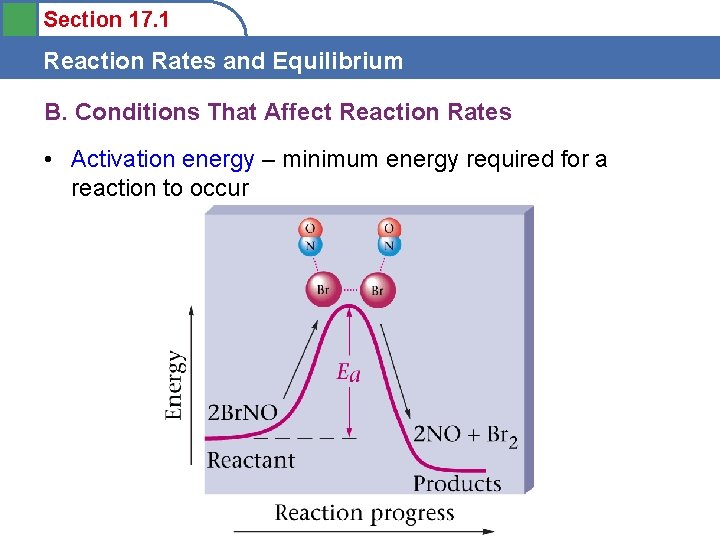
Section 17. 1 Reaction Rates and Equilibrium B. Conditions That Affect Reaction Rates • Activation energy – minimum energy required for a reaction to occur
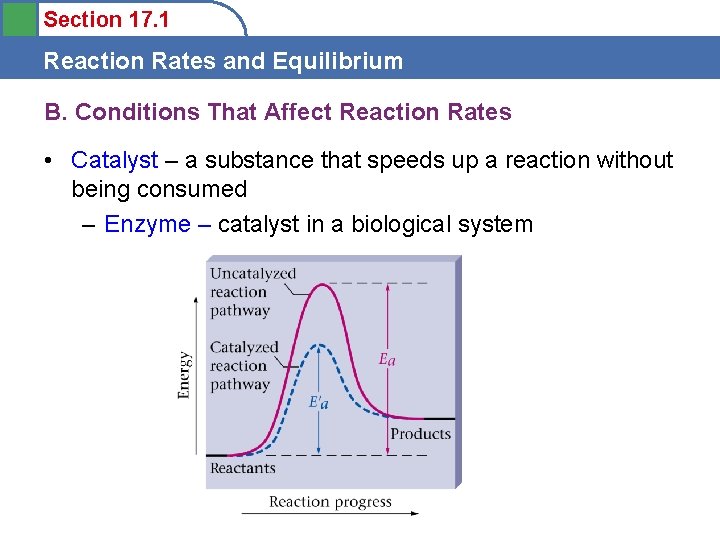
Section 17. 1 Reaction Rates and Equilibrium B. Conditions That Affect Reaction Rates • Catalyst – a substance that speeds up a reaction without being consumed – Enzyme – catalyst in a biological system

Section 17. 1 Reaction Rates and Equilibrium C. Heterogeneous Reactions • Homogeneous reaction – all reactants and products are in one phase – Gas – Solution • Heterogeneous reaction – reactants in two phases
Section 17. 1 Reaction Rates and Equilibrium C. Heterogeneous Reactions

Section 17. 1 Reaction Rates and Equilibrium D. The Equilibrium Condition • Equilibrium – the exact balancing of two processes, one of which is the opposite of the other
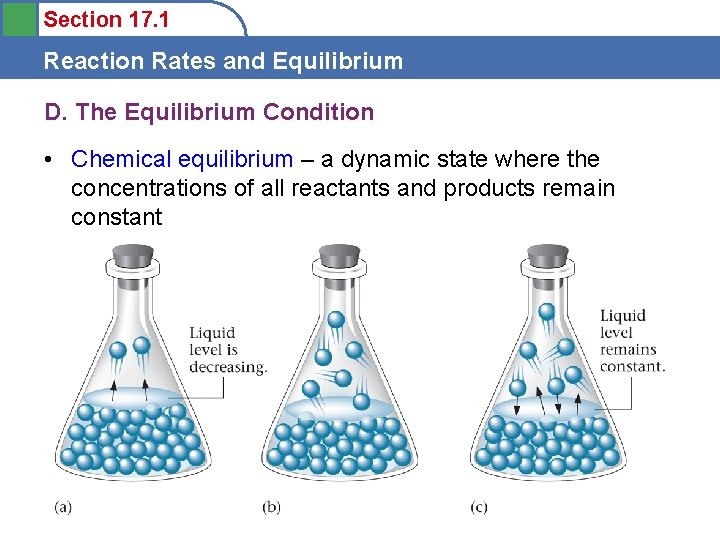
Section 17. 1 Reaction Rates and Equilibrium D. The Equilibrium Condition • Chemical equilibrium – a dynamic state where the concentrations of all reactants and products remain constant
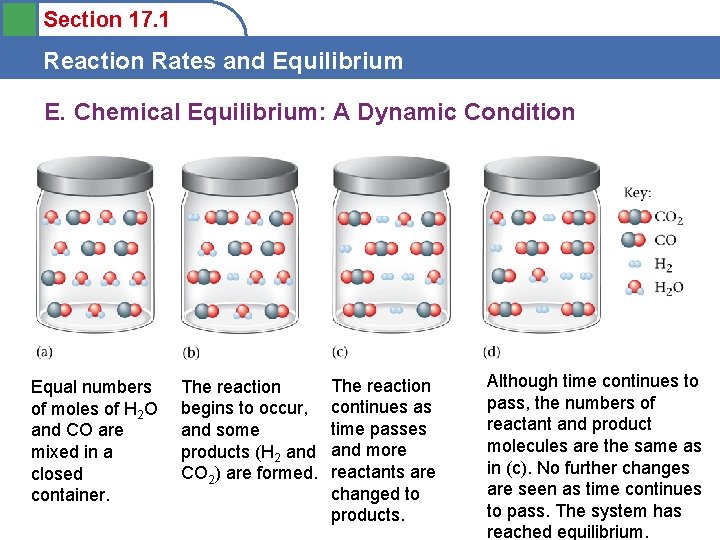
Section 17. 1 Reaction Rates and Equilibrium E. Chemical Equilibrium: A Dynamic Condition Equal numbers of moles of H 2 O and CO are mixed in a closed container. The reaction begins to occur, and some products (H 2 and CO 2) are formed. The reaction continues as time passes and more reactants are changed to products. Although time continues to pass, the numbers of reactant and product molecules are the same as in (c). No further changes are seen as time continues to pass. The system has reached equilibrium.

Section 17. 1 Reaction Rates and Equilibrium E. Chemical Equilibrium: A Dynamic Condition • Why does equilibrium occur?
- Slides: 11