Section 16 2 Proving Figures are Similar Using


- Slides: 16
Section 16. 2: Proving Figures are Similar Using Transformations 1
Objective: By following instructions, students will be able to: 1. Explain how similarity transformations can be used to show two figures are similar. 2
A similarity transformation is a transformation in which an image has the same shape as its pre-image. Similarity transformations can include: 1. Reflections 2. Rotations 3. Translations 4. Dilations 3
Reflection (Flip) 4
Translation (Slide) 5
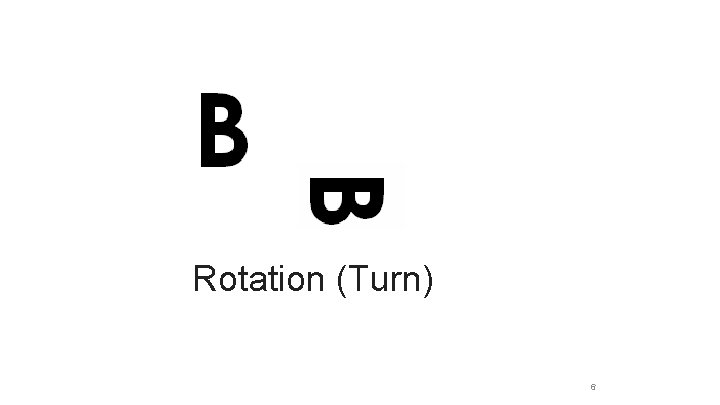
Rotation (Turn) 6
Dilation 7
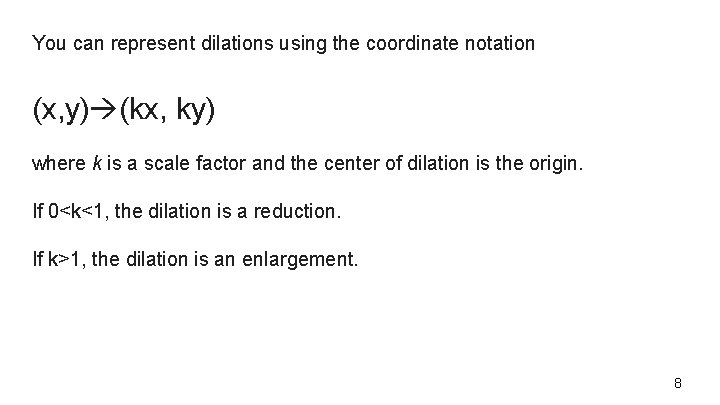
You can represent dilations using the coordinate notation (x, y) (kx, ky) where k is a scale factor and the center of dilation is the origin. If 0<k<1, the dilation is a reduction. If k>1, the dilation is an enlargement. 8
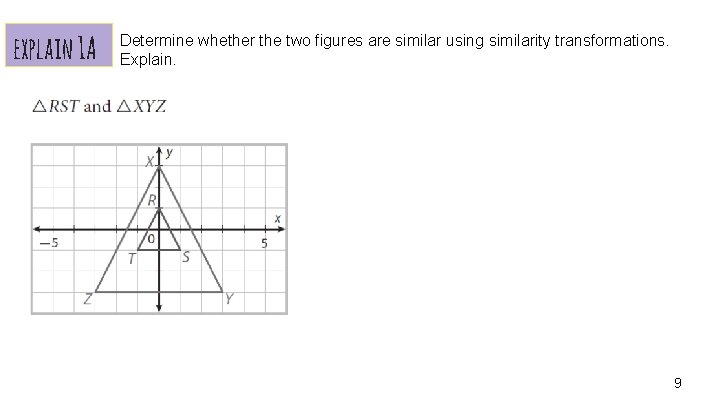
explain 1 A Determine whether the two figures are similar using similarity transformations. Explain. 9
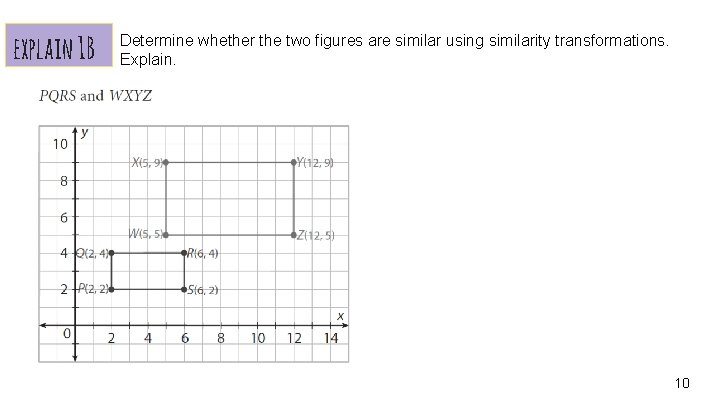
explain 1 B Determine whether the two figures are similar using similarity transformations. Explain. 10
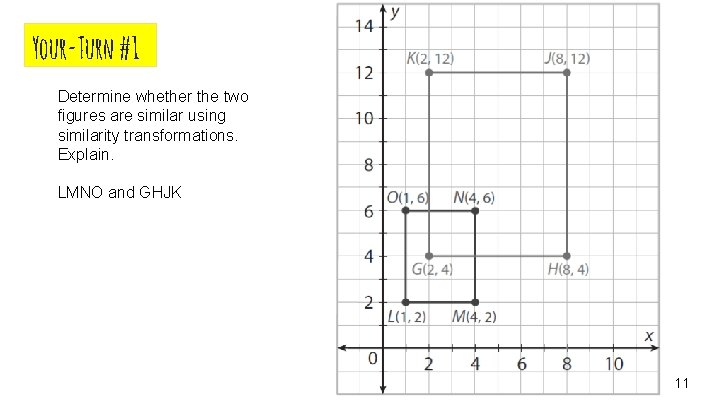
Your-Turn #1 Determine whether the two figures are similar using similarity transformations. Explain. LMNO and GHJK 11
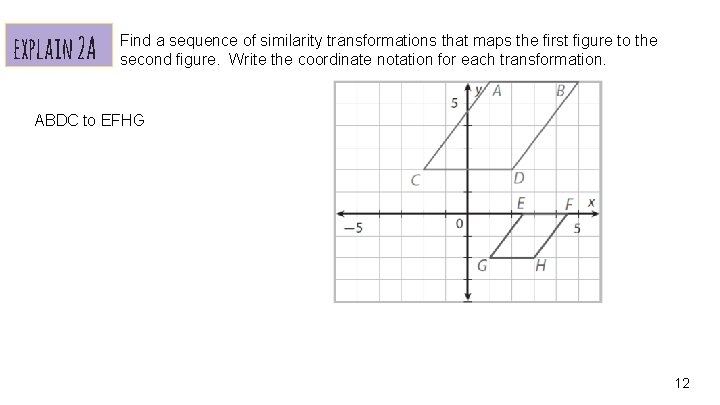
explain 2 A Find a sequence of similarity transformations that maps the first figure to the second figure. Write the coordinate notation for each transformation. ABDC to EFHG 12
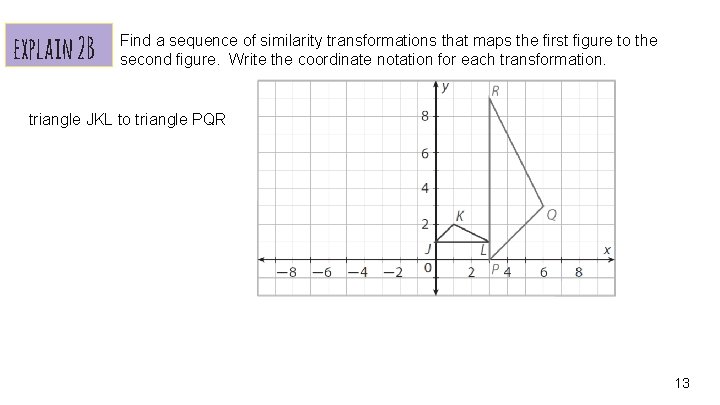
explain 2 B Find a sequence of similarity transformations that maps the first figure to the second figure. Write the coordinate notation for each transformation. triangle JKL to triangle PQR 13
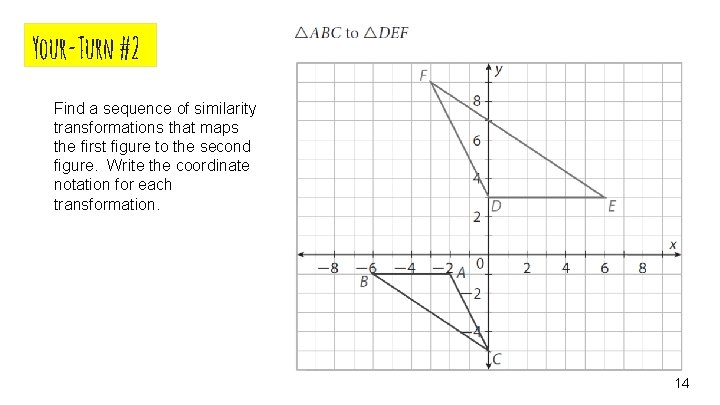
Your-Turn #2 Find a sequence of similarity transformations that maps the first figure to the second figure. Write the coordinate notation for each transformation. 14
Revisit Objective: Did we… 1. Explain how similarity transformations can be used to show two figures are similar? 15
HW: Sec 16. 2 page 644 #s 1 -10, 18 -20 16