
Section 16 2 Factors Affecting Reaction Rates Identify

- Slides: 18
Section 16. 2 Factors Affecting Reaction Rates • Identify factors that affect the rates of chemical reactions. • Explain the role of a catalyst.
The Nature of Reactants • Some substances react more readily than others.
Concentration • Chemists change reaction rates by changing concentrations of reactants. • When concentrations are increased, more molecules are available to collide, and therefore collisions occur more frequently. Thus the rate of reaction will increase.
Surface Area • Greater surface area allows particles to collide with many more particles per unit of time. • For the same mass, many small particles have more surface area than one large particle. • Reaction rate increases with increasing surface area.
Temperature • Increasing temperature generally increases reaction rate. • For example, you know that the reactions that cause foods to spoil occur faster at room temperature than when the foods are refrigerated. • Increasing temperature increases the kinetic energy of the particles. • Reacting particles collide more frequently at higher temperatures.
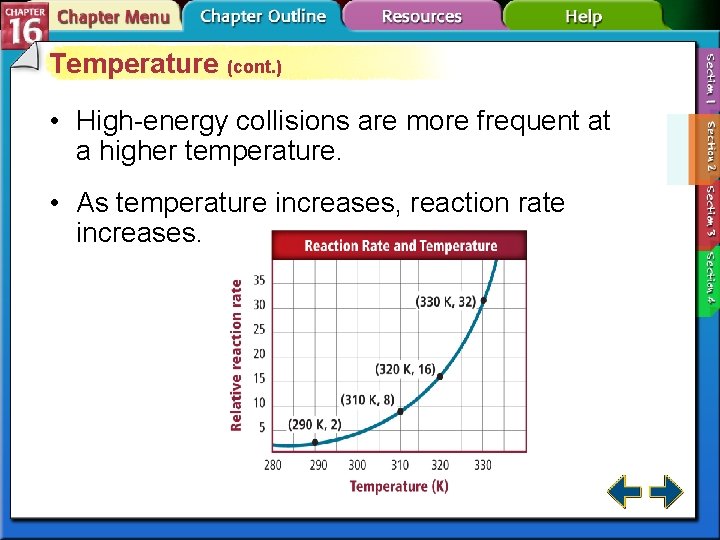
Temperature (cont. ) • High-energy collisions are more frequent at a higher temperature. • As temperature increases, reaction rate increases.
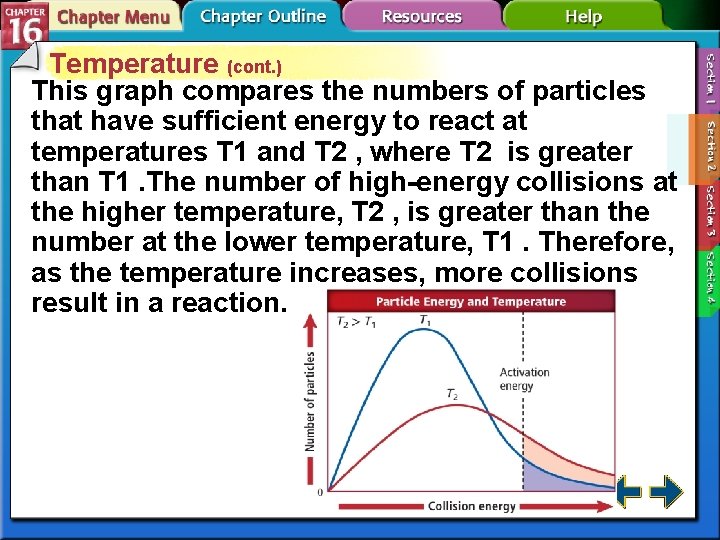
Temperature (cont. ) This graph compares the numbers of particles that have sufficient energy to react at temperatures T 1 and T 2 , where T 2 is greater than T 1. The number of high-energy collisions at the higher temperature, T 2 , is greater than the number at the lower temperature, T 1. Therefore, as the temperature increases, more collisions result in a reaction.
Catalysts and Inhibitors • A catalyst is a substance that increases the rate of a chemical reaction without being consumed in the reaction. • Catalysts are used extensively in manufacturing because producing more of a product quickly reduces its cost. A catalyst does not yield more product and is not included in either the reactants or the products of the reaction. Thus, catalysts are not included in chemical equations. • An inhibitor is a substance that slows or prevents a reaction.
• How catalysts and inhibitors work : A catalyst lowers the activation energy required for a reaction to take place at a given temperature. Recall that a low activation energy means that more of the collisions between particles will have sufficient energy to overcome the activation energy barrier and bring about a reaction. By lowering the activation energy, a catalyst increases the average reaction rate.
• Inhibitors can act in a variety of ways. Some block lower energy pathways and thus raise the activation energy of a reaction. Others react with the catalyst and destroy it or prevent it from performing its function. In biological reactions, an inhibitor might bind the enzyme that catalyzes a reaction and prevent the reaction from occurring. In the food industry, inhibitors are called preservatives or antioxidants
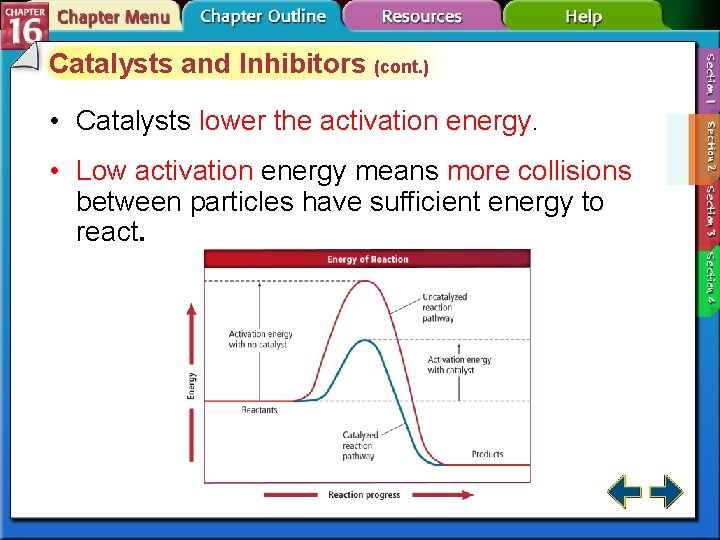
Catalysts and Inhibitors (cont. ) • Catalysts lower the activation energy. • Low activation energy means more collisions between particles have sufficient energy to react.
Catalysts and Inhibitors (cont. ) • A heterogeneous catalyst exists in a physical state different than that of the reaction it catalyzes. • A homogeneous catalyst exists in the same physical state as the reaction it catalyzes.
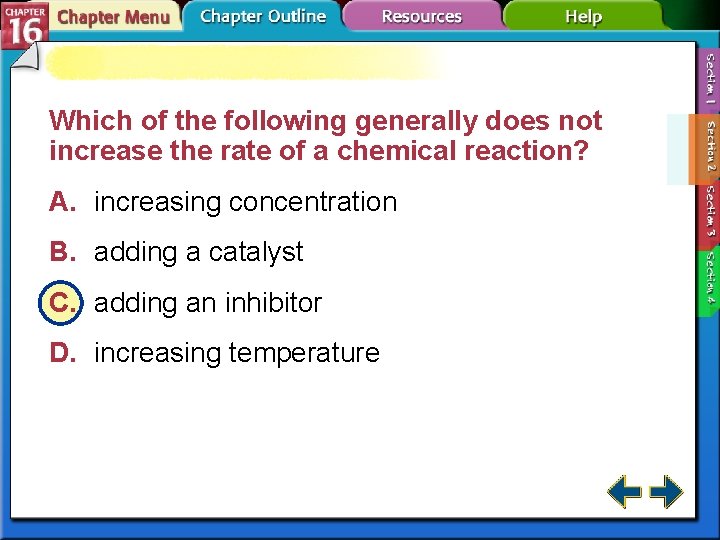
Which of the following generally does not increase the rate of a chemical reaction? A. increasing concentration B. adding a catalyst C. adding an inhibitor D. increasing temperature A. B. C. D. A B C D
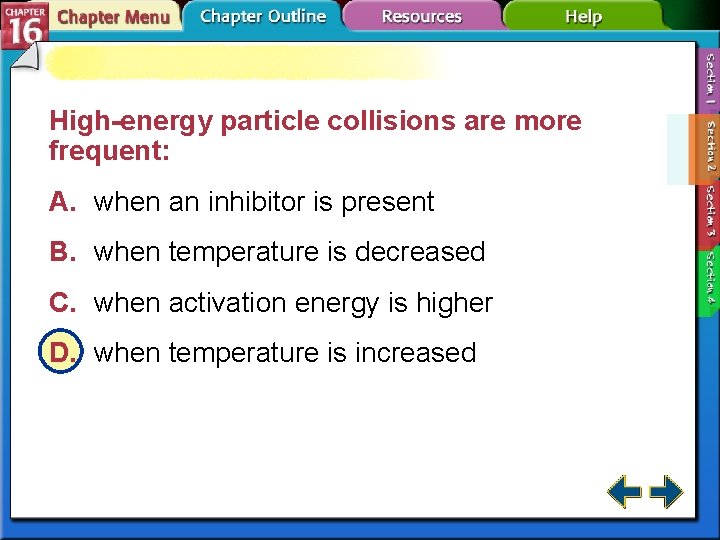
High-energy particle collisions are more frequent: A. when an inhibitor is present B. when temperature is decreased C. when activation energy is higher D. when temperature is increased A. B. C. D. A B C D
• Q 1: Explain how collision theory accounts for the effect of concentration on reaction rate. • Increasing reactant concentration increases collision frequency between reactant particles. • Q 2: Explain the difference between a catalyst and an inhibitor. • A catalyst speeds up the rate of a reaction by lowering the activation energy. An inhibitor slows or even stops a reaction by interfering with the reactants or with the catalyst.
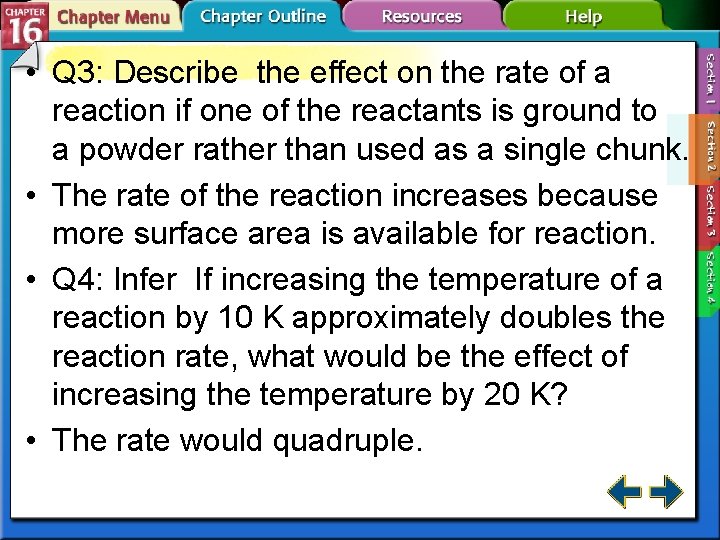
• Q 3: Describe the effect on the rate of a reaction if one of the reactants is ground to a powder rather than used as a single chunk. • The rate of the reaction increases because more surface area is available for reaction. • Q 4: Infer If increasing the temperature of a reaction by 10 K approximately doubles the reaction rate, what would be the effect of increasing the temperature by 20 K? • The rate would quadruple.
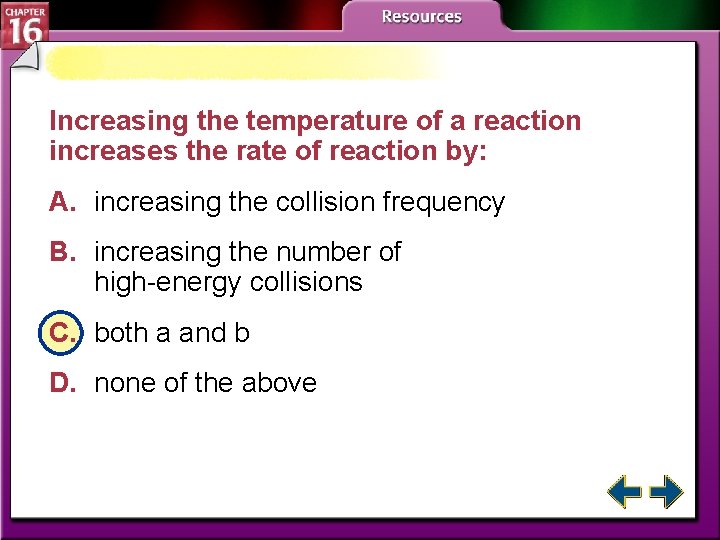
Increasing the temperature of a reaction increases the rate of reaction by: A. increasing the collision frequency B. increasing the number of high-energy collisions C. both a and b D. none of the above A. B. C. D. A B C D
End of section 16. 2