
SECTION 16 1 HUMAN POPULATION GROWTH AND NATURAL
- Slides: 15
SECTION 16. 1: HUMAN POPULATION GROWTH AND NATURAL RESOURCES Biology
OBJECTIVES • How is the human population stretching the Earth’s carrying capacity? • How is the growing human population exerting pressure on Earth’s natural resources? • Explain how effective management of Earth’s resources will help meet the needs of the future.
EARTH’S CARRYING CAPACITY • Thomas Malthus: 1700 s • First proposed that human population was growing faster than Earth’s resources could support • His observations and predictions are still being used today • Today’s human population is about 7 billion people, higher than earlier predictions of what the Earth could hold • Do not know the exact number of people that can be supported, but it is not unlimited, and it changes depending on how we utilize resources
TECHNOLOGY AND HUMAN POPULATION • Human modifications has changed the carrying capacity of Earth • Agriculture, transportation, medical advances, and sanitation • Farming equipment has allowed for vastly more food production than simple human and animals could have ever produced • Medical Advances • Contributed to population growth • Decrease in infant mortality, death from infection prevented by antibiotics and antiseptic cleaners
NONRENEWABLE RESOURCES • Nonrenewable resources are resources that are used faster than they form • Oil and coal make up the majority of our energy use • Made from dead organisms that have been concentrated over thousands of years • 2006: 77 million barrels per day of oil • This growth cannot continue indefinitely, new technologies need to be developed to use other forms of energy
RENEWABLE RESOURCES • Renewable Resources: Resources that cannot be used up or can replenish themselves over time • Wind and Solar Energy cannot be used up by humans • Plant and animal resources are renewable because they could last indefinitely if allowed to regrow and reproduce over time • Need to be replenished faster than they are used • If renewable resources are not used carefully they can become nonrenewable
DRINKING WATER • Currently drinking water is a renewable resource • Pollution (pesticides, industrial waste, and other contaminants) have been found in water sources • This contaminates water sources for millions of people • Groundwater is also being extracted from aquifers faster than it is being replaced • This is one of the reason’s the drought in California has been going on for so long • Both contamination and overuse can lead to a loss of this renewable resources
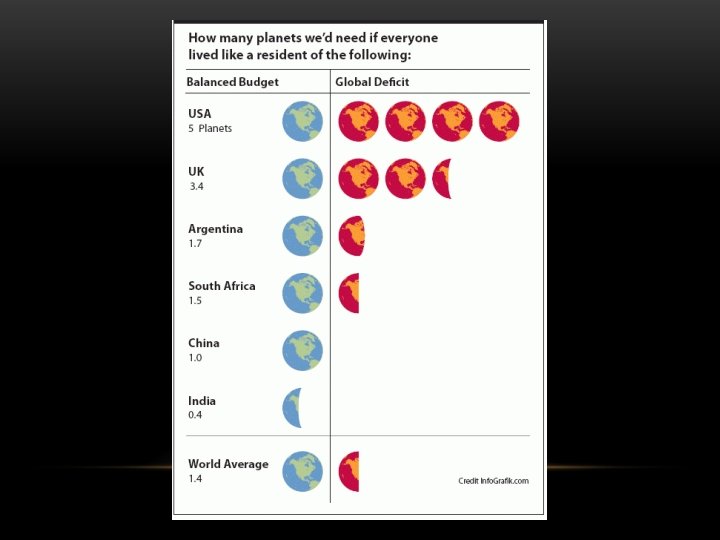
WASTE • The United States uses more resources and produces more waste than any other country on Earth • 230 million tons of garbage per year • 4. 2 pounds per day person (1 ton person per year) • If we all generated that must trash (everyone on Earth) could our planet sustain our usage and out waste?
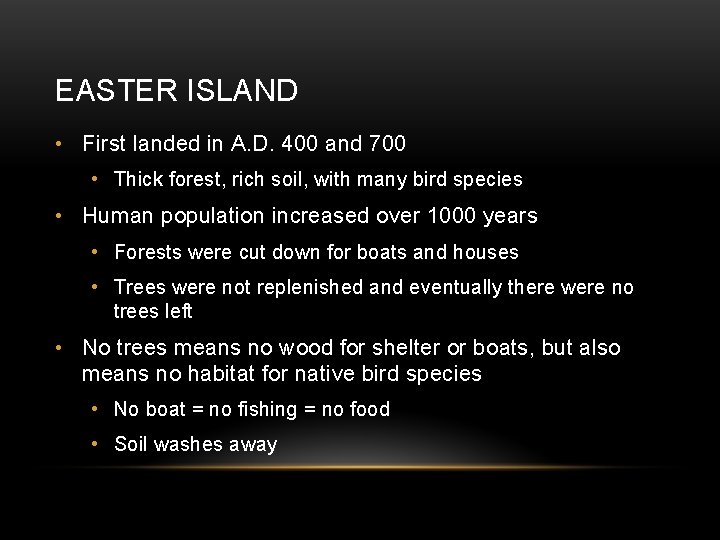
EASTER ISLAND • First landed in A. D. 400 and 700 • Thick forest, rich soil, with many bird species • Human population increased over 1000 years • Forests were cut down for boats and houses • Trees were not replenished and eventually there were no trees left • No trees means no wood for shelter or boats, but also means no habitat for native bird species • No boat = no fishing = no food • Soil washes away
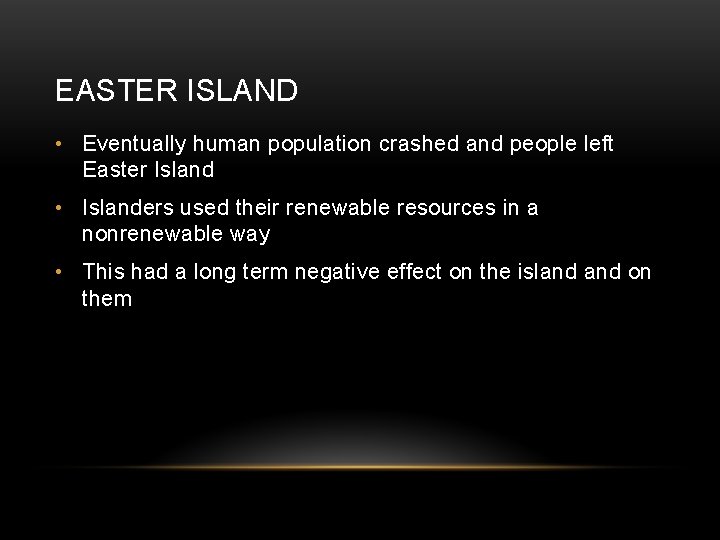
EASTER ISLAND • Eventually human population crashed and people left Easter Island • Islanders used their renewable resources in a nonrenewable way • This had a long term negative effect on the island on them
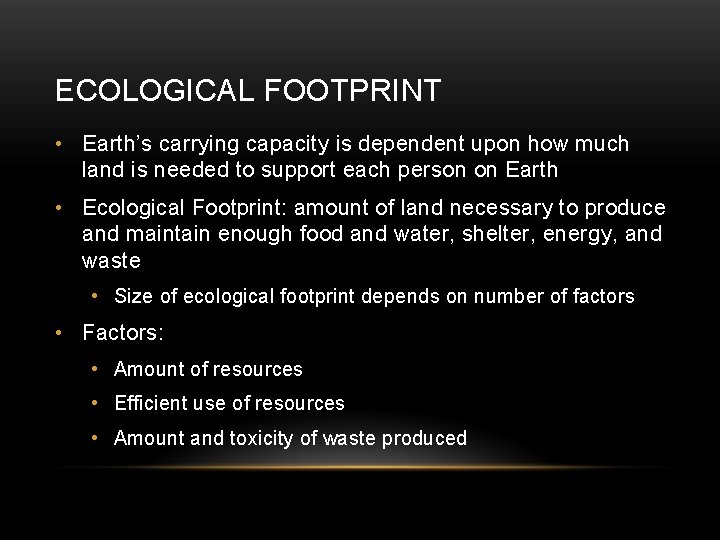
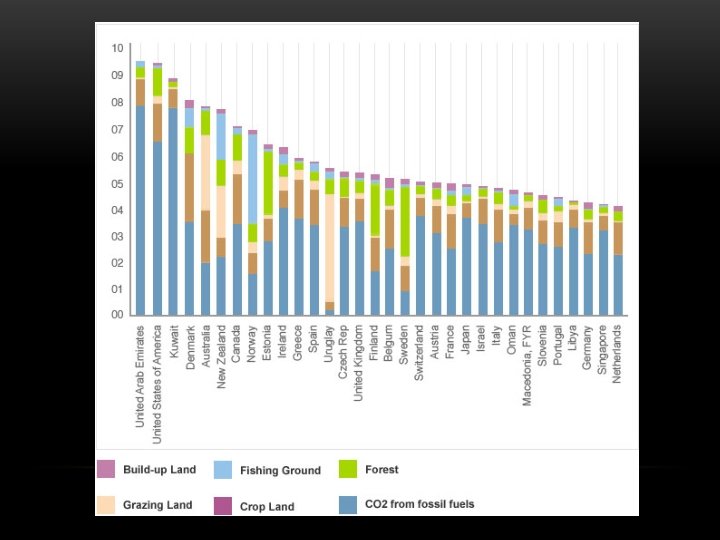
ECOLOGICAL FOOTPRINT • Earth’s carrying capacity is dependent upon how much land is needed to support each person on Earth • Ecological Footprint: amount of land necessary to produce and maintain enough food and water, shelter, energy, and waste • Size of ecological footprint depends on number of factors • Factors: • Amount of resources • Efficient use of resources • Amount and toxicity of waste produced
ECOLOGICAL FOOTPRINT • Many decisions need to be made about the way humans live and use their resources • Waste production and management • Rules to regulate resource use and waste production • How much resource use and waste production should individuals and populations be allowed? • How much land is needed for agriculture, living space, other uses? • How much water for crop irrigation and for humans drinking water? • Humans need to move away from consumerism to sustainability
OUTPUT • Use the Frayer model to define nonrenewable and renewable resources. • The progressive increase in Earth’s human carrying capacity came from advances in technology. What density-independent and density-dependent limiting factors may prevent the human population from continued growth?