
Section 15 1 Forming Solutions Objectives 1 To
Section 15. 1 Forming Solutions Objectives 1. To understand the process of dissolving 2. To learn why certain substances dissolve in water and to predict solubility 3. To learn qualitative terms describing the concentration of a solution 4. To understand the factors that affect the rate at which a solid dissolves

Section 15. 1 Forming Solutions What is a solution? • Solution – homogeneous mixture – Solvent – substance present in largest amount – Solutes – other substances in the solution – Aqueous solution – solution with water as the solvent

Section 15. 1 Forming Solutions
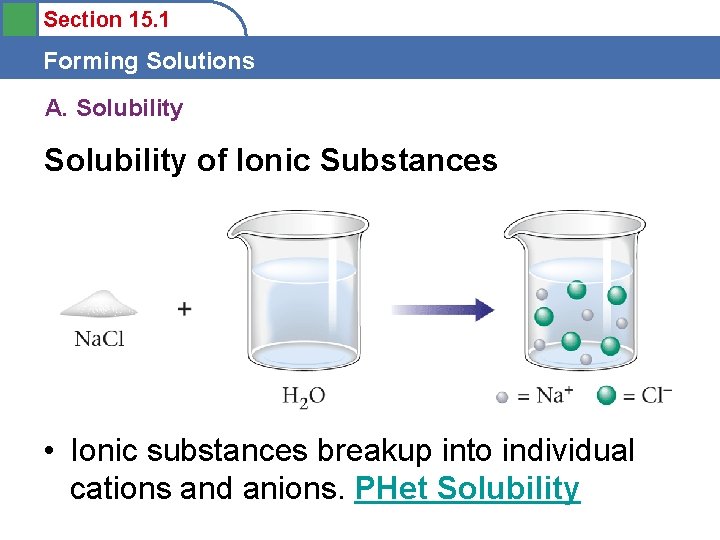
Section 15. 1 Forming Solutions A. Solubility of Ionic Substances • Ionic substances breakup into individual cations and anions. PHet Solubility
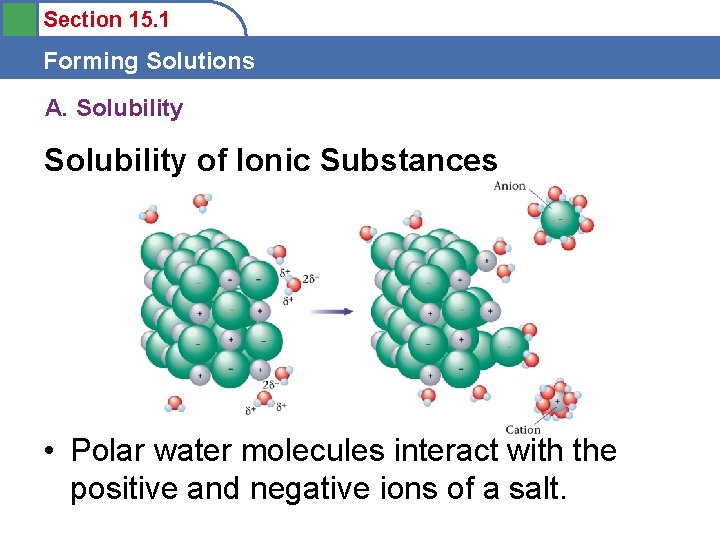
Section 15. 1 Forming Solutions A. Solubility of Ionic Substances • Polar water molecules interact with the positive and negative ions of a salt.
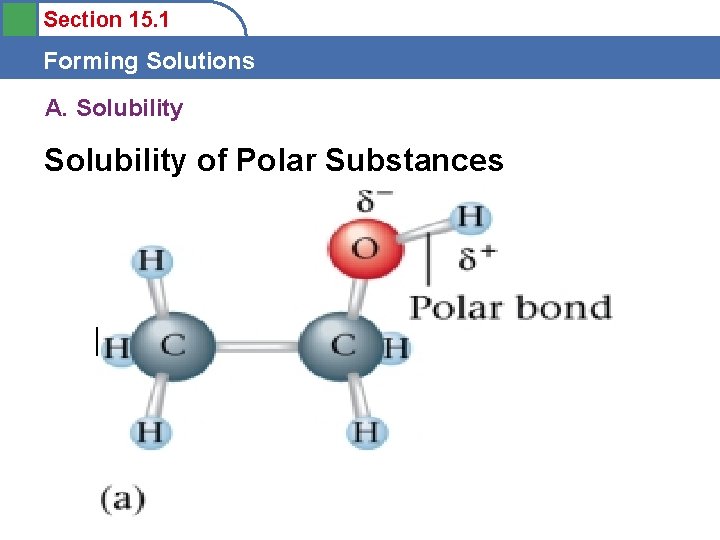
Section 15. 1 Forming Solutions A. Solubility of Polar Substances

Section 15. 1 Forming Solutions A. Solubility • Ethanol is soluble in water because of the polar OH bond.
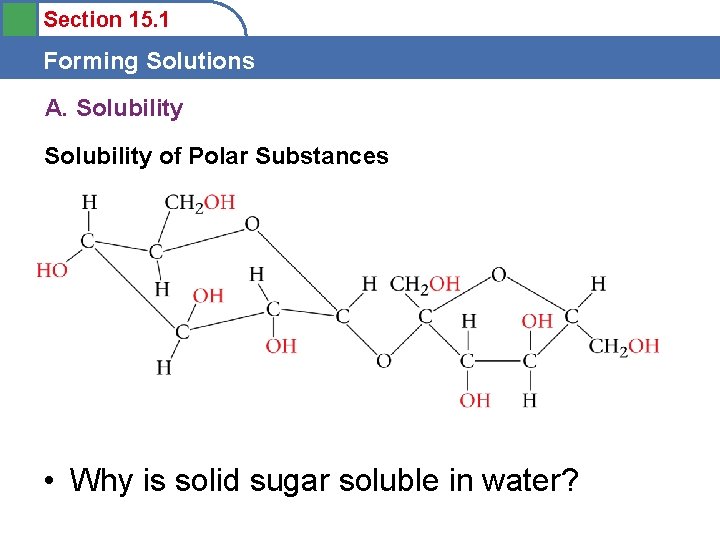
Section 15. 1 Forming Solutions A. Solubility of Polar Substances • Why is solid sugar soluble in water?
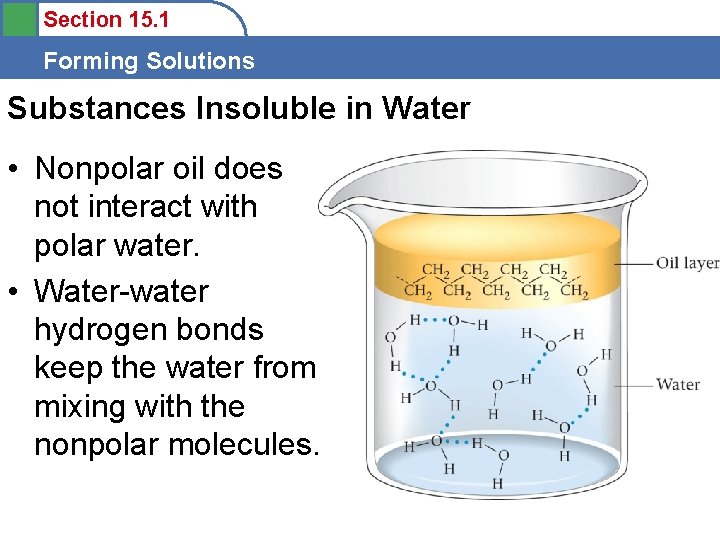
Section 15. 1 Forming Solutions Substances Insoluble in Water • Nonpolar oil does not interact with polar water. • Water-water hydrogen bonds keep the water from mixing with the nonpolar molecules.

Section 15. 1 Forming Solutions A. Solubility How Substances Dissolve • A “hole” must be made in the water structure for each solute particle. • The lost water-water interactions must be replaced by water-solute interactions. • “like dissolves like”

Section 15. 1 Forming Solutions A. Solubility Predict if the following substances would dissolve in water…. • • • NH 3 BCl 3 CH 4 CH 3 Cl H 2 S HCl

Section 15. 1 Forming Solutions A. Solubility How Substances Dissolve • “like dissolves like” • Packing popcorn demo • Phenolphthalein in water • What makes a good waterproof material? • Gum in your hair?

Section 15. 1 Forming Solutions A. Solubility Predict if the following substances would dissolve in water or oil • CH 3 OH • CH 2 Cl 2 • BF 3 • CH 4 • CH 3 CH 2 CH 2 OH • CCl 4 • As. H 3 • A bear swimming off the coast of Alaska
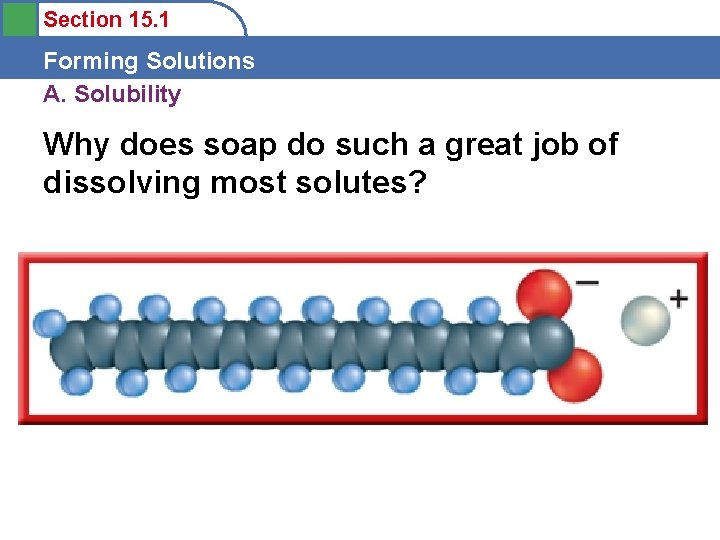
Section 15. 1 Forming Solutions A. Solubility Why does soap do such a great job of dissolving most solutes?

Section 15. 1 Forming Solutions B. Solution Composition: An Introduction • The solubility of a solute is limited. – Saturated solution – contains as much solute as will dissolve at that temperature – Unsaturated solution – has not reached the limit of solute that will dissolve
Section 15. 1 Forming Solutions B. Solution Composition: An Introduction – Supersaturated solution – occurs when a solution is saturated at an elevated temperature and then allowed to cool but all of the solid remains dissolved • Contains more dissolved solid than a saturated solution at that temperature • Unstable – adding a crystal causes precipitation • VIDEO? Hand Warmers?
Section 15. 1 Forming Solutions B. Solution Composition: An Introduction • Solutions are mixtures. • Amounts of substances can vary in different solutions. – Specify the amounts of solvent and solutes – Qualitative measures of concentration • concentrated – relatively large amount of solute • dilute – relatively small amount of solute
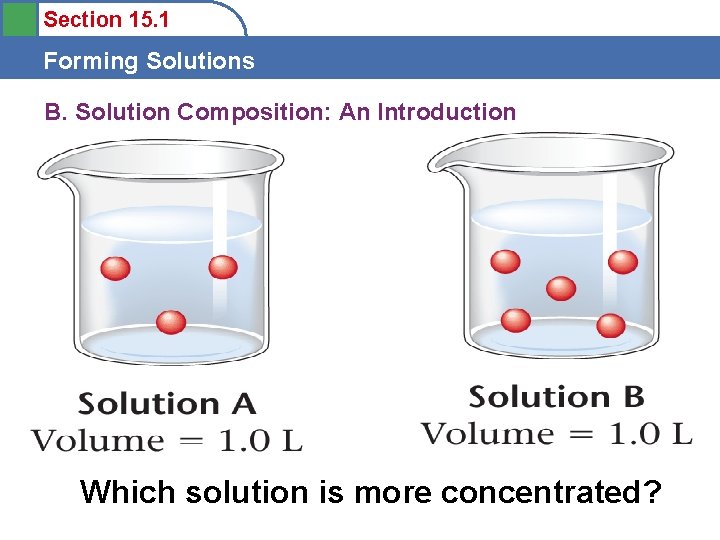
Section 15. 1 Forming Solutions B. Solution Composition: An Introduction Which solution is more concentrated?
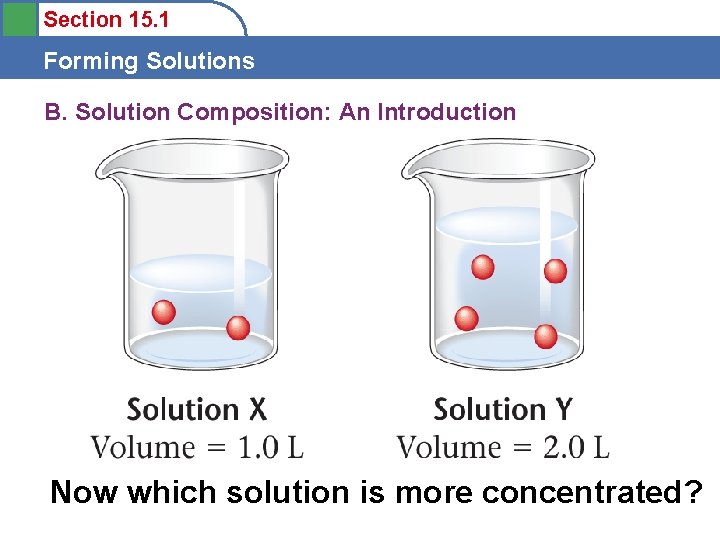
Section 15. 1 Forming Solutions B. Solution Composition: An Introduction Now which solution is more concentrated?
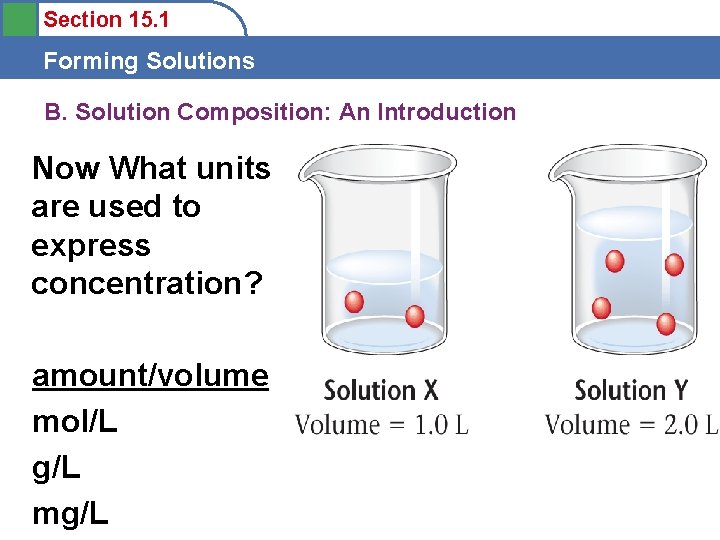
Section 15. 1 Forming Solutions B. Solution Composition: An Introduction Now What units are used to express concentration? amount/volume mol/L g/L mg/L
Section 15. 1 Forming Solutions C. Factors Affecting the Rate of Dissolving • • Surface area (molecular exposure) (grind) Stirring (increases molecular interactions) Temperature (increases speed of molecule) How will an increase in any of the above 3 factors affect the rate of dissolving? Why?
Section 15. 1 Forming Solutions Objectives Review 1. To understand the process of dissolving 2. To learn why certain substances dissolve in water and to predict solubility 3. To learn qualitative terms describing the concentration of a solution 4. To understand the factors that affect the rate at which a solid dissolves 5. Work Session: Page 527 # 1, 3, 4, 6
Section 15. 2 Describing Solution Composition Objectives 1. To understand mass percent and how to calculate it 2. To understand use molarity 3. To learn to calculate the concentration of a solution made by diluting a stock solution
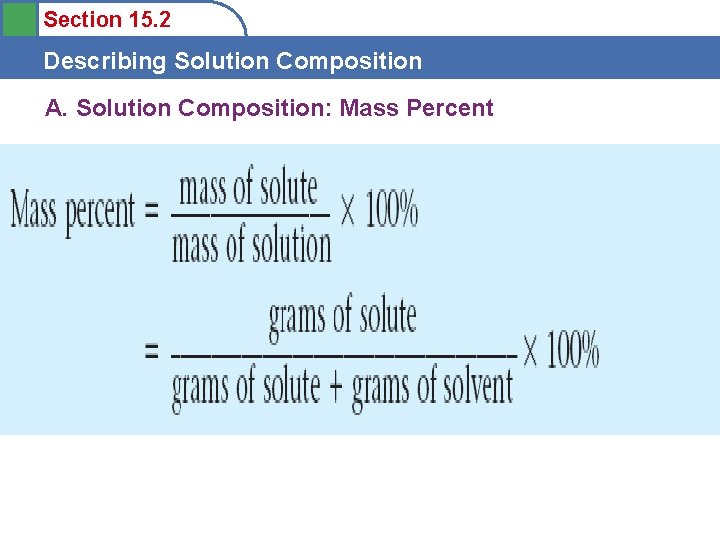
Section 15. 2 Describing Solution Composition A. Solution Composition: Mass Percent
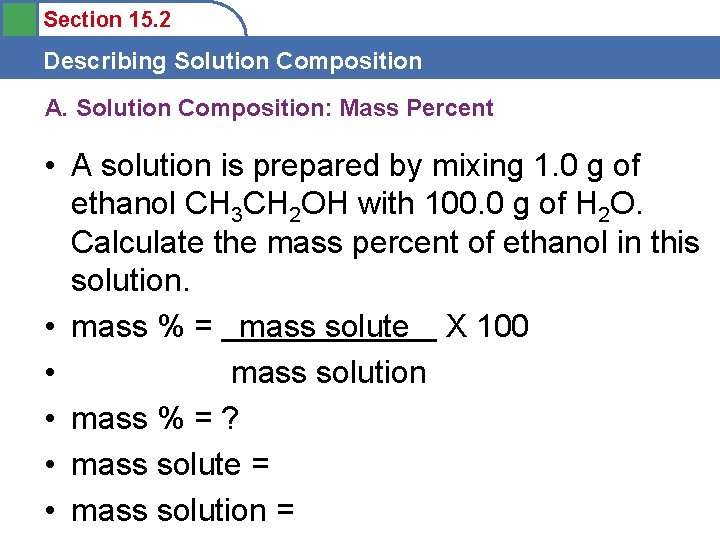
Section 15. 2 Describing Solution Composition A. Solution Composition: Mass Percent • A solution is prepared by mixing 1. 0 g of ethanol CH 3 CH 2 OH with 100. 0 g of H 2 O. Calculate the mass percent of ethanol in this solution. • mass % = mass solute X 100 • mass solution • mass % = ? • mass solute = • mass solution =
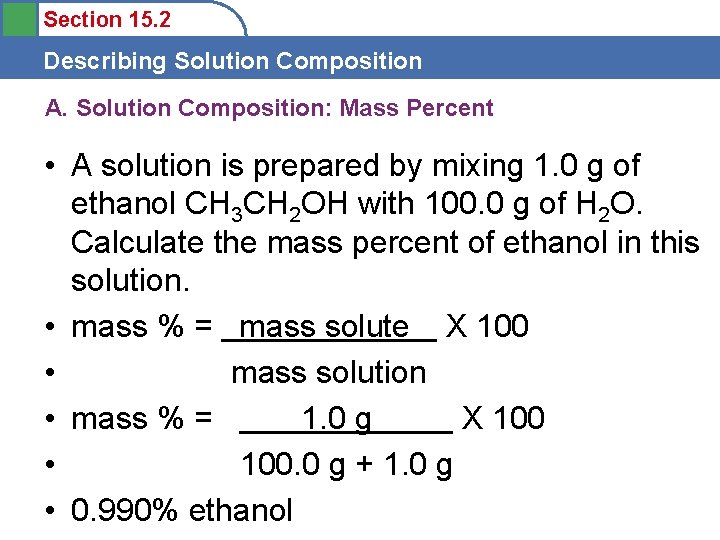
Section 15. 2 Describing Solution Composition A. Solution Composition: Mass Percent • A solution is prepared by mixing 1. 0 g of ethanol CH 3 CH 2 OH with 100. 0 g of H 2 O. Calculate the mass percent of ethanol in this solution. • mass % = mass solute X 100 • mass solution • mass % = 1. 0 g X 100 • 100. 0 g + 1. 0 g • 0. 990% ethanol
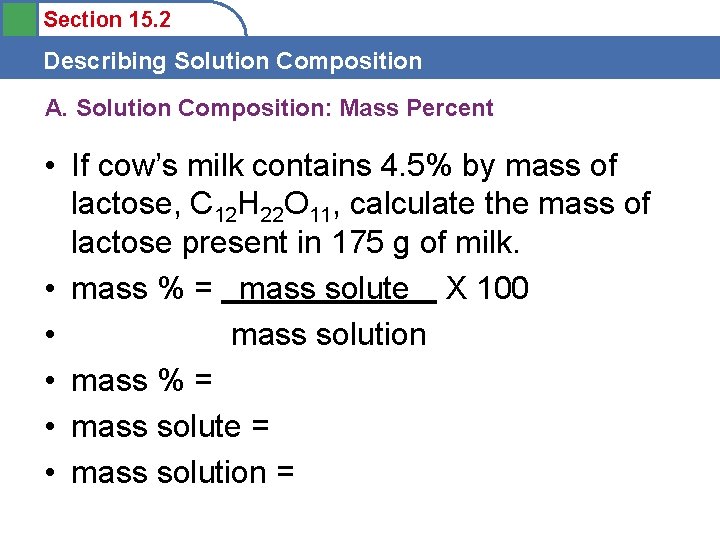
Section 15. 2 Describing Solution Composition A. Solution Composition: Mass Percent • If cow’s milk contains 4. 5% by mass of lactose, C 12 H 22 O 11, calculate the mass of lactose present in 175 g of milk. • mass % = mass solute X 100 • mass solution • mass % = • mass solute = • mass solution =
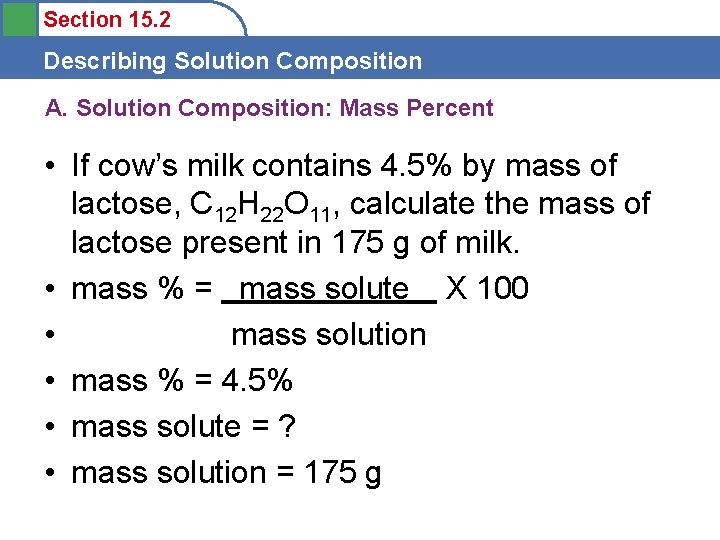
Section 15. 2 Describing Solution Composition A. Solution Composition: Mass Percent • If cow’s milk contains 4. 5% by mass of lactose, C 12 H 22 O 11, calculate the mass of lactose present in 175 g of milk. • mass % = mass solute X 100 • mass solution • mass % = 4. 5% • mass solute = ? • mass solution = 175 g
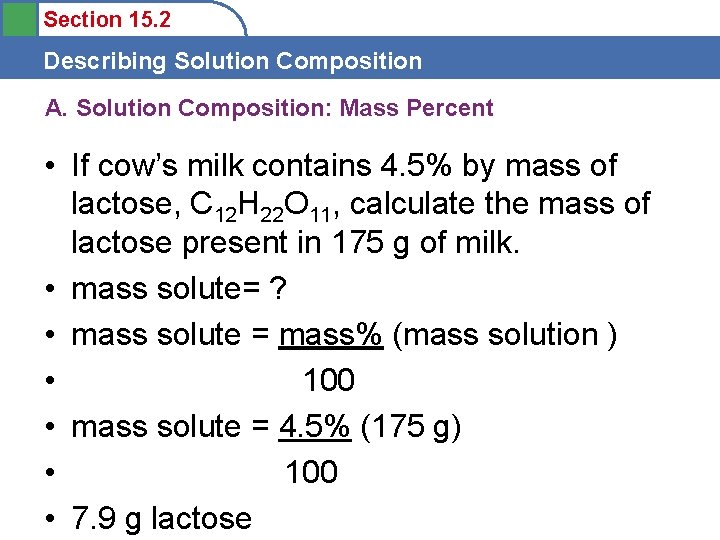
Section 15. 2 Describing Solution Composition A. Solution Composition: Mass Percent • If cow’s milk contains 4. 5% by mass of lactose, C 12 H 22 O 11, calculate the mass of lactose present in 175 g of milk. • mass solute= ? • mass solute = mass% (mass solution ) • 100 • mass solute = 4. 5% (175 g) • 100 • 7. 9 g lactose
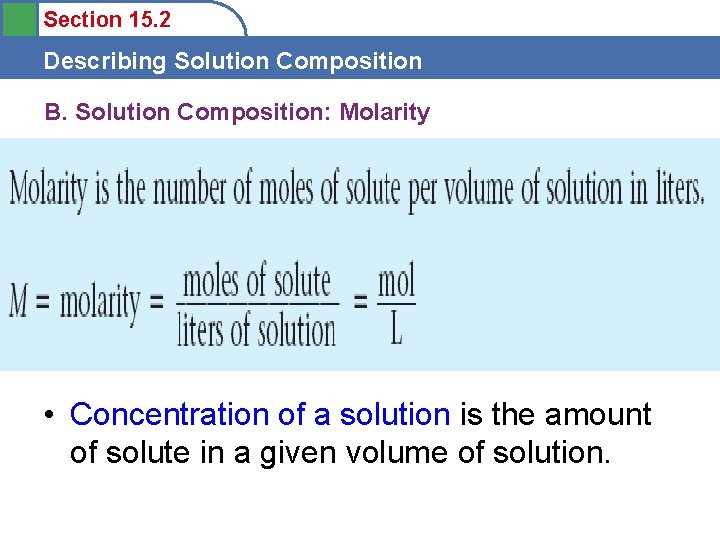
Section 15. 2 Describing Solution Composition B. Solution Composition: Molarity • Concentration of a solution is the amount of solute in a given volume of solution.
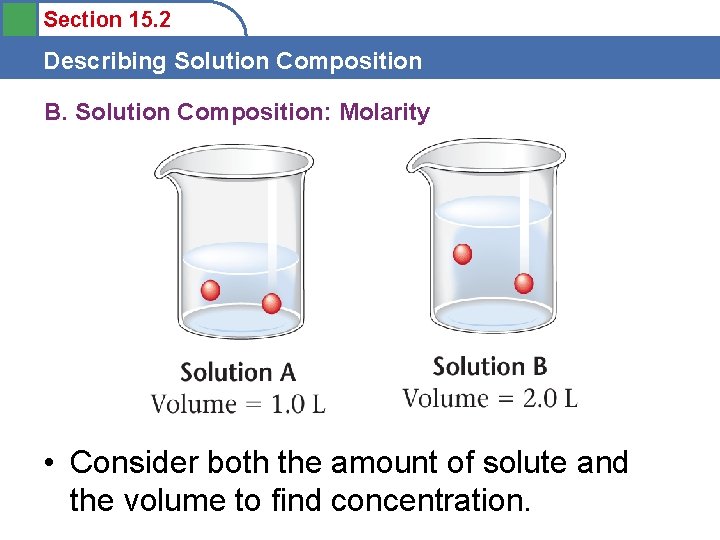
Section 15. 2 Describing Solution Composition B. Solution Composition: Molarity • Consider both the amount of solute and the volume to find concentration.
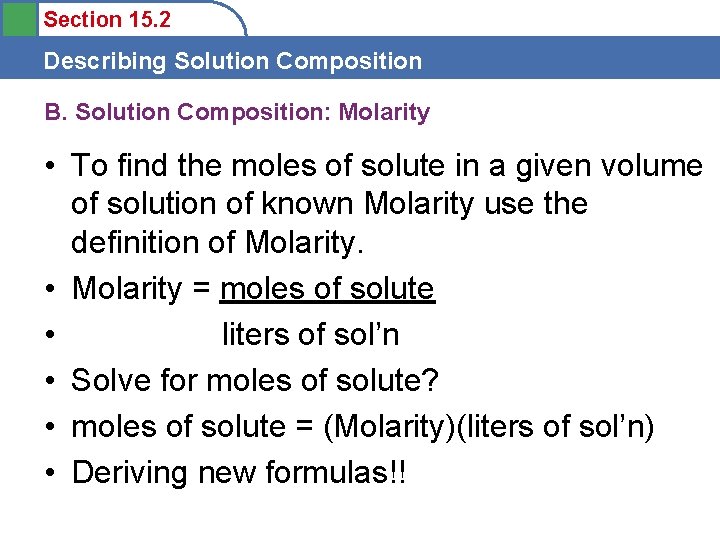
Section 15. 2 Describing Solution Composition B. Solution Composition: Molarity • To find the moles of solute in a given volume of solution of known Molarity use the definition of Molarity. • Molarity = moles of solute • liters of sol’n • Solve for moles of solute? • moles of solute = (Molarity)(liters of sol’n) • Deriving new formulas!!
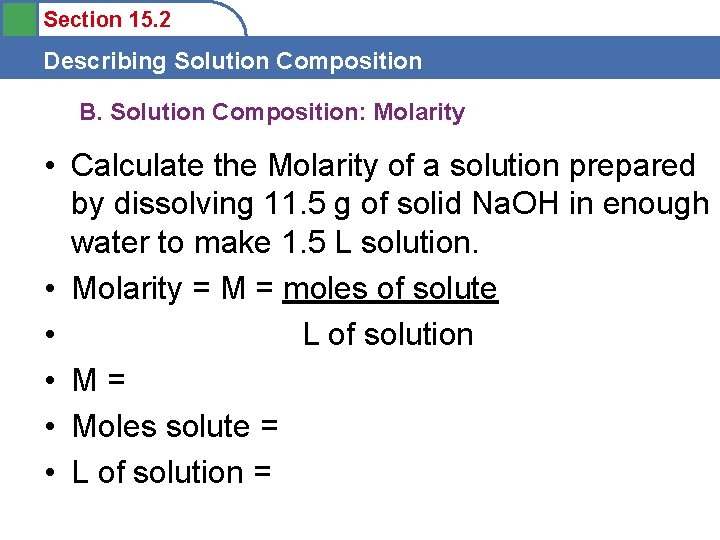
Section 15. 2 Describing Solution Composition B. Solution Composition: Molarity • Calculate the Molarity of a solution prepared by dissolving 11. 5 g of solid Na. OH in enough water to make 1. 5 L solution. • Molarity = M = moles of solute • L of solution • M = • Moles solute = • L of solution =
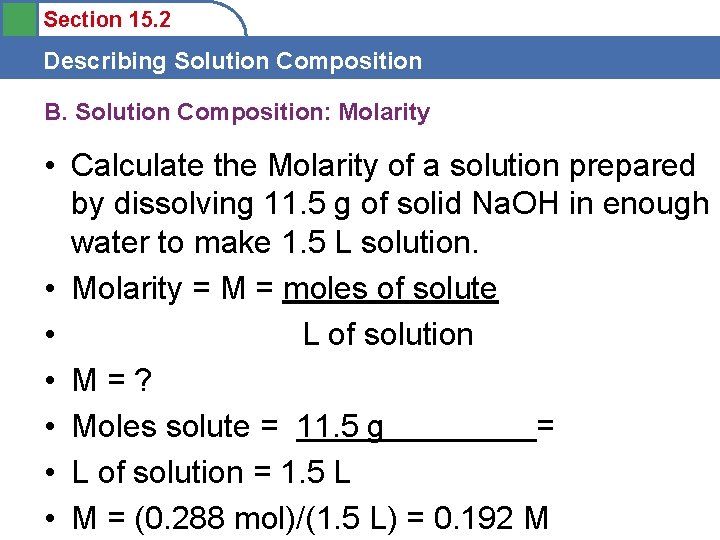
Section 15. 2 Describing Solution Composition B. Solution Composition: Molarity • Calculate the Molarity of a solution prepared by dissolving 11. 5 g of solid Na. OH in enough water to make 1. 5 L solution. • Molarity = M = moles of solute • L of solution • M = ? • Moles solute = 11. 5 g = • L of solution = 1. 5 L • M = (0. 288 mol)/(1. 5 L) = 0. 192 M
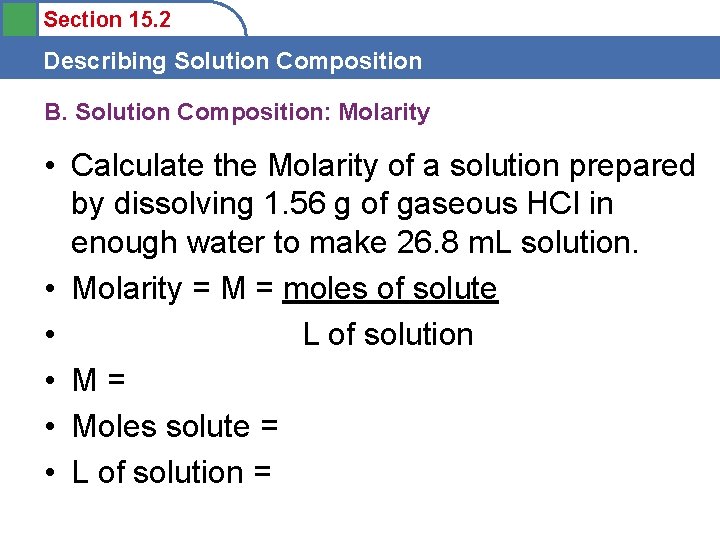
Section 15. 2 Describing Solution Composition B. Solution Composition: Molarity • Calculate the Molarity of a solution prepared by dissolving 1. 56 g of gaseous HCl in enough water to make 26. 8 m. L solution. • Molarity = M = moles of solute • L of solution • M = • Moles solute = • L of solution =
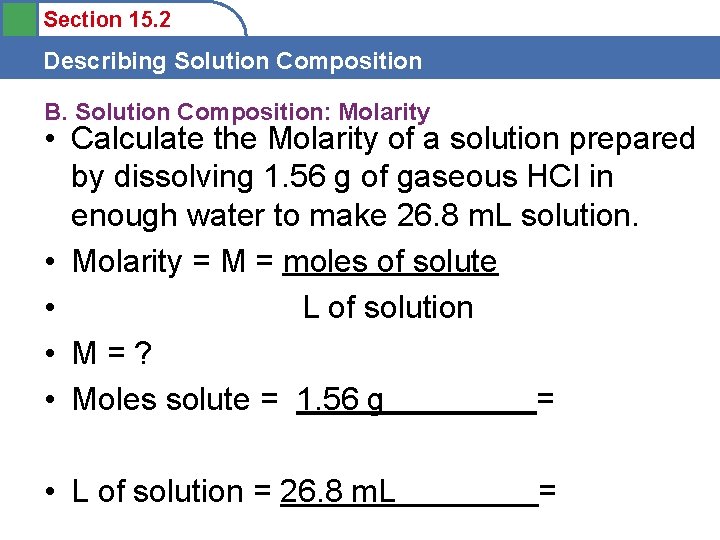
Section 15. 2 Describing Solution Composition B. Solution Composition: Molarity • Calculate the Molarity of a solution prepared by dissolving 1. 56 g of gaseous HCl in enough water to make 26. 8 m. L solution. • Molarity = M = moles of solute • L of solution • M = ? • Moles solute = 1. 56 g = • L of solution = 26. 8 m. L =
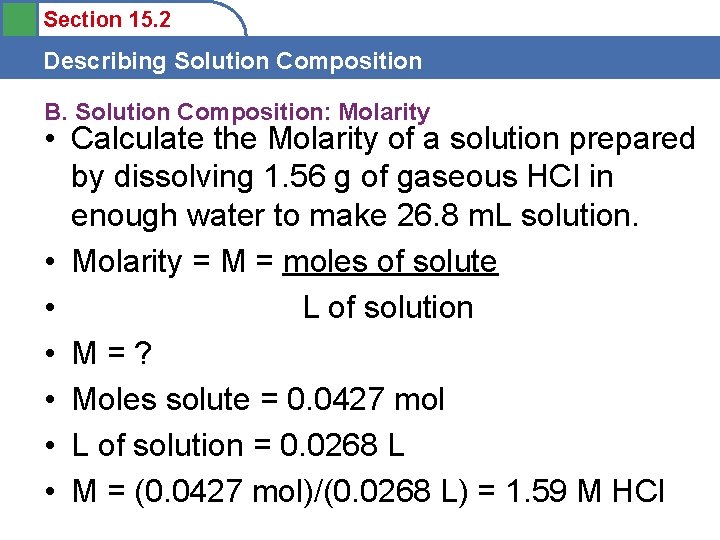
Section 15. 2 Describing Solution Composition B. Solution Composition: Molarity • Calculate the Molarity of a solution prepared by dissolving 1. 56 g of gaseous HCl in enough water to make 26. 8 m. L solution. • Molarity = M = moles of solute • L of solution • M = ? • Moles solute = 0. 0427 mol • L of solution = 0. 0268 L • M = (0. 0427 mol)/(0. 0268 L) = 1. 59 M HCl
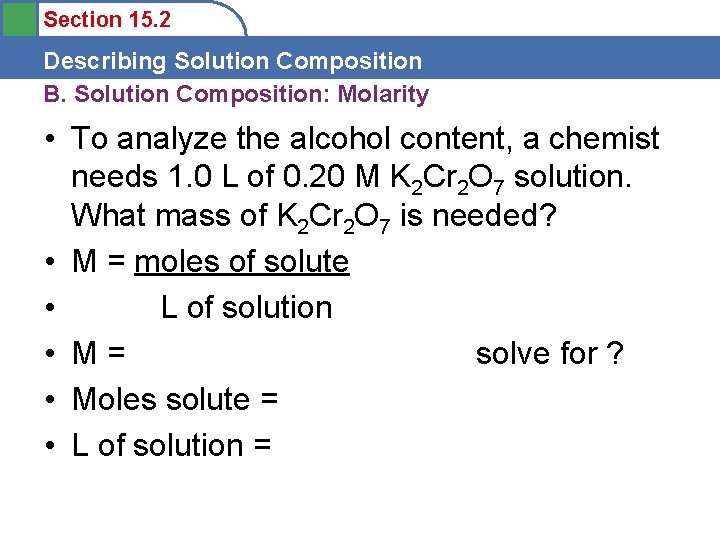
Section 15. 2 Describing Solution Composition B. Solution Composition: Molarity • To analyze the alcohol content, a chemist needs 1. 0 L of 0. 20 M K 2 Cr 2 O 7 solution. What mass of K 2 Cr 2 O 7 is needed? • M = moles of solute • L of solution • M = solve for ? • Moles solute = • L of solution =
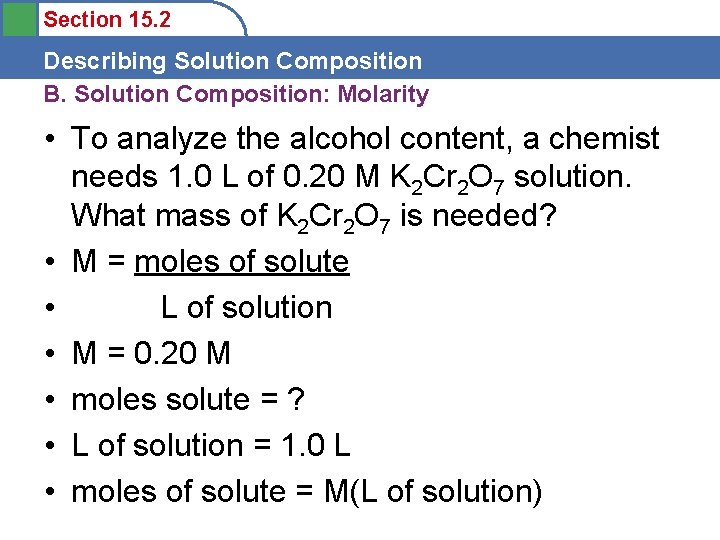
Section 15. 2 Describing Solution Composition B. Solution Composition: Molarity • To analyze the alcohol content, a chemist needs 1. 0 L of 0. 20 M K 2 Cr 2 O 7 solution. What mass of K 2 Cr 2 O 7 is needed? • M = moles of solute • L of solution • M = 0. 20 M • moles solute = ? • L of solution = 1. 0 L • moles of solute = M(L of solution)
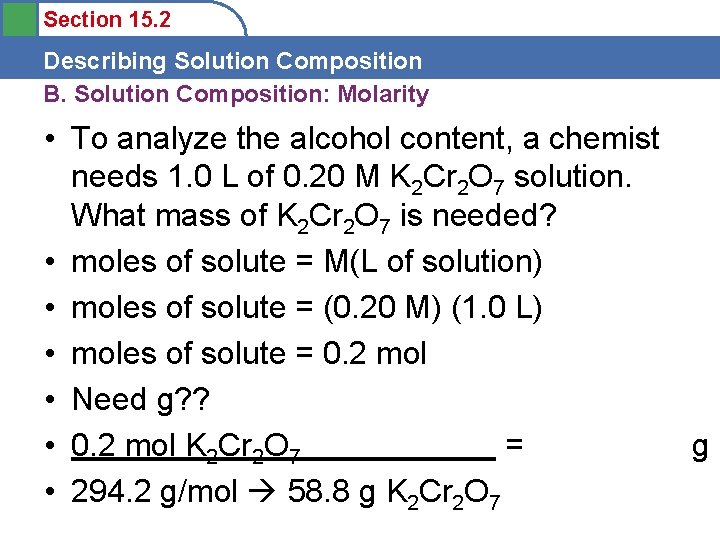
Section 15. 2 Describing Solution Composition B. Solution Composition: Molarity • To analyze the alcohol content, a chemist needs 1. 0 L of 0. 20 M K 2 Cr 2 O 7 solution. What mass of K 2 Cr 2 O 7 is needed? • moles of solute = M(L of solution) • moles of solute = (0. 20 M) (1. 0 L) • moles of solute = 0. 2 mol • Need g? ? • 0. 2 mol K 2 Cr 2 O 7 = g • 294. 2 g/mol 58. 8 g K 2 Cr 2 O 7
Section 15. 2 Describing Solution Composition B. Solution Composition: Molarity • Standard solution - a solution whose concentration is accurately known • To make a standard solution – Mass out a sample of solute. – Transfer to a volumetric flask. – Add enough solvent to mark on flask. – Spinner plate, magnetic pill, wand…….
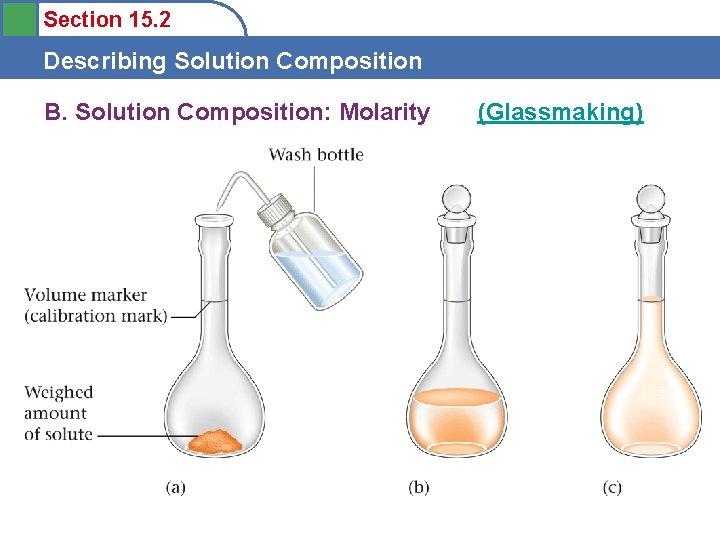
Section 15. 2 Describing Solution Composition B. Solution Composition: Molarity (Glassmaking)
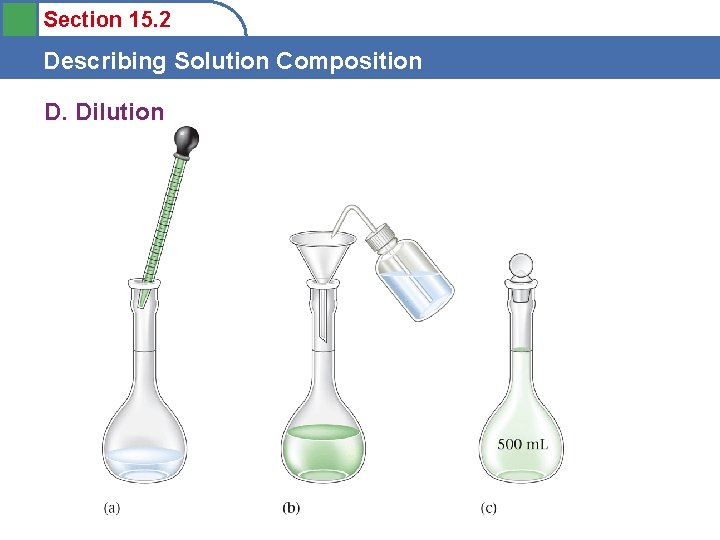
Section 15. 2 Describing Solution Composition C. Dilution • Water can be added to an aqueous solution to dilute the solution to a lower concentration. • Only water is added in the dilution – the amount of solute is the same in both the original and final solution.
Section 15. 2 Describing Solution Composition D. Dilution • Diluting a solution – Mix a measured amount of original solution with DI water in a volumetric flask – Use the formula M 1 V 1 = M 2 V 2 – M = Molarity – V = Volume
Section 15. 2 Describing Solution Composition D. Dilution
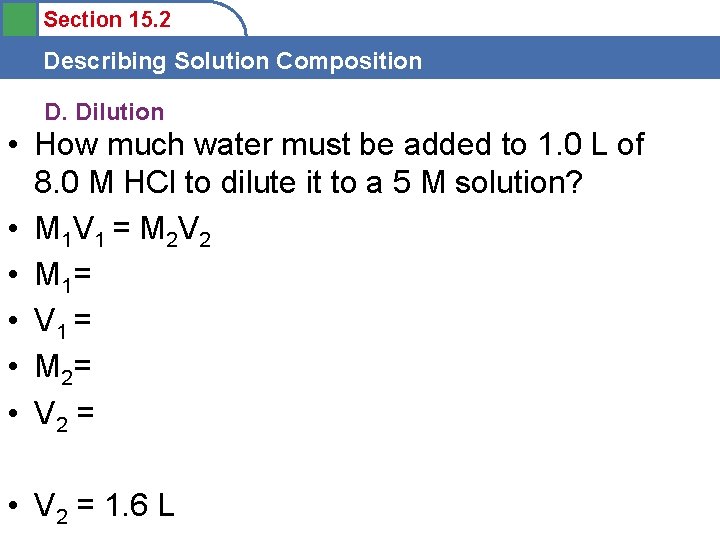
Section 15. 2 Describing Solution Composition D. Dilution • How much water must be added to 1. 0 L of 8. 0 M HCl to dilute it to a 5 M solution? • M 1 V 1 = M 2 V 2 • M 1 = • V 1 = • M 2 = • V 2 = 1. 6 L
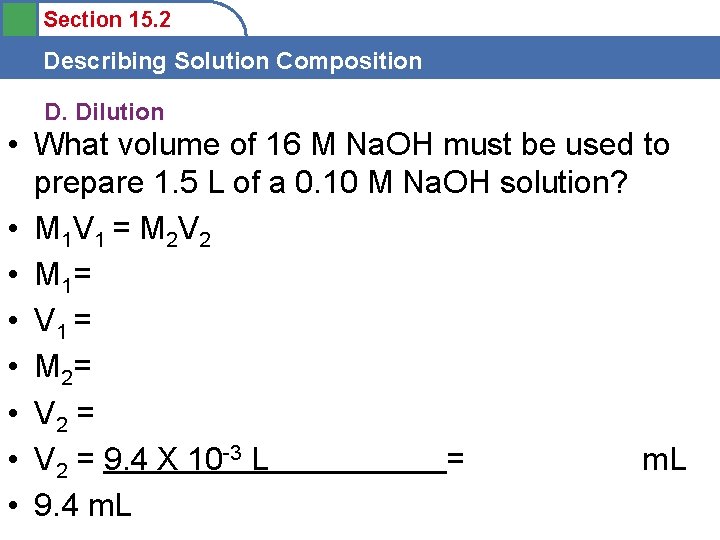
Section 15. 2 Describing Solution Composition D. Dilution • What volume of 16 M Na. OH must be used to prepare 1. 5 L of a 0. 10 M Na. OH solution? • M 1 V 1 = M 2 V 2 • M 1 = • V 1 = • M 2 = • V 2 = 9. 4 X 10 -3 L = m. L • 9. 4 m. L
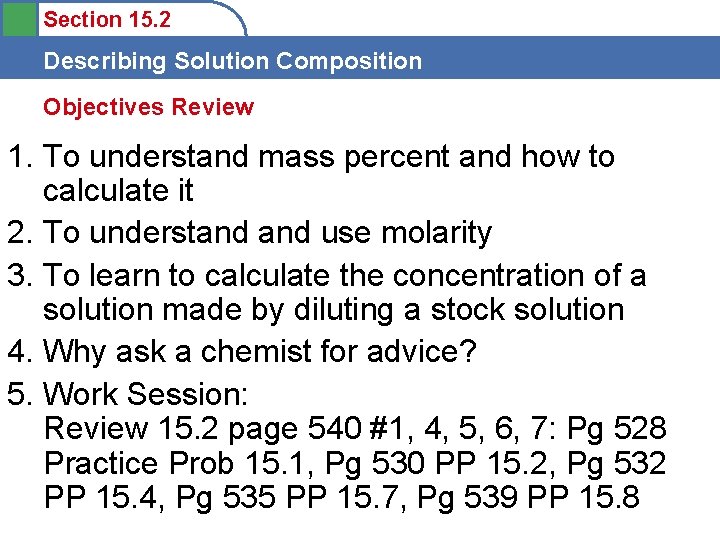
Section 15. 2 Describing Solution Composition Objectives Review 1. To understand mass percent and how to calculate it 2. To understand use molarity 3. To learn to calculate the concentration of a solution made by diluting a stock solution 4. Why ask a chemist for advice? 5. Work Session: Review 15. 2 page 540 #1, 4, 5, 6, 7: Pg 528 Practice Prob 15. 1, Pg 530 PP 15. 2, Pg 532 PP 15. 4, Pg 535 PP 15. 7, Pg 539 PP 15. 8
Section 15. 3 Properties of Solutions Objectives • To understand the effect of a solute on solution properties

Section 15. 3 Properties of Solutions Objectives • To

Section 15. 3 Properties of Solutions
Section 15. 3 Properties of Solutions D. Boiling Point and Freezing Point • The presence of solute “particles” causes the liquid range to become wider. – Boiling point increases – (add a pinch of salt when you boil water for spaghetti) – Freezing point decreases – (add rock salt when you make icecream) – Salting the Interstate in winter
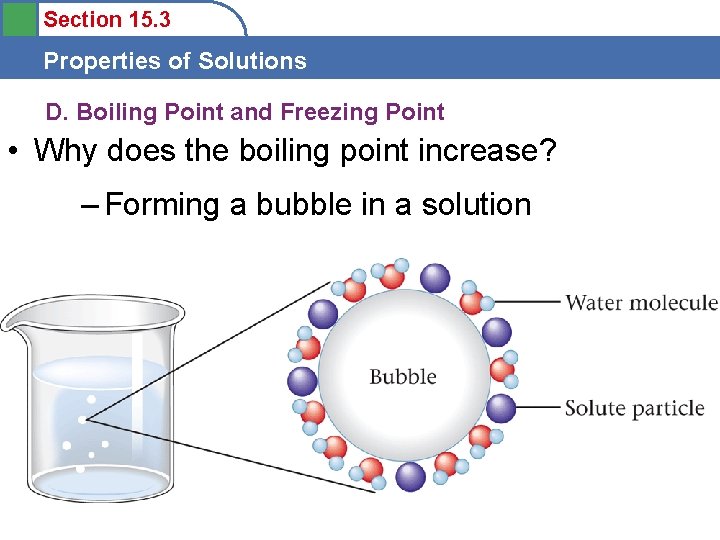
Section 15. 3 Properties of Solutions D. Boiling Point and Freezing Point • Why does the boiling point increase? – Forming a bubble in a solution
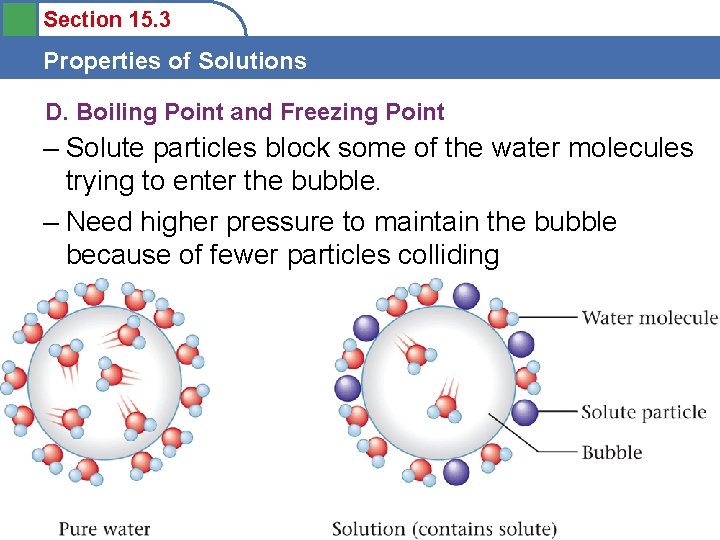
Section 15. 3 Properties of Solutions D. Boiling Point and Freezing Point – Solute particles block some of the water molecules trying to enter the bubble. – Need higher pressure to maintain the bubble because of fewer particles colliding
Section 15. 3 Properties of Solutions D. Boiling Point and Freezing Point • Colligative property – a solution property that depends on the number of solute particles present • Boiling Point Elevation • Freezing Point Depression
Section 15. 3 Properties of Solutions Objectives Review 1. To understand the effect of a solute on solution properties 2. Work Session: Review Page 553 #8 Page 557 # 49, 51
Section 15. 3 Properties of Solutions Objectives Review 1. This is the end of the required material for this chapter.
Section 15. 3 Properties of Solutions Objectives Review 1. To learn to solve stoichiometric problems involving solution reactions 2. To do calculations involving acid-base reactions 3. To learn about normality and equivalent weight 4. To use normality in stoichiometric calculations 5. To understand the effect of a solute on solution properties
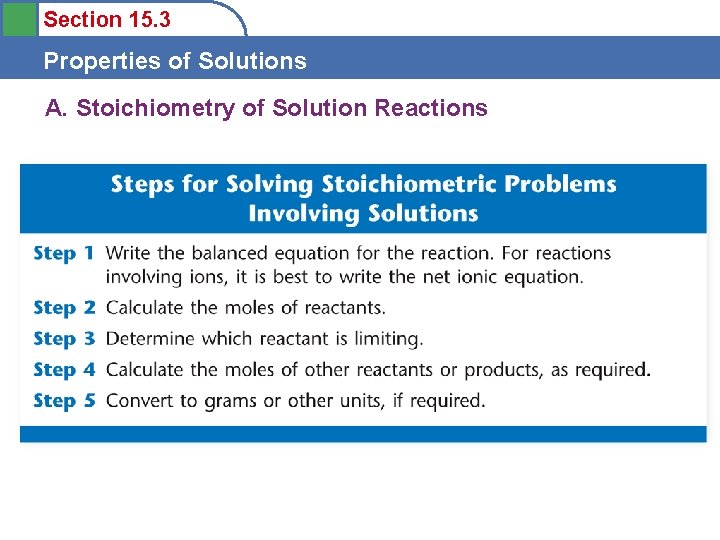
Section 15. 3 Properties of Solutions A. Stoichiometry of Solution Reactions
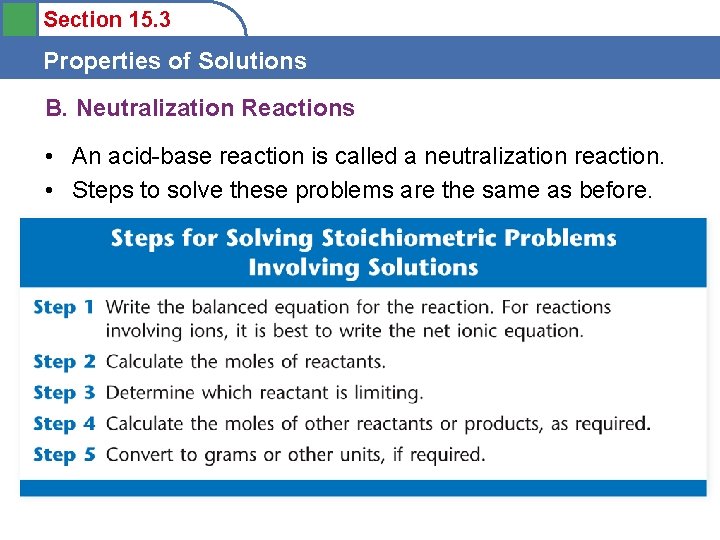
Section 15. 3 Properties of Solutions B. Neutralization Reactions • An acid-base reaction is called a neutralization reaction. • Steps to solve these problems are the same as before.
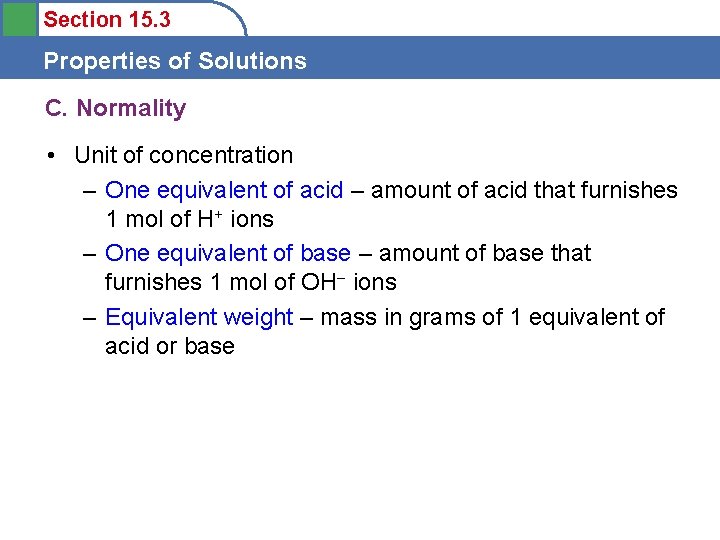
Section 15. 3 Properties of Solutions C. Normality • Unit of concentration – One equivalent of acid – amount of acid that furnishes 1 mol of H+ ions – One equivalent of base – amount of base that furnishes 1 mol of OH ions – Equivalent weight – mass in grams of 1 equivalent of acid or base
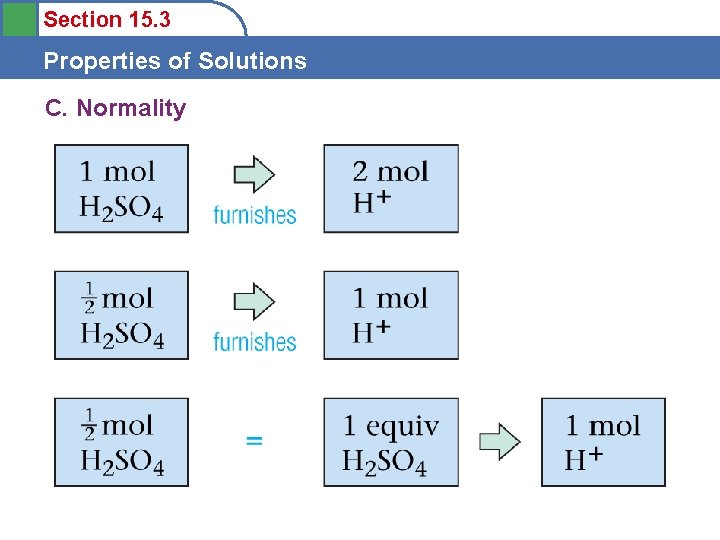
Section 15. 3 Properties of Solutions C. Normality
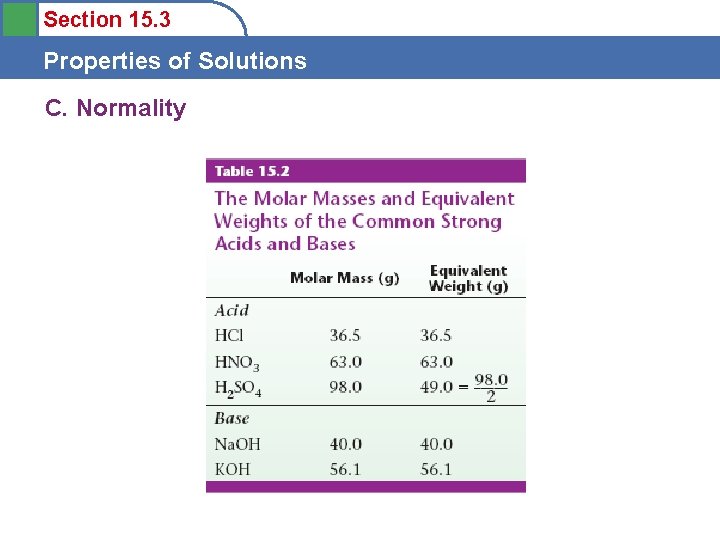
Section 15. 3 Properties of Solutions C. Normality
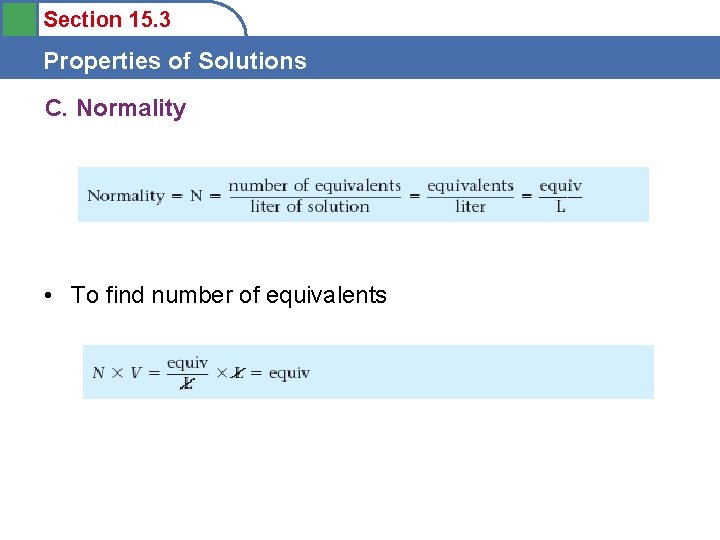
Section 15. 3 Properties of Solutions C. Normality • To find number of equivalents
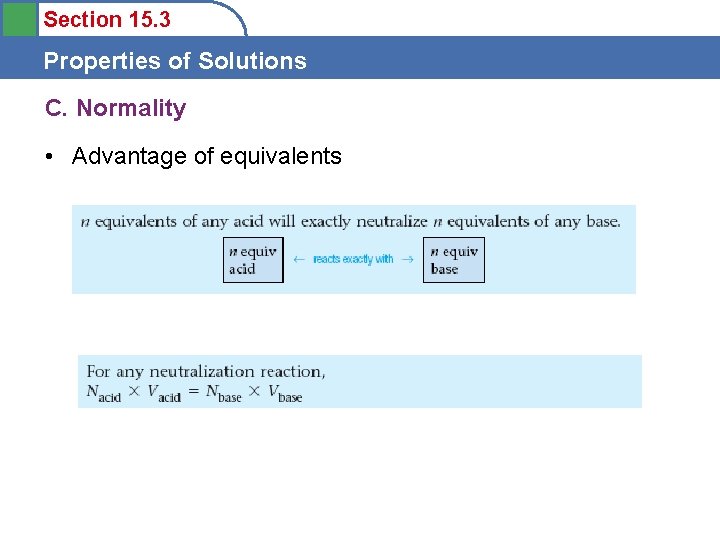
Section 15. 3 Properties of Solutions C. Normality • Advantage of equivalents
- Slides: 65