
Section 14 2 Flaws of Voting Methods 1
- Slides: 20
Section 14. 2 Flaws of Voting Methods 1. 2. 3. 4. 5. Objectives Use the majority criterion to determine a voting system’s fairness. Use the head-to-head criterion to determine a voting system’s fairness. Use the monotonicity criterion to determine a voting system’s fairness. Use the irrelevant alternatives criterion to determine a voting system’s fairness. Understand Arrow’s Impossibility Theorem. 11/25/2020 Section 14. 2 1
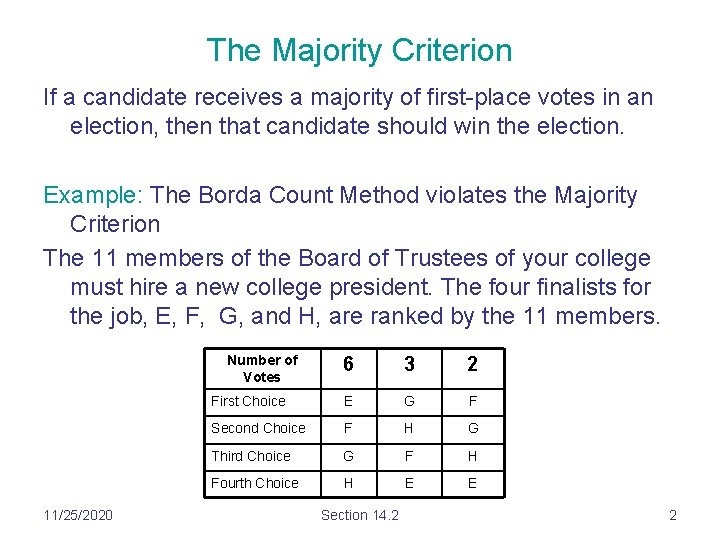
The Majority Criterion If a candidate receives a majority of first-place votes in an election, then that candidate should win the election. Example: The Borda Count Method violates the Majority Criterion The 11 members of the Board of Trustees of your college must hire a new college president. The four finalists for the job, E, F, G, and H, are ranked by the 11 members. Number of Votes 11/25/2020 6 3 2 First Choice E G F Second Choice F H G Third Choice G F H Fourth Choice H E E Section 14. 2 2
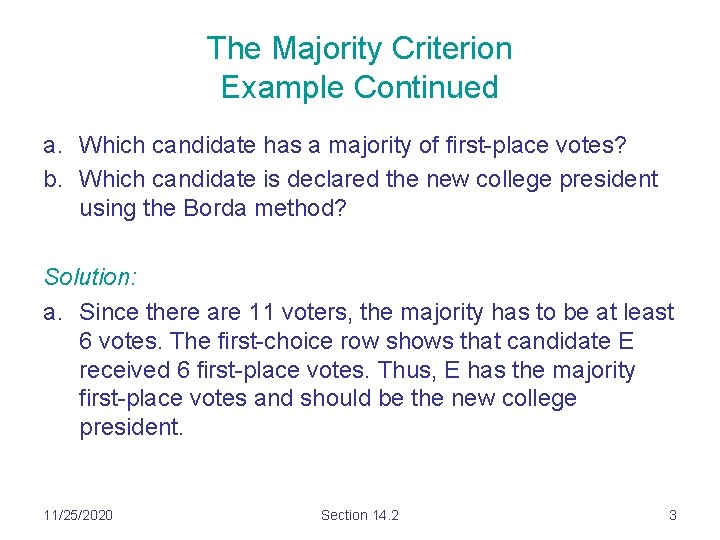
The Majority Criterion Example Continued a. Which candidate has a majority of first-place votes? b. Which candidate is declared the new college president using the Borda method? Solution: a. Since there are 11 voters, the majority has to be at least 6 votes. The first-choice row shows that candidate E received 6 first-place votes. Thus, E has the majority first-place votes and should be the new college president. 11/25/2020 Section 14. 2 3
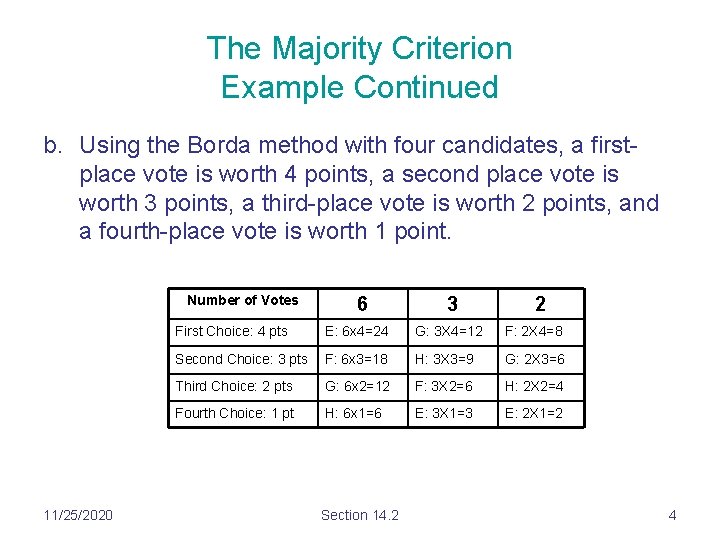
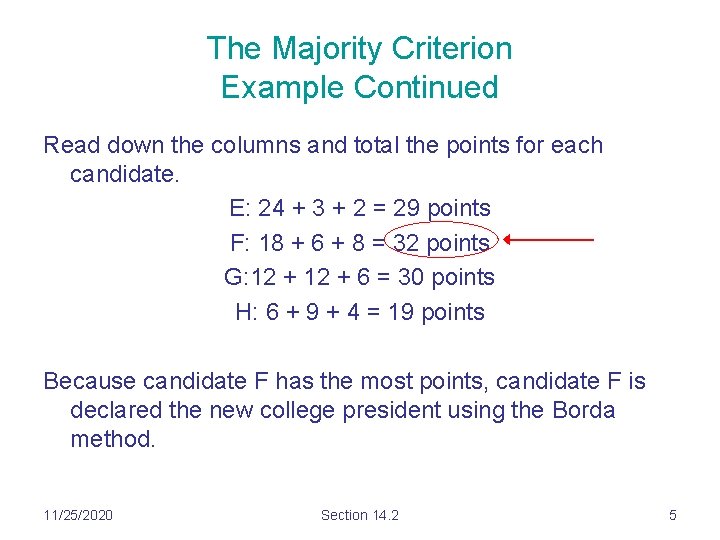
The Majority Criterion Example Continued b. Using the Borda method with four candidates, a firstplace vote is worth 4 points, a second place vote is worth 3 points, a third-place vote is worth 2 points, and a fourth-place vote is worth 1 point. Number of Votes 11/25/2020 6 3 2 First Choice: 4 pts E: 6 x 4=24 G: 3 X 4=12 F: 2 X 4=8 Second Choice: 3 pts F: 6 x 3=18 H: 3 X 3=9 G: 2 X 3=6 Third Choice: 2 pts G: 6 x 2=12 F: 3 X 2=6 H: 2 X 2=4 Fourth Choice: 1 pt H: 6 x 1=6 E: 3 X 1=3 E: 2 X 1=2 Section 14. 2 4
The Majority Criterion Example Continued Read down the columns and total the points for each candidate. E: 24 + 3 + 2 = 29 points F: 18 + 6 + 8 = 32 points G: 12 + 6 = 30 points H: 6 + 9 + 4 = 19 points Because candidate F has the most points, candidate F is declared the new college president using the Borda method. 11/25/2020 Section 14. 2 5
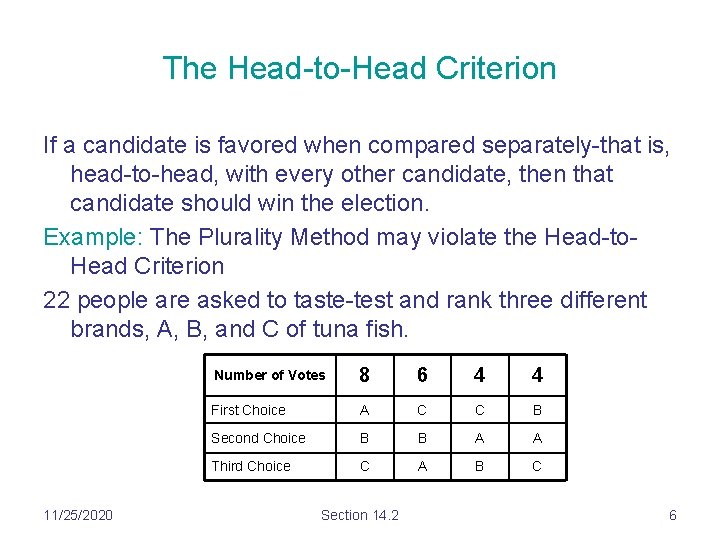
The Head-to-Head Criterion If a candidate is favored when compared separately-that is, head-to-head, with every other candidate, then that candidate should win the election. Example: The Plurality Method may violate the Head-to. Head Criterion 22 people are asked to taste-test and rank three different brands, A, B, and C of tuna fish. 11/25/2020 Number of Votes 8 6 4 4 First Choice A C C B Second Choice B B A A Third Choice C A B C Section 14. 2 6
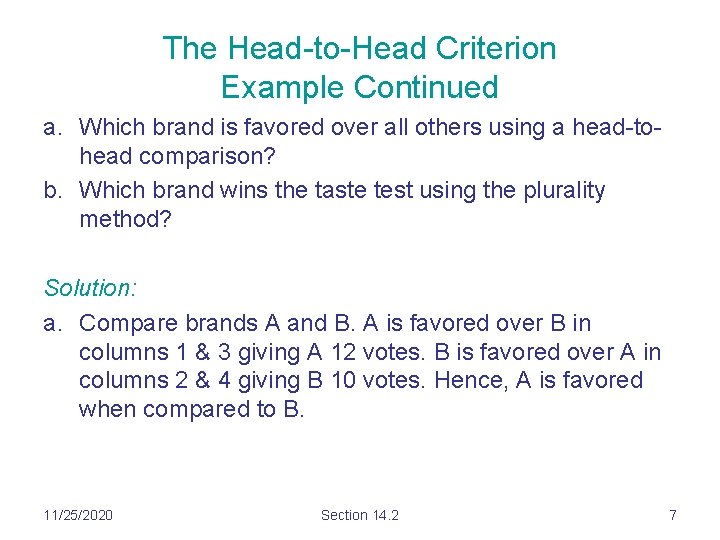
The Head-to-Head Criterion Example Continued a. Which brand is favored over all others using a head-tohead comparison? b. Which brand wins the taste test using the plurality method? Solution: a. Compare brands A and B. A is favored over B in columns 1 & 3 giving A 12 votes. B is favored over A in columns 2 & 4 giving B 10 votes. Hence, A is favored when compared to B. 11/25/2020 Section 14. 2 7
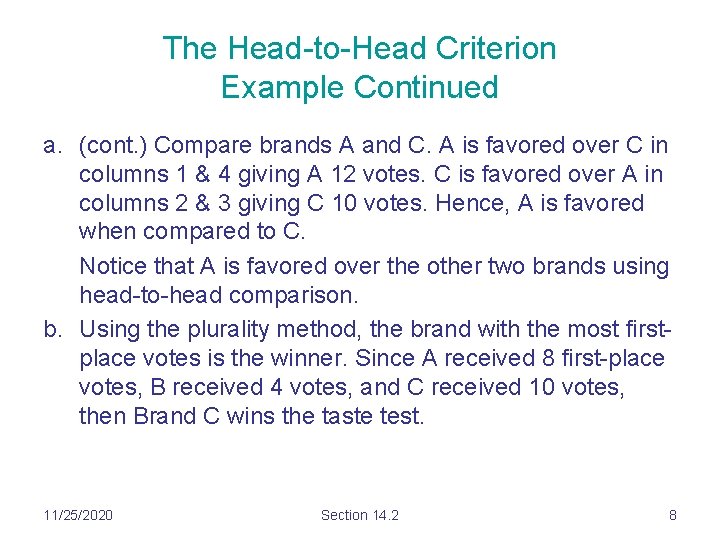
The Head-to-Head Criterion Example Continued a. (cont. ) Compare brands A and C. A is favored over C in columns 1 & 4 giving A 12 votes. C is favored over A in columns 2 & 3 giving C 10 votes. Hence, A is favored when compared to C. Notice that A is favored over the other two brands using head-to-head comparison. b. Using the plurality method, the brand with the most firstplace votes is the winner. Since A received 8 first-place votes, B received 4 votes, and C received 10 votes, then Brand C wins the taste test. 11/25/2020 Section 14. 2 8
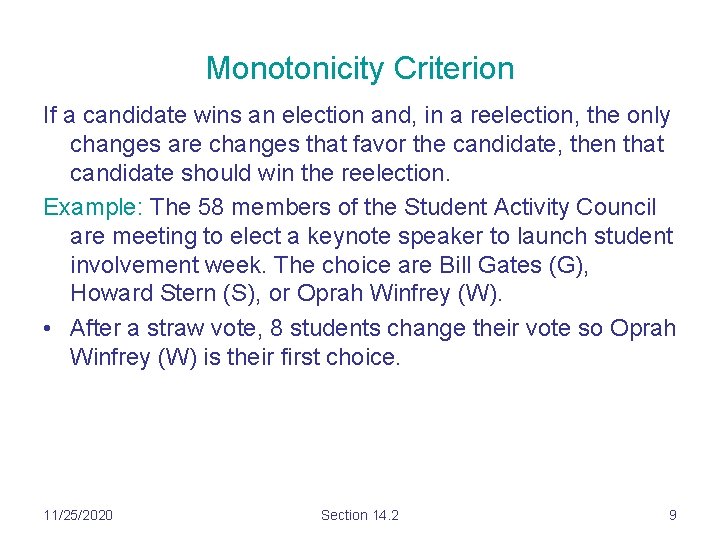
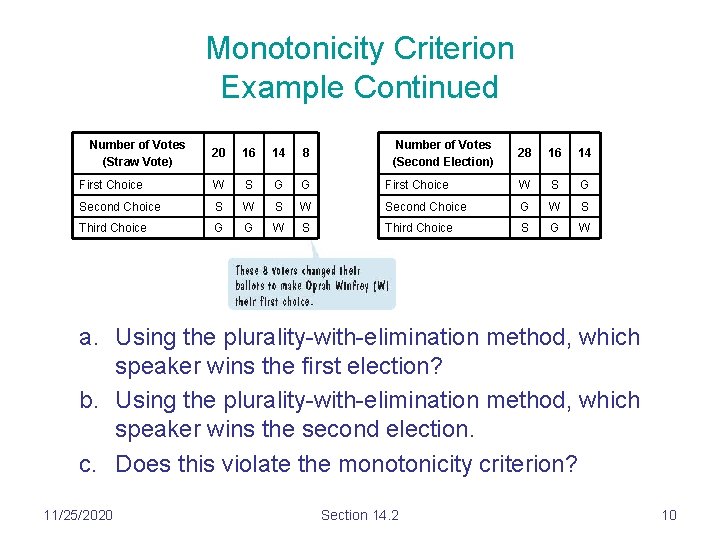
Monotonicity Criterion If a candidate wins an election and, in a reelection, the only changes are changes that favor the candidate, then that candidate should win the reelection. Example: The 58 members of the Student Activity Council are meeting to elect a keynote speaker to launch student involvement week. The choice are Bill Gates (G), Howard Stern (S), or Oprah Winfrey (W). • After a straw vote, 8 students change their vote so Oprah Winfrey (W) is their first choice. 11/25/2020 Section 14. 2 9
Monotonicity Criterion Example Continued Number of Votes (Straw Vote) 20 16 14 8 First Choice W S G G Second Choice S W S Third Choice G G W Number of Votes (Second Election) 28 16 14 First Choice W S G W Second Choice G W S S Third Choice S G W a. Using the plurality-with-elimination method, which speaker wins the first election? b. Using the plurality-with-elimination method, which speaker wins the second election. c. Does this violate the monotonicity criterion? 11/25/2020 Section 14. 2 10
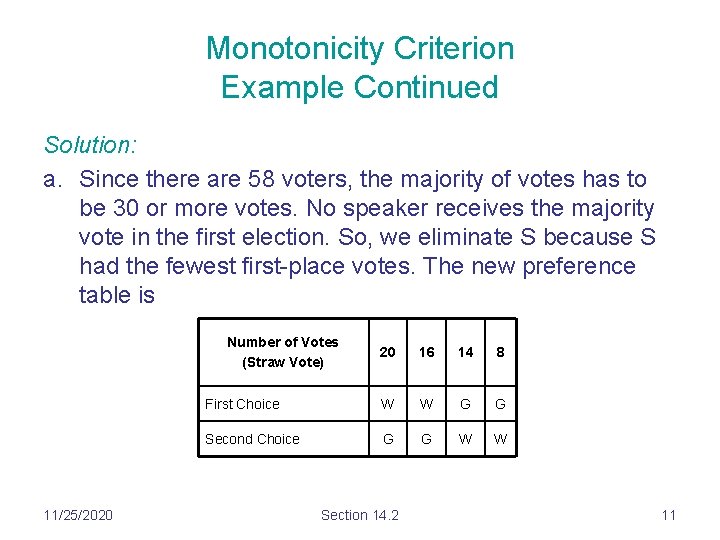
Monotonicity Criterion Example Continued Solution: a. Since there are 58 voters, the majority of votes has to be 30 or more votes. No speaker receives the majority vote in the first election. So, we eliminate S because S had the fewest first-place votes. The new preference table is Number of Votes (Straw Vote) 11/25/2020 20 16 14 8 First Choice W W G G Second Choice G G W W Section 14. 2 11
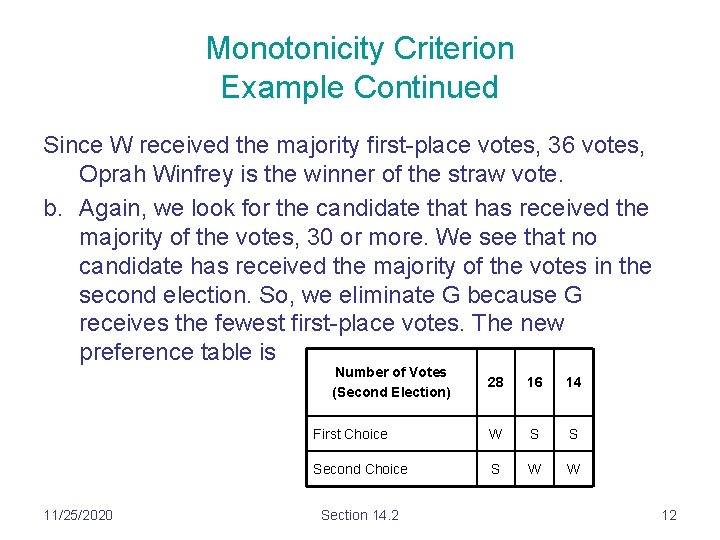
Monotonicity Criterion Example Continued Since W received the majority first-place votes, 36 votes, Oprah Winfrey is the winner of the straw vote. b. Again, we look for the candidate that has received the majority of the votes, 30 or more. We see that no candidate has received the majority of the votes in the second election. So, we eliminate G because G receives the fewest first-place votes. The new preference table is Number of Votes (Second Election) 11/25/2020 28 16 14 First Choice W S S Second Choice S W W Section 14. 2 12
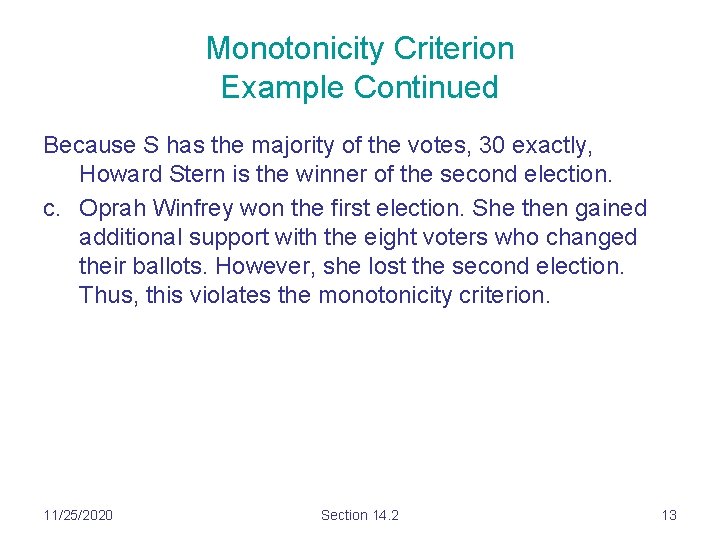
Monotonicity Criterion Example Continued Because S has the majority of the votes, 30 exactly, Howard Stern is the winner of the second election. c. Oprah Winfrey won the first election. She then gained additional support with the eight voters who changed their ballots. However, she lost the second election. Thus, this violates the monotonicity criterion. 11/25/2020 Section 14. 2 13
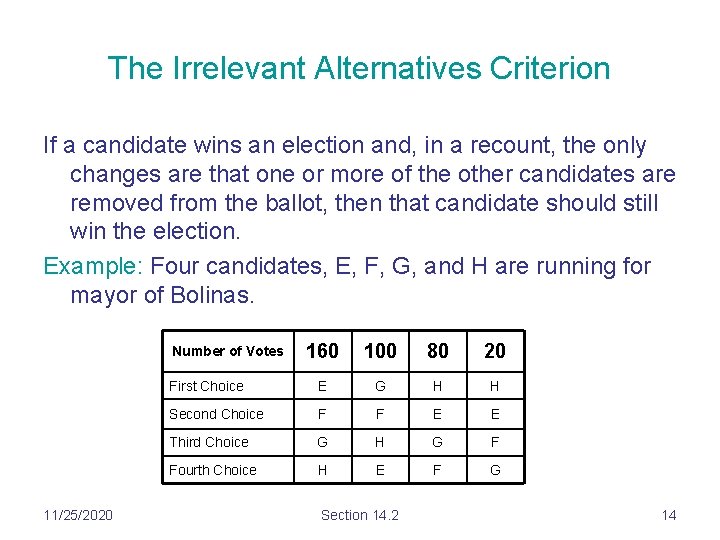
The Irrelevant Alternatives Criterion If a candidate wins an election and, in a recount, the only changes are that one or more of the other candidates are removed from the ballot, then that candidate should still win the election. Example: Four candidates, E, F, G, and H are running for mayor of Bolinas. 160 100 80 20 First Choice E G H H Second Choice F F E E Third Choice G H G F Fourth Choice H E F G Number of Votes 11/25/2020 Section 14. 2 14
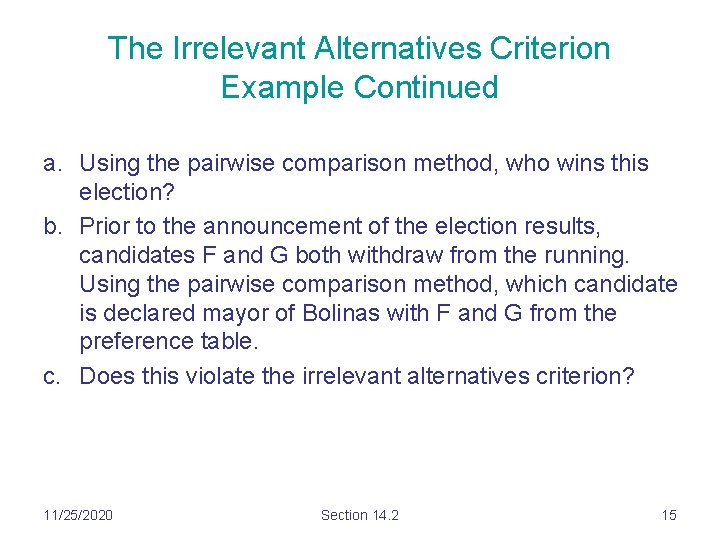
The Irrelevant Alternatives Criterion Example Continued a. Using the pairwise comparison method, who wins this election? b. Prior to the announcement of the election results, candidates F and G both withdraw from the running. Using the pairwise comparison method, which candidate is declared mayor of Bolinas with F and G from the preference table. c. Does this violate the irrelevant alternatives criterion? 11/25/2020 Section 14. 2 15
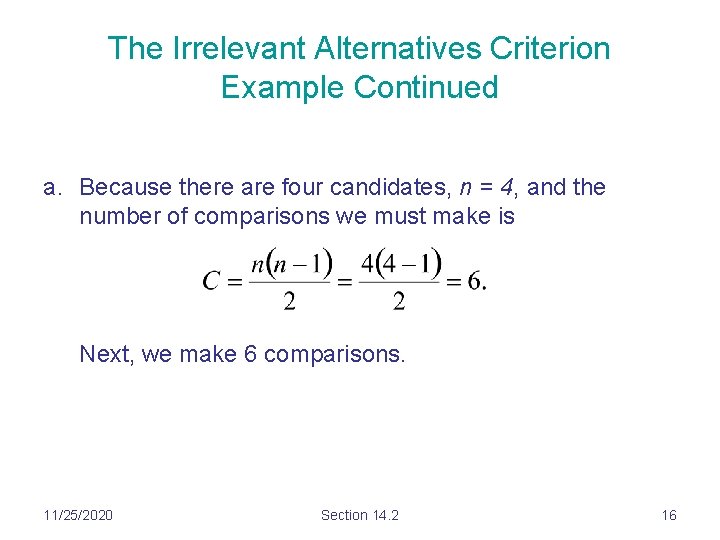
The Irrelevant Alternatives Criterion Example Continued a. Because there are four candidates, n = 4, and the number of comparisons we must make is Next, we make 6 comparisons. 11/25/2020 Section 14. 2 16
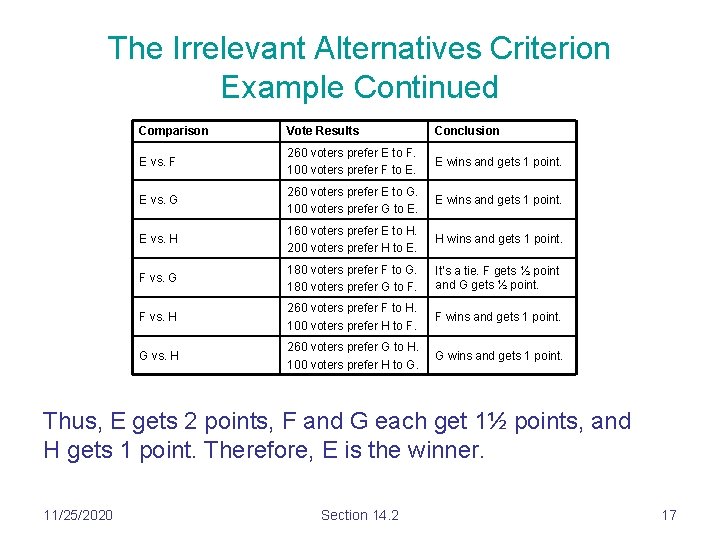
The Irrelevant Alternatives Criterion Example Continued Comparison Vote Results Conclusion E vs. F 260 voters prefer E to F. 100 voters prefer F to E. E wins and gets 1 point. E vs. G 260 voters prefer E to G. 100 voters prefer G to E. E wins and gets 1 point. E vs. H 160 voters prefer E to H. 200 voters prefer H to E. H wins and gets 1 point. F vs. G 180 voters prefer F to G. 180 voters prefer G to F. It’s a tie. F gets ½ point and G gets ½ point. F vs. H 260 voters prefer F to H. 100 voters prefer H to F. F wins and gets 1 point. G vs. H 260 voters prefer G to H. 100 voters prefer H to G. G wins and gets 1 point. Thus, E gets 2 points, F and G each get 1½ points, and H gets 1 point. Therefore, E is the winner. 11/25/2020 Section 14. 2 17
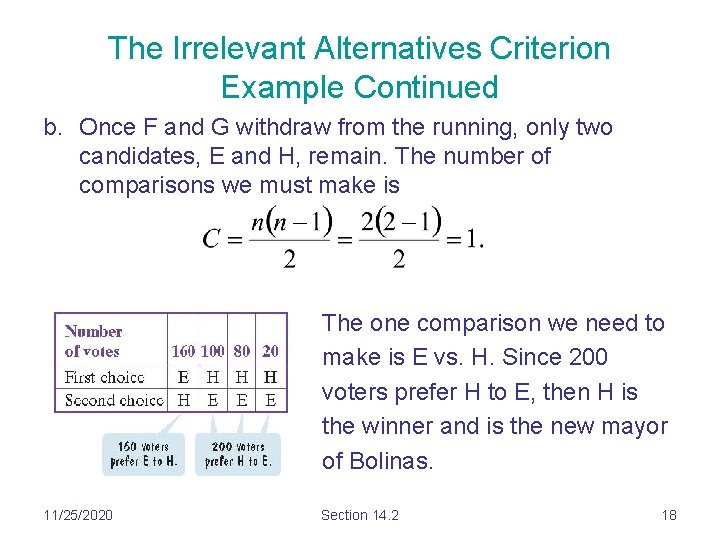
The Irrelevant Alternatives Criterion Example Continued b. Once F and G withdraw from the running, only two candidates, E and H, remain. The number of comparisons we must make is The one comparison we need to make is E vs. H. Since 200 voters prefer H to E, then H is the winner and is the new mayor of Bolinas. 11/25/2020 Section 14. 2 18
The Irrelevant Alternatives Criterion Example Continued c. The first election count produced E as the winner. When F and G were withdrawn from the election, the winner was H, not E. This violates the irrelevant alternatives criterion. 11/25/2020 Section 14. 2 19
The Search for a Fair Voting System Arrow’s Impossibility Theorem It is mathematically impossible for any democratic voting system to satisfy each of the four fairness criteria. • In 1951, economist Kenneth Arrow proved that there does not exist, and will never exist, any democratic voting system that satisfies all of the fairness criteria. 11/25/2020 Section 14. 2 20