
SECTION 13 2 COMPARING TWO POPULATION PROPORTION FORMULAS
- Slides: 17
SECTION 13. 2 COMPARING TWO POPULATION PROPORTION
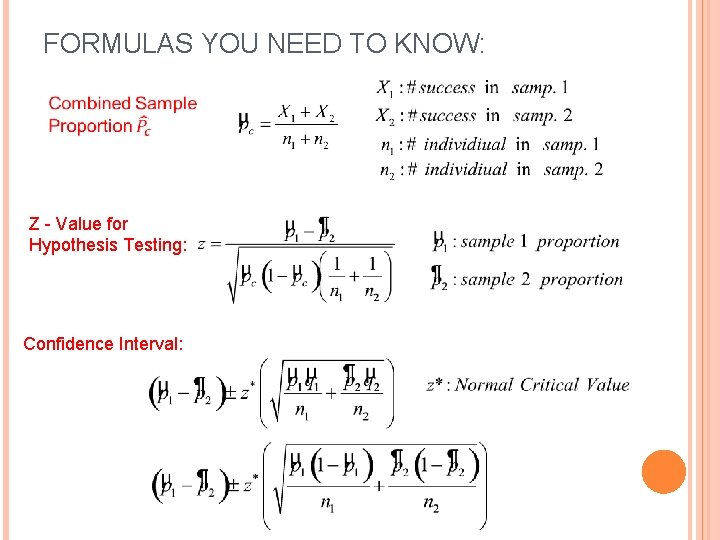
FORMULAS YOU NEED TO KNOW: Z - Value for Hypothesis Testing: Confidence Interval:
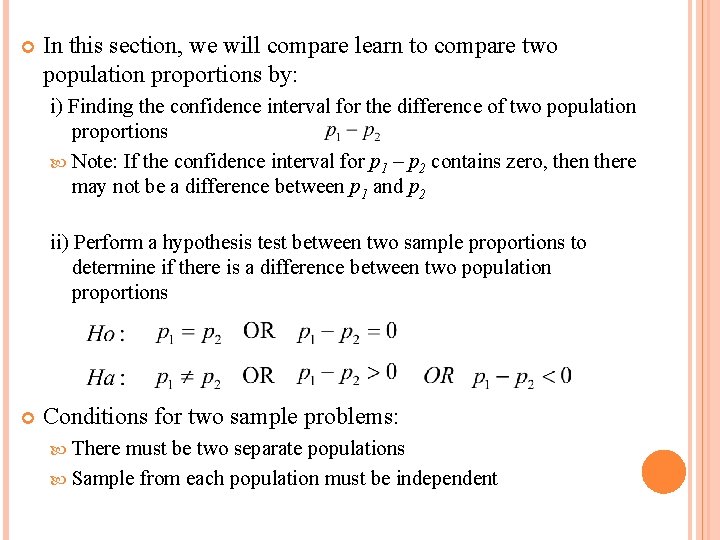
In this section, we will compare learn to compare two population proportions by: i) Finding the confidence interval for the difference of two population proportions Note: If the confidence interval for p 1 – p 2 contains zero, then there may not be a difference between p 1 and p 2 ii) Perform a hypothesis test between two sample proportions to determine if there is a difference between two population proportions Conditions for two sample problems: There must be two separate populations Sample from each population must be independent
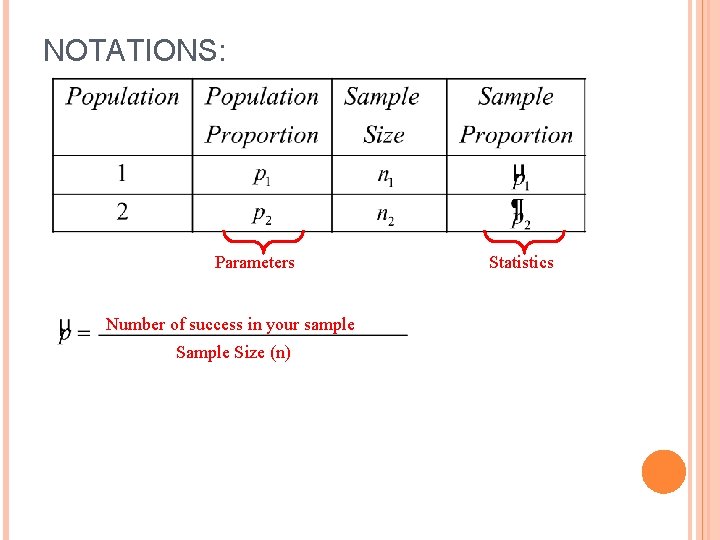
NOTATIONS: Parameters Number of success in your sample Size (n) Statistics
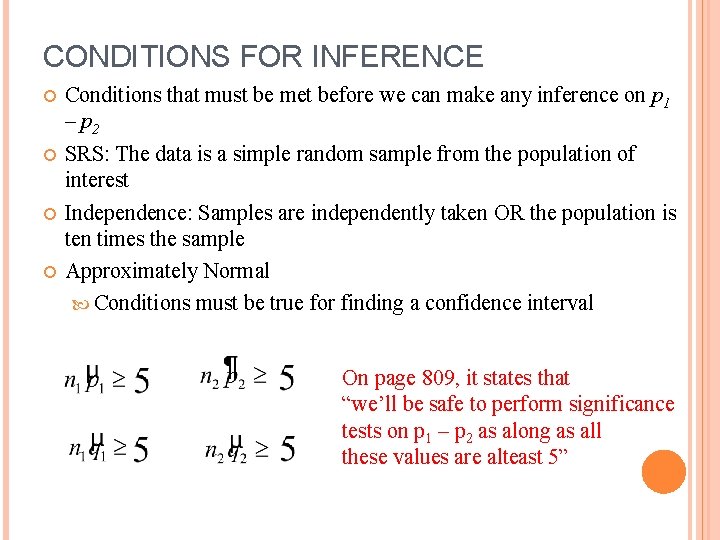
CONDITIONS FOR INFERENCE Conditions that must be met before we can make any inference on p 1 – p 2 SRS: The data is a simple random sample from the population of interest Independence: Samples are independently taken OR the population is ten times the sample Approximately Normal Conditions must be true for finding a confidence interval On page 809, it states that “we’ll be safe to perform significance tests on p 1 – p 2 as along as all these values are alteast 5”
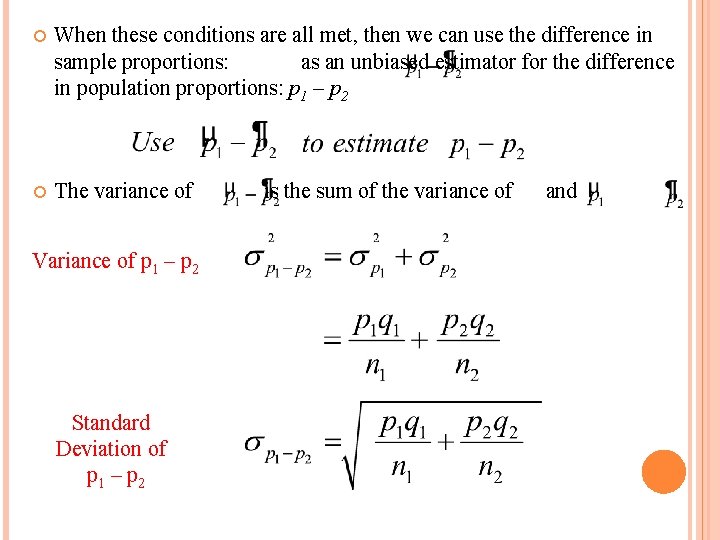
When these conditions are all met, then we can use the difference in sample proportions: as an unbiased estimator for the difference in population proportions: p 1 – p 2 The variance of Variance of p 1 – p 2 Standard Deviation of p 1 – p 2 is the sum of the variance of and
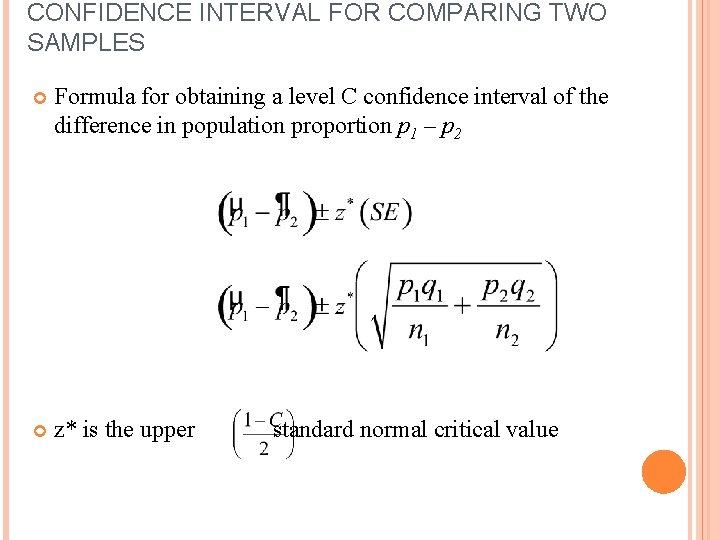
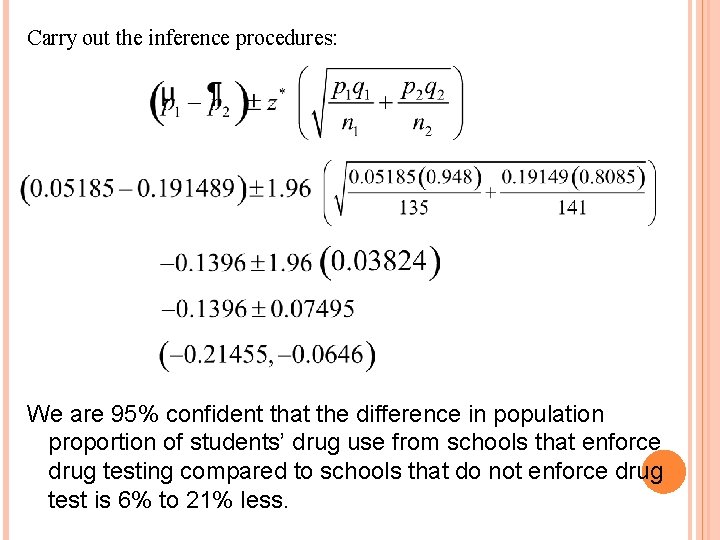
CONFIDENCE INTERVAL FOR COMPARING TWO SAMPLES Formula for obtaining a level C confidence interval of the difference in population proportion p 1 – p 2 z* is the upper standard normal critical value
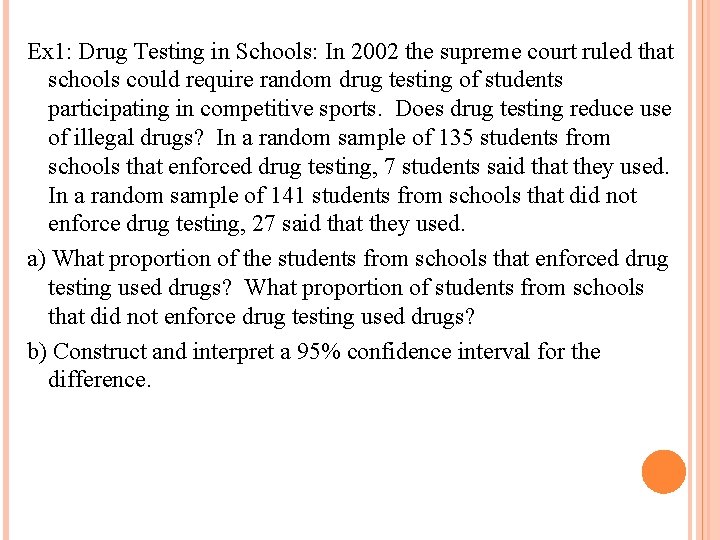
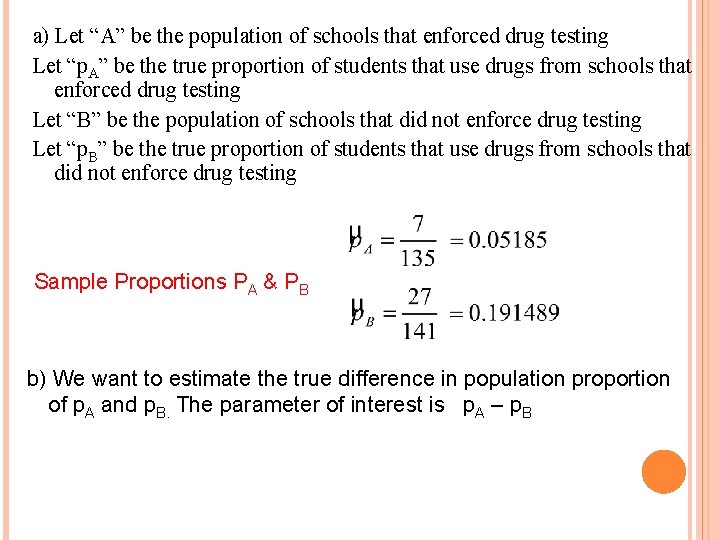
Ex 1: Drug Testing in Schools: In 2002 the supreme court ruled that schools could require random drug testing of students participating in competitive sports. Does drug testing reduce use of illegal drugs? In a random sample of 135 students from schools that enforced drug testing, 7 students said that they used. In a random sample of 141 students from schools that did not enforce drug testing, 27 said that they used. a) What proportion of the students from schools that enforced drug testing used drugs? What proportion of students from schools that did not enforce drug testing used drugs? b) Construct and interpret a 95% confidence interval for the difference.
a) Let “A” be the population of schools that enforced drug testing Let “p. A” be the true proportion of students that use drugs from schools that enforced drug testing Let “B” be the population of schools that did not enforce drug testing Let “p. B” be the true proportion of students that use drugs from schools that did not enforce drug testing Sample Proportions PA & PB b) We want to estimate the true difference in population proportion of p. A and p. B. The parameter of interest is p. A – p. B
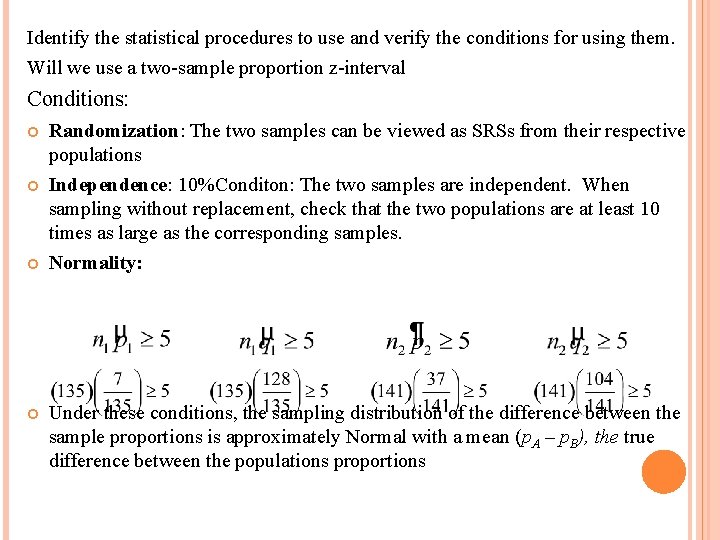
Identify the statistical procedures to use and verify the conditions for using them. Will we use a two-sample proportion z-interval Conditions: Randomization: The two samples can be viewed as SRSs from their respective populations Independence: 10%Conditon: The two samples are independent. When sampling without replacement, check that the two populations are at least 10 times as large as the corresponding samples. Normality: Under these conditions, the sampling distribution of the difference between the sample proportions is approximately Normal with a mean (p. A – p. B), the true difference between the populations proportions
Carry out the inference procedures: We are 95% confident that the difference in population proportion of students’ drug use from schools that enforce drug testing compared to schools that do not enforce drug test is 6% to 21% less.
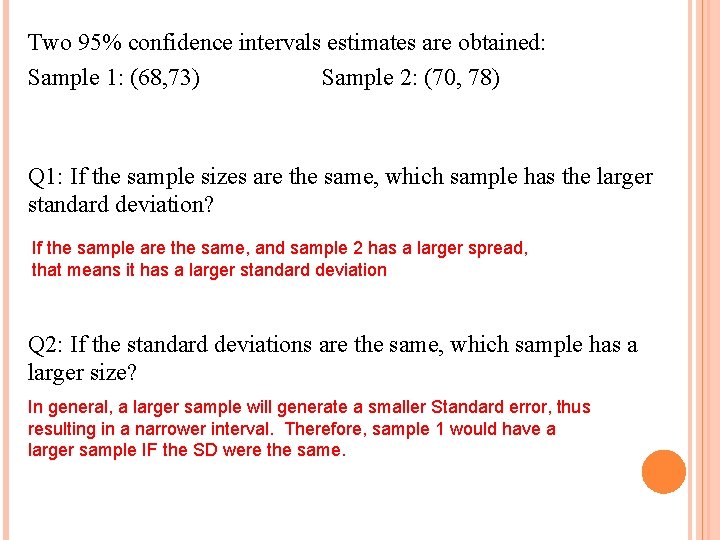
Two 95% confidence intervals estimates are obtained: Sample 1: (68, 73) Sample 2: (70, 78) Q 1: If the sample sizes are the same, which sample has the larger standard deviation? If the sample are the same, and sample 2 has a larger spread, that means it has a larger standard deviation Q 2: If the standard deviations are the same, which sample has a larger size? In general, a larger sample will generate a smaller Standard error, thus resulting in a narrower interval. Therefore, sample 1 would have a larger sample IF the SD were the same.
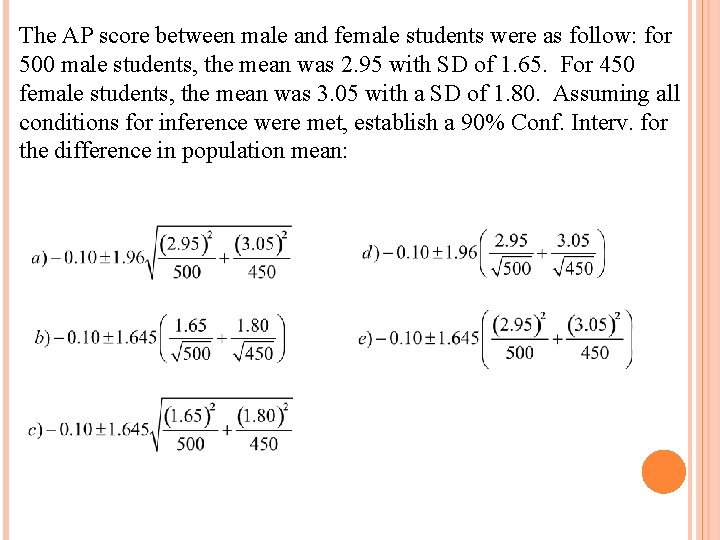
The AP score between male and female students were as follow: for 500 male students, the mean was 2. 95 with SD of 1. 65. For 450 female students, the mean was 3. 05 with a SD of 1. 80. Assuming all conditions for inference were met, establish a 90% Conf. Interv. for the difference in population mean:
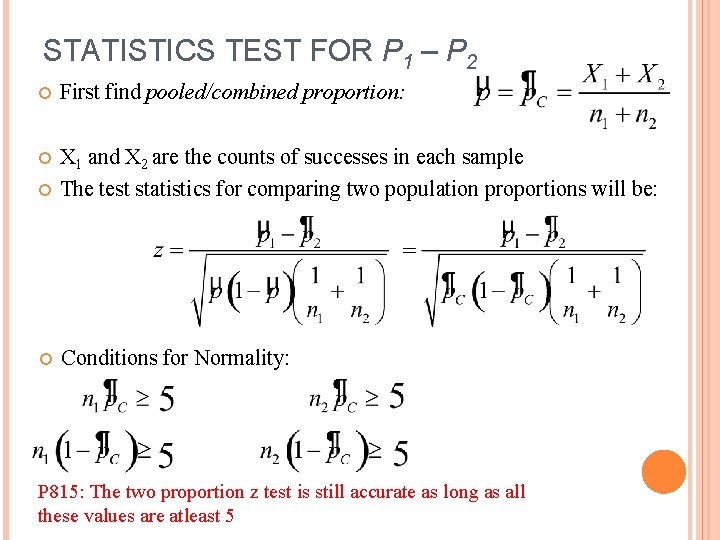
STATISTICS TEST FOR P 1 – P 2 First find pooled/combined proportion: X 1 and X 2 are the counts of successes in each sample The test statistics for comparing two population proportions will be: Conditions for Normality: P 815: The two proportion z test is still accurate as long as all these values are atleast 5
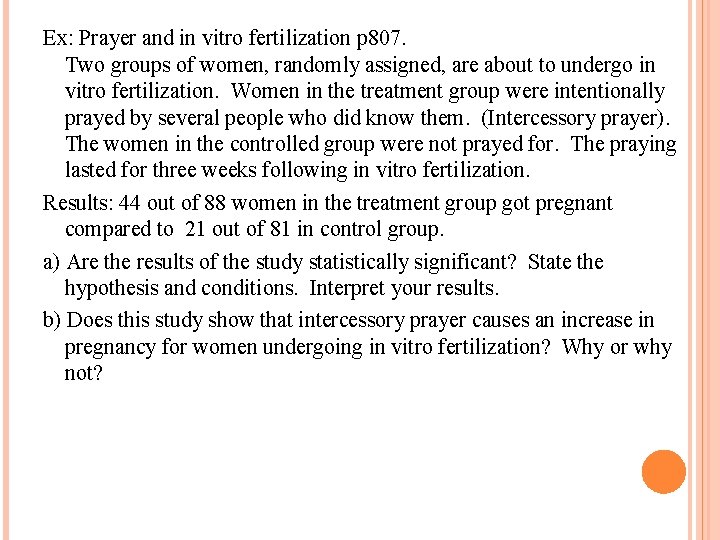
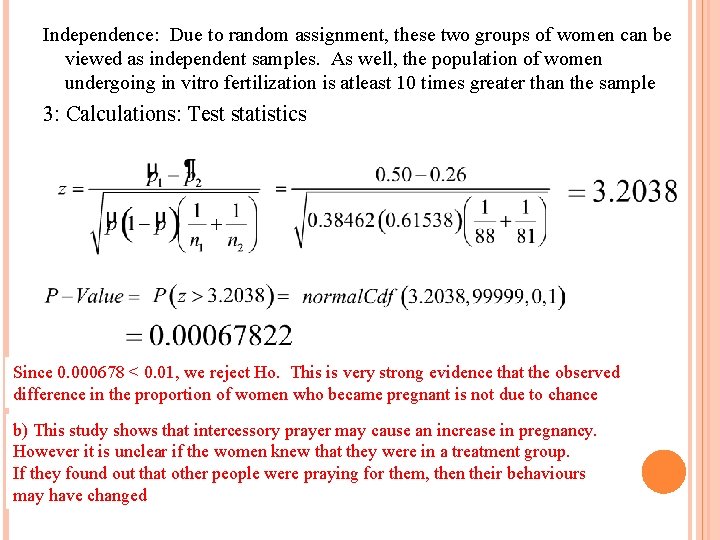
Ex: Prayer and in vitro fertilization p 807. Two groups of women, randomly assigned, are about to undergo in vitro fertilization. Women in the treatment group were intentionally prayed by several people who did know them. (Intercessory prayer). The women in the controlled group were not prayed for. The praying lasted for three weeks following in vitro fertilization. Results: 44 out of 88 women in the treatment group got pregnant compared to 21 out of 81 in control group. a) Are the results of the study statistically significant? State the hypothesis and conditions. Interpret your results. b) Does this study show that intercessory prayer causes an increase in pregnancy for women undergoing in vitro fertilization? Why or why not?
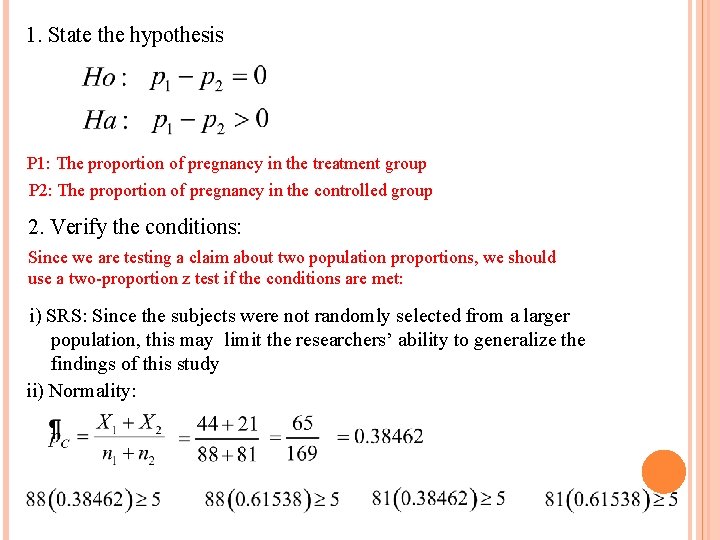
1. State the hypothesis P 1: The proportion of pregnancy in the treatment group P 2: The proportion of pregnancy in the controlled group 2. Verify the conditions: Since we are testing a claim about two population proportions, we should use a two-proportion z test if the conditions are met: i) SRS: Since the subjects were not randomly selected from a larger population, this may limit the researchers’ ability to generalize the findings of this study ii) Normality:
Independence: Due to random assignment, these two groups of women can be viewed as independent samples. As well, the population of women undergoing in vitro fertilization is atleast 10 times greater than the sample 3: Calculations: Test statistics Since 0. 000678 < 0. 01, we reject Ho. This is very strong evidence that the observed difference in the proportion of women who became pregnant is not due to chance b) This study shows that intercessory prayer may cause an increase in pregnancy. However it is unclear if the women knew that they were in a treatment group. If they found out that other people were praying for them, then their behaviours may have changed