
Section 13 1 Wave Action Wave Action How

- Slides: 32
Section 13 – 1 Wave Action
Wave Action How does a wave form? How does wavelength and wave height change as a wave enters shallow water? What factors determine the size of a wave?
Wave Action
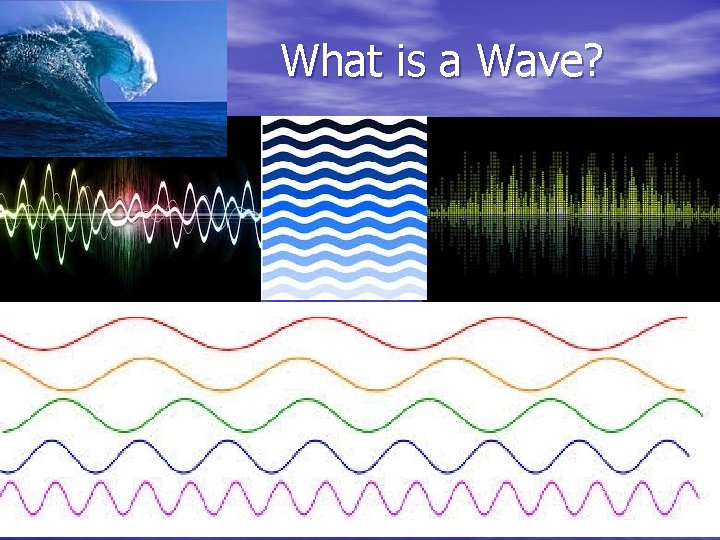
What is a Wave?
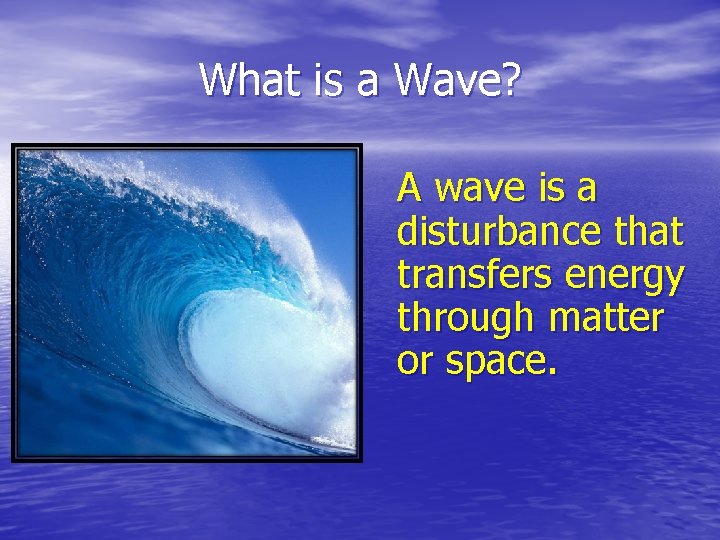
What is a Wave? A wave is a disturbance that transfers energy through matter or space.
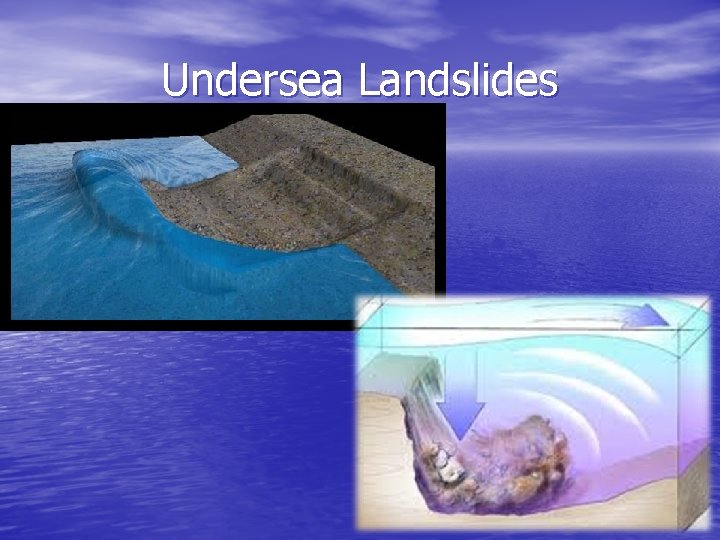
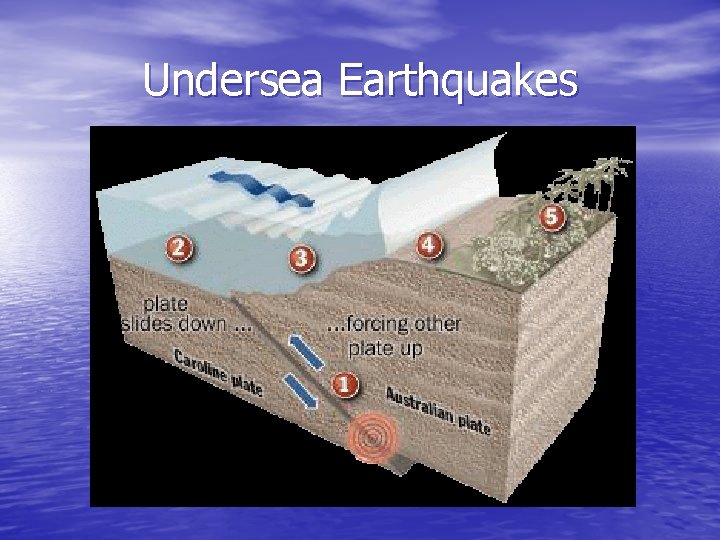
What causes a Wave? • Wind transfers energy into the sea causing waves to occur. • Undersea earthquakes and landslides can also put energy into the water to produce ocean waves. • 1. Wind • 2. undersea earthquakes • 3. undersea landslides
Undersea Landslides
Undersea Earthquakes
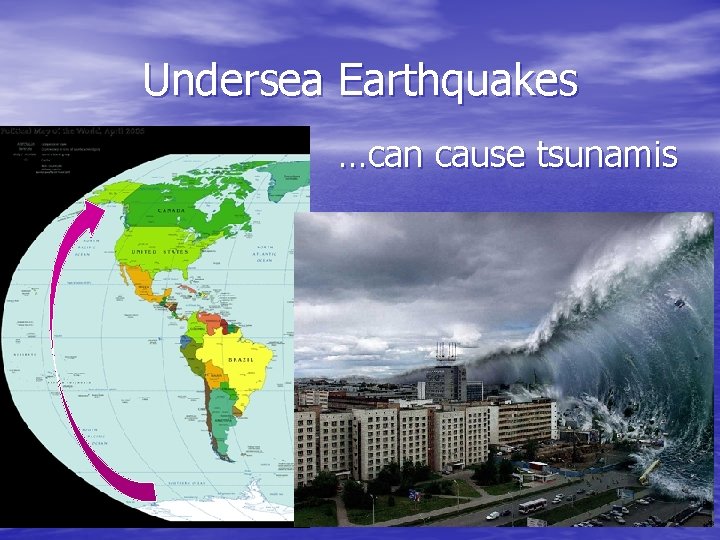
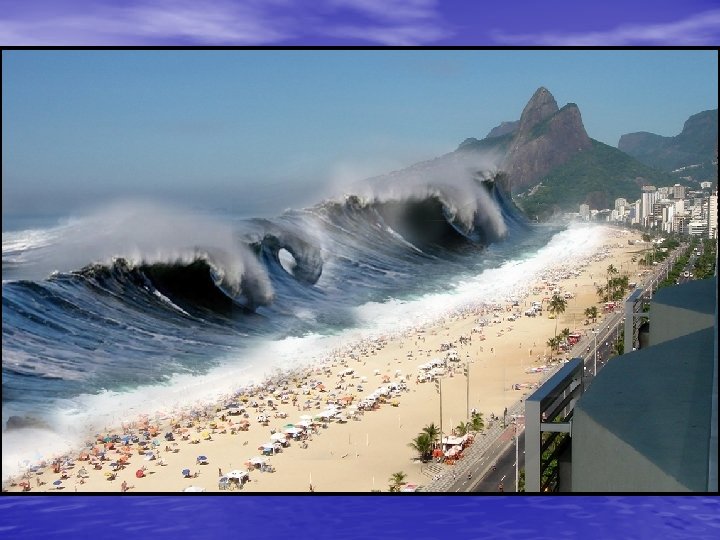
Undersea Earthquakes …can cause tsunamis
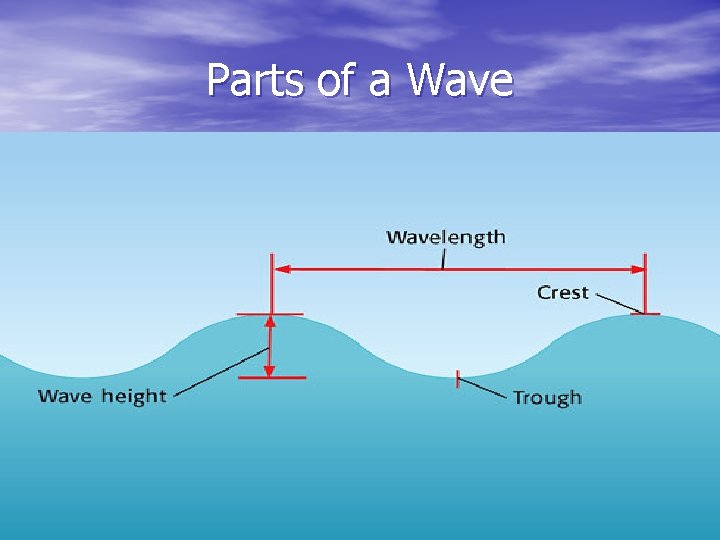
Parts of a Wave
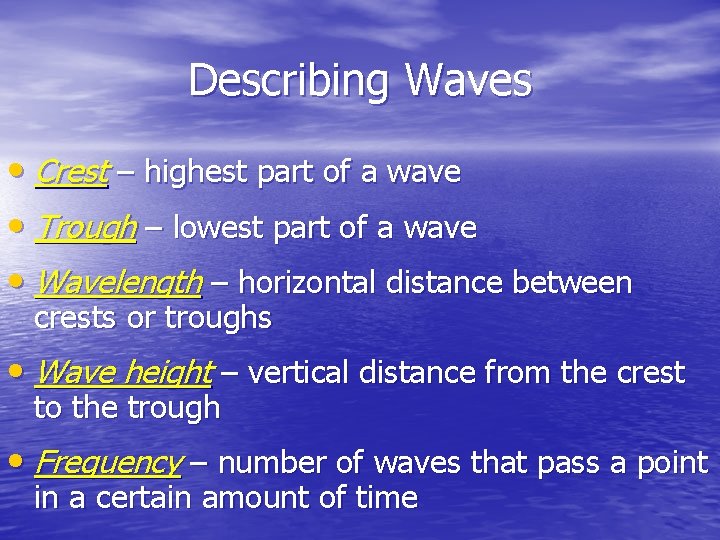
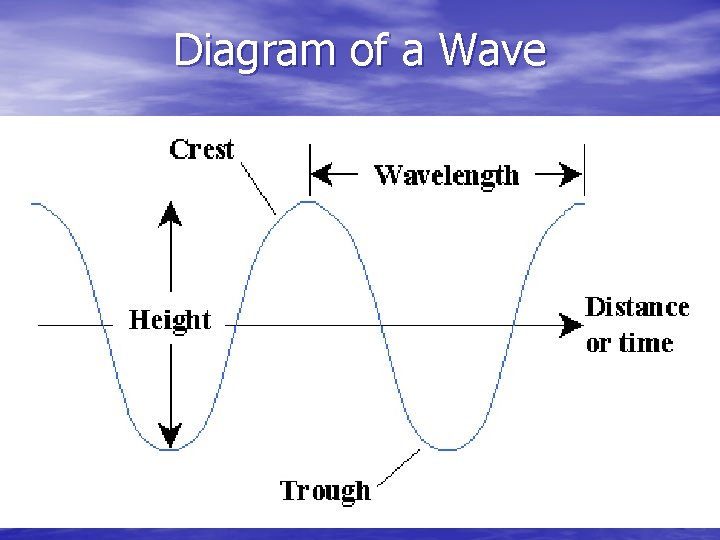
Describing Waves • Crest – highest part of a wave • Trough – lowest part of a wave • Wavelength – horizontal distance between crests or troughs • Wave height – vertical distance from the crest to the trough • Frequency – number of waves that pass a point in a certain amount of time
Diagram of a Wave
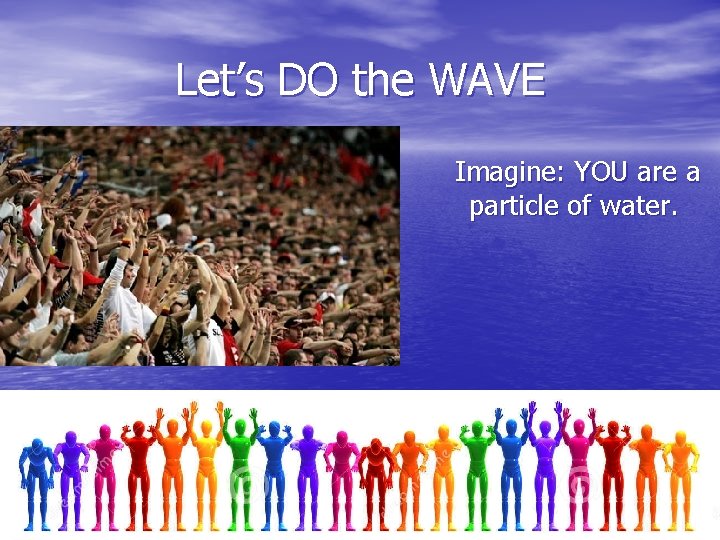
Let’s DO the WAVE Imagine: YOU are a particle of water.
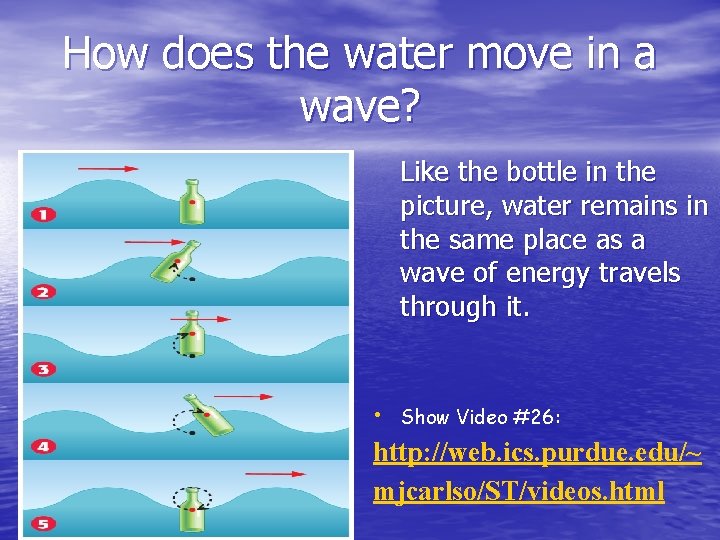
How does the water move in a wave? Like the bottle in the picture, water remains in the same place as a wave of energy travels through it. • Show Video #26: http: //web. ics. purdue. edu/~ mjcarlso/ST/videos. html
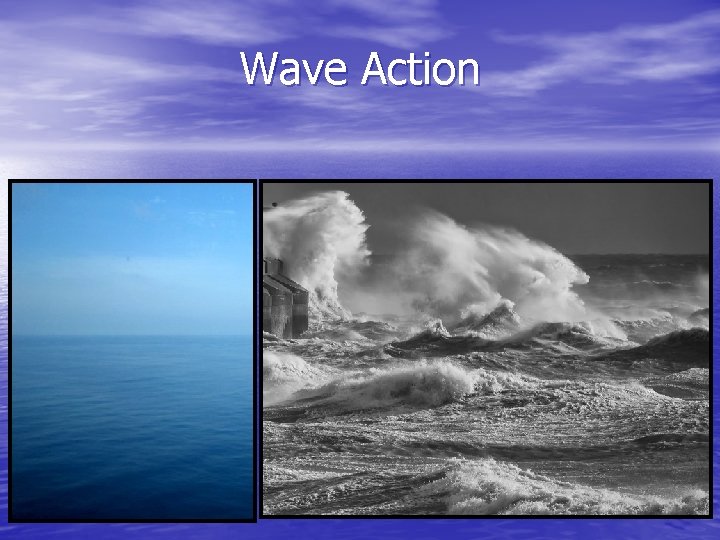
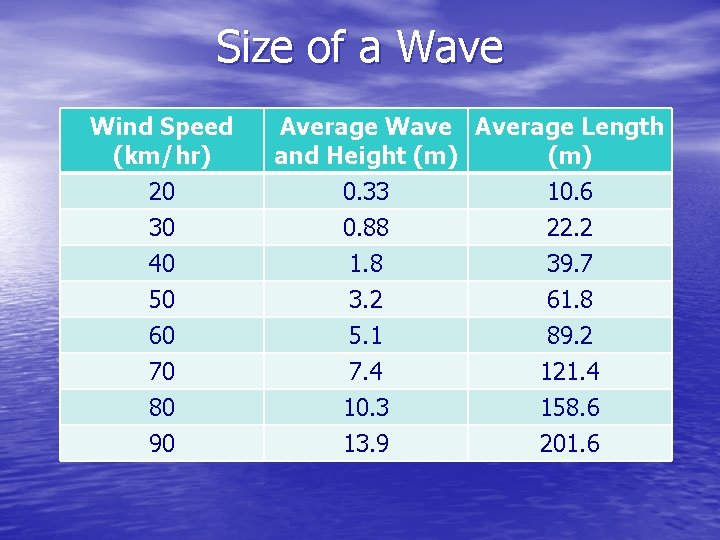
Size of a Wave • Wave size depends on the amount of energy that is transferred to the water. • The amount of energy transferred depends on three things: – Wind speed – Length of time it blows – Distance over which it blows • As each of these factors increase, so does the size of the wave.
Size of a Wave Wind Speed (km/hr) 20 30 40 50 60 70 80 90 Average Wave Average Length and Height (m) 0. 33 10. 6 0. 88 22. 2 1. 8 39. 7 3. 2 61. 8 5. 1 89. 2 7. 4 121. 4 10. 3 158. 6 13. 9 201. 6
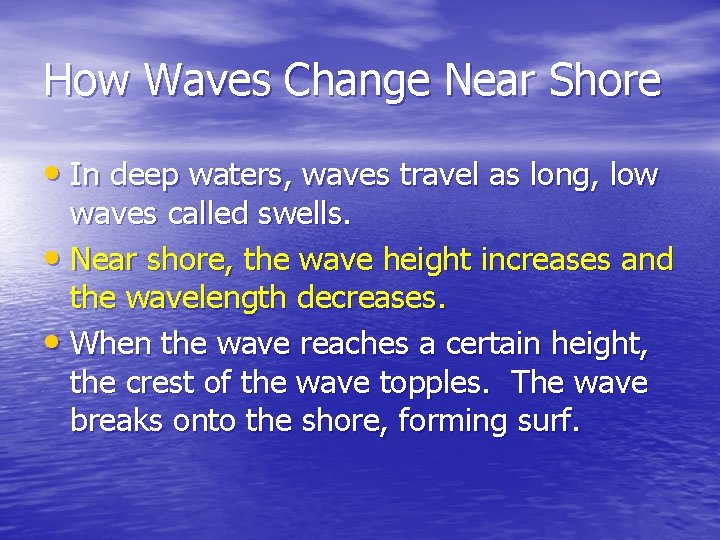
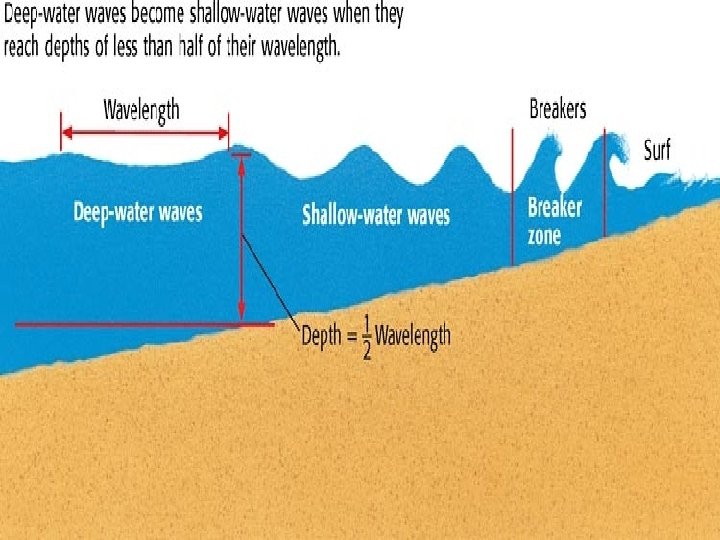
How Waves Change Near Shore • In deep waters, waves travel as long, low waves called swells. • Near shore, the wave height increases and the wavelength decreases. • When the wave reaches a certain height, the crest of the wave topples. The wave breaks onto the shore, forming surf.
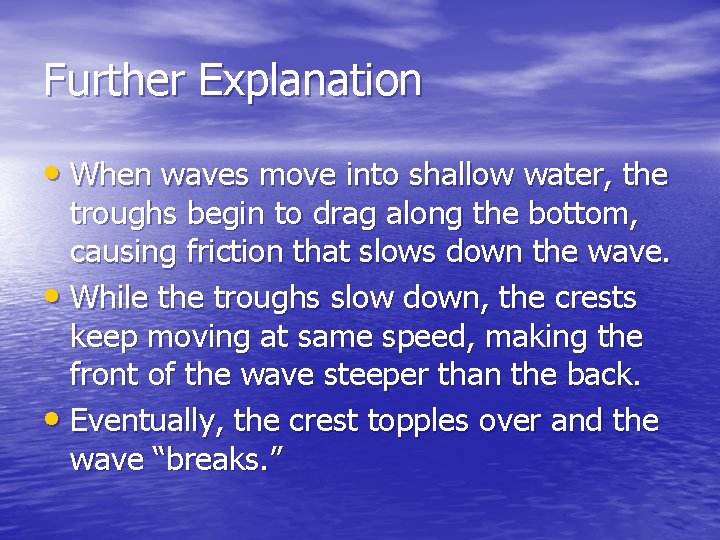
Further Explanation • When waves move into shallow water, the troughs begin to drag along the bottom, causing friction that slows down the wave. • While the troughs slow down, the crests keep moving at same speed, making the front of the wave steeper than the back. • Eventually, the crest topples over and the wave “breaks. ”
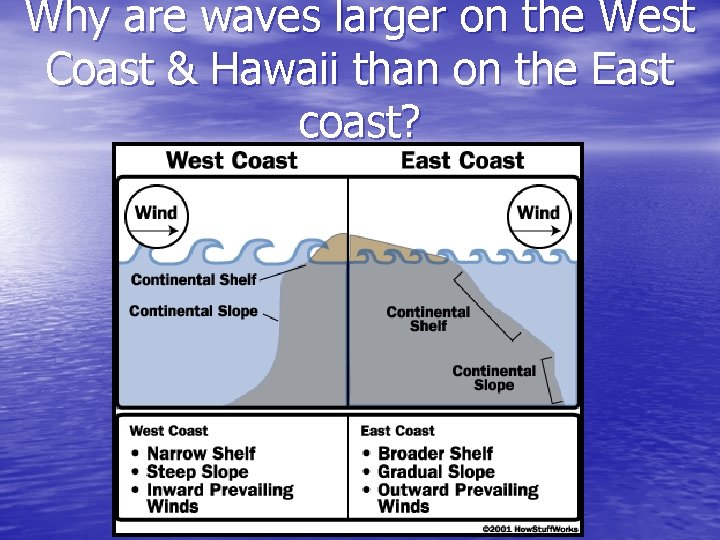
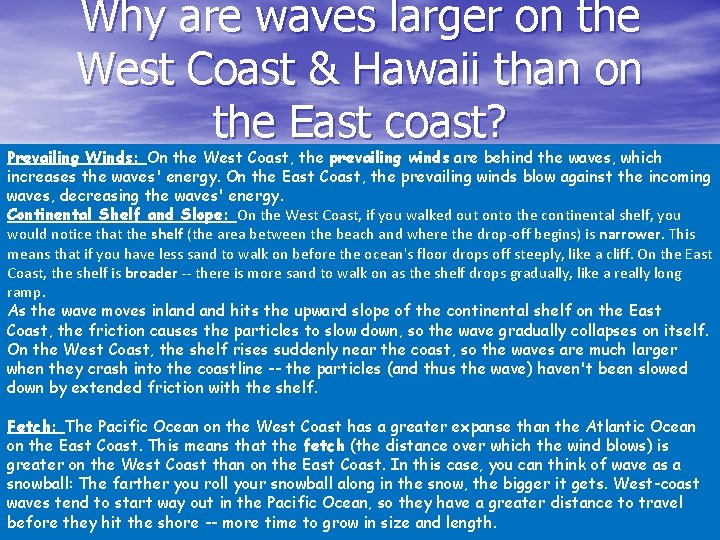
Why are waves larger on the West Coast & Hawaii than on the East coast?
Why are waves larger on the West Coast & Hawaii than on the East coast? Prevailing Winds: On the West Coast, the prevailing winds are behind the waves, which increases the waves' energy. On the East Coast, the prevailing winds blow against the incoming waves, decreasing the waves' energy. Continental Shelf and Slope: On the West Coast, if you walked out onto the continental shelf, you would notice that the shelf (the area between the beach and where the drop-off begins) is narrower. This means that if you have less sand to walk on before the ocean's floor drops off steeply, like a cliff. On the East Coast, the shelf is broader -- there is more sand to walk on as the shelf drops gradually, like a really long ramp. As the wave moves inland hits the upward slope of the continental shelf on the East Coast, the friction causes the particles to slow down, so the wave gradually collapses on itself. On the West Coast, the shelf rises suddenly near the coast, so the waves are much larger when they crash into the coastline -- the particles (and thus the wave) haven't been slowed down by extended friction with the shelf. Fetch: The Pacific Ocean on the West Coast has a greater expanse than the Atlantic Ocean on the East Coast. This means that the fetch (the distance over which the wind blows) is greater on the West Coast than on the East Coast. In this case, you can think of wave as a snowball: The farther you roll your snowball along in the snow, the bigger it gets. West-coast waves tend to start way out in the Pacific Ocean, so they have a greater distance to travel before they hit the shore -- more time to grow in size and length.
How Waves Affect the Shore • Sandbars • Rip Currents • Longshore Drift
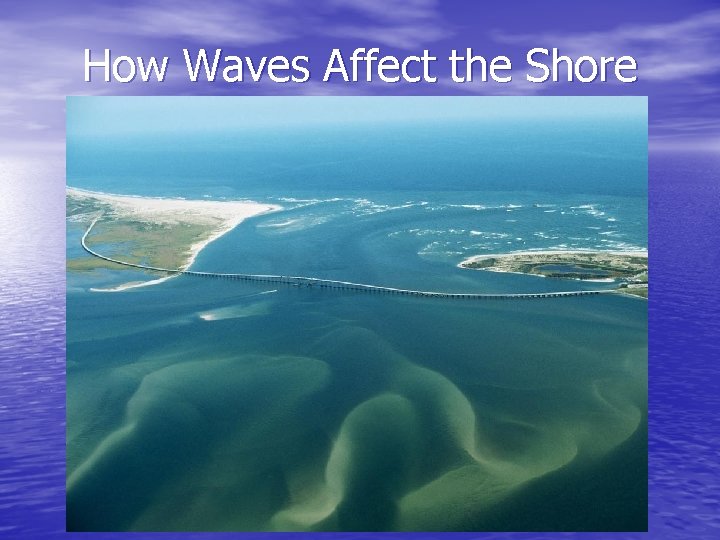
How Waves Affect the Shore
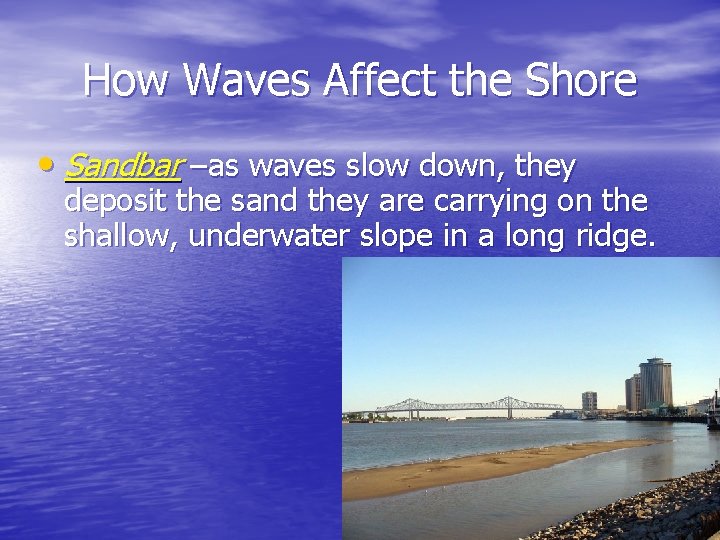
How Waves Affect the Shore • Sandbar –as waves slow down, they deposit the sand they are carrying on the shallow, underwater slope in a long ridge.
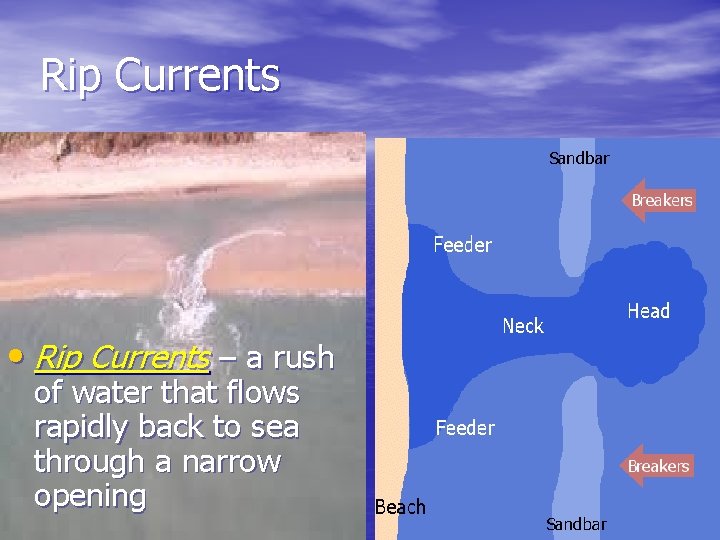
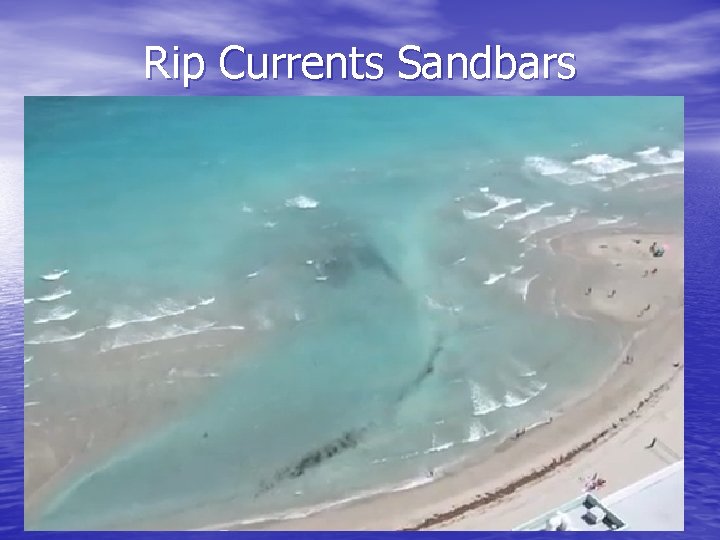
Rip Currents • Rip Currents – a rush of water that flows rapidly back to sea through a narrow opening
Rip Currents Sandbars
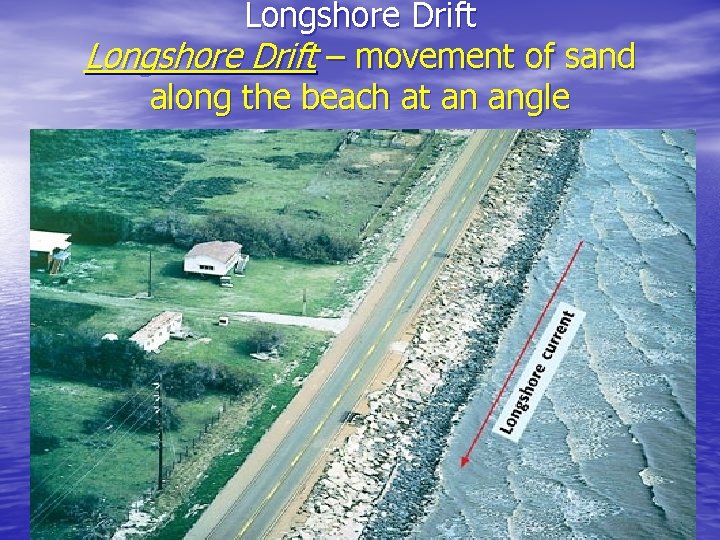
Longshore Drift – movement of sand along the beach at an angle
Longshore Drift • Longshore Drift Video • http: //www. youtube. com/watch? v=U 9 Eh. V a 4 Mm. Es
Beach Erosion • Over time, erosion can wear away a beach • Threatens homes, buildings, property • Video of Erosion Wearing away shoreline: – http: //www. youtube. com/watch? v=z. Uh 3 Weil. F N 4 – Landforms on coast: http: //www. youtube. com/watch? v=ZWEJq 03 NBao
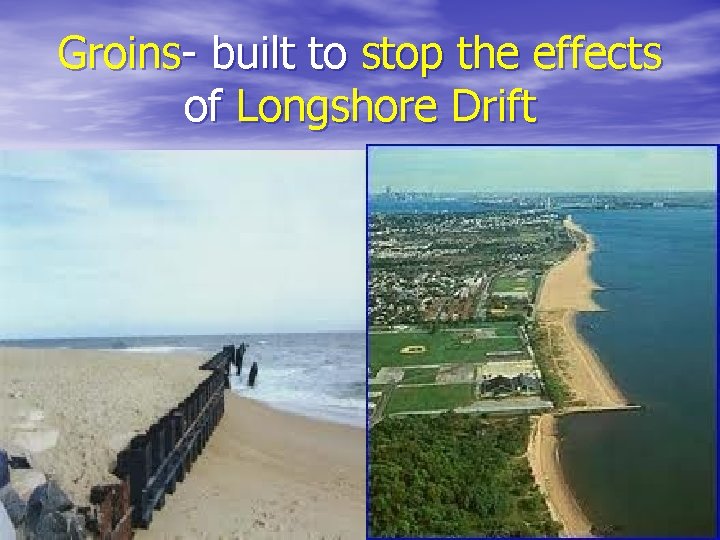
Reducing Beach Erosion • groin – a wall of rocks or concrete to reduce erosion along a stretch of beach& stop the effects of longshore drift. • However, Building groins can increases the amount of erosion farther down the beach
Groins- built to stop the effects of Longshore Drift