
SECTION 12 1 TESTS ABOUT A POPULATION MEAN
SECTION 12. 1 TESTS ABOUT A POPULATION MEAN:
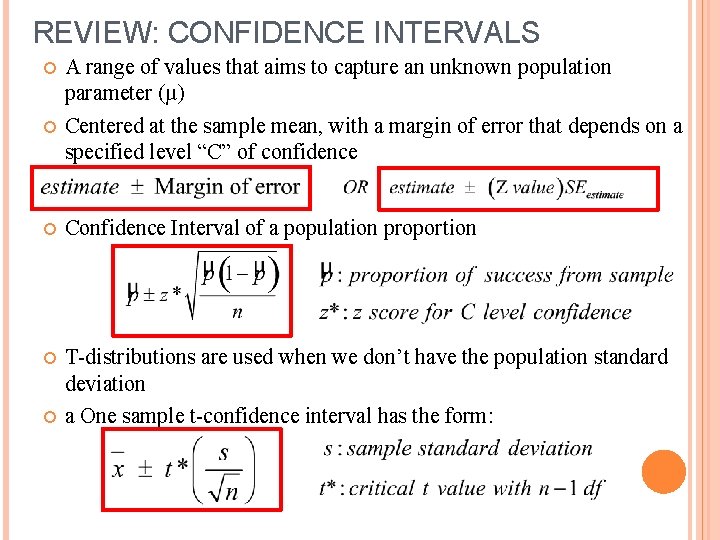
REVIEW: CONFIDENCE INTERVALS A range of values that aims to capture an unknown population parameter (µ) Centered at the sample mean, with a margin of error that depends on a specified level “C” of confidence Confidence Interval of a population proportion T-distributions are used when we don’t have the population standard deviation a One sample t-confidence interval has the form:
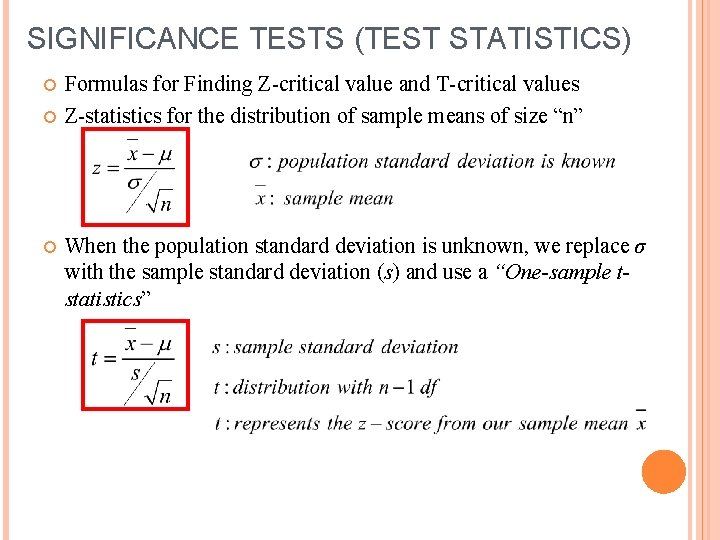
SIGNIFICANCE TESTS (TEST STATISTICS) Formulas for Finding Z-critical value and T-critical values Z-statistics for the distribution of sample means of size “n” When the population standard deviation is unknown, we replace σ with the sample standard deviation (s) and use a “One-sample tstatistics”

REVIEW: STEPS FOR CONDUCTING A SIGNIFICANCE TEST 1. State the Null and Alternative Hypothesis a) Null (Ho) always indicates no change, μ is always equal to something (Assumed pop. Mean) b) Alternative (Ha) Always greater, less than, or not equal to something (Assumed pop. Mean) 2. State and Verify the conditions required for performing significance test a) SRS look for this in the question, if it’s not there, indicate that you assume that it is b) Independence most subjects are independent of each other c) Normality np and nq >10, N>10 n 3. Use sample mean to find Z-value P-value 4. If Pvalue < α Reject Ho, 5. Pvalue > α DO NOT Reject Ho
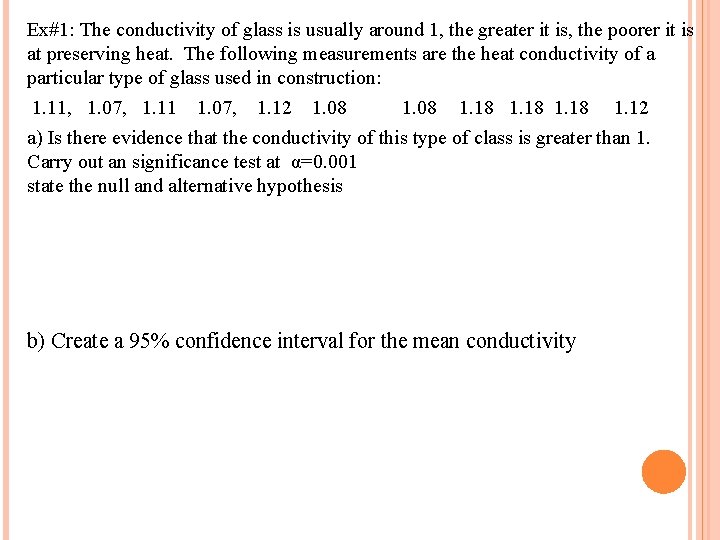
Ex#1: The conductivity of glass is usually around 1, the greater it is, the poorer it is at preserving heat. The following measurements are the heat conductivity of a particular type of glass used in construction: 1. 11, 1. 07, 1. 11 1. 07, 1. 12 1. 08 1. 18 1. 12 a) Is there evidence that the conductivity of this type of class is greater than 1. Carry out an significance test at α=0. 001 state the null and alternative hypothesis b) Create a 95% confidence interval for the mean conductivity
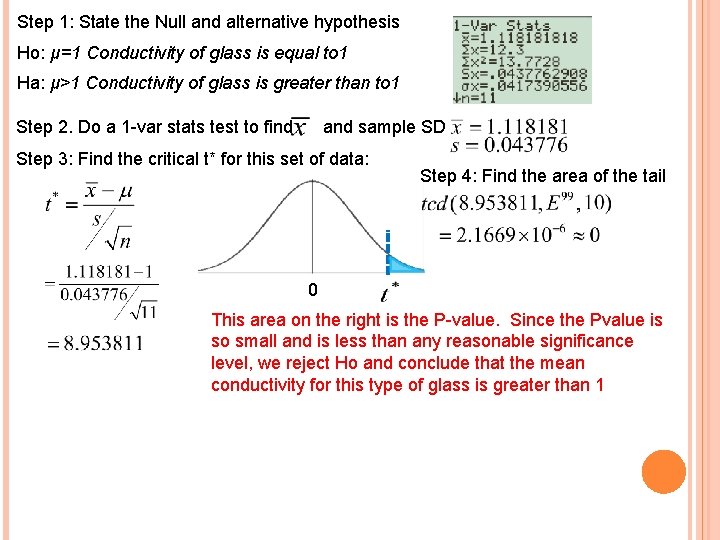
Step 1: State the Null and alternative hypothesis Ho: μ=1 Conductivity of glass is equal to 1 Ha: μ>1 Conductivity of glass is greater than to 1 Step 2. Do a 1 -var stats test to find and sample SD Step 3: Find the critical t* for this set of data: Step 4: Find the area of the tail 0 This area on the right is the P-value. Since the Pvalue is so small and is less than any reasonable significance level, we reject Ho and conclude that the mean conductivity for this type of glass is greater than 1
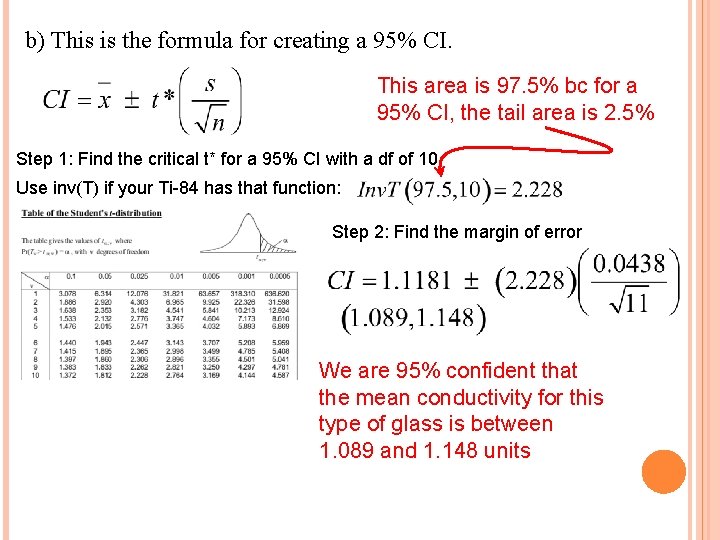
b) This is the formula for creating a 95% CI. This area is 97. 5% bc for a 95% CI, the tail area is 2. 5% Step 1: Find the critical t* for a 95% CI with a df of 10 Use inv(T) if your Ti-84 has that function: Step 2: Find the margin of error We are 95% confident that the mean conductivity for this type of glass is between 1. 089 and 1. 148 units
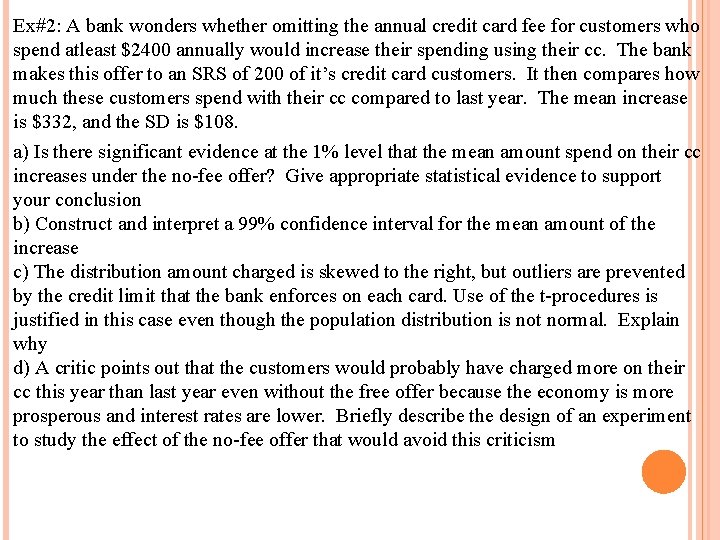
Ex#2: A bank wonders whether omitting the annual credit card fee for customers who spend atleast $2400 annually would increase their spending using their cc. The bank makes this offer to an SRS of 200 of it’s credit card customers. It then compares how much these customers spend with their cc compared to last year. The mean increase is $332, and the SD is $108. a) Is there significant evidence at the 1% level that the mean amount spend on their cc increases under the no-fee offer? Give appropriate statistical evidence to support your conclusion b) Construct and interpret a 99% confidence interval for the mean amount of the increase c) The distribution amount charged is skewed to the right, but outliers are prevented by the credit limit that the bank enforces on each card. Use of the t-procedures is justified in this case even though the population distribution is not normal. Explain why d) A critic points out that the customers would probably have charged more on their cc this year than last year even without the free offer because the economy is more prosperous and interest rates are lower. Briefly describe the design of an experiment to study the effect of the no-fee offer that would avoid this criticism
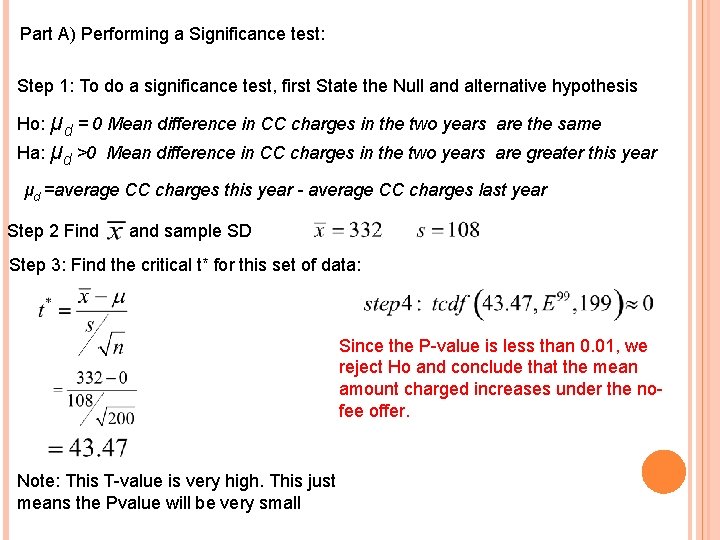
Part A) Performing a Significance test: Step 1: To do a significance test, first State the Null and alternative hypothesis Ho: μd = 0 Mean difference in CC charges in the two years are the same Ha: μd >0 Mean difference in CC charges in the two years are greater this year μd =average CC charges this year - average CC charges last year Step 2 Find and sample SD Step 3: Find the critical t* for this set of data: Since the P-value is less than 0. 01, we reject Ho and conclude that the mean amount charged increases under the nofee offer. Note: This T-value is very high. This just means the Pvalue will be very small
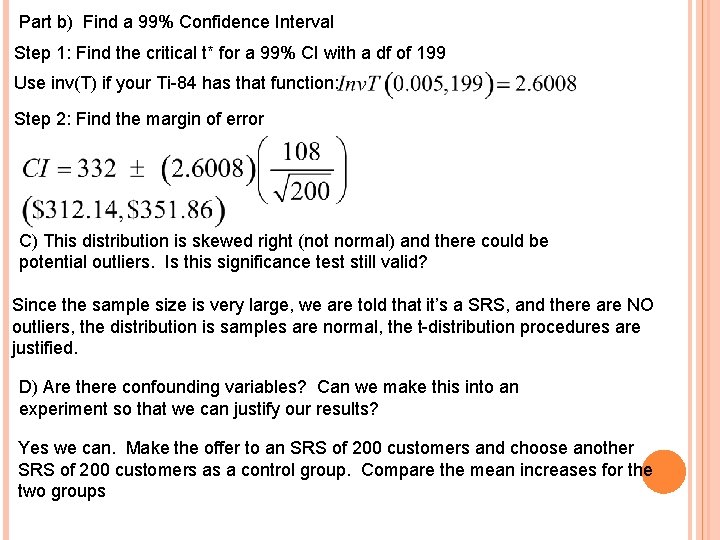
Part b) Find a 99% Confidence Interval Step 1: Find the critical t* for a 99% CI with a df of 199 Use inv(T) if your Ti-84 has that function: Step 2: Find the margin of error C) This distribution is skewed right (not normal) and there could be potential outliers. Is this significance test still valid? Since the sample size is very large, we are told that it’s a SRS, and there are NO outliers, the distribution is samples are normal, the t-distribution procedures are justified. D) Are there confounding variables? Can we make this into an experiment so that we can justify our results? Yes we can. Make the offer to an SRS of 200 customers and choose another SRS of 200 customers as a control group. Compare the mean increases for the two groups
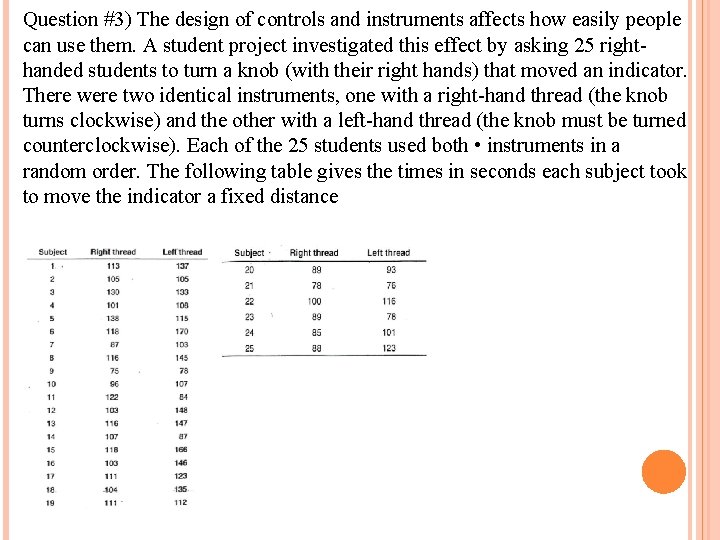
Question #3) The design of controls and instruments affects how easily people can use them. A student project investigated this effect by asking 25 righthanded students to turn a knob (with their right hands) that moved an indicator. There were two identical instruments, one with a right-hand thread (the knob turns clockwise) and the other with a left-hand thread (the knob must be turned counterclockwise). Each of the 25 students used both • instruments in a random order. The following table gives the times in seconds each subject took to move the indicator a fixed distance
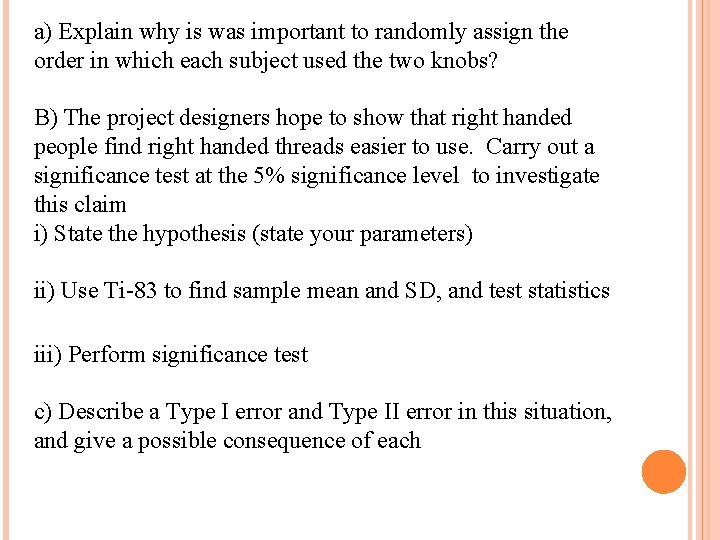
a) Explain why is was important to randomly assign the order in which each subject used the two knobs? B) The project designers hope to show that right handed people find right handed threads easier to use. Carry out a significance test at the 5% significance level to investigate this claim i) State the hypothesis (state your parameters) ii) Use Ti-83 to find sample mean and SD, and test statistics iii) Perform significance test c) Describe a Type I error and Type II error in this situation, and give a possible consequence of each
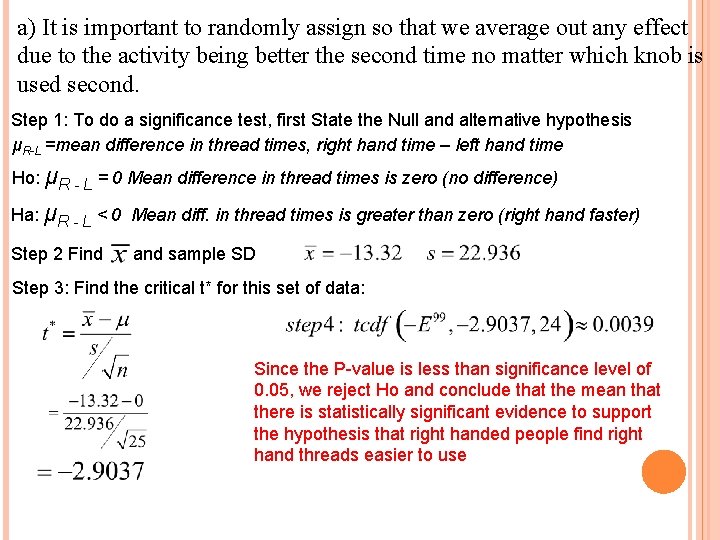
a) It is important to randomly assign so that we average out any effect due to the activity being better the second time no matter which knob is used second. Step 1: To do a significance test, first State the Null and alternative hypothesis μR-L =mean difference in thread times, right hand time – left hand time Ho: μR - L = 0 Mean difference in thread times is zero (no difference) Ha: μR - L < 0 Mean diff. in thread times is greater than zero (right hand faster) Step 2 Find and sample SD Step 3: Find the critical t* for this set of data: Since the P-value is less than significance level of 0. 05, we reject Ho and conclude that the mean that there is statistically significant evidence to support the hypothesis that right handed people find right hand threads easier to use
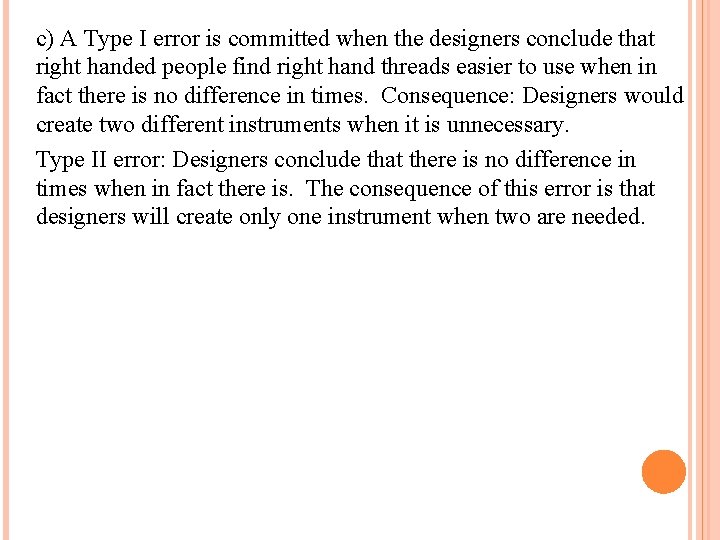
c) A Type I error is committed when the designers conclude that right handed people find right hand threads easier to use when in fact there is no difference in times. Consequence: Designers would create two different instruments when it is unnecessary. Type II error: Designers conclude that there is no difference in times when in fact there is. The consequence of this error is that designers will create only one instrument when two are needed.
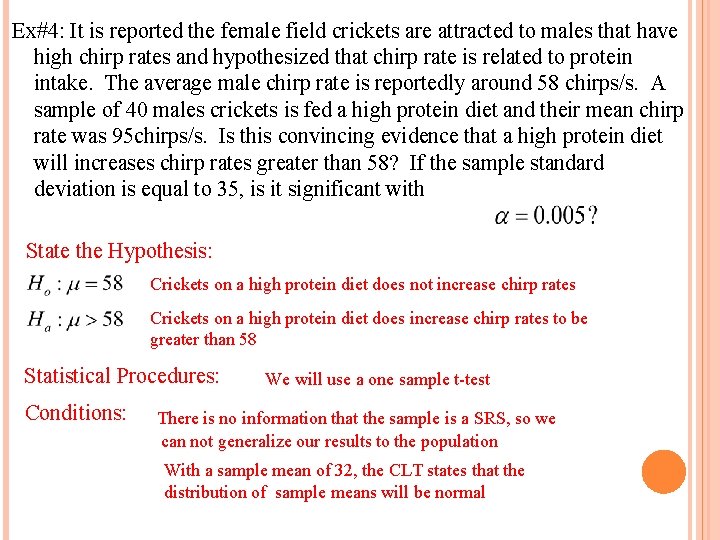
Ex#4: It is reported the female field crickets are attracted to males that have high chirp rates and hypothesized that chirp rate is related to protein intake. The average male chirp rate is reportedly around 58 chirps/s. A sample of 40 males crickets is fed a high protein diet and their mean chirp rate was 95 chirps/s. Is this convincing evidence that a high protein diet will increases chirp rates greater than 58? If the sample standard deviation is equal to 35, is it significant with State the Hypothesis: Crickets on a high protein diet does not increase chirp rates Crickets on a high protein diet does increase chirp rates to be greater than 58 Statistical Procedures: Conditions: We will use a one sample t-test There is no information that the sample is a SRS, so we can not generalize our results to the population With a sample mean of 32, the CLT states that the distribution of sample means will be normal
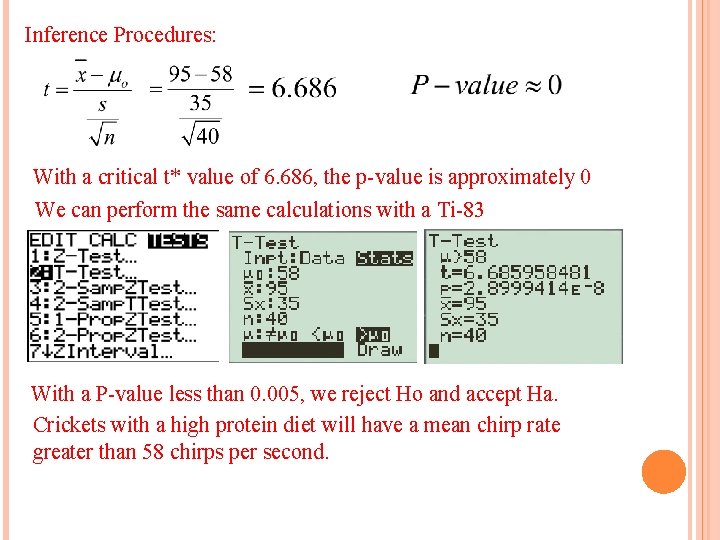
Inference Procedures: With a critical t* value of 6. 686, the p-value is approximately 0 We can perform the same calculations with a Ti-83 With a P-value less than 0. 005, we reject Ho and accept Ha. Crickets with a high protein diet will have a mean chirp rate greater than 58 chirps per second.
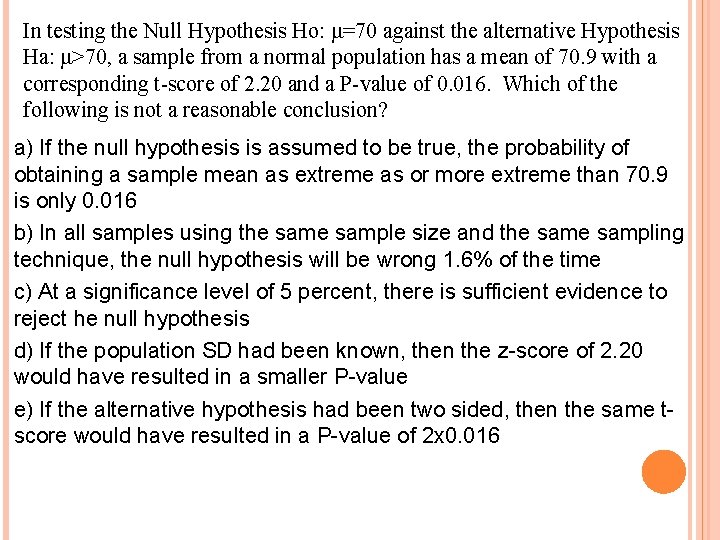
In testing the Null Hypothesis Ho: μ=70 against the alternative Hypothesis Ha: μ>70, a sample from a normal population has a mean of 70. 9 with a corresponding t-score of 2. 20 and a P-value of 0. 016. Which of the following is not a reasonable conclusion? a) If the null hypothesis is assumed to be true, the probability of obtaining a sample mean as extreme as or more extreme than 70. 9 is only 0. 016 b) In all samples using the sample size and the sampling technique, the null hypothesis will be wrong 1. 6% of the time c) At a significance level of 5 percent, there is sufficient evidence to reject he null hypothesis d) If the population SD had been known, then the z-score of 2. 20 would have resulted in a smaller P-value e) If the alternative hypothesis had been two sided, then the same tscore would have resulted in a P-value of 2 x 0. 016
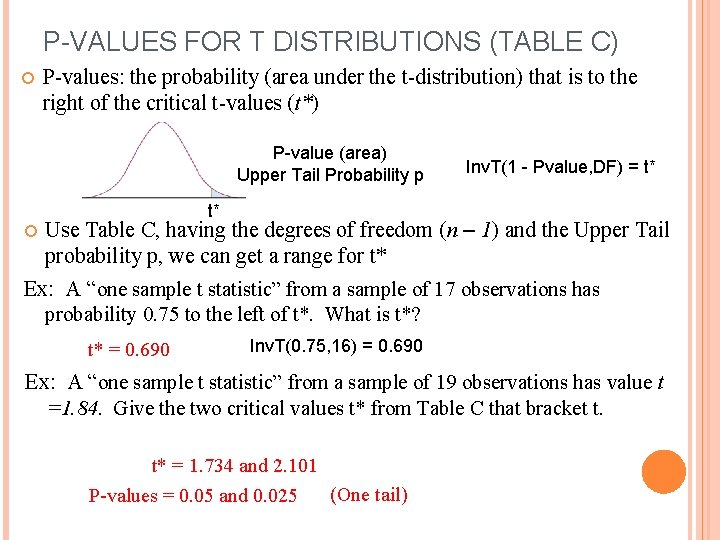
P-VALUES FOR T DISTRIBUTIONS (TABLE C) P-values: the probability (area under the t-distribution) that is to the right of the critical t-values (t*) P-value (area) Upper Tail Probability p Inv. T(1 - Pvalue, DF) = t* t* Use Table C, having the degrees of freedom (n – 1) and the Upper Tail probability p, we can get a range for t* Ex: A “one sample t statistic” from a sample of 17 observations has probability 0. 75 to the left of t*. What is t*? t* = 0. 690 Inv. T(0. 75, 16) = 0. 690 Ex: A “one sample t statistic” from a sample of 19 observations has value t =1. 84. Give the two critical values t* from Table C that bracket t. t* = 1. 734 and 2. 101 (One tail) P-values = 0. 05 and 0. 025
MAIN IDEAS: PURPOSE OF A SIGNIFICANCE TEST: The whole point of a significance test is to figure out the mean of a population A) What’s Given: You are given an initial null hypothesis Ho, with a suggested mean You aren’t sure whether if this mean is true or not, so you need to test it B) Take a sample: You take a sample and get a sample mean. In reality, x should be close to u, with the following conditions met: Sample was a SRS (unbias), each observation was independent, and assuming that the population was normal If the population was not normal, the distribution of sample means x should be normal [CLT]
C) Is x close enough to ? If the sample mean x is close to u, then it supports our null hypothesis (Ho) that If x is NOT close to , this is evidence that , and Ho is not true D) How far does x need to be from until we reject Ho ? This depends on our P-value and alpha , (alpha = 10%, 5%, 1%, or 0. 5%. . . ) The P-value is the probability of getting a sample mean x (that we got) if Ho was true Alpha is the limit we place on the p-value for accepting Ho If p-value > alpha accept Ho If p-value < alpha reject Ho Note: the p-value depends on the alternative hypothesis Ha, [One tail or two tail]
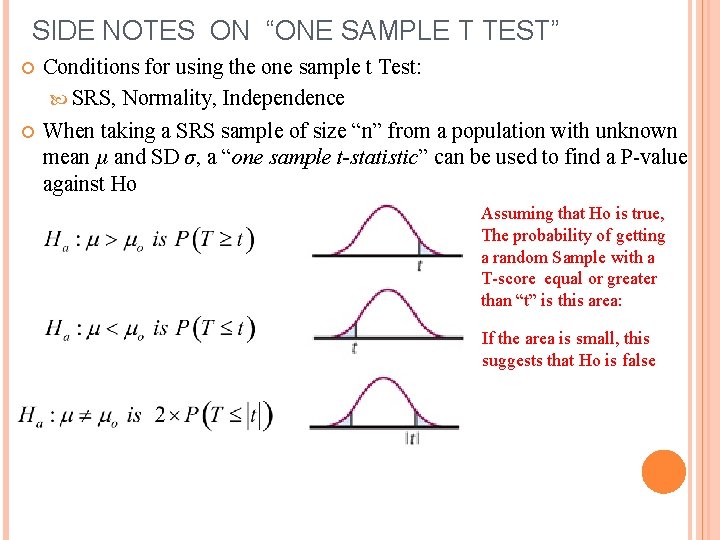
SIDE NOTES ON “ONE SAMPLE T TEST” Conditions for using the one sample t Test: SRS, Normality, Independence When taking a SRS sample of size “n” from a population with unknown mean µ and SD σ, a “one sample t-statistic” can be used to find a P-value against Ho Assuming that Ho is true, The probability of getting a random Sample with a T-score equal or greater than “t” is this area: If the area is small, this suggests that Ho is false
- Slides: 21