
Section 12 1 Characteristics of Chemical Bonds A

Section 12. 1 Characteristics of Chemical Bonds A. Types of Chemical Bonds • Bond – force that holds groups of atoms together and makes them function as a unit • Bond energy – energy required to break a chemical bond
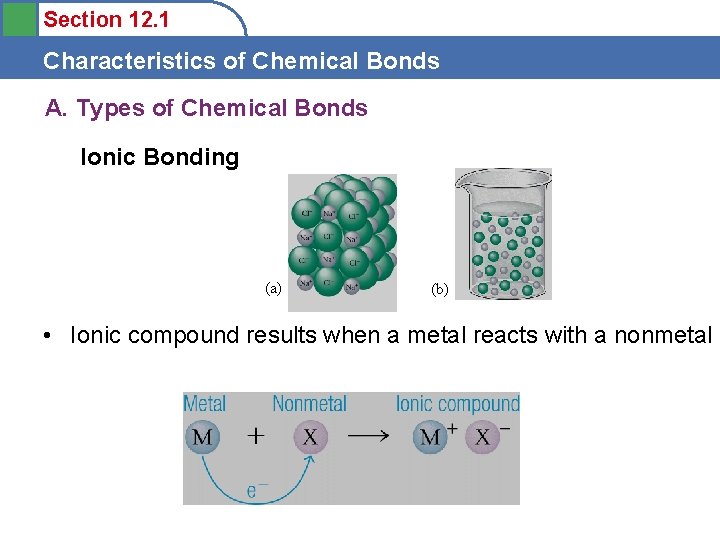
Section 12. 1 Characteristics of Chemical Bonds A. Types of Chemical Bonds Ionic Bonding (a) (b) • Ionic compound results when a metal reacts with a nonmetal
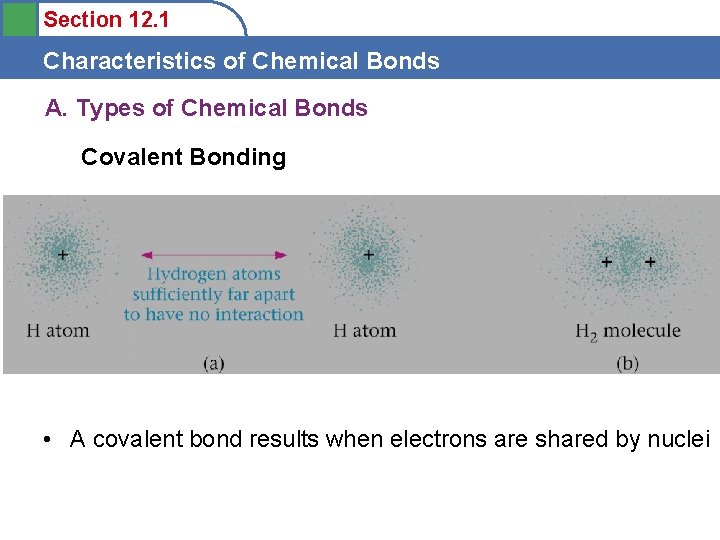
Section 12. 1 Characteristics of Chemical Bonds A. Types of Chemical Bonds Covalent Bonding • A covalent bond results when electrons are shared by nuclei
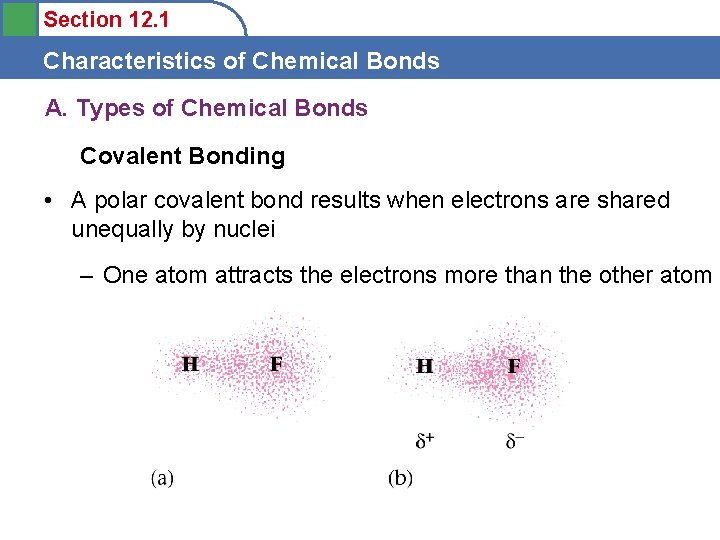
Section 12. 1 Characteristics of Chemical Bonds A. Types of Chemical Bonds Covalent Bonding • A polar covalent bond results when electrons are shared unequally by nuclei – One atom attracts the electrons more than the other atom
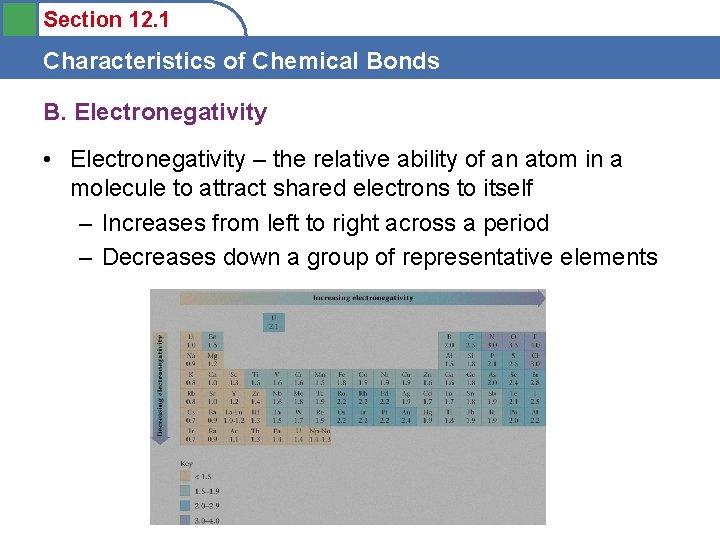
Section 12. 1 Characteristics of Chemical Bonds B. Electronegativity • Electronegativity – the relative ability of an atom in a molecule to attract shared electrons to itself – Increases from left to right across a period – Decreases down a group of representative elements
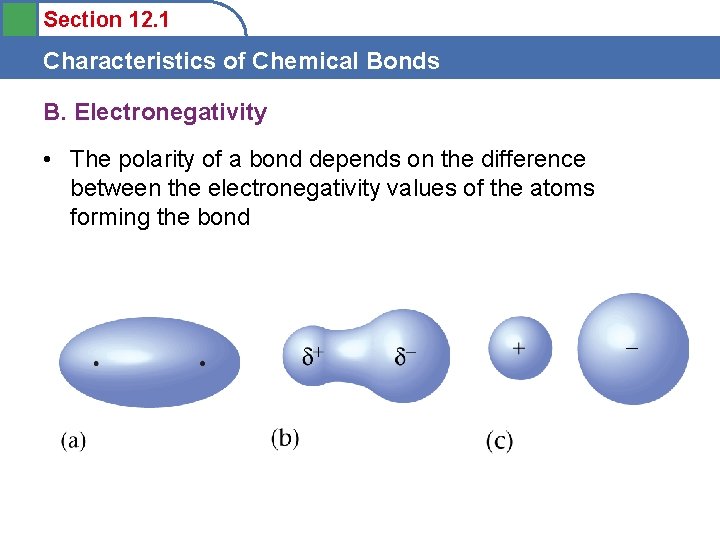
Section 12. 1 Characteristics of Chemical Bonds B. Electronegativity • The polarity of a bond depends on the difference between the electronegativity values of the atoms forming the bond
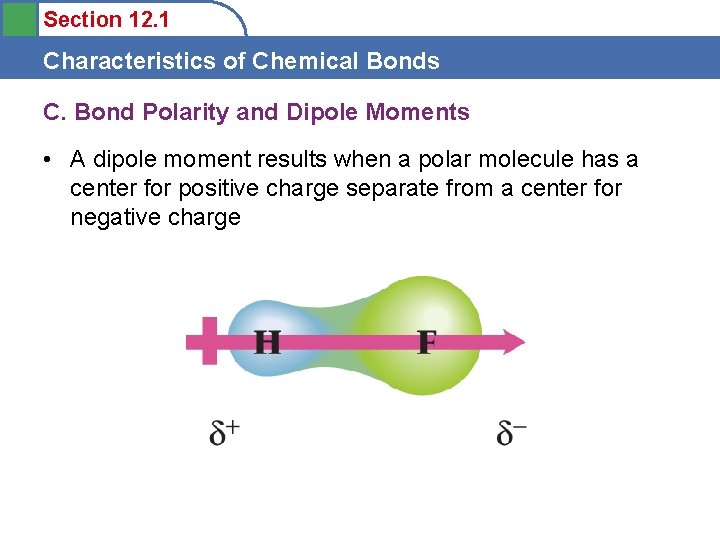
Section 12. 1 Characteristics of Chemical Bonds C. Bond Polarity and Dipole Moments • A dipole moment results when a polar molecule has a center for positive charge separate from a center for negative charge

Section 12. 1 Characteristics of Chemical Bonds C. Bond Polarity and Dipole Moments • Water molecule dipole moment
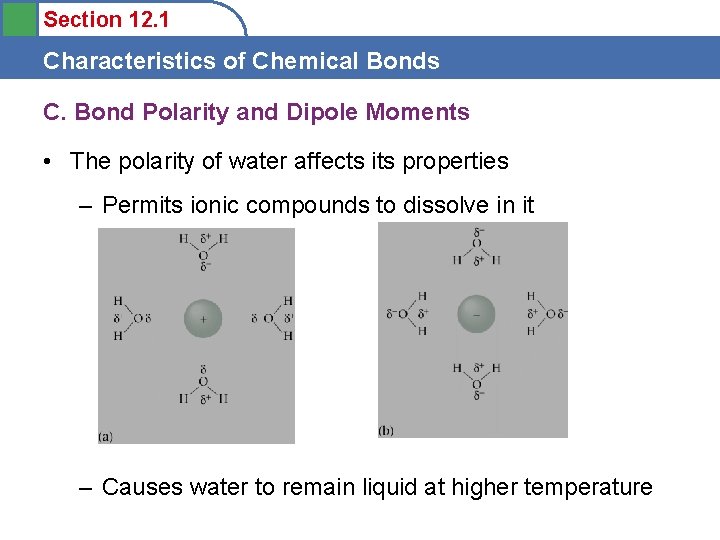
Section 12. 1 Characteristics of Chemical Bonds C. Bond Polarity and Dipole Moments • The polarity of water affects its properties – Permits ionic compounds to dissolve in it – Causes water to remain liquid at higher temperature
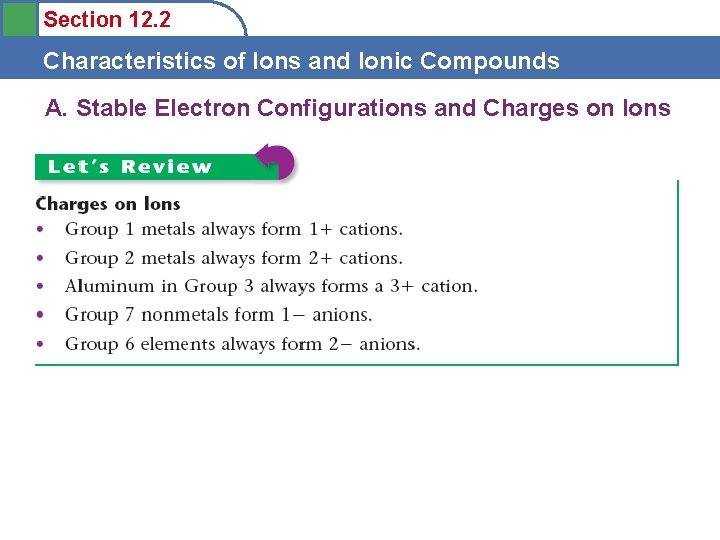
Section 12. 2 Characteristics of Ions and Ionic Compounds A. Stable Electron Configurations and Charges on Ions
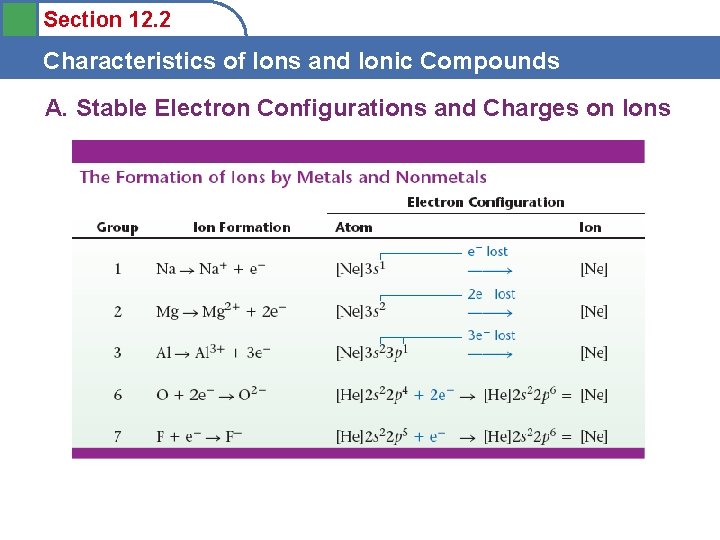
Section 12. 2 Characteristics of Ions and Ionic Compounds A. Stable Electron Configurations and Charges on Ions
Section 12. 2 Characteristics of Ions and Ionic Compounds A. Stable Electron Configurations and Charges on Ions • Atoms in stable compounds usually have a noble gas electron configuration – Metals lose electrons to reach noble gas configuration – Nonmetals gain electrons to reach noble gas configuration
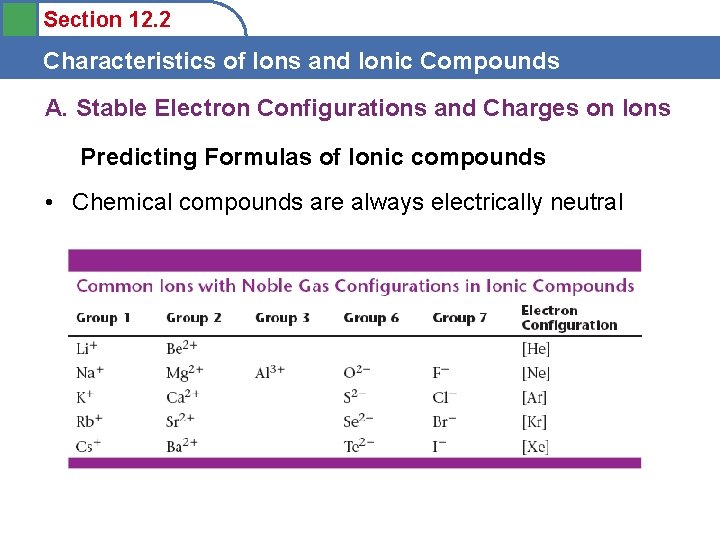
Section 12. 2 Characteristics of Ions and Ionic Compounds A. Stable Electron Configurations and Charges on Ions Predicting Formulas of Ionic compounds • Chemical compounds are always electrically neutral
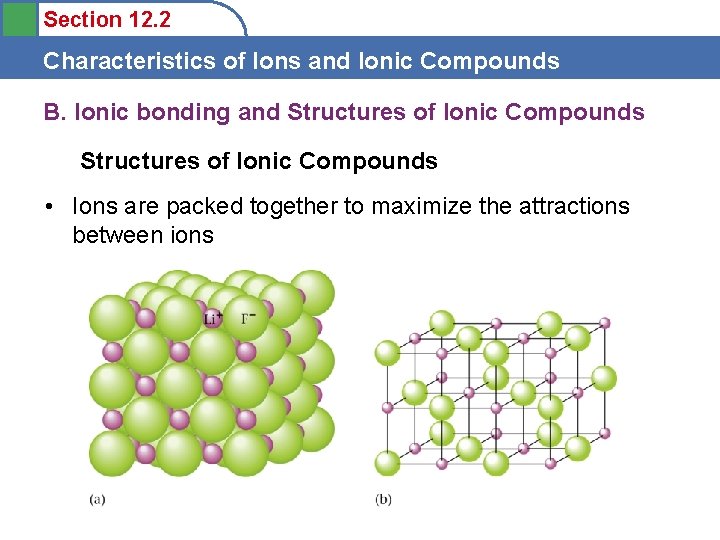
Section 12. 2 Characteristics of Ions and Ionic Compounds B. Ionic bonding and Structures of Ionic Compounds • Ions are packed together to maximize the attractions between ions
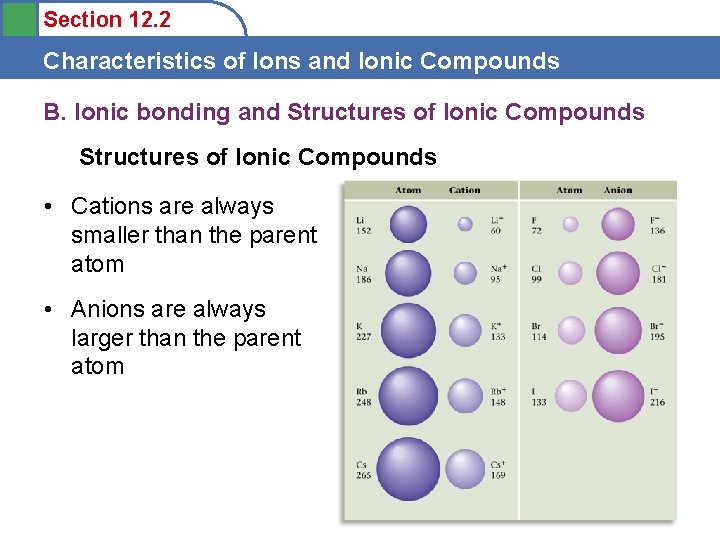
Section 12. 2 Characteristics of Ions and Ionic Compounds B. Ionic bonding and Structures of Ionic Compounds • Cations are always smaller than the parent atom • Anions are always larger than the parent atom
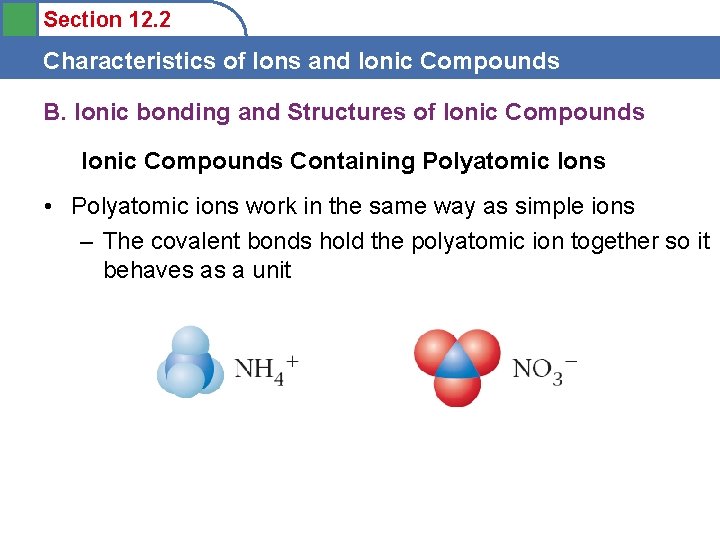
Section 12. 2 Characteristics of Ions and Ionic Compounds B. Ionic bonding and Structures of Ionic Compounds Containing Polyatomic Ions • Polyatomic ions work in the same way as simple ions – The covalent bonds hold the polyatomic ion together so it behaves as a unit
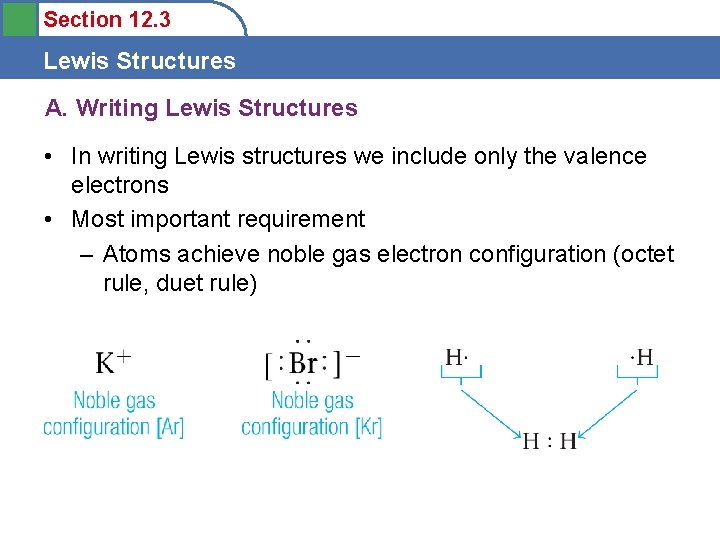
Section 12. 3 Lewis Structures A. Writing Lewis Structures • In writing Lewis structures we include only the valence electrons • Most important requirement – Atoms achieve noble gas electron configuration (octet rule, duet rule)
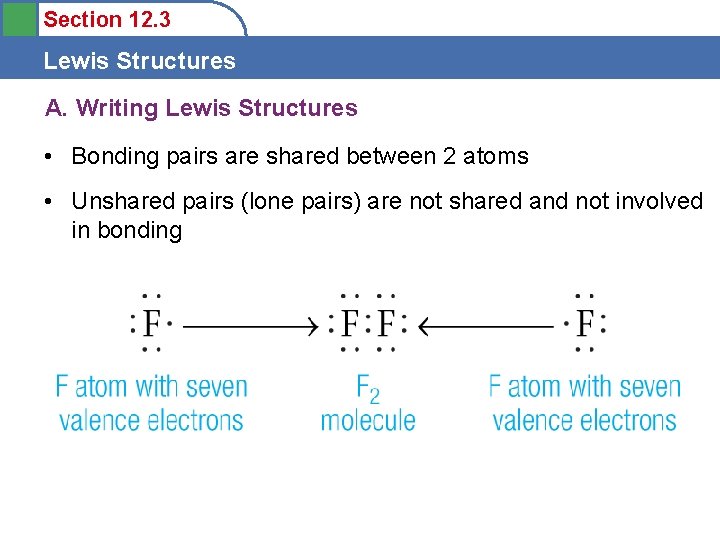
Section 12. 3 Lewis Structures A. Writing Lewis Structures • Bonding pairs are shared between 2 atoms • Unshared pairs (lone pairs) are not shared and not involved in bonding
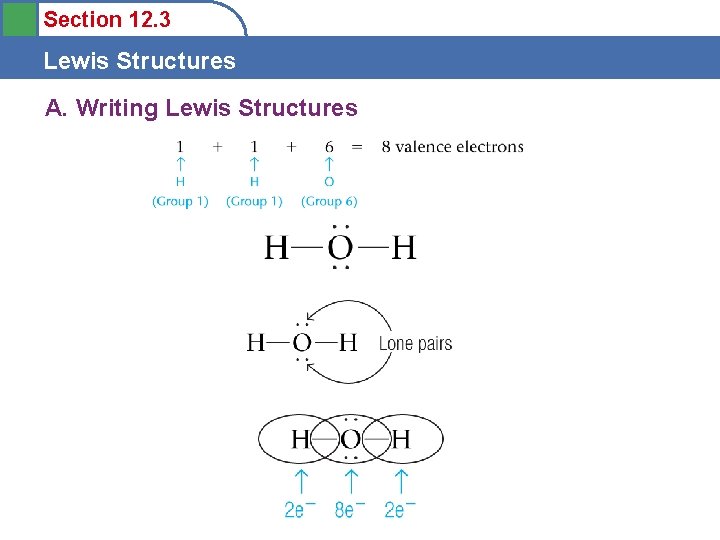
Section 12. 3 Lewis Structures A. Writing Lewis Structures
Section 12. 3 Lewis Structures B. Lewis Structures of Molecules with Multiple Bonds • Single bond – covalent bond in which 1 pair of electrons is shared by 2 atoms • Double bond – covalent bond in which 2 pairs of electrons are shared by 2 atoms • Triple bond – covalent bond in which 3 pairs of electrons are shared by 2 atoms
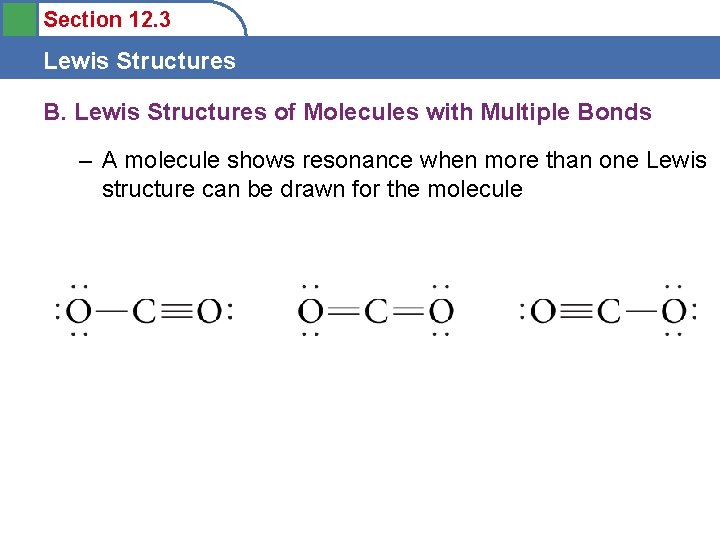
Section 12. 3 Lewis Structures B. Lewis Structures of Molecules with Multiple Bonds – A molecule shows resonance when more than one Lewis structure can be drawn for the molecule
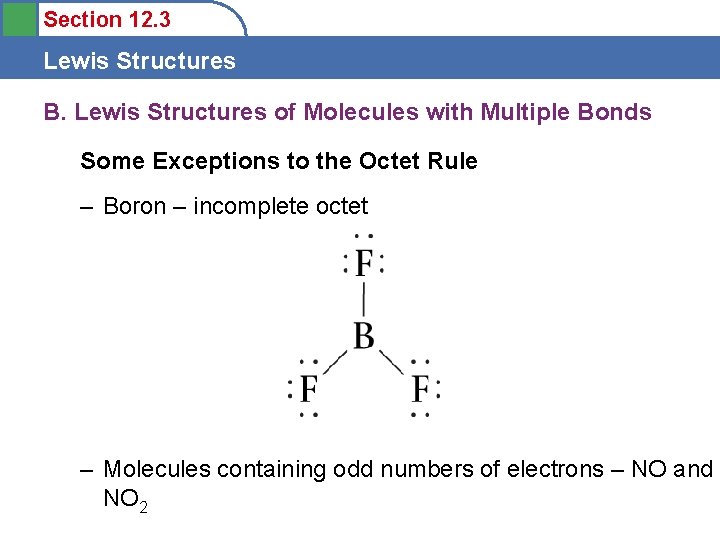
Section 12. 3 Lewis Structures B. Lewis Structures of Molecules with Multiple Bonds Some Exceptions to the Octet Rule – Boron – incomplete octet – Molecules containing odd numbers of electrons – NO and NO 2
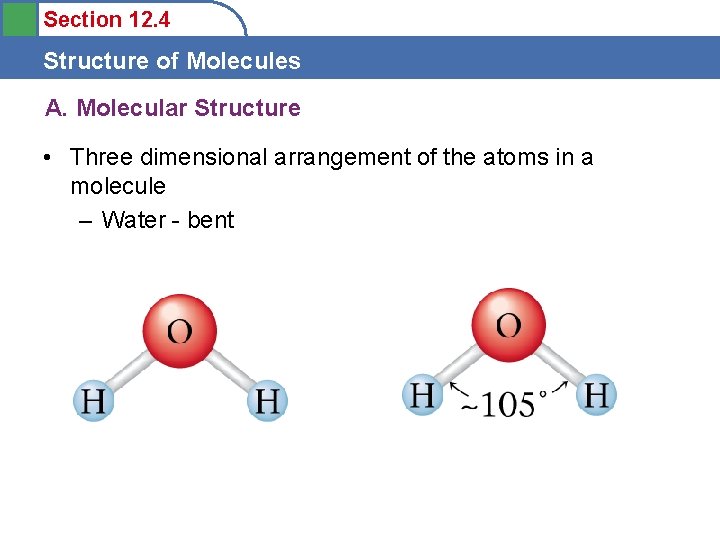
Section 12. 4 Structure of Molecules A. Molecular Structure • Three dimensional arrangement of the atoms in a molecule – Water - bent
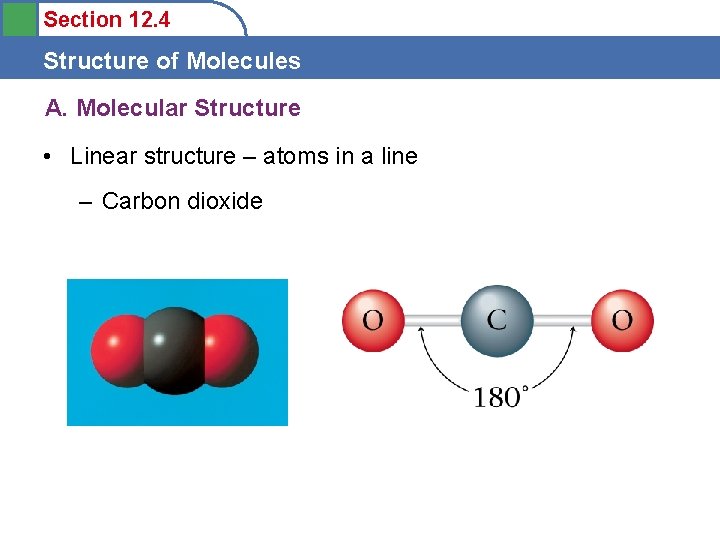
Section 12. 4 Structure of Molecules A. Molecular Structure • Linear structure – atoms in a line – Carbon dioxide
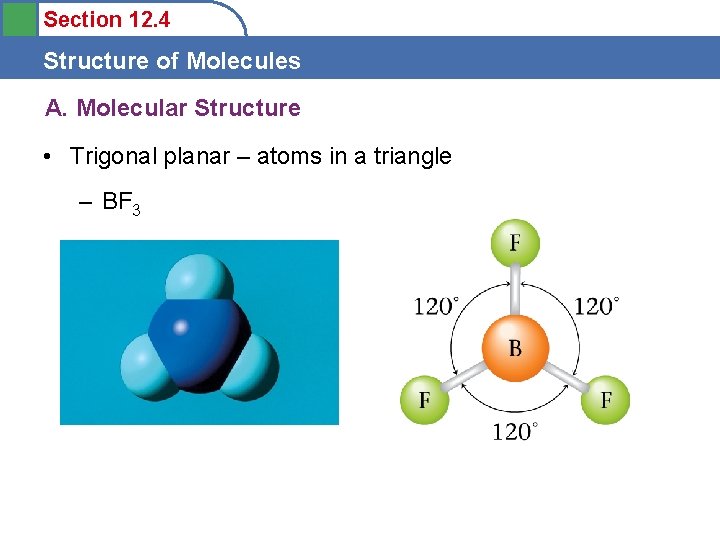
Section 12. 4 Structure of Molecules A. Molecular Structure • Trigonal planar – atoms in a triangle – BF 3
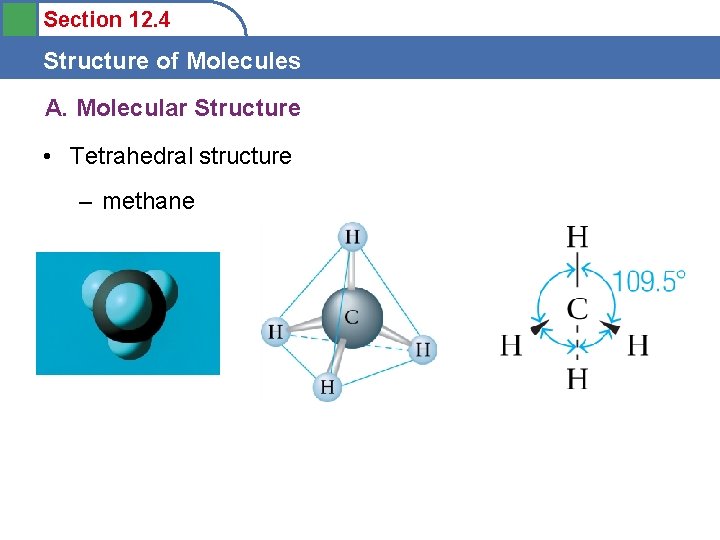
Section 12. 4 Structure of Molecules A. Molecular Structure • Tetrahedral structure – methane
Section 12. 4 Structure of Molecules B. The VSEPR Model • Valence shell electron pair repulsion (VSEPR) model – Molecular structure is determined by minimizing repulsions between electron pairs
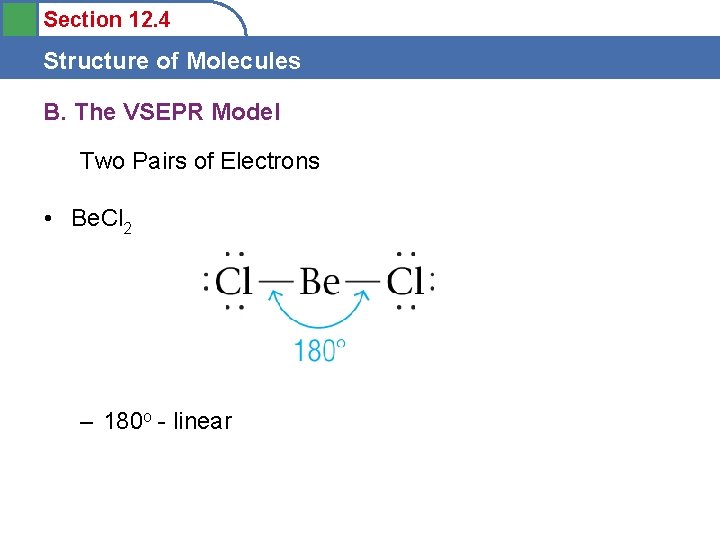
Section 12. 4 Structure of Molecules B. The VSEPR Model Two Pairs of Electrons • Be. Cl 2 – 180 o - linear
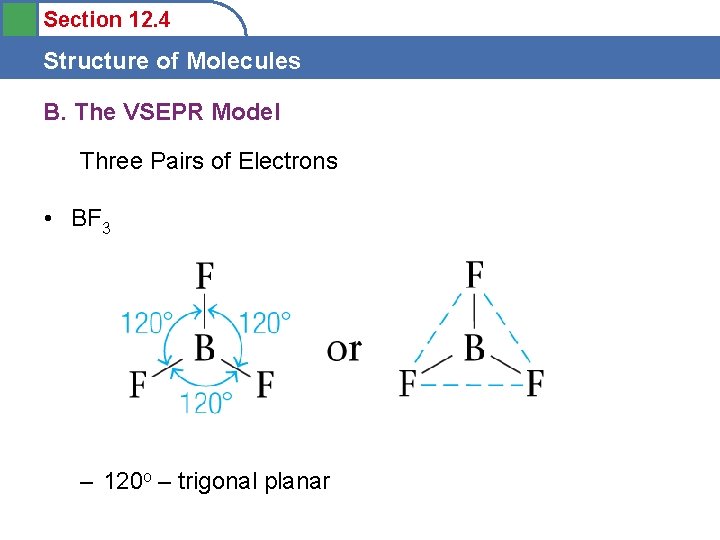
Section 12. 4 Structure of Molecules B. The VSEPR Model Three Pairs of Electrons • BF 3 – 120 o – trigonal planar
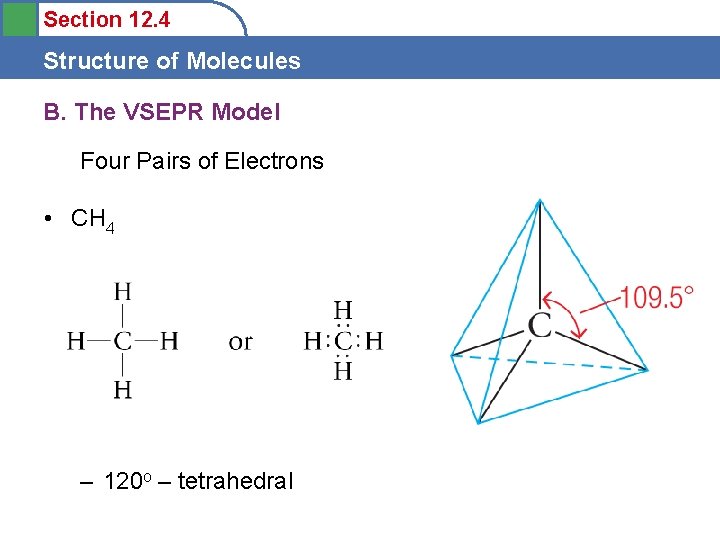
Section 12. 4 Structure of Molecules B. The VSEPR Model Four Pairs of Electrons • CH 4 – 120 o – tetrahedral
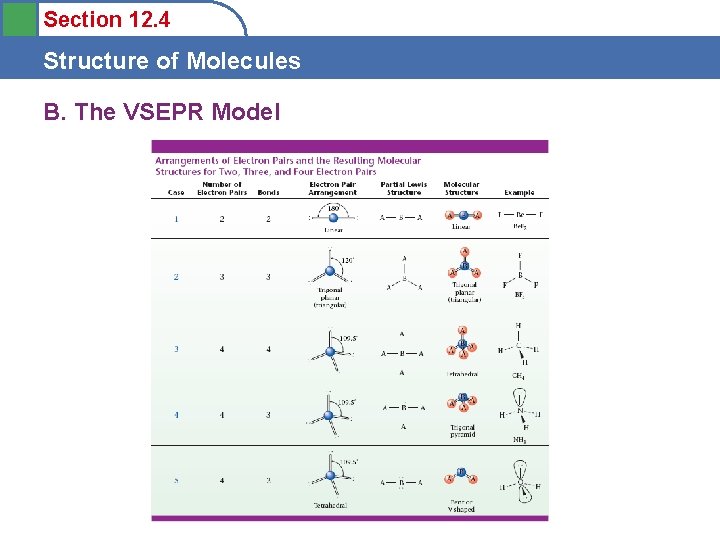
Section 12. 4 Structure of Molecules B. The VSEPR Model

Section 12. 4 Structure of Molecules C. Molecules with Double Bonds When using VSEPR model to predict molecular geometry of a molecule • a double bond is counted the same as a single electron pair
- Slides: 32