
Section 11 Potentiometry Potentiometric Electrodes Potentiometric electrodes measure
- Slides: 31
Section 11 Potentiometry
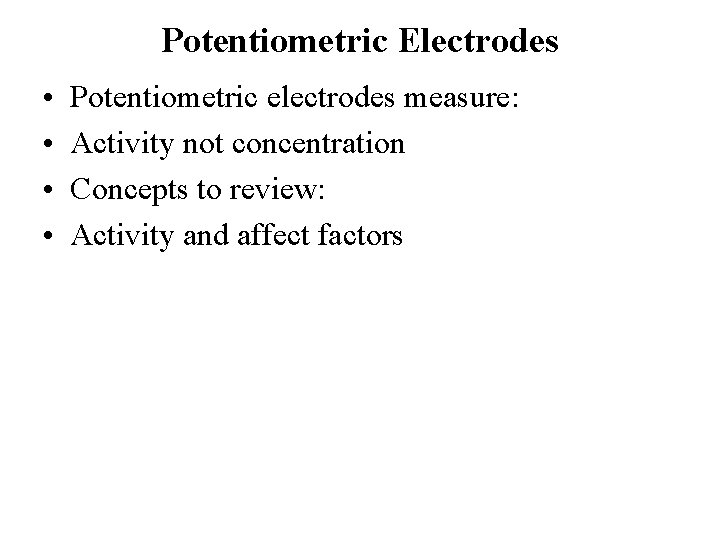
Potentiometric Electrodes • • Potentiometric electrodes measure: Activity not concentration Concepts to review: Activity and affect factors
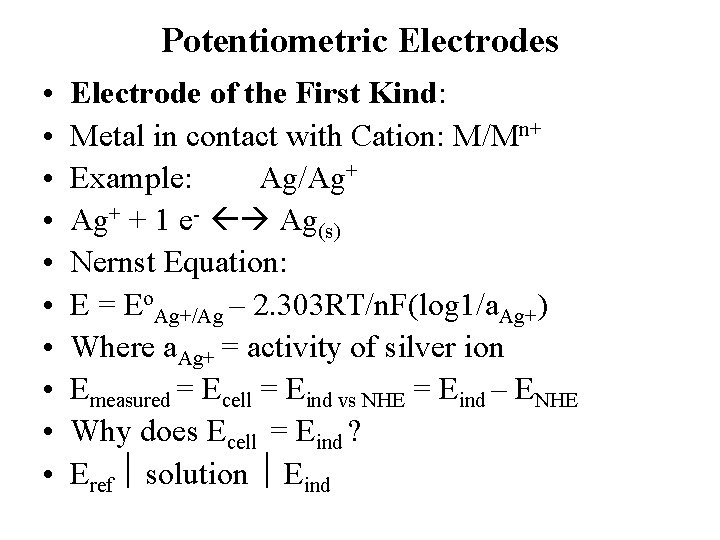
Potentiometric Electrodes • • • Electrode of the First Kind: Metal in contact with Cation: M/Mn+ Example: Ag/Ag+ + 1 e- Ag(s) Nernst Equation: E = Eo. Ag+/Ag – 2. 303 RT/n. F(log 1/a. Ag+) Where a. Ag+ = activity of silver ion Emeasured = Ecell = Eind vs NHE = Eind – ENHE Why does Ecell = Eind ? Eref solution Eind
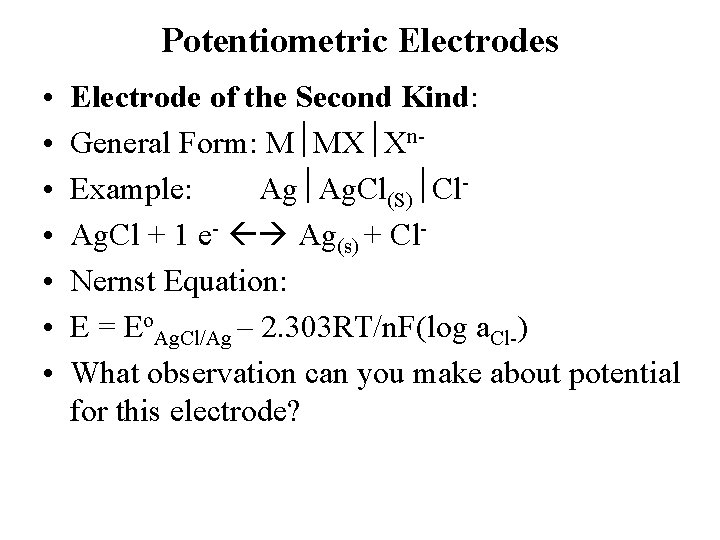
Potentiometric Electrodes • • Electrode of the Second Kind: General Form: M MX Xn. Example: Ag Ag. Cl(S) Cl. Ag. Cl + 1 e- Ag(s) + Cl. Nernst Equation: E = Eo. Ag. Cl/Ag – 2. 303 RT/n. F(log a. Cl-) What observation can you make about potential for this electrode?
Potentiometric Electrodes • Can the previous electrode be utilized to measure a. Ag+ ?
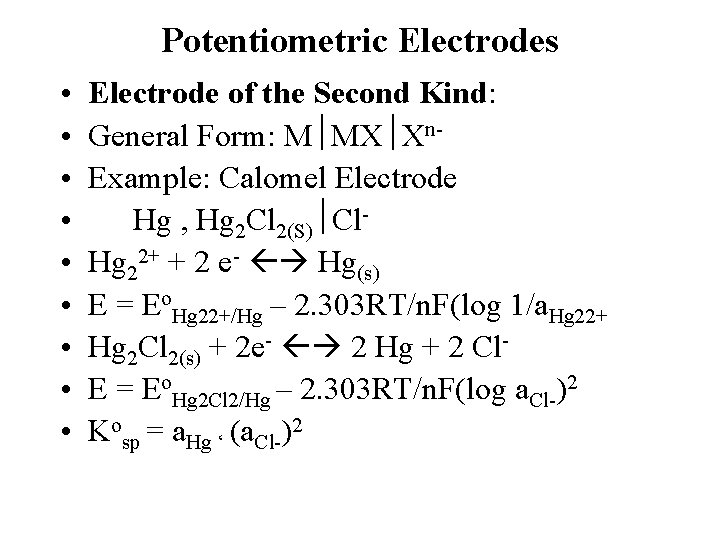
Potentiometric Electrodes • • • Electrode of the Second Kind: General Form: M MX Xn. Example: Calomel Electrode Hg , Hg 2 Cl 2(S) Cl. Hg 22+ + 2 e- Hg(s) E = Eo. Hg 22+/Hg – 2. 303 RT/n. F(log 1/a. Hg 22+ Hg 2 Cl 2(s) + 2 e- 2 Hg + 2 Cl. E = Eo. Hg 2 Cl 2/Hg – 2. 303 RT/n. F(log a. Cl-)2 Kosp = a. Hg ‘ (a. Cl-)2
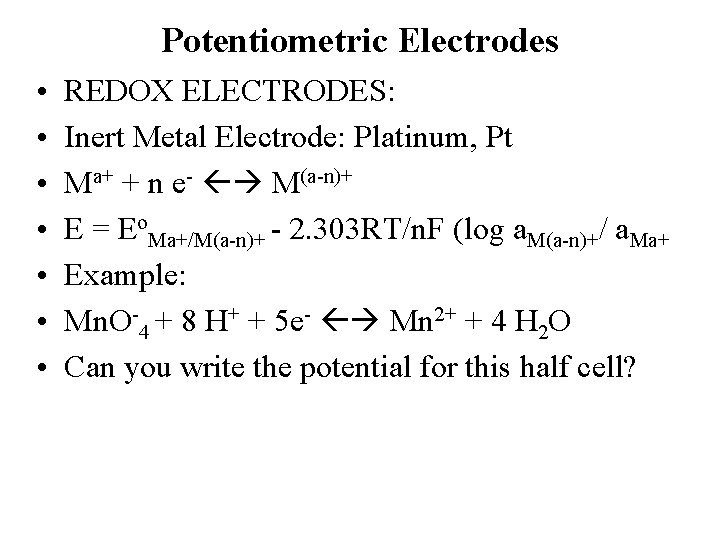
Potentiometric Electrodes • • REDOX ELECTRODES: Inert Metal Electrode: Platinum, Pt Ma+ + n e- M(a-n)+ E = Eo. Ma+/M(a-n)+ - 2. 303 RT/n. F (log a. M(a-n)+/ a. Ma+ Example: Mn. O-4 + 8 H+ + 5 e- Mn 2+ + 4 H 2 O Can you write the potential for this half cell?
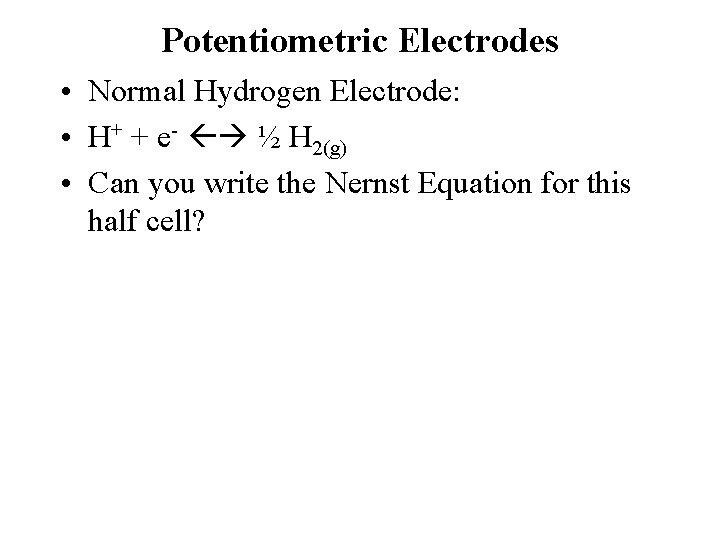
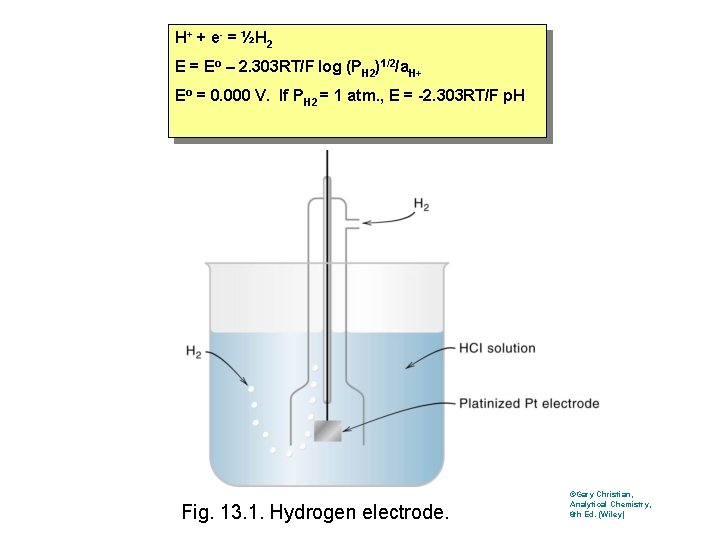
Potentiometric Electrodes • Normal Hydrogen Electrode: • H+ + e- ½ H 2(g) • Can you write the Nernst Equation for this half cell?
H+ + e- = ½H 2 E = Eo – 2. 303 RT/F log (PH 2)1/2/a. H+ Eo = 0. 000 V. If PH 2 = 1 atm. , E = -2. 303 RT/F p. H Fig. 13. 1. Hydrogen electrode. ©Gary Christian, Analytical Chemistry, 6 th Ed. (Wiley)
Potentiometric Electrodes • • • Cells Without Liquid Junction: Two Half Cells Required Indicator Electrode Reference Electrode Example: Pt H 2(g), HCl (solution) Ag. Cl(s) Ag Can you write the cell potential Ecell for this electrode system?
Potentiometric Electrodes • • Cells With Liquid Junction: Two Half Cells Required Indicator Electrode Reference Electrode Example: Hg Hg 2 Cl 2(s) KCl(saturated) HCl(solution), H 2(g) Pt Can you write the cell potential Ecell for this electrode system? • Ecell = (Eright – Eleft) + Ej
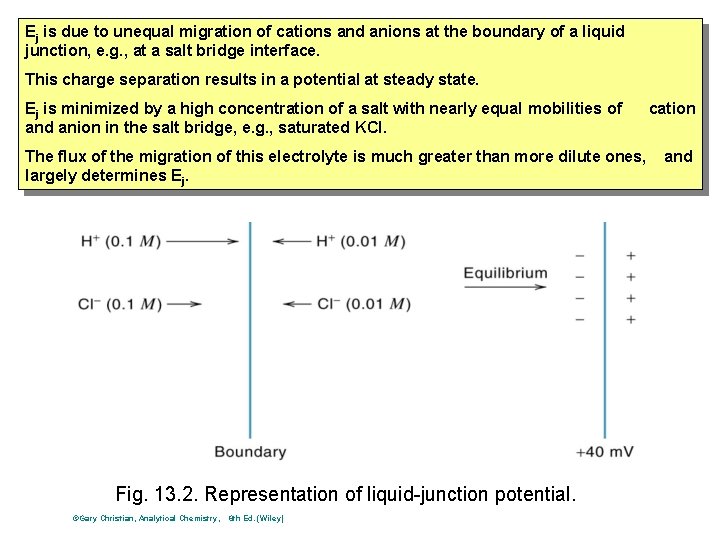
Ej is due to unequal migration of cations and anions at the boundary of a liquid junction, e. g. , at a salt bridge interface. This charge separation results in a potential at steady state. Ej is minimized by a high concentration of a salt with nearly equal mobilities of and anion in the salt bridge, e. g. , saturated KCl. The flux of the migration of this electrolyte is much greater than more dilute ones, largely determines Ej. Fig. 13. 2. Representation of liquid-junction potential. ©Gary Christian, Analytical Chemistry, 6 th Ed. (Wiley) cation and
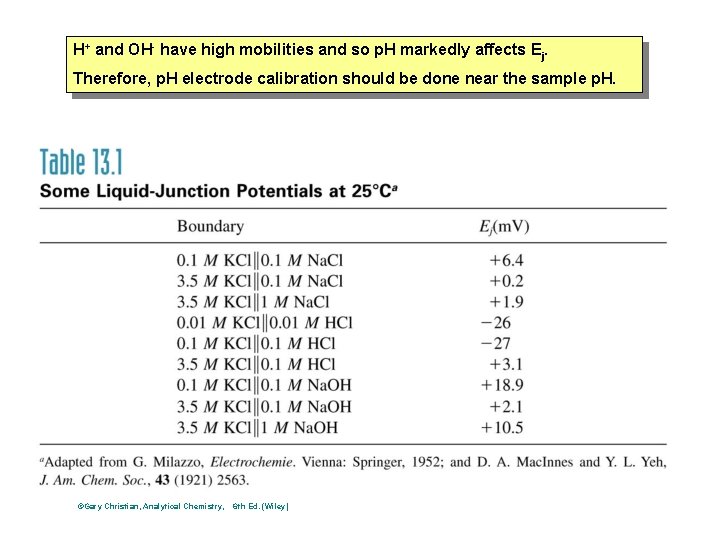
H+ and OH- have high mobilities and so p. H markedly affects Ej. Therefore, p. H electrode calibration should be done near the sample p. H. ©Gary Christian, Analytical Chemistry, 6 th Ed. (Wiley)
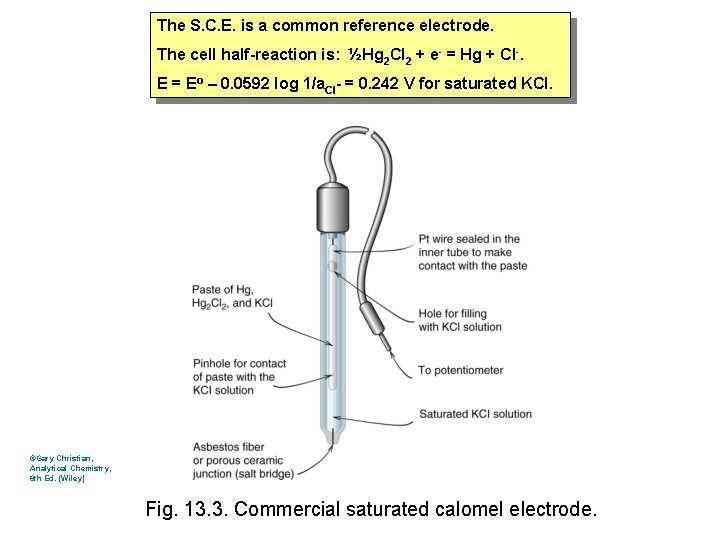
The S. C. E. is a common reference electrode. The cell half-reaction is: ½Hg 2 Cl 2 + e- = Hg + Cl-. E = Eo – 0. 0592 log 1/a. Cl- = 0. 242 V for saturated KCl. ©Gary Christian, Analytical Chemistry, 6 th Ed. (Wiley) Fig. 13. 3. Commercial saturated calomel electrode.
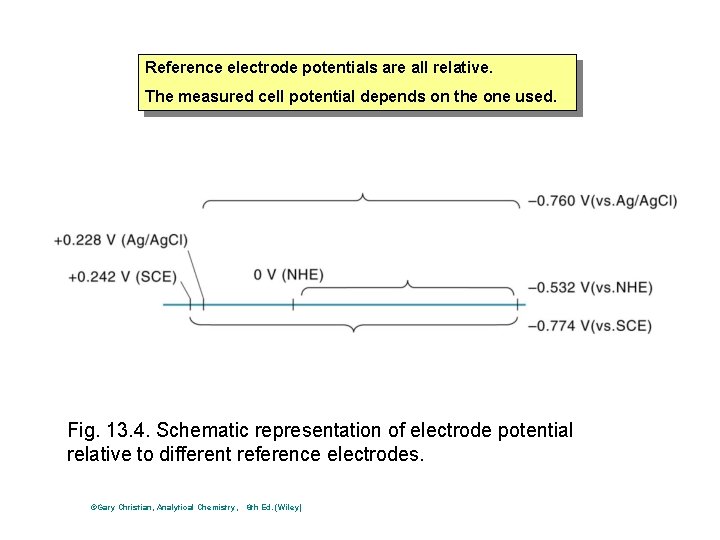
Reference electrode potentials are all relative. The measured cell potential depends on the one used. Fig. 13. 4. Schematic representation of electrode potential relative to different reference electrodes. ©Gary Christian, Analytical Chemistry, 6 th Ed. (Wiley)
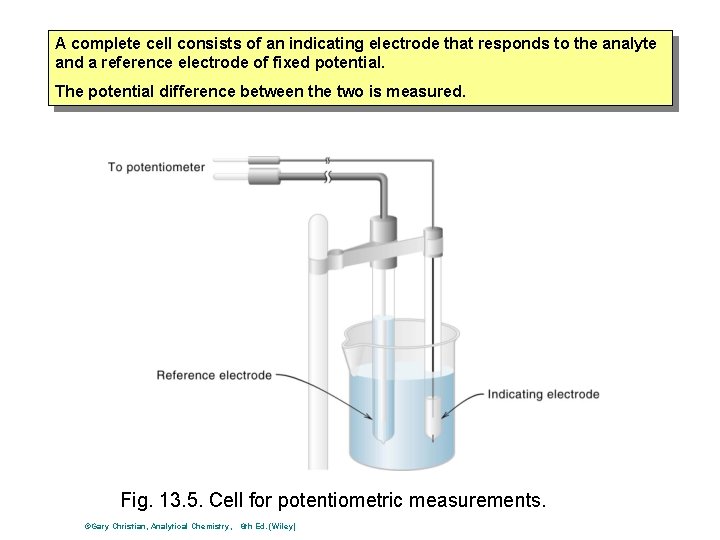
A complete cell consists of an indicating electrode that responds to the analyte and a reference electrode of fixed potential. The potential difference between the two is measured. Fig. 13. 5. Cell for potentiometric measurements. ©Gary Christian, Analytical Chemistry, 6 th Ed. (Wiley)
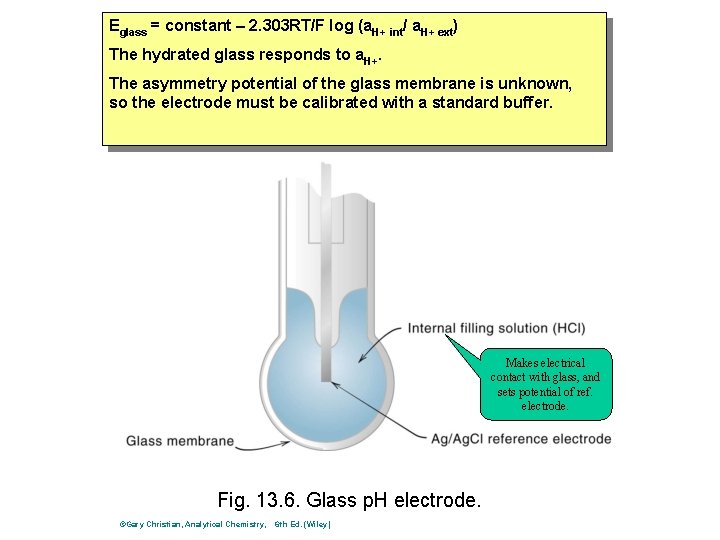
Eglass = constant – 2. 303 RT/F log (a. H+ int/ a. H+ ext) The hydrated glass responds to a. H+. The asymmetry potential of the glass membrane is unknown, so the electrode must be calibrated with a standard buffer. Makes electrical contact with glass, and sets potential of ref. electrode. Fig. 13. 6. Glass p. H electrode. ©Gary Christian, Analytical Chemistry, 6 th Ed. (Wiley)
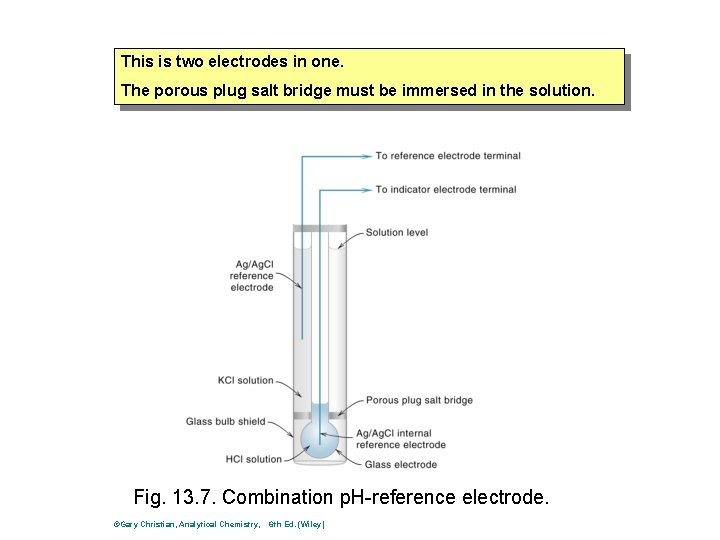
This is two electrodes in one. The porous plug salt bridge must be immersed in the solution. Fig. 13. 7. Combination p. H-reference electrode. ©Gary Christian, Analytical Chemistry, 6 th Ed. (Wiley)
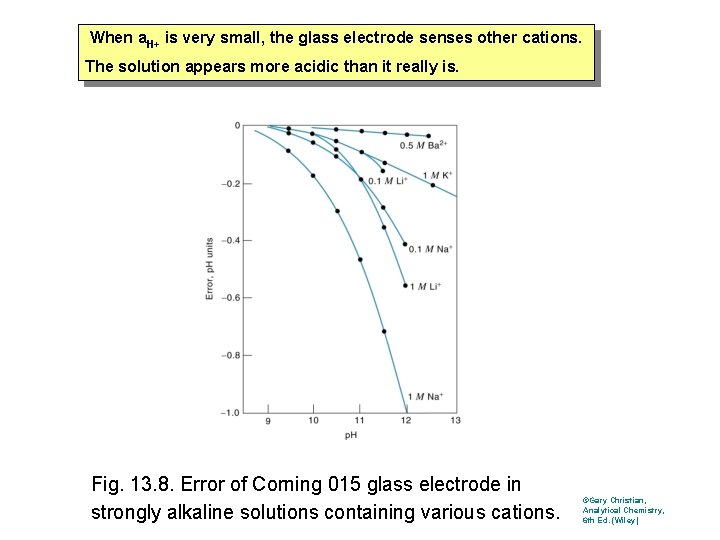
When a. H+ is very small, the glass electrode senses other cations. The solution appears more acidic than it really is. Fig. 13. 8. Error of Corning 015 glass electrode in strongly alkaline solutions containing various cations. ©Gary Christian, Analytical Chemistry, 6 th Ed. (Wiley)
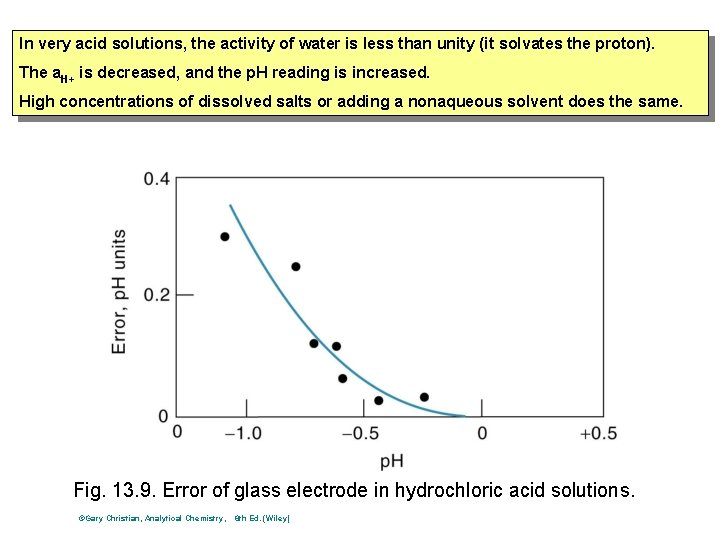
In very acid solutions, the activity of water is less than unity (it solvates the proton). The a. H+ is decreased, and the p. H reading is increased. High concentrations of dissolved salts or adding a nonaqueous solvent does the same. Fig. 13. 9. Error of glass electrode in hydrochloric acid solutions. ©Gary Christian, Analytical Chemistry, 6 th Ed. (Wiley)
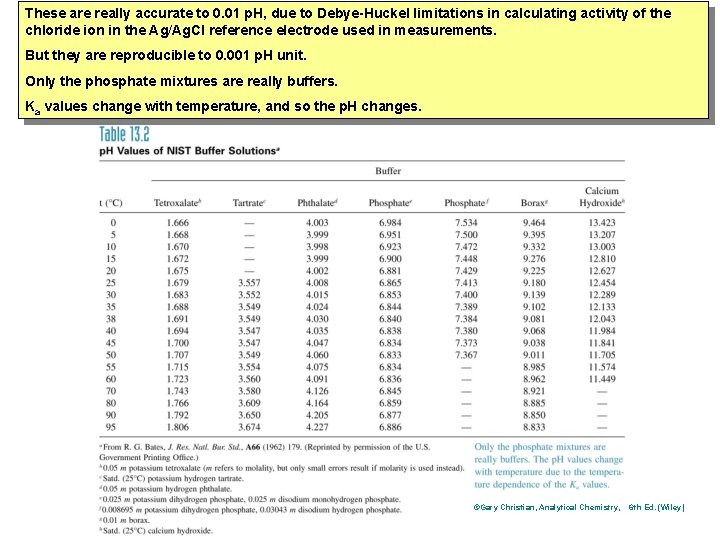
These are really accurate to 0. 01 p. H, due to Debye-Huckel limitations in calculating activity of the chloride ion in the Ag/Ag. Cl reference electrode used in measurements. But they are reproducible to 0. 001 p. H unit. Only the phosphate mixtures are really buffers. Ka values change with temperature, and so the p. H changes. ©Gary Christian, Analytical Chemistry, 6 th Ed. (Wiley)
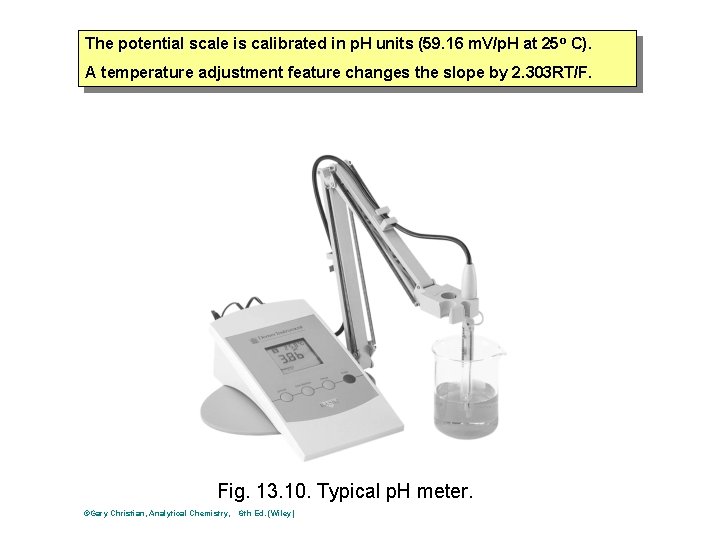
The potential scale is calibrated in p. H units (59. 16 m. V/p. H at 25 o C). A temperature adjustment feature changes the slope by 2. 303 RT/F. Fig. 13. 10. Typical p. H meter. ©Gary Christian, Analytical Chemistry, 6 th Ed. (Wiley)
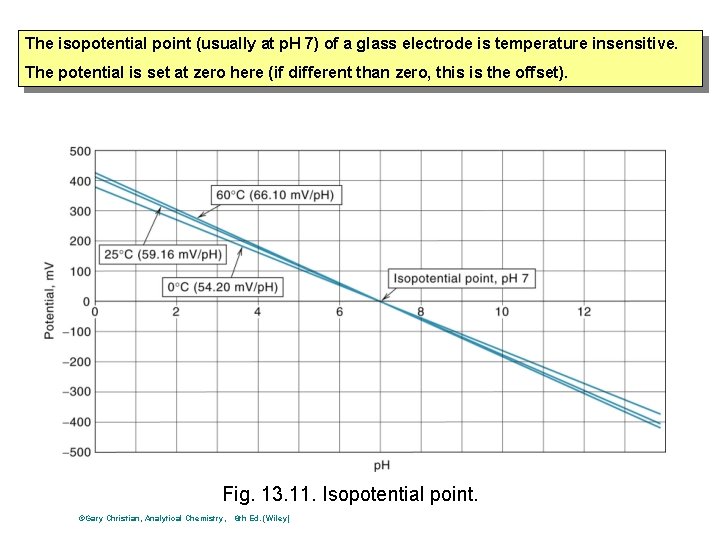
The isopotential point (usually at p. H 7) of a glass electrode is temperature insensitive. The potential is set at zero here (if different than zero, this is the offset). Fig. 13. 11. Isopotential point. ©Gary Christian, Analytical Chemistry, 6 th Ed. (Wiley)
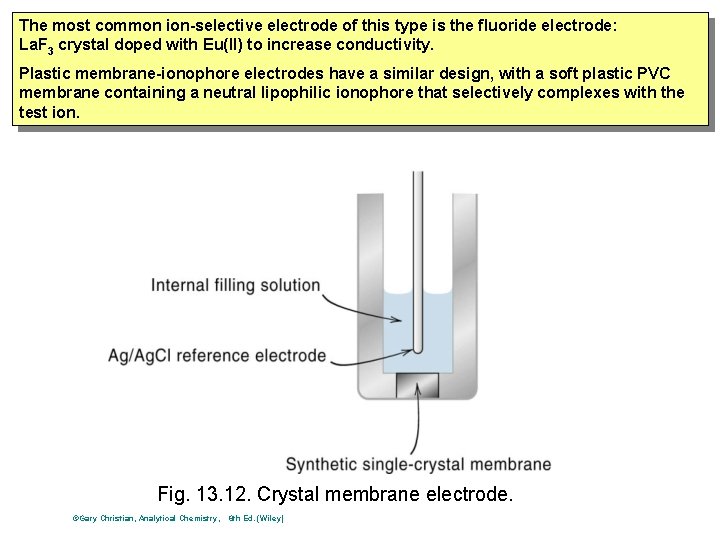
The most common ion-selective electrode of this type is the fluoride electrode: La. F 3 crystal doped with Eu(II) to increase conductivity. Plastic membrane-ionophore electrodes have a similar design, with a soft plastic PVC membrane containing a neutral lipophilic ionophore that selectively complexes with the test ion. Fig. 13. 12. Crystal membrane electrode. ©Gary Christian, Analytical Chemistry, 6 th Ed. (Wiley)
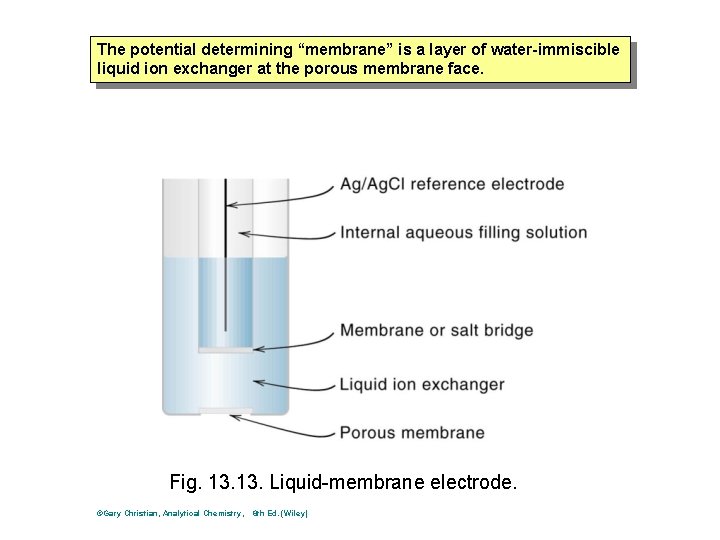
The potential determining “membrane” is a layer of water-immiscible liquid ion exchanger at the porous membrane face. Fig. 13. Liquid-membrane electrode. ©Gary Christian, Analytical Chemistry, 6 th Ed. (Wiley)
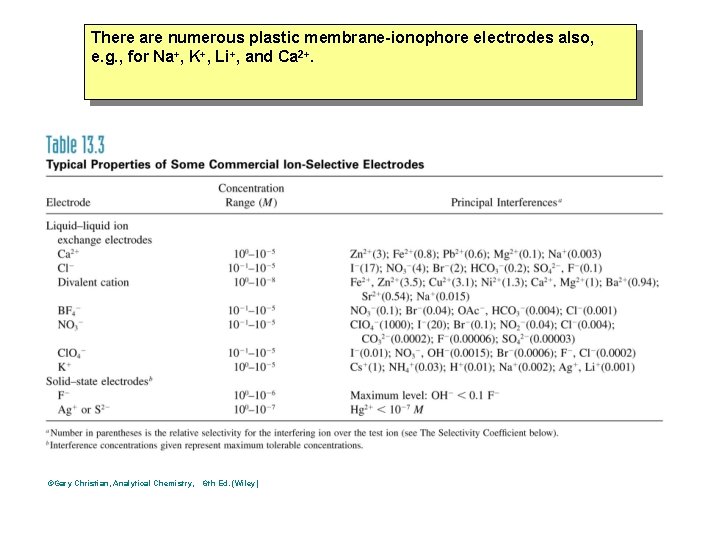
There are numerous plastic membrane-ionophore electrodes also, e. g. , for Na+, K+, Li+, and Ca 2+. ©Gary Christian, Analytical Chemistry, 6 th Ed. (Wiley)
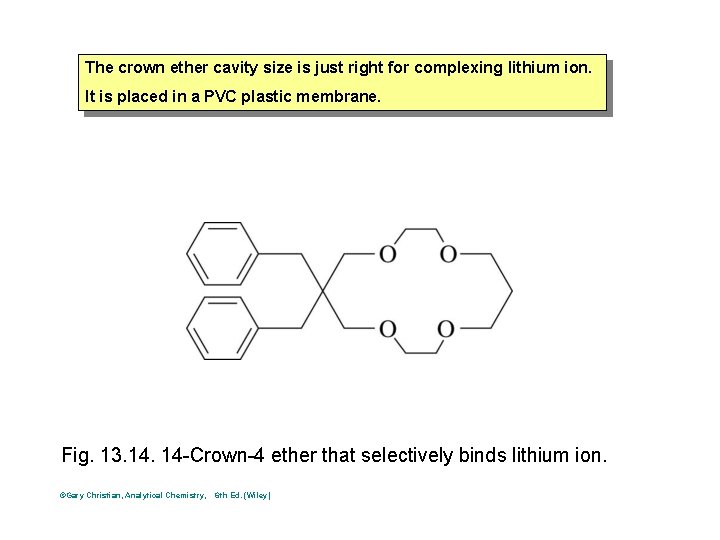
The crown ether cavity size is just right for complexing lithium ion. It is placed in a PVC plastic membrane. Fig. 13. 14 -Crown-4 ether that selectively binds lithium ion. ©Gary Christian, Analytical Chemistry, 6 th Ed. (Wiley)
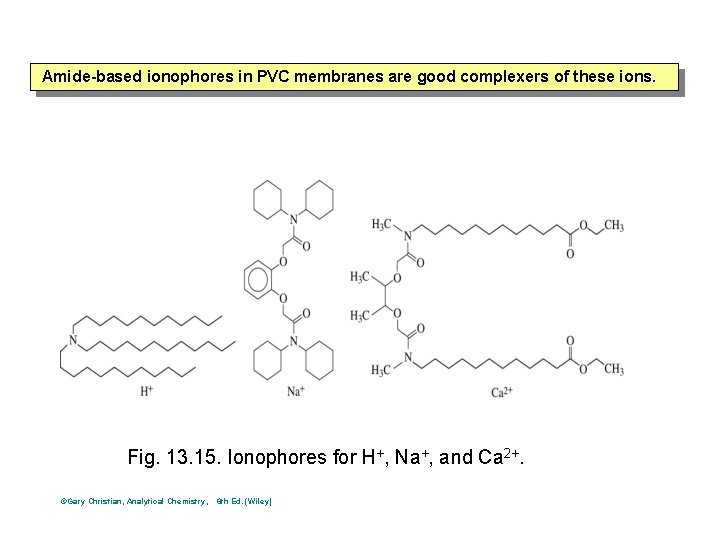
Amide-based ionophores in PVC membranes are good complexers of these ions. Fig. 13. 15. Ionophores for H+, Na+, and Ca 2+. ©Gary Christian, Analytical Chemistry, 6 th Ed. (Wiley)
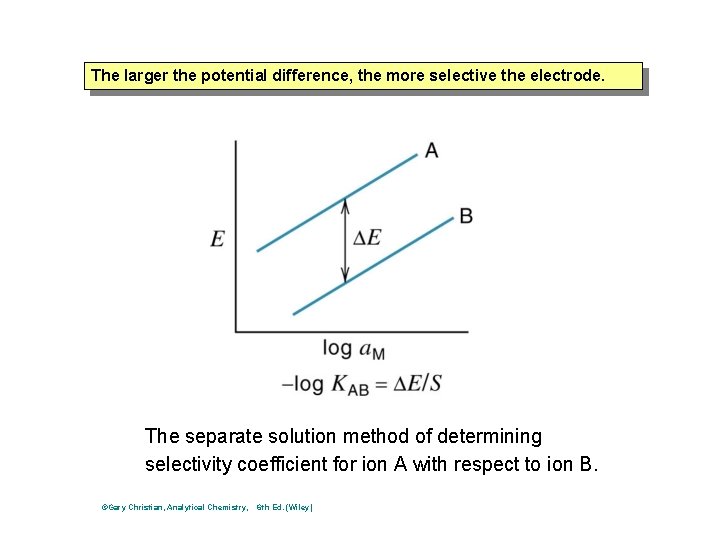
The larger the potential difference, the more selective the electrode. The separate solution method of determining selectivity coefficient for ion A with respect to ion B. ©Gary Christian, Analytical Chemistry, 6 th Ed. (Wiley)
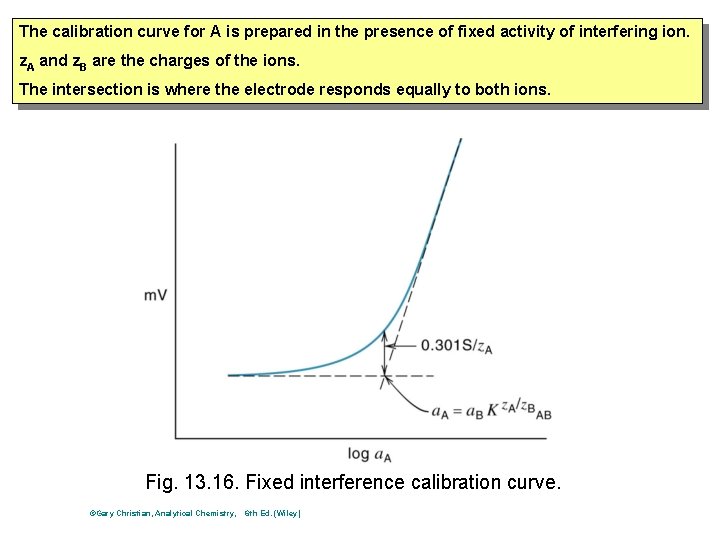
The calibration curve for A is prepared in the presence of fixed activity of interfering ion. z. A and z. B are the charges of the ions. The intersection is where the electrode responds equally to both ions. Fig. 13. 16. Fixed interference calibration curve. ©Gary Christian, Analytical Chemistry, 6 th Ed. (Wiley)
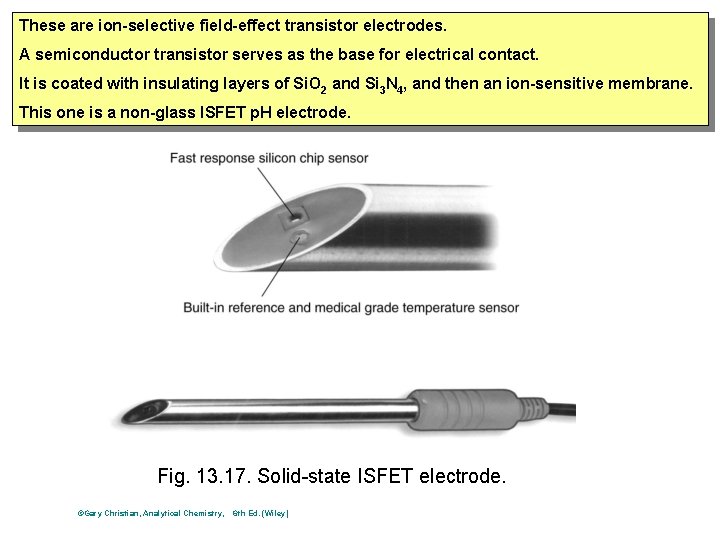
These are ion-selective field-effect transistor electrodes. A semiconductor transistor serves as the base for electrical contact. It is coated with insulating layers of Si. O 2 and Si 3 N 4, and then an ion-sensitive membrane. This one is a non-glass ISFET p. H electrode. Fig. 13. 17. Solid-state ISFET electrode. ©Gary Christian, Analytical Chemistry, 6 th Ed. (Wiley)