
Section 11 Christian Morality The Enlightenment Ren Descartes
- Slides: 27
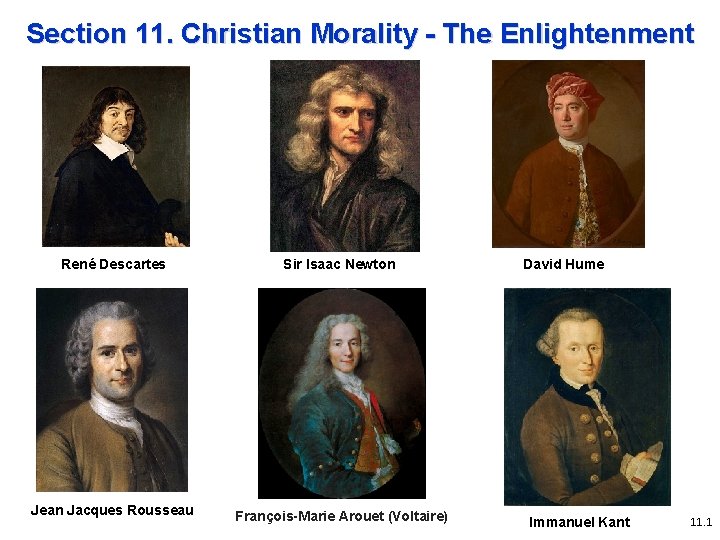
Section 11. Christian Morality - The Enlightenment René Descartes Sir Isaac Newton Jean Jacques Rousseau François-Marie Arouet (Voltaire) David Hume Immanuel Kant 11. 1
The Beginning of the Age of Reason It has always struck me as ironic that men like al-Ghazali and William of Ockham were quite content to use reason to prove the existence of God but were reluctant to use reason to try to understand anything about God. When the Reformers looked to Scripture alone to understand the basics of Christianity, they did so, in large measure, in reaction to false understandings of Scripture that allowed, among other things, the selling of indulgences. Unfortunately, they also threw out centuries of scriptural interpretation that constantly maintained the Christian beliefs that God is both three and one, Jesus is both divine and human and Mary is both virgin and mother. Kenneth Copeland’s description of God as about 6’ 2” and 200 pounds is certainly an example of this so extreme that most serious Protestants would cringe but a more current example is the use of two-dimensional and three-dimensional art in Churches is still a matter of serious debate even though it had been a settled issue at the Second Council of Nicaea. Ockham also started a certain skepticism about the value of reason in the University when applied to the Queen of Sciences, Theology. As mentioned, theology was still allowed in the University, but it was now, at best, a peer to the other sciences and, over time, a lesser area of study. Since the Reformers, men of faith, had little use for reason in matters of Theology, it should not be surprising that men of reason would have little use for faith in matters of the physical sciences. Look how Galileo suffered because men of faith prevented his use of reason to examine the creation in which we live. No, faith was for believers, reason alone was all that was required for men of science. And so the Age of Enlightenment was born. 11. 2
The Early French Enlightenment – Blaise Pascal (I) If Reason in matters of faith was rejected by the Reformers, faith received equal treatment by the men of the Enlightenment. As theology exited stage left, philosophy was right there to take its place. There were two Frenchmen that excelled in philosophy in the seventeenth century; Blaise Pascal and René Descartes. It is hard to say if Blaise Pascal was the last man of the Age of Reformation or the first man of the Age of Enlightenment. Pascal, born in 1623, was himself a mixture of Catholicism and Calvinism. He was a Jansenists were a schismatic branch of Roman Catholicism that adopted Calvin’s interpretation of Augustine without abandoning the organizational structure of Catholic understanding of Church and worship. Pascal was a bit of a prodigy as a young man. At age 18, he built a mechanical calculator (the Pascaline) to help his father figure out the constantly changing taxes he was required to pay. In his failed attempt to produce a perpetual motion machine, Pascal managed to invent an early kind of roulette wheel. As he grew older, Pascal became both a mathematician and a scientist as well as a philosopher. As a mathematician, he wrote “Treatise on the Arithmetical Triangle“ which described a convenient tabular presentation for binomial coefficients, now called Pascal's triangle. As a scientist, he showed the effect that air pressure had on liquids. 11. 3
The Early French Enlightenment – Blaise Pascal (II) While Pascal was both a scientist and a mathematician, his works in philosophy were, perhaps, his most important contributions. His two major works were his “Provincial Letters” and his “Thoughts” (Pensées). The Provincial Letters were written mainly to combat what he saw as casuistry in the Catholic Church in France and especially within the Jesuit order. Casuistry is basically using a series of reasonings to justify otherwise unjustifiable results. As an example, basic morality says that lying is immoral. Casuistry then goes on to point out a generally accepted exception such as the proper answer to the old “Do these jeans make me look fat? ” question. In other words, lying may be justified to spare someone embarrassment. Casuistry would then go on to say that since lying, or any evil, might be justifiable in some circumstances, then it is up to the conscience of the individual to make that determination. This soon morphs into lying is OK. Pascal believed that the Jesuits used casuistry to justify the excesses of the wealthy ruling class or, as we might say today, the donor class. Pascal’s Thoughts (Pensées) was written as a defense of the Christian religion. It remains today one of the finest examples of French prose ever written. Pascal, himself a gambler during his brief lifetime (he died at age 39) is also famous for Pascal’s Wager. The wager goes like this. If I do believe that God exists and God does exist, I go to Heaven. If God does not exist and I believe, nothing happens. I’m dead. If I don’t believe that God exists and God does exist. I go to Hell. If God doesn’t exist, nothing happens. I’m dead. Pascal then decided that a believer had the best odds of experiencing the abiding happiness of Heaven. As I said, Pascal was a gambler, 11. 4
The Early French Enlightenment – René Descartes Like Blaise Pascal, René Descartes was a great philosopher (Meditations on First Philosophy, still a standard text in many university departments of philosophy), a mathematician (Cartesian coordinates) and a scientist (studies in human physiology). Descartes was born in France in 1596. Again, like Blaise Pascal, René Descartes considered himself to be a believing and practicing Catholic Christian. In fact, in his work Meditations on First Philosophy, he proposed two proofs for the existence of God. Descartes specifically stated that his Meditations was meant as a defense of his Catholic faith. Descartes constantly defended faith in reaction to the rational skepticism of his time. But Descartes was still a true man of Reason and he made a key distinction in his philosophy that, like Luther’s 95 Theses, may have taken his thoughts beyond where they were originally intended. In a work that preceded Meditations, his Discourse on the Method, Descartes wrote his famous foundational statement Cogito ergo sum (I think therefore I am). Since I think I can be sure that I exist and that I can rely on the truth of what my mind tells me. That then led Descartes to make a subtle shift in philosophy. Descartes changed the goal of his philosophy from seeking what is true to seeking what one can be sure of. If truth is the goal of philosophy, then truth might look to an external authority (God). If certainty is the goal, that shifts the source of authority from an external to an internal one, a human one. Descartes, perhaps unintentionally, took the final step in separating faith and reason in the pursuit of truth. Perhaps this is why some call Descartes The Father of Modern Philosophy. In fact, Descartes may have taken an unintentional first step toward what became an increasingly skeptical view of the existence of absolute truth. 11. 5
From Faith Alone to Reason Alone I mentioned Pascal and Descartes, two seventeenth century philosophers because I believe that they were transitional men from an age where God and faith were the dominant considerations in the search for truth an age where humankind and reason took the lead in that search. I am going to look at two men of the enlightenment, John Locke of England Jean Jacques Rousseau of France because their two viewpoints are still visible, in however blurry a fashion, in the world we see around us today. I will also make passing mention of three other men; Immanuel Kant, David Hume and Voltaire. Each man could have an entire course taught on their lives and their influence on the history of philosophy. If this were a course on philosophy, I could not pass them by so easily. This, however, is a course on morality and I believe that Locke and Rousseau drew the first battle lines in the moral divide we see in Christianity, as well as in politics, today. Spoiler Alert: Locke jumped out to a big lead but recently Rousseau has gained a lot of ground and may have even passed Locke. Stay tuned. As I make my way to Locke and Rousseau, I will also mention some other men along the way. I am trying to describe a difference between the Enlightenment as experienced in the British Isles as contrasted to the Enlightenment experienced on the continent of Europe. 11. 6
The British Enlightenment – Thomas Hobbes Like Pascal and Descartes, Hobbes was a transitional character. He was born in Wiltshire, England in 1588. he received his Bachelor’s degree from Magdalen Hall at Oxford in 1608 and then went on a grand tour of Europe. While in Europe, he developed an interest in understanding how human physical sensations influenced human thoughts. He was also interested in the role that human beings played as they began to interact with others to take their place within civil society. In the end, he tried to find a connection between what had been considered three separate areas of study, the Body, Human Activity and the State. In an early work. Elements of Law, Hobbes wrote that patrimonial kingdoms did not require the consent of those being governed. He changed his mind, however, on that point in his greatest work, Leviathan. In Leviathan, Hobbes wrote that, without some form of government, humans lived in what he called A State of Nature. In such a state, each individual would have a right to everything that the world could offer. The problem was that everyone would have such a right and the result would be a never-ending war. In such a state, nothing would ever be accomplished on a societal level so humankind would need to cede some of its individual rights to a sovereign for the sake of peace and prosperity. Such a sovereign would have control over civil, military, judicial and ecclesiastical affairs. The sovereign’s power, strong though it may be, still derives from the willingness of the people to cede their authority. This was Hobbes’ version of a social contract. Hobbes’ view on the authority of the sovereign over the Church did not appeal to many in England nor did his view that faith and reason should never be in conflict in the pursuit of truth. 11. 7
The British Enlightenment – John Locke (I) John Locke was born n 1632 in Somerset, England. His parents were Calvinist Puritans. In 1652, he began his studies at Christchurch School at Oxford. He received a Bachelor’s degree here in 1656 and a Masters in 1658. In 1666, Locke became an assistant to Dr. David Thomas at Oxford and became friends with a politician, Lord Anthony Ashley Cooper who would later become the first Earl of Shaftsbury. Lord Ashley became so impressed with Locke’s knowledge of medicine that he appointed Locke to be his personal physician. Lord Ashley also arranged for Locke to be placed under the tutelage of Thomas Sydenham, the English Hippocrates. The two men became close friends for the rest of their lives. While Locke was quite proficient in Medicine, his interests drifted to philosophy. Sydenham seemed to have influenced Locke’s philosophy while Lord Ashley influenced Locke’s politics. In 1679, Locke wrote his Two Treatises of Government. In his first treatise Locke argued against the idea that Kings ruled by Divine Right. This idea was proposed by Robert Filmore who believed that this right derived from the right of Adam to be lord over Eve as described in Genesis. In his second Treatise, Locke posits his own explanation of the human state of nature and the civil state. He states that. in the civil state, an individual does cede some of his natural freedoms to the sovereign for protection but that does not include his freedom of religious thought. He also notes that the legitimacy of the rule of the sovereign depends on the continued consent of the governed. Otherwise, the governed could easily become slaves to the ruler. 11. 8
The British Enlightenment – John Locke (II) The second Treatise goes on to say that the main reason for the existence of civil society itself is the protection of property. When Locke used the word ‘property’ however, he used it with its original meaning derived rom the Latin word proprius, that which belonged properly to oneself including life, liberty and estate. On the continent, Rousseau used the French derivative of that Latin word, propre, in his philosophy as we shall see later. Locke was not specific about the form that civil government should take be it monarchy (rule by a monarch), oligarchy (rule by a political or intellectual elite) or republic (rule by elected representative of the people). Whatever form the government might take it should be a commonwealth type of government where the ruling power governs under an established set of laws and not by dictates of the ruling power. As mentioned, Locke agreed with Hobbes that civil government existed because individual humans who were free by nature ceded certain of those natural rights to government or protection. Locke went on to say, however, that the legitimacy of the civil government was only maintained so long as individuals continued to consent to the ruling authority. He made it clear that when a civil government no longer had that consent, the governed had the right to revolt against the government. Locke’s words are familiar to Americans to the point where they are taken for granted. Their greatness will be even clearer when compared to the words of Rousseau. Before we begin to discuss Rousseau and contrast the continental enlightenment with the British enlightenment, there a few other important figures of the time who are worth mentioning. 11. 9
Isaac Newton was born on Christmas Day in 1642 in Lincolnshire, England. He was born in a proper Anglican household. Newton described himself as a Christian in that he believed that Jesus was the one mediator between God and humankind. But Newton was also a Unitarian. He did not believe in the Trinity nor did he believe that Jesus was divine. Newton was also very fond of Alchemy. Isaac Newton was a polymath. He excelled in mathematics, optics, as well as his famous work on gravity and the laws of motion. He posited the existence of a universal ether. The word “ether” was used to describe a necessary medium through which things like light would move. In 1887, a famous experiment (Michelson-Morley) seemed to disprove this theory. In today’s world of Quantum Mechanics, it seems to be experiencing a comeback with the notion of the Higgs field. I mention Newton here because his principles of the laws of gravity and of motion portrayed a view of the universe that was very deterministic. For decades scientists believed that, by using Newton’s Laws, the universe became very predictable. This, combined with Kant’s views on morality based on rationalism seemed to put human reason in a position where faith was not only less important than reason but could be seen as completely irrelevant in the pursuit of truth. Al-Ghazali used reason to attack reason in Islam. Ockham may have used reason to attack reason in Christianity. In both those cases, reason was under attack by advocates of faith. During the Enlightenment, reason began to fight back against men of faith. We’ll look briefly at Immanuel Kant. Interestingly, reason also came under attack by men of reason. There was a taste of it from David Hume of Scotland. Hume was an example of the skepticism of both faith and reason that was lurking on the outside waiting for its turn to take center stage. We’ll also take a look at Adam Smith. 11. 10
Immanuel Kant: Morality Based on Reason Immanuel Kant was born in Prussia in 1724. He was raised in a vert strict Lutheran family. Before becoming involved in philosophy and morality, Kant was a teacher and a popular author. He never married. He had a strong, intuitive mind. He wrote a number of works but his key works for our concern were his “Ground Work of a Metaphysics of Morals” and his “The Critique of Practical Reason”. Kant’s view of morality is that it is based on reason and free will. Here is how Kant reasoned. 1. Without freedom, morality is not possible. 2. Morality exists, thus 3. Freedom exists. Kant believed that true freedom came from rationality so… 1. Without reason, we would be slaves to our passions (lust, envy, avarice, etc. ) 2. If we were slaves to our passions, we would not be free; thus 3. Without reason, we would not be free. Therefore morality and reason are necessarily related. 1. Without reason, there is no freedom 2. Without freedom, there is no morality, thus 3. Without reason, there is no morality. Descartes may have unintentionally replaced God with human reason at the center of morality, but Kant did so intentionally. 11
Immanuel Kant: Duty and Universality Kant believed that human beings were not like animals. Instinct played no role in their actions. In matters of morality then reason should lead, not follow, in determining the morality of actions. To be moral, then is to conform our free will to the moral law. The next question, of course, is what is the moral law? Kant assumes that there is such a thing as moral law and that there is some representation of it that can be rationally understood. He believed that one aspect of a moral law that can be rationally understood is its universality. Just as mathematics has universal laws such as a*(b+c)=ab+ac, and you can test that law by filling in any set of numbers, the moral law must also have some abstract means by which an action can tested to determine its morality. That test was the test of universality. We should act according to a principle which we can universalize either with or without consistency. This is what Kant calls the categorical imperative. By testing the principle of our actions in this way, we determine if they are moral. If we can universalize our actions without any inconsistency, then they are moral; if we cannot do so, they are not to be considered moral. Kant then concludes that all moral actions are rational and immoral actions are irrational. It is our duty to freely conform our wills to act morally, therefore, rationally. This is what Kant calls the categorical imperative. This imperative requires moral actions to be rationally consistent. If we act this way, we may not be happy, but we will be moral. We will have done our duty. Since Kant believed that for morality to be real, there must be a moral order that exists in the universe. While Kant did not believe that the existence or non-existence of God could be proven by cause-and-effect, he did hold that belief in God, based on the need for natural order, was rational. 11. 12
The Scottish Enlightenment – Adam Smith was born in Scotland in 1723. His two great works, Theory of Moral Sentiments and An Inquiry Into the Nature and Causes of the Wealth of Nations cause him to be a figure of great debate. Was he a moralist as the former work might suggest or was he perhaps the economist as the latter work would suggest? Did morality play any role in Smith’s ideas regarding the wealth of nations? Consider these two statements: How selfish so ever man may be supposed, there are evidently some principles in his nature, which interest him in the fortune of others, and render their happiness necessary to him, though he derives nothing from it except the pleasure of seeing it. (Moral Sentiments) It is not from the benevolence of the butcher, the brewer, or the baker, that we expect our dinner, but from their regard to their own interest. We address ourselves, not to their humanity but to their self-love, and never talk to them of our own necessities but of their advantages. (Wealth of Nations) Adam Smith is known as a free-market economist, but he was also very wary of monopolies and on business interests having too much influence on political matters. He did believe however that wealth for the most people in society can be had where each segment of society was free to pursue its own place in the market of goods and services (and ideas). Smith sees the equilibrium of such a marketplace as guided by his famous phrase “an invisible hand” so long as no portion of society is able to interfere with the free exchange of goods and services. In the end, Smith seemed to be saying that economic morality where the most people would be able to benefit from being part of society came from the freedom of the process. There was no moral shame in pursuing one’s own goals (enlightened selfinterest) so long as they did not intentionally try to limit the freedom of others to do the same. 11. 13
The Scottish Enlightenment – David Hume was born in Scotland in 1711. Hume is known for his treatises on science, philosophy and morality but he is mostly known for his skepticism regarding what can be known. David Hume had very serious questions about causality. Like al-Ghazali in Islam and Ockham in Christianity, Hume has serious doubts about the validity of the use of cause -and-effect thinking in the pursuit of truth. Despite this skepticism that Hume shared with al-Ghazali and Ockham about causality, he was nonetheless an advocate of the scientific method. Hume was also very much unlike al-Ghazali and Ockham in another respect. Al-Ghazali and Ockham felt that cause-and-effect reasoning somehow limited the will of God. Hume didn’t believe in the existence of God, at least of a personal God. Hume was an atheist though he never publicly declared himself one since Church and State were closely tied in the Scotland of his time. Hume argued that it is impossible to deduce the existence of God from the existence of the world becauses cannot be determined from effects. When faced with the proposition that the only answer to the question "why is there something rather than nothing? " was a necessary being called God, Hume responded that there was no such thing as a necessary being. Yet Hume never managed to actually answer the question. He simply shrugged it off declaring it to be irrelevant. With God out of the picture, Hume believed that human reason was all that could relied upon in the search for truth, but Hume also was skeptical about what reason could know. Hume and his skepticism regarding both faith and reason would play a greater role in modern times than in the time of the Enlightenment. More on Hume later. 11. 14
The Later French Enlightenment - Voltaire The Enlightenment period cannot be spoken about without mention of François-Marie Arouet whose nom de plume was Voltaire. He was born in Paris in 1694 and died there in 1778 just before the French Revolution which began the following year. Voltaire was best known as a writer. He was also something of an historian and a philosopher but in matters of morality, Voltaire was not quite against it but preferred that it have no affect on his own life or on the lives of others with whom he might have a more intimate interest. Voltaire believed in a God whom he could consider by reason alone. Voltaire’s God was the Deist clock-maker. Being too easily bored by things, Voltaire liked the novelty of Eastern religions but had no time whatsoever for the monotheistic religions of his time. Voltaire simply loved being different. About Roman Catholicism, Voltaire wrote. “La nôtre [religion] est sans contredit la plus ridicule, la plus absurde, et la plus sanguinaire qui ait jamais infecté le monde. (Our religion is, beyond a doubt, the most absurd, and the most bloody that has ever infected the world. ) About Islam, Voltaire wrote a letter to Frederik II of Prussia in 1740 in which he ascribed to Mohammed “a brutality that is assuredly nothing any man can excuse”. Rabbi Joseph Telushkin believed that Voltaire was, by far, the most anti-Semitic of all the Enlightenment scholars. In Voltaire's A Philosophical Dictionary, he wrote of Jews: "In short, we find in them only an ignorant and barbarous people, who have long united the most sordid avarice with the most detestable superstition and the most invincible hatred for every people by whom they are tolerated and enriched. " Voltaire did support religious tolerance and the separation of Church and State. He had great influence (unrequitted) on Rousseau but, at heart, a “Peck’s Bad Boy” who was a master of le bon mot, more at home in affaires des salons than of affaires du monde. 11. 15
The Later French Enlightenment - Jean Jacques Rousseau (I) When most people think of Rousseau they think of a Frenchman that was a native of Catholic France. In fact, he was born to a Calvinist family in Geneva, Switzerland in 1712. He wrote about his experiences growing up in Switzerland in one of his famous works, Confessions. At age 15, Rousseau ran away from Switzerland wound up in the Duchy of Savoy, one of those not-quite-countries that were part of the Holy Roman Empire. He was given refuge by a Catholic priest who introduced him to Francoise-Louise de Warens, a noble woman from a Protestant background who was on her way to becoming a Catholic. Rousseau became her ward and, a few years later, her lover. At age 25, he inherited some money from his mother. He repaid Mme. de Warens the money she had invested in him and went off on his own. Around the age of 33, Rousseau journeyed to Paris and took Thérèse Levasseur as his mistress. Thérèse was a seamstress who was the sole support of her mother and her siblings. She bore him a son and at least two other children. Each child was quickly dispatched to a foundling home. It is the peak of irony that Rousseau would go on to be considered an expert on children and a well-regarded theorist on education. Rousseau’s first great written work was the result of a competition offered by the Academie de Dijon on whether the arts and sciences had improved or corrupted public morals. Rousseau took the interesting position that social development, including of the arts and sciences, is corrosive of both civic virtue and individual moral character. His works was called Discourse on the Sciences and Arts (aka First Discourse). It was in this work that he had what he called his epiphany. He concluded that humankind is born good but evil occurs when the naturally good human nature is corrupted by society. The desire to advance one’s intelligence and standing in society was at the root of that corruption. 11. 16
The Later French Enlightenment - Jean Jacques Rousseau (II) It is in his belief in this moral principle, that Rousseau lays the foundation for what would become the French Revolution some decades later. It is my proposition that Rousseau also lays the foundation of what is to come in the twentieth century. Each individual is born good. Evil and corruption are the fault of society. If then, evil is the fault of society, then it is not the individual who must be made moral. It is society that needs to be fixed. Of course, Rousseau never quite explains how a society made up entirely of people who are born good somehow contracts this evil nature. Rousseau does offer us that notion that it is the individual’s desire to improve himself within society that triggers all problems but then how can that be laid at the feet of society? Rousseau also used this viewpoint as the foundation of his education theories. If all children are naturally good, the education system should not allow the society of the classroom to ruin the child. The child should be free to pursue his or her own interests without any interference from teachers or classmates. In fact, teachers should be more like guides or perhaps aides as the child pursues his natural interests. Yet, if they are to be guides, isn’t that another thing that is associated with society? Rousseau’s Second Discourse was his Discourse on the Origins of Inequality. In this discourse, Rousseau discusses two kinds of inequality; natural and moral. All human beings are born with a natural inequality. Some people are taller, stronger, faster than others. That is simply nature at work and Rousseau pays little attention to it. It is the moral man that Rousseau is most interested in. The moral man is a “noble savage”. He is out of place in a society. He relies on his innate animal senses and not on reason, at least on reason as society explains it. The “reason” that the noble savage has is understanding his place in nature and constantly adapting to it. Rousseau wrote his Second Discourse after he returned to Geneva, Switzerland re-converted to Calvinism. 11. 17
The Later French Enlightenment - Jean Jacques Rousseau (III) Rousseau wrote two other pieces worth noting. Emile was Rousseau’s great discourse on education. In Emile, Rousseau asks if education is meant to grow the natural man or the citizen. He also suggests that children are better served by pursuing their natural curiosities than by books. Maria Montessori favored that part of Rousseau’s approach to education. As a student grows older, he should be required to learn a trade that suited the student’s natural abilities and mentored by someone skilled in that trade. Rousseau does speak about the education of women but his views are interesting. "everything man and woman have in common belongs to the species, and. . . everything which distinguishes them belongs to the sex“ Rousseau also believed that women should be "passive and weak“. Women should "put up little resistance“. Women are "made specially to please man“. Rousseau does add, however, that "man ought to please her in turn“. Keeping the “noble savage” in mind Rousseau also saw that the dominance of man as a function of "the sole fact of his strength", that is, as a strictly "natural" law, prior to the introduction of "the law of love“. Rousseau, as mentioned, was influenced by Voltaire. in December 1745 Rousseau wrote a letter introducing himself to Voltaire replied with a polite response. Subsequently, when Rousseau sent Voltaire a copy of his book Discourse on Inequality, Voltaire replied, noting his disagreement with the views expressed in the book: No one has ever employed so much intellect to persuade men to be beasts. In reading your work one is seized with a desire to walk on four paws. When Rousseau wrote a romantic novel, Julie, or the New Heloise, Voltaire commented: No more about Jean-Jacques' romance if you please. I have read it, to my sorrow, and it would be to his if I had time to say what I think of this silly book. Despite these slights, Rousseau continued to publicly endorse Voltaire. When Rosseau died a month after Voltaire, he was placed near him in the Panthéon. 11. 18
Locke, Rousseau and Revolutions (I) In the second half of the eighteenth century, two revolutions took place. The American revolution began in 1776 while the French Revolution began in 1789. Both revolutions involved principles that arose from the influence of the Enlightenment. I believe that the two revolutions, though influenced by a common belief that human beings had a natural right to self-determination, it was the context in which that natural right was understood that made all the difference. I’ll try my best to explain. I think it’s fair to say that John Locke had a great impact on the American Revolution while Jean-Jacques Rousseau had a great influence on the revolt in France. Both Locke and Rousseau believed that the natural state of humankind was free and that government should be by the consent of the governed. But there was a huge gap between what Locke and Rousseau believed that natural human state was like. For Rousseau, humans were born in a natural state of freedom and goodness. So long as the person remained in that state, his freedom and goodness were maintained as his freedom would let him explore and adapt to the changes that nature and his own natural state imposed on him. The civil state, society, was what caused evil to enter into a person’s life. For evil to be avoided, it was society that had to be made moral. In France, there were different estates that is, levels of society. The First Estate was the nobility. The Second Estate was the clergy, the Third Estate was the common people. The Monarchy was above all and so had no estate. The system of estates was the French version of Identity Politics. Each estate was its own ID group. Since each estate formed a segment of society, when the Revolution occurred, to avoid evil in humankind, each level had to be fixed. Each person was then viewed more by the estate in which they were situated than as an individual. So morality was based on the ID group and not the person in the group. 11. 19
Locke, Rousseau and Revolutions (II) John Locke agreed with Rousseau that individual freedom was the natural state of every human being. Locke had a much more sanguine opinion of the civil state, however. He believed that human individuals ceded some of their natural freedoms to insure their property and by property Locke meant those things proper to an individual; life, liberty and estate. Here Locke had a different meaning of estate than Rousseau. For Locke, estate was not your ID group within society. Estate meant those freedoms, naturally belonging to the individual that were not ceded to civil society. Yes, this included but was not limited to private property. The most important freedom included in the idea of estate, was the freedom of an individual (not a group) to pursue his or her own view of happiness. Locke also disagreed with Rousseau about evil in the world. While Rousseau saw civil society as the source of evil, he never quite explained how that society, completely made up of people who were born naturally good, became evil in the first place. Locke had a much more traditional view of evil, Locke believed that each human was born as a tabula rasa, a blank slate. Each individual was then capable of both good and evil and civil society should encourage the former and discourage the latter. It is no coincidence that the founding documents of both the American and the French revolution seem to reflect Locke more than Rousseau. Thomas Jefferson wrote the American Declaration of Independence and the Marquis de Lafayette (with some help from Jefferson) wrote the French Declaration of the Rights of Man. It was in the implementation of each Revolution and it’s follow-up form of government that the Locke-Rousseau divide becomes more evident. 11. 20
Locke, Rousseau and Revolutions (III) The American Revolution began by a declaration of representatives of all thirteen British colonies in what would become the United States. They simply declared that they were, and ought to be, free from the British monarchy across the ocean. They resented being taxed and subject to the laws of a people far away without having any significant representation in the formation of those laws and taxes. The British government, believing the American colonists to be ingrates, sought to quell the American revolt by force of arms. This is a key point. The American colonists needed to unite in order to succeed in the faces of armed opposition almost from the start. That was not the case in the French Revolution. The French Government had spent a lot of money in wars within the continent. They had also spent money helping the Americans in their revolution. The King at that time, Louis XVI was still living opulently while the people had suffered through drought, poor harvests and the hunger that comes from those sufferings. In 1786, the government had run out of funds. In 1786, the controller of the treasury proposed a universal land tax that provided no exemptions for the nobility. To garner support for the tax, Louis called for a meeting of the Estates-General. The Estates-General hadn’t met in session since 1614. The meeting was scheduled for May, 1789. Representatives of the nobility, clergy and commoners (mostly the emerging business class, the bourgeoisie) would be allow to bring a list of grievances to the King. The Estates-General would normally vote by class but the Commoners decided that wouldn’t do. They wanted one man-one vote. After some dispute, the commoners, the clergy and a number of liberal nobles agreed and a several weeks later, a National Assembly met instead of the Estates-General and work on a national constitution began. 11. 21
Locke, Rousseau and Revolutions (IV) While the National Assembly worked on the new constitution, there was great unrest among the masses. The Bastille was stormed to take possession of arms and ammunition that were stored there. To quell the concern of the people, Lafayette produced the Declaration of the Rights of Man and of the Citizen. This outlined the goal of the new government in much the same way as the Declaration of independence did for the new American government. In 1791, the constitution was completed. It called for a Constitutional monarchy in which the King had veto power over legislation. This moderate proposal may have reflected a way of thinking that would have very likely appealed to Hobbes and represented the moderate tone of Locke. The reaction by the more radical elements of the Common people were far more like Rousseau. A group called the Jacobins (named after the street where their meeting place was located) led by a man named Robespierre combined several of the more radical elements of the common class. They wanted no part of a monarchy of any kind. They wanted a republic. They had no idea how it should be ordered but they knew that the current order, the monarchy and the estates, had to be removed. The Jacobins believed those orders to be repressive and beyond reform. They must be removed. The old orders represented the evils of civil society that were keeping man from his natural freedom. Blood ran on the streets in France. The King and Queen were arrested and imprisoned. Later they were both killed. 11. 22
Locke, Rousseau and Revolutions (V) Every revolution eats its own. The Montagnard group of Jacobins led by Robespierre lost power and Robespierre and his followers were themselves arrested and executed. The Girondin segment of the Jacobins were now in charge. They called a convention in 1795 and declared a two-house legislature. The executive comprised five people called The Directorate. Royalists and Jacobins were furious but the army under the control of Napoleon Bonaparte silenced them. The Directorate managed to stay in power four years. Those years showed how far the revolution had strayed from Lafayette’s words and broke down as many revolutions do when they make utopian promises to fix society while proving unable even to fix themselves. As we all know, the revolution continued to eat its own as Napoleon staged a coup in 1799. He ended the Directorate and essentially ended the French Revolution as he began the French Empire. The Locke inspired American Revolution had its own share of bloodshed in its war with England but, when that war was over, order was maintained. After an eight-year experiment with the Articles of Confederation that failed, they put in place, again, in an orderly manner, a new government. That government remains in place today because the rules it created recognized, as Locke did, that human beings were born capable of great good but also capable of great evil. They formed institutions that ceded specific powers to the Federal Government but maintained all other powers to the states and their citizens. The Federal Government to whom those few powers were ceded was itself divided into three parts where each part could keep a check on the other two. This form of government has lasted because it recognized that morality was something that individuals did or did not have. Groups are not moral in the same way that individuals are. The Constitution also recognized the Christian principle (expressed in its understanding of Original Sin) that individuals were capable of great good and great evil. It also recognized that rights and responsibilities belonged to the individual. It allowed freedom but had checks and balances against evil. 11. 23
Locke, Rousseau and Revolutions (VI) The French Revolution was more concerned with the belief in noble principles than in the details of how those principles might best be achieved. The French Revolution did not seem as concerned about how man’s freedom could best be preserved within civil society. Civil society was the enemy. Rousseau himself said that evil resulted from human efforts to succeed and to advance within society. For Rousseau, human freedom was most preserved in the way that the natives of America preserved simply to live as independently as possible in as small a civil group as possible. The problem of course is that the Native Americans were few people who lived on a large swath of land and, even with all that, still had individuals within the tribe who acted immorally. So, here’s the scorecard. America had two forms of government since their revolution; the Articles of Confederation and the Constitution. France on the other hand had; - The National Assembly under Robespierre and the Montangnard Jacobins The Directorate under the Girondin Jacobins Note: These first two governments formed the First Republic (1792 -1804) The First Empire under Napoleon I (1804 -1814) The First Bourbon Restoration (Monarchy) under Louis XVIII (1814/1814) The Hundred Days rule under Napoleon I (1814) The Second Bourbon Restoration under Louis XVIII succeeded by Charles X (1815 -1830) The July Revolution of 1830 ending the Bourbon line of Kings being replaced by the House of Orleans under Louis Philippe I (1830 -1848) The Second Republic (1848 -1852) The Second Empire (1852 -1870) under Napoleon III The Third Republic (1870 -1940) The Vichy Government (1940 -1944) The Fourth Republic (1946 -1958) 11. 24 The Fifth Republic (1958 -Present Day)
Summary From the beginning of Christianity, faith and reason seemed to play nicely together as the faith expanded across the Roman Empire and even burst out into several lands in the East such as Armenia, Persia and India. All this took place despite ongoing persecution by governments in those lands. Most people believe it was Constantine that made Christianity the official religion of the Roman Empire, but that event happened several decades after Constantine’s death when the Emperor Theodosius issued the Edict of Thessalonica in 380 CE declaring Catholic Christianity to be the official religion of the Empire. That decree did not lead to the persecution of other religions. It did lead to the defunding by the Empire of the shrines and Temples of traditional Roman deities. Faith and Reason argued with each other for several centuries after 380 regarding the persons of the Trinity and the nature of Jesus Christ. Most of these debates arose in the Eastern half of the Empire. Pelagianism was the major debate in the West. In 476 CE, however, the Western Empire ceased to exist and its new rulers ceased to be Catholic Christians. They were either Arian Christians or what came to be called Pagans. During the sixth and seventh centuries, large portions of what had once been the Western Empire were, bit by bit, reconverted to Catholic Christianity and, in the East, where Catholic Christianity remained intact, one more great debate took place over the use of imagery in places of worship. What triggered this debate was the rise of Islam which, like Judaism, saw God as spirit only and saw the use imagery as a form of idolatry. Catholic Christianity decided that, since Jesus was Himself human and that the other two persons of the Trinity showed their presence in a material way, the use of imagery was allowed. Faith and Reason continued to work together within Catholic Christianity 11. 25
Summary (II) When the Islamic conquests had finally been halted, another round of turmoil rattled the former Western Empire as tribal lands began to develop into nation states. This period of turmoil, called the Dark Ages, allowed little, if any, time for debates between faith and reason. Survival was the key issue, but faith played a significant role in helping individuals manage their lives through the turmoil. At the beginning of the eleventh century, the world underwent a period of global warming. All across Europe and the Mid-East, a new prosperity was experienced. Crops were abundant. Lands previously too cold for farming were open. The prosperity allowed people enough leisure time to focus on things beyond mere survival. Cities grew allowing merchant and skilled labor classes to develop. Universities were established all across Western Europe. In those universities theology and the sciences were taught on an equal footing. This period may well have been the last time that faith and reason were in balance. While Western Europe was entering its own Golden Age, Islam, which had conquered and dominated the Middle East, much of Persia and part of India as well as all of North Africa, saw its own Golden Age coming to an end. One important part of that was a word we are going to hear a lot about in the classes yet to come, skepticism. In the case of Islam, that skepticism was from a man of faith, Abu Hamid al-Ghazali, who was skeptical of the use of reason in trying to come to know more about Allah. Al-Ghazali’s writings made their way into Europe and, as the fourteenth century dawned, William of Ockham, perhaps having read Al-Ghazali, wrote his own skeptical comments about the value of human reason in trying to know more about the Christian God. About 150 years after Ockham Catholic Christianity in the West underwent the Great Reformation. Two of the great leaders of that movement, Luther and Calvin, claimed Ockham as one of the sources of their ideas. 11. 26
Summary (III) The Reformation, and the Roman Catholic counter-reformation, once again drew Christianity into another series of debates. The Protestant side, following the example of Ockham and his advocates, Luther and Calvin, stressed faith alone. The Catholic side, which continued to look more to Aquinas than Ockham, continued to hold a place for reason but even Catholicism began to stress faith more than reason. The balance of the religious debate was clearly swinging to the side of faith over reason. Then Descartes, perhaps accidentally, and Kant, quite intentionally, changed the focus of morality from God to humanity and things began quite rapidly to swing the other way. The British Enlightenment continued to see a place for God, however diminished, in the area of what was and wasn’t moral. In America, the leadership may have had its elements of Deism and Freemasonry but George Washington, himself a Freemason, declared that the future of the republic depended on the morality of its citizenry that was based on that citizenry’s belief in God and its belief in individual freedoms that derive, not from the state, but from that God. Rousseau in the French Enlightenment had little use for God and faith. Reason alone was at the center of human morality. Morality came from a belief in moral ideals such as liberty, equality and the brotherhood of man. Once society was cured of its past evils and came to accept those ideals, then society would be moral. Rousseau had no specific idea of what that society would look like or how its ideals could be achieved. And out of Scotland came a hint of things to come. David Hume’s skepticism began to question the use of human reason to know anything be it issues of morality or issues of knowledge in general. Hume’s skepticism took a while to get to center stage but when it arrived, it questioned everything. 11. 27