
Section 11 2 Your Muscular System The Muscles
- Slides: 12
Section 11. 2 Your Muscular System The Muscles in Your Body • Muscles move eye as you read. • Muscles in your chest allow you to breath. • Muscles in your heart pump blood. • Every time your body moves, muscles are at work. Slide 1 of 16
Section 11. 2 Your Muscular System Types of Muscle Your body has three types of muscle tissue that perform different functions. • Smooth Muscle is involuntary muscle that causes movements within your body. • Cardiac Muscle is involuntary muscle that is found only in the heart. • Skeletal Muscles are the muscles that you control to do activities, such as walk or play a musical instrument. A thick strand of tissue called a tendon attaches a muscle to a bone. Slide 2 of 16
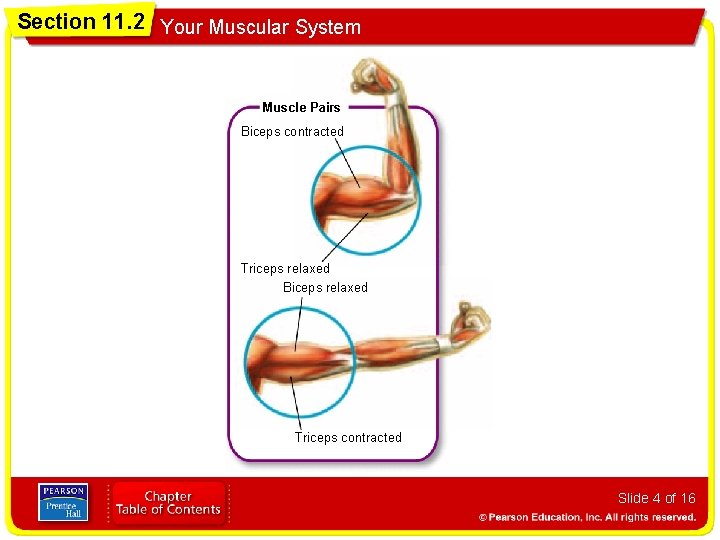
Section 11. 2 Your Muscular System How Muscles Work • All muscles do work by contracting, or becoming shorter and thicker. • Many skeletal muscles work in pairs. • One muscle in the pair contracts to move the bone in one direction. • Then, the other muscle in the pair contracts to move the bone back. Slide 3 of 16
Section 11. 2 Your Muscular System Muscle Pairs Biceps contracted Triceps relaxed Biceps relaxed Triceps contracted Slide 4 of 16
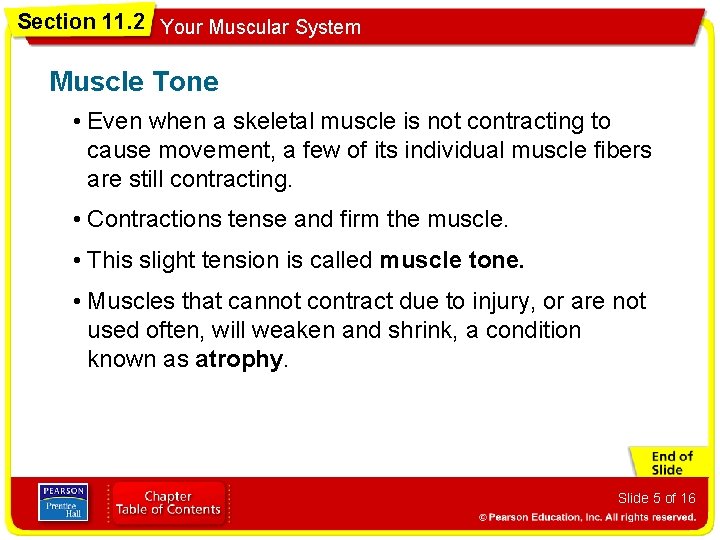
Section 11. 2 Your Muscular System Muscle Tone • Even when a skeletal muscle is not contracting to cause movement, a few of its individual muscle fibers are still contracting. • Contractions tense and firm the muscle. • This slight tension is called muscle tone. • Muscles that cannot contract due to injury, or are not used often, will weaken and shrink, a condition known as atrophy. Slide 5 of 16
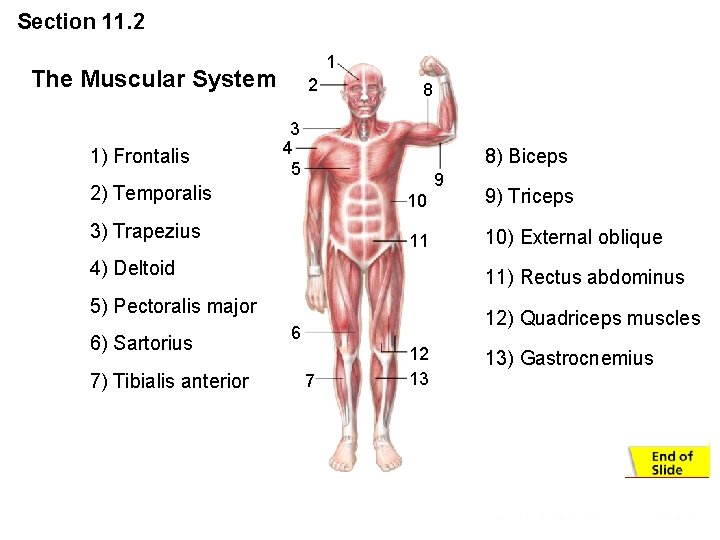
Section 11. 2 Your Muscular System 1 The Muscular System 1) Frontalis 2 8 3 4 5 8) Biceps 9 2) Temporalis 3) Trapezius 10 9) Triceps 11 10) External oblique 4) Deltoid 11) Rectus abdominus 5) Pectoralis major 6) Sartorius 7) Tibialis anterior 12) Quadriceps muscles 6 7 12 13 13) Gastrocnemius Slide 6 of 16
Section 11. 2 Your Muscular System Keeping Healthy • You can maintain a healthy muscular system by regularly participating in different types of exercise. • To help prevent injuries, exercise sessions should include a warm-up and cool-down period. Slide 7 of 16
Section 11. 2 Your Muscular System Working Your Muscles • Some types of exercise increase a muscle’s endurance—how long it can contract without tiring. • Other exercises make individual fibers grow, which causes the muscles to thicken and increase in strength. • Anabolic steroids are artificial forms of the male hormone testosterone. Slide 8 of 16
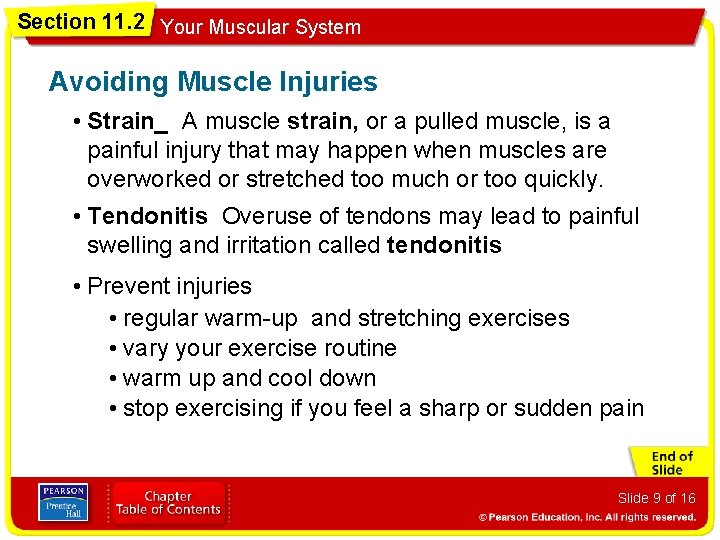
Section 11. 2 Your Muscular System Avoiding Muscle Injuries • Strain_ A muscle strain, or a pulled muscle, is a painful injury that may happen when muscles are overworked or stretched too much or too quickly. • Tendonitis Overuse of tendons may lead to painful swelling and irritation called tendonitis • Prevent injuries • regular warm-up and stretching exercises • vary your exercise routine • warm up and cool down • stop exercising if you feel a sharp or sudden pain Slide 9 of 16
Section 11. 2 Your Muscular System Preventing Muscle Cramps • A cramp is a strong, uncontrolled muscle contraction. • To relieve a cramp, try massaging the affected area and exercising the limb gently. • Stretching and drinking plenty of water before and during exercise can help you avoid muscle cramps. Slide 10 of 16
Section 11. 2 Your Muscular System Vocabulary Smooth muscle Involuntary muscle that causes movements inside your body, such as those involved in breathing and digestion. Cardiac muscle Involuntary muscle that is found only in the heart. skeletal muscle Voluntary muscle attached to and moves bones tendon A think strand of tissue that attaches a muscle to a bone. Muscle tone Contractions of limited muscle fibers that keep a muscle tense, but do not produce movement. Slide 11 of 16
Section 11. 2 Your Muscular System Vocabulary atrophy Anabolic steroid strain tendonitis A condition in which muscles that cannot contract or are not used often weaken and shrink. An artificial form of the male hormone testosterone that is used to increase muscle size and strength. A pulled muscle Painful swelling and irritation of a tendon, often caused by overuse. Slide 12 of 16