
Section 11 1 Permutations and Combinations Objective Count
Section 11. 1 – Permutations and Combinations Objective: Count by FCP, Permutations and Combinations
Essential Understanding � Fundamental Counting Principle (FCP) ◦ If event M occurs in m ways and event N occurs in n ways, then event M followed by event N can occur in ways. ◦ Example: 3 pants and 2 shirts give ◦ Tree Diagrams can show why this works. possible outfits.

Ex. 1 –How many more 2004 style plates are possible than 1912 plates?
Essential Understanding � Permutation ◦ An arrangement of items in a particular order. �Ex: 3 items
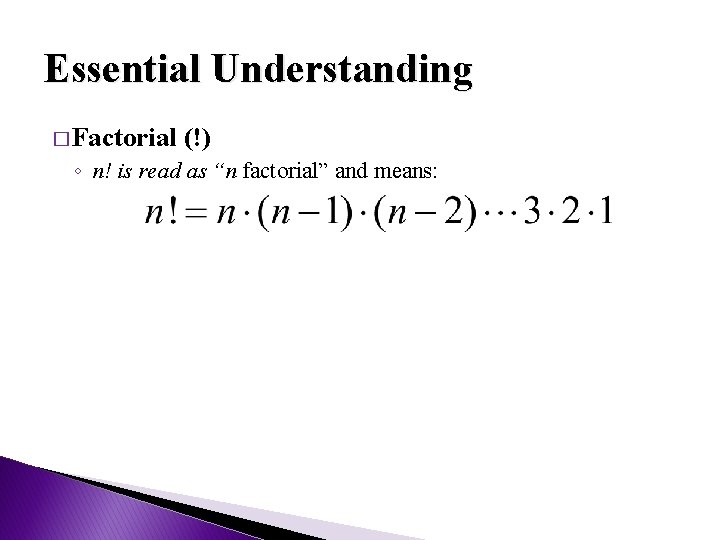
Essential Understanding � Factorial (!) ◦ n! is read as “n factorial” and means:
Ex. 2 – In how many ways can you file 12 folders, one after another, in a drawer?
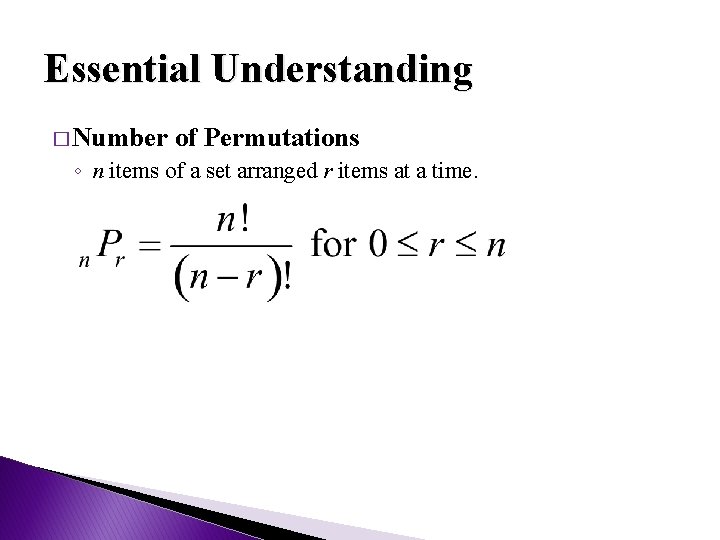
Essential Understanding � Number of Permutations ◦ n items of a set arranged r items at a time.
Ex. 3 – In how many ways can 10 runners finish first, second, and third?

Essential Understanding � Combination ◦ A selection in which order doesn’t matter. � Number of Combinations ◦ n items of a set chosen r items at a time.
Ex. 4 – Suppose the same 10 runners ran a race where the top 3 advance to the championship race. How many ways are there for this to happen?
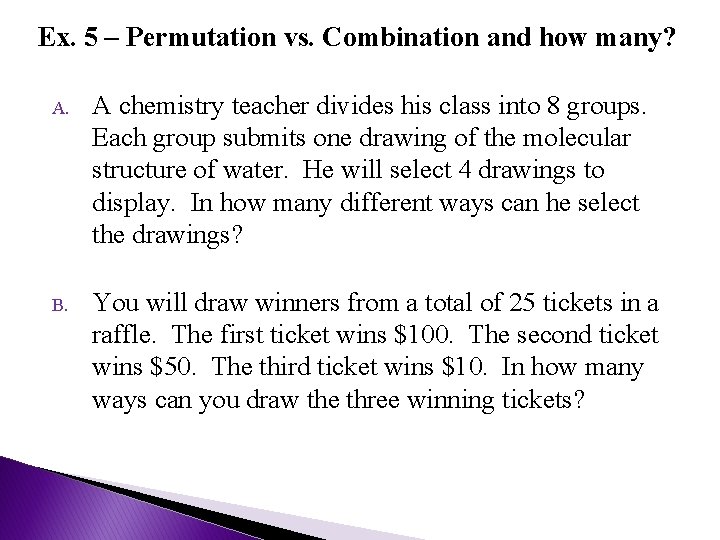
Ex. 5 – Permutation vs. Combination and how many? A. A chemistry teacher divides his class into 8 groups. Each group submits one drawing of the molecular structure of water. He will select 4 drawings to display. In how many different ways can he select the drawings? B. You will draw winners from a total of 25 tickets in a raffle. The first ticket wins $100. The second ticket wins $50. The third ticket wins $10. In how many ways can you draw the three winning tickets?
HMW pp. 678 -680 20, 35, 41, 43, 45, 56, 63, 68, 50, 51
- Slides: 12