
Section 10 Mixins Subclasses Spring 2020 Dispatch Overview

Section 10 Mixins & Subclasses Spring 2020

Dispatch Overview Dispatch is the runtime procedure for looking up which function to call based on the parameters given: • Ruby (and Java) use Single Dispatchon the implicit self (or “this”) parameter • Uses runtime class of self to lookup the method when a call is made • This is what you learned in CSE 143 • Double Dispatch uses the runtime classes of both self and a single method parameter • Ruby/Java do not have this, but we can emulate it • This is what you will do in HW 7 • You can dispatch on any number of the parameters and the general term for this is Multiple Dispatchor Multimethods
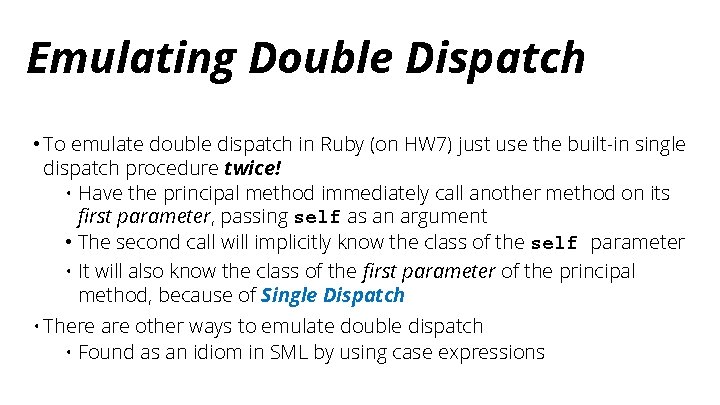
Emulating Double Dispatch • To emulate double dispatch in Ruby (on HW 7) just use the built-in single dispatch procedure twice! • Have the principal method immediately call another method on its first parameter, passing self as an argument • The second call will implicitly know the class of the self parameter • It will also know the class of the first parameter of the principal method, because of Single Dispatch • There are other ways to emulate double dispatch • Found as an idiom in SML by using case expressions
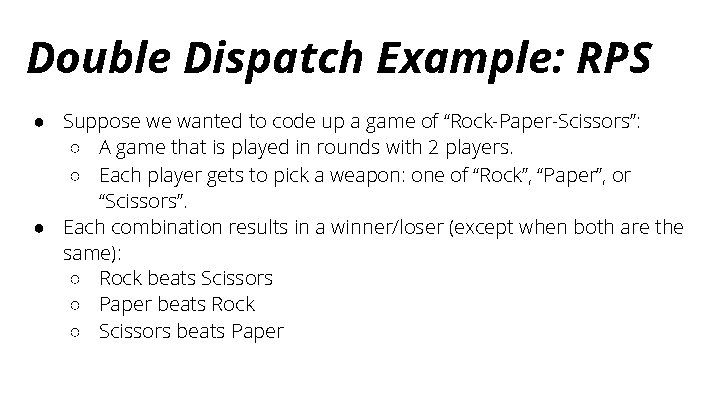
Double Dispatch Example: RPS ● Suppose we wanted to code up a game of “Rock-Paper-Scissors”: ○ A game that is played in rounds with 2 players. ○ Each player gets to pick a weapon: one of “Rock”, “Paper”, or “Scissors”. ● Each combination results in a winner/loser (except when both are the same): ○ Rock beats Scissors ○ Paper beats Rock ○ Scissors beats Paper

Double Dispatch Example: RPS ● What are the different combinations of games? ○ Player 1 fights Player 2 with a tool, and Player 2 responds, which determines the outcome. Player 1 Player 2 Rock Paper Scissors Rock Tie Paper wins Rock wins Paper wins Tie Scissor wins Scissors Rock wins Scissor wins Tie
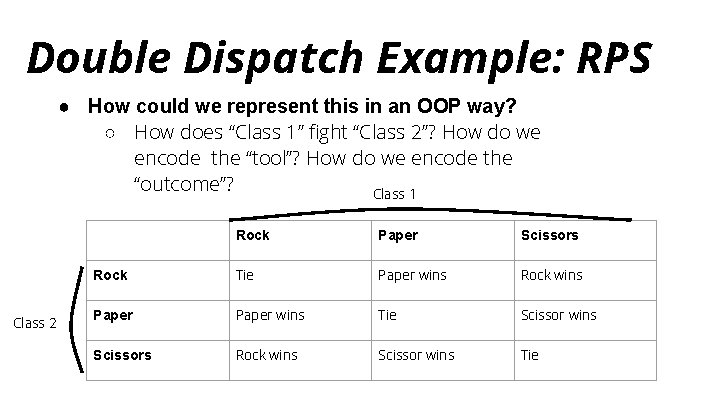
Double Dispatch Example: RPS ● How could we represent this in an OOP way? ○ How does “Class 1” fight “Class 2”? How do we encode the “tool”? How do we encode the “outcome”? Class 1 Class 2 Rock Paper Scissors Rock Tie Paper wins Rock wins Paper wins Tie Scissor wins Scissors Rock wins Scissor wins Tie
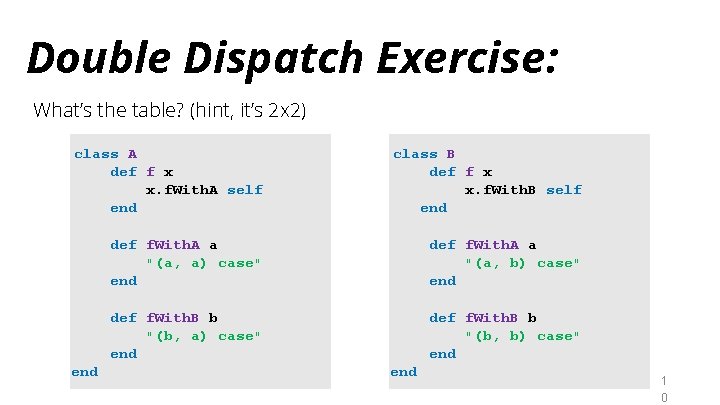
Double Dispatch Exercise: What’s the table? (hint, it’s 2 x 2) class A def f x x. f. With. A self end class B def f x x. f. With. B self end def f. With. A a "(a, a) case" end def f. With. A a "(a, b) case" end def f. With. B b "(b, a) case" end def f. With. B b "(b, b) case" end end 1 0
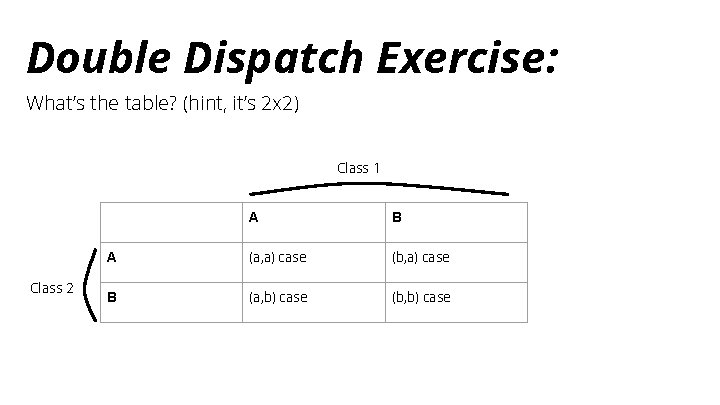
Double Dispatch Exercise: What’s the table? (hint, it’s 2 x 2) Class 1 Class 2 A B A (a, a) case (b, a) case B (a, b) case (b, b) case
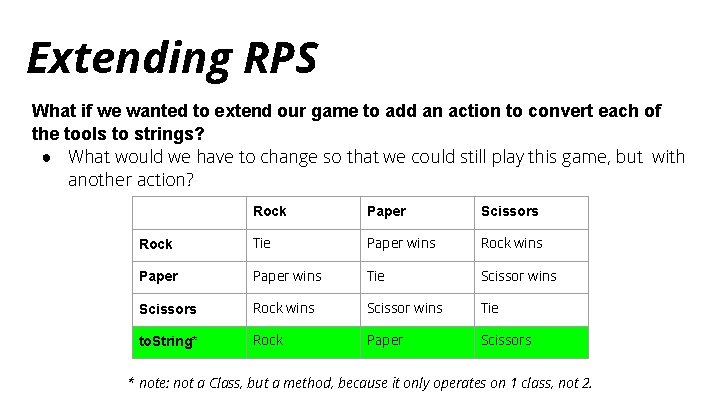
Extending RPS What if we wanted to extend our game to add an action to convert each of the tools to strings? ● What would we have to change so that we could still play this game, but with another action? Rock Paper Scissors Rock Tie Paper wins Rock wins Paper wins Tie Scissor wins Scissors Rock wins Scissor wins Tie to. String* Rock Paper Scissors * note: not a Class, but a method, because it only operates on 1 class, not 2.
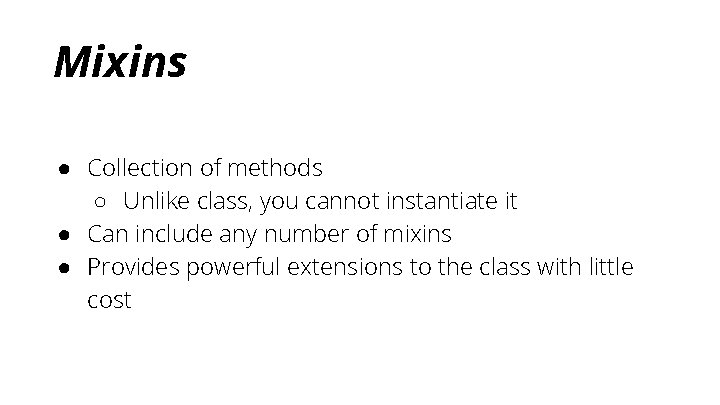
Mixins ● Collection of methods ○ Unlike class, you cannot instantiate it ● Can include any number of mixins ● Provides powerful extensions to the class with little cost
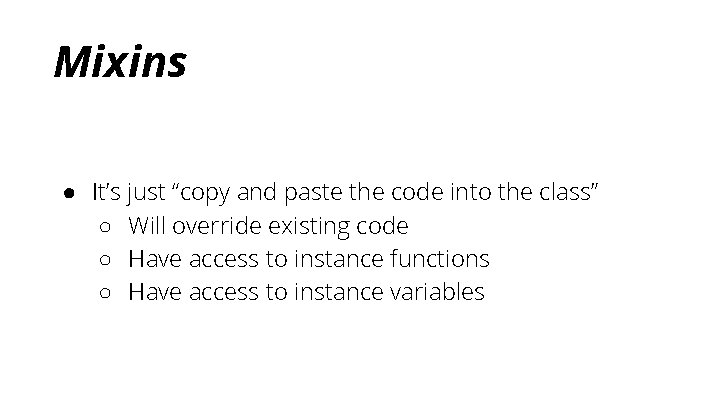
Mixins ● It’s just “copy and paste the code into the class” ○ Will override existing code ○ Have access to instance functions ○ Have access to instance variables

Mixins Example module Doubler def double self + self # assume included in classes w/ + end class String include Doubler end class Another. Pt attr_accessor : x, : y include Doubler def + other ans = Another. Pt. new ans. x = self. x + other. x ans. y = self. y + other. y ans end
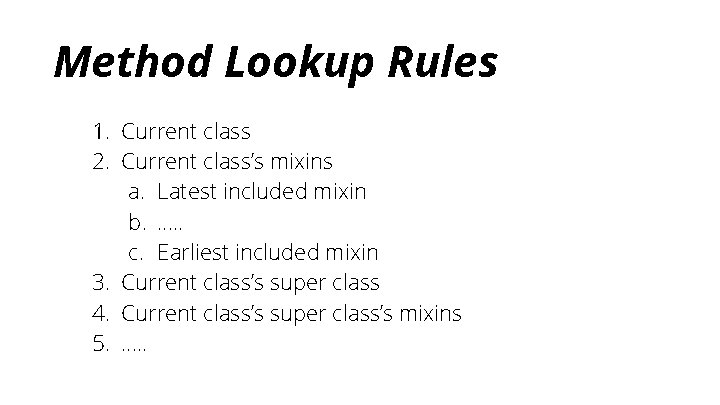
Method Lookup Rules 1. Current class 2. Current class’s mixins a. Latest included mixin b. …. . c. Earliest included mixin 3. Current class’s super class 4. Current class’s super class’s mixins 5. …. .
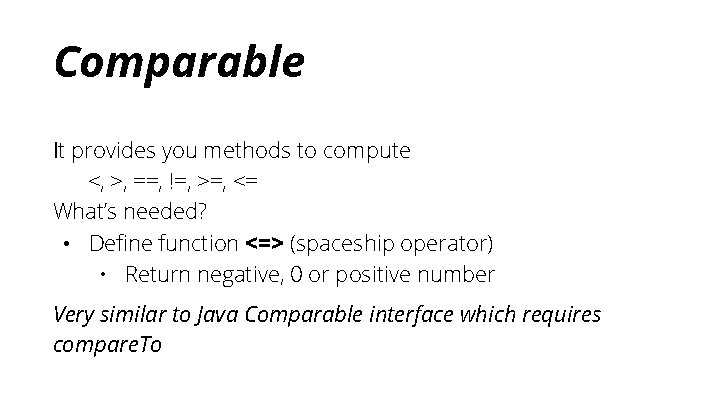
Comparable It provides you methods to compute <, >, ==, !=, >=, <= What’s needed? • Define function <=> (spaceship operator) • Return negative, 0 or positive number Very similar to Java Comparable interface which requires compare. To
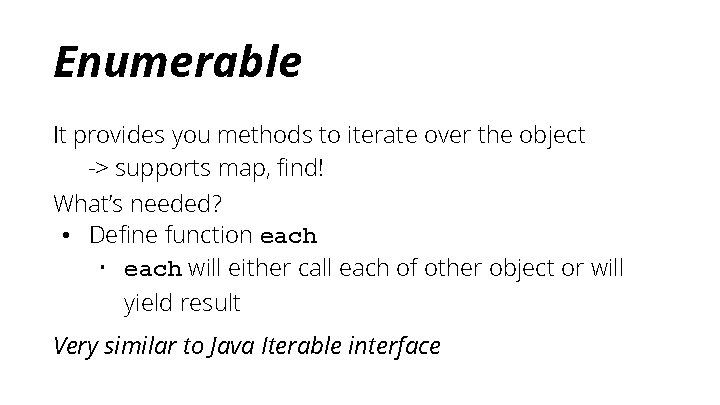
Enumerable It provides you methods to iterate over the object -> supports map, find! What’s needed? • Define function each • each will either call each of other object or will yield result Very similar to Java Iterable interface
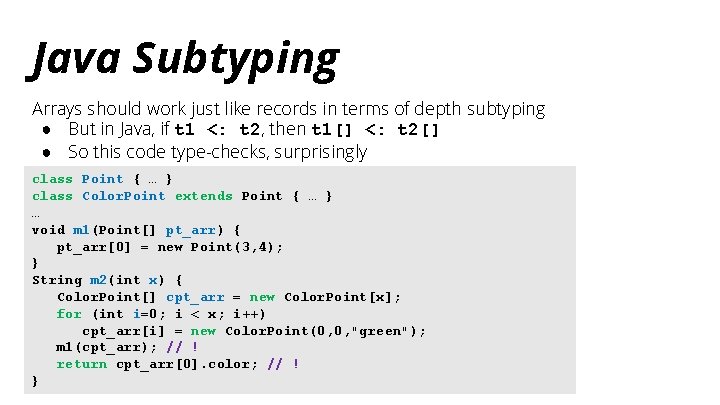
Java Subtyping Arrays should work just like records in terms of depth subtyping ● But in Java, if t 1 <: t 2, then t 1[] <: t 2[] ● So this code type-checks, surprisingly class Point { … } class Color. Point extends Point { … } … void m 1(Point[] pt_arr) { pt_arr[0] = new Point(3, 4); } String m 2(int x) { Color. Point[] cpt_arr = new Color. Point[x]; for (int i=0; i < x; i++) cpt_arr[i] = new Color. Point(0, 0, "green"); m 1(cpt_arr); // ! return cpt_arr[0]. color; // ! }
Why? More flexible type system allows more programs but prevents fewer errors ● Seemed especially important before Java/C# had generics Good news: despite this “inappropriate” depth subtyping ● e. color will never fail due to there being no color field ● Array reads e 1[e 2] always return a (subtype of) t if e 1 is a t[] Bad news: to get the good news ● e 1[e 2]=e 3 can fail even if e 1 has type t[] and e 3 has type t ● Array stores check the run-time class of e 1's elements and do not allow storing a supertype ● No type-system help to avoid such bugs / performance cost
wat https: //www. destroyallsoftware. com/talks/wat
Thank you for a great quarter! Take care of yourself and eachother ��
- Slides: 19