
SECTION 10 Cosets and the Theorem of Lagrange


- Slides: 9
SECTION 10 Cosets and the Theorem of Lagrange Theorem Let H be a subgroup of G. Let the relation L be defined on G by a Lb if and only if a-1 b H. Let the relation R be defined on G by a R b if and only if ab-1 H. Then Land R both equivalence relations on G Proof: exercise 26. The equivalence relation L defines a partition of G, and the cell containing a is {ah | h H}, which we denote by a. H. Similarly for the equivalence relation R.
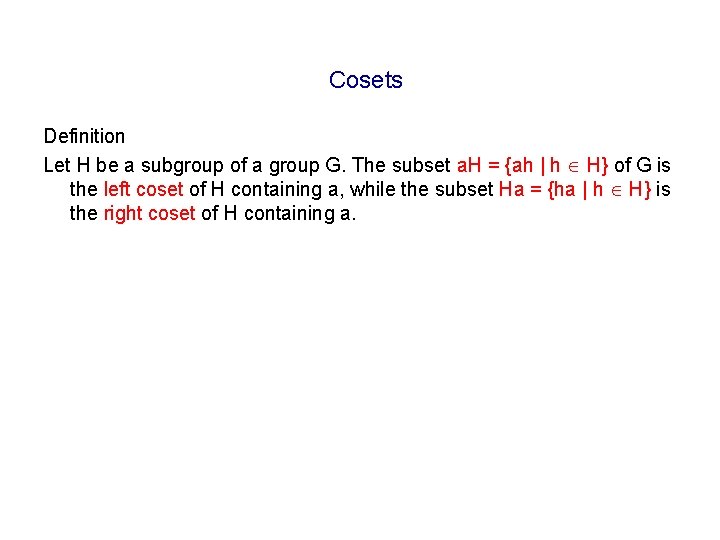
Cosets Definition Let H be a subgroup of a group G. The subset a. H = {ah | h H} of G is the left coset of H containing a, while the subset Ha = {ha | h H} is the right coset of H containing a.
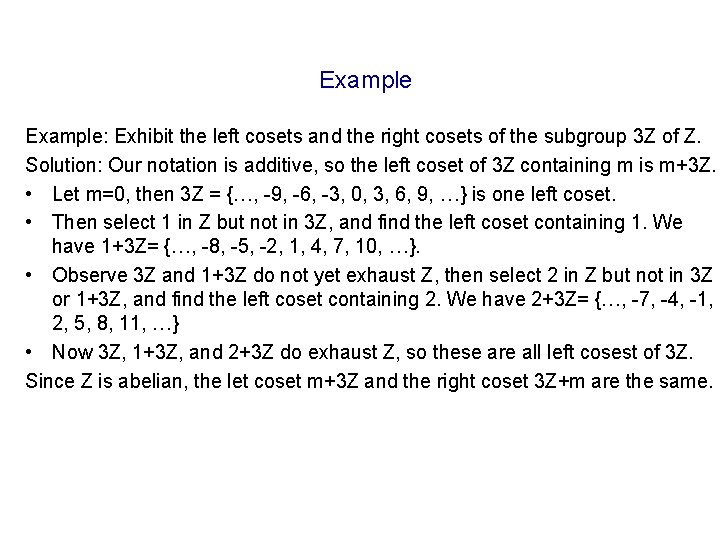
Example: Exhibit the left cosets and the right cosets of the subgroup 3 Z of Z. Solution: Our notation is additive, so the left coset of 3 Z containing m is m+3 Z. • Let m=0, then 3 Z = {…, -9, -6, -3, 0, 3, 6, 9, …} is one left coset. • Then select 1 in Z but not in 3 Z, and find the left coset containing 1. We have 1+3 Z= {…, -8, -5, -2, 1, 4, 7, 10, …}. • Observe 3 Z and 1+3 Z do not yet exhaust Z, then select 2 in Z but not in 3 Z or 1+3 Z, and find the left coset containing 2. We have 2+3 Z= {…, -7, -4, -1, 2, 5, 8, 11, …} • Now 3 Z, 1+3 Z, and 2+3 Z do exhaust Z, so these are all left cosest of 3 Z. Since Z is abelian, the let coset m+3 Z and the right coset 3 Z+m are the same.
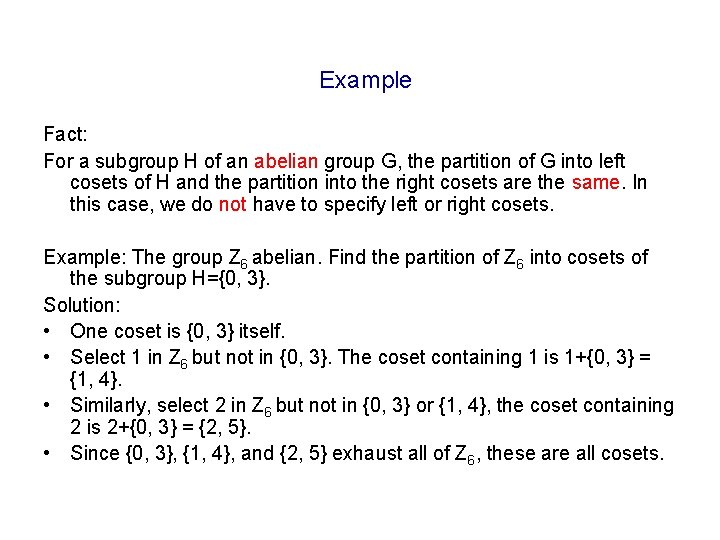
Example Fact: For a subgroup H of an abelian group G, the partition of G into left cosets of H and the partition into the right cosets are the same. In this case, we do not have to specify left or right cosets. Example: The group Z 6 abelian. Find the partition of Z 6 into cosets of the subgroup H={0, 3}. Solution: • One coset is {0, 3} itself. • Select 1 in Z 6 but not in {0, 3}. The coset containing 1 is 1+{0, 3} = {1, 4}. • Similarly, select 2 in Z 6 but not in {0, 3} or {1, 4}, the coset containing 2 is 2+{0, 3} = {2, 5}. • Since {0, 3}, {1, 4}, and {2, 5} exhaust all of Z 6, these are all cosets.
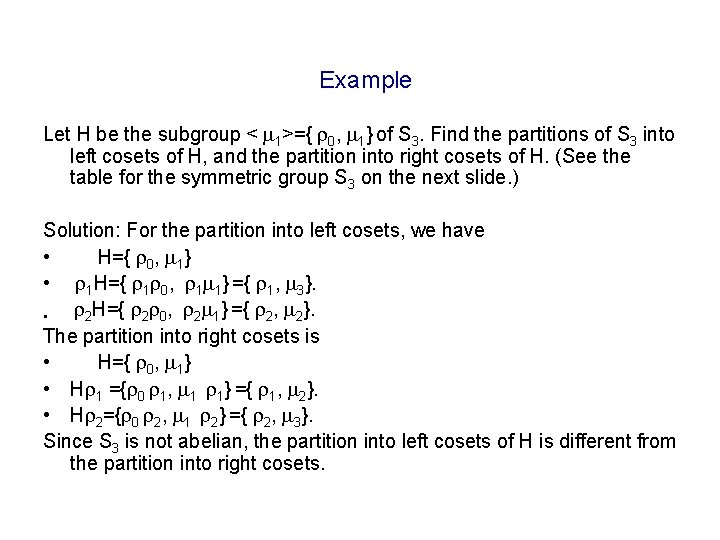
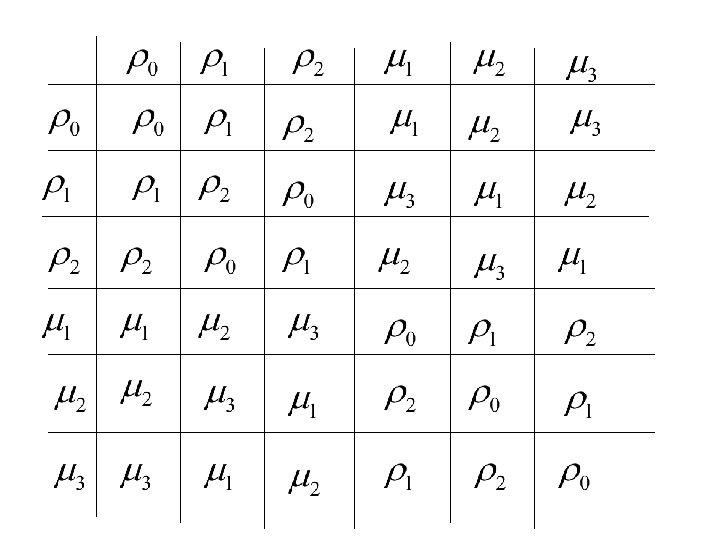
Example Let H be the subgroup < 1>={ 0, 1} of S 3. Find the partitions of S 3 into left cosets of H, and the partition into right cosets of H. (See the table for the symmetric group S 3 on the next slide. ) Solution: For the partition into left cosets, we have • H={ 0, 1} • 1 H={ 1 0, 1 1} ={ 1, 3}. 2 H={ 2 0, 2 1} ={ 2, 2}. • The partition into right cosets is • H={ 0, 1} • H 1 ={ 0 1, 1 1} ={ 1, 2}. • H 2={ 0 2, 1 2} ={ 2, 3}. Since S 3 is not abelian, the partition into left cosets of H is different from the partition into right cosets.
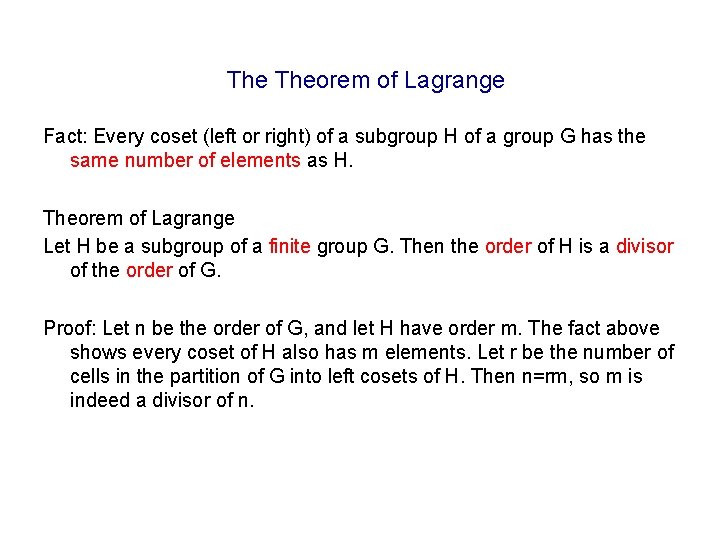
The Theorem of Lagrange Fact: Every coset (left or right) of a subgroup H of a group G has the same number of elements as H. Theorem of Lagrange Let H be a subgroup of a finite group G. Then the order of H is a divisor of the order of G. Proof: Let n be the order of G, and let H have order m. The fact above shows every coset of H also has m elements. Let r be the number of cells in the partition of G into left cosets of H. Then n=rm, so m is indeed a divisor of n.
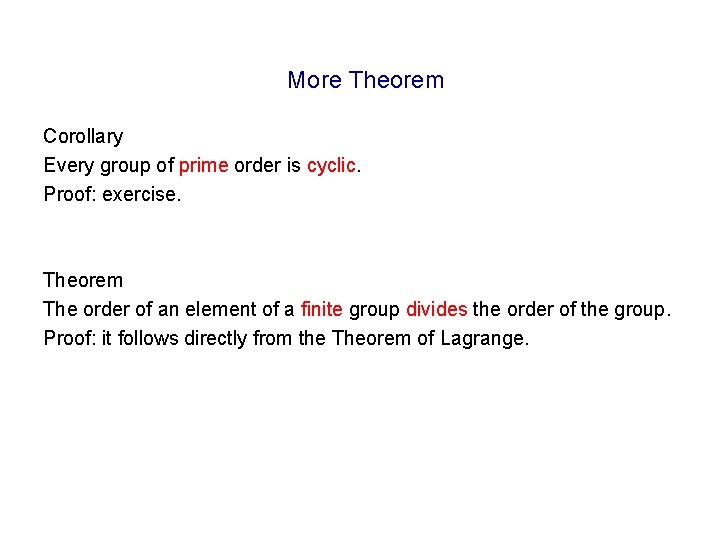
More Theorem Corollary Every group of prime order is cyclic. Proof: exercise. Theorem The order of an element of a finite group divides the order of the group. Proof: it follows directly from the Theorem of Lagrange.
Index Definition Let H be a subgroup of a group G. The number of left cosets of H in G is the index (G: H) of H in G. Note: if G is finite, then (G: H) is finite and (G: H)=|G| / |H|, since every coset of H contains |H| elements. Theorem Suppose H and K are subgroups of a group G such that K H G, and suppose (H : K) and (G: H) are both finite. Then (G: K) is finite, and (G: K)= (G: H) (H : K)