
Section 1 The Method of Science Essential Questions
- Slides: 21
Section 1 The Method of Science
Essential Questions What steps do scientists often use to solve problems? Why do scientists use variables? What is the difference between a scientific law and a scientific theory?
Review Vocabulary investigation: an observation or study by close examination
New Vocabulary scientific methods constant hypothesis control experiment bias variable model dependent variable theory independent variable scientific law
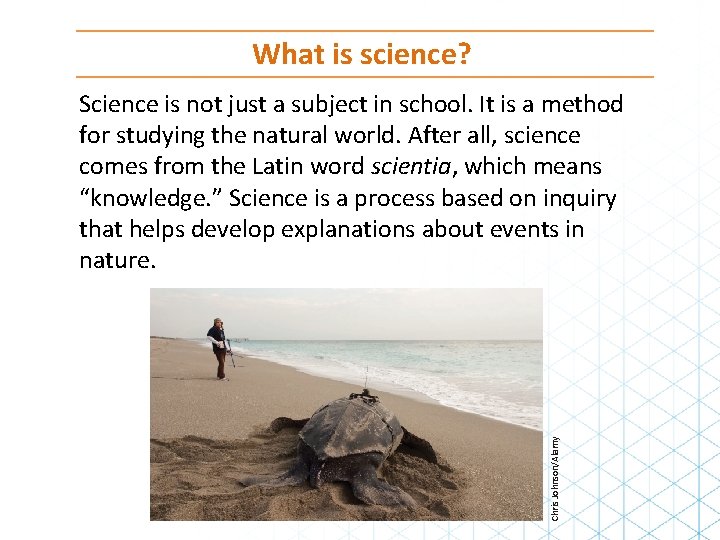
What is science? Chris Johnson/Alamy Science is not just a subject in school. It is a method for studying the natural world. After all, science comes from the Latin word scientia, which means “knowledge. ” Science is a process based on inquiry that helps develop explanations about events in nature.
What is Science? Three major categories: 1. Life Science 2. Earth Science 3. Physical Science
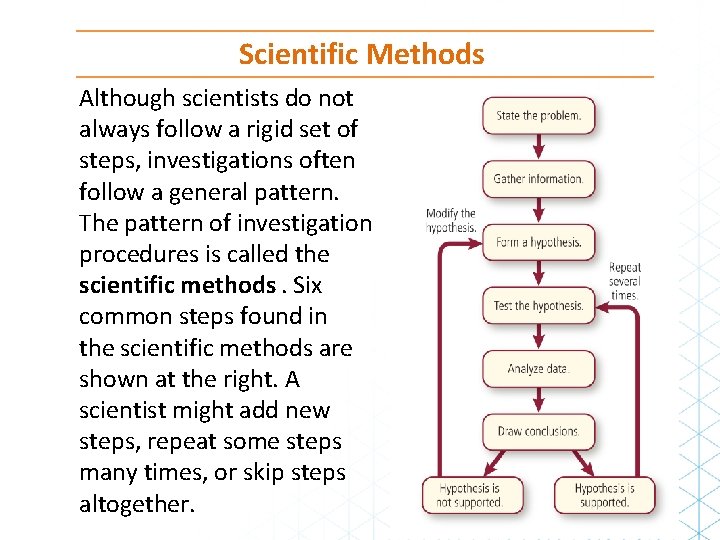
Scientific Methods Although scientists do not always follow a rigid set of steps, investigations often follow a general pattern. The pattern of investigation procedures is called the scientific methods. Six common steps found in the scientific methods are shown at the right. A scientist might add new steps, repeat some steps many times, or skip steps altogether.
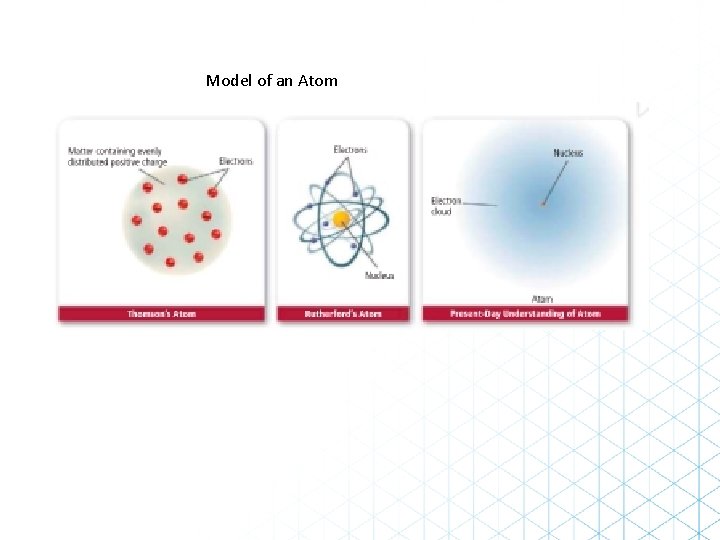
Visualizing with Models Sometimes, scientists cannot see everything that they are testing. They might be observing something that is too large or small, takes too much time to see completely, or is hazardous. In these cases, scientists use models. A model represents an idea, event, or object to help people better understand it.
Model of an Atom
Parts of an Experiment - Independent and dependent variables - Constants - Control and experimental groups
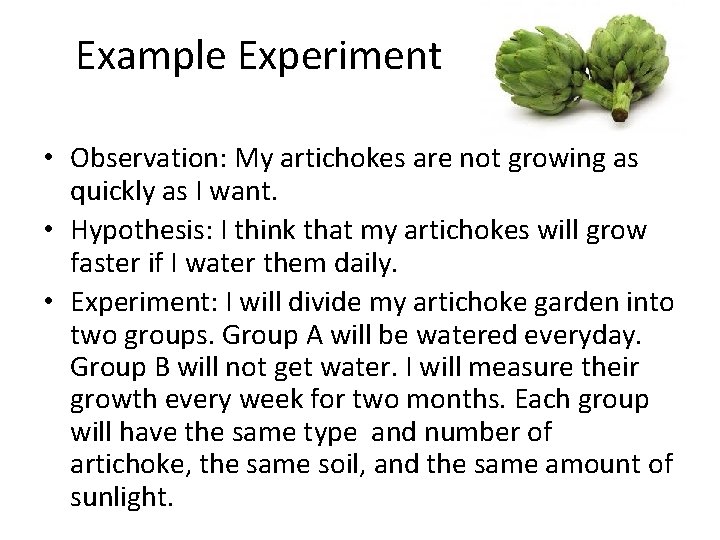
Example Experiment j • Observation: My artichokes are not growing as quickly as I want. • Hypothesis: I think that my artichokes will grow faster if I water them daily. • Experiment: I will divide my artichoke garden into two groups. Group A will be watered everyday. Group B will not get water. I will measure their growth every week for two months. Each group will have the same type and number of artichoke, the same soil, and the same amount of sunlight.
Independent Variable • The factor that is being changed or tested in an experiment • Hint: The independent variable is what I can change or control. • Experiment: I will divide my artichoke garden into two groups. Group A will be watered everyday. Group B will not get water. I will measure their growth every week for two months. Each group will have the same type and number of artichoke, the same soil, and the same amount of sunlight. • Can you identify the independent variable?
Dependent Variable • Your results! • The outcome… what is being observed or measured. • Experiment: I will divide my artichoke garden into two groups. Group A will be watered everyday. Group B will not get water. I will measure their growth every week for two months. Each group will have the same type and number of artichoke, the same soil, and the same amount of sunlight. • Can you identify the dependent variable?
Constants • Every factor besides the independent variable must remain the same so you know for sure what has affected your results. • Experiment: I will divide my artichoke garden into two groups. Group A will be watered everyday. Group B will not get water. I will measure their growth every week for two months. Each group will have the same type and number of artichoke, the same soil, and the same amount of sunlight. • Can you identify some constants?
Experimental Group • The group that is being tested/experimented on. • Experiment: I will divide my artichoke garden into two groups. Group A will be watered everyday. Group B will not get water. I will measure their growth every week for two months. Each group will have the same type and number of artichoke, the same soil, and the same amount of sunlight. • Which is the experimental group?
Control Group • One group of test subjects is used for comparison. • They do not get exposed to the i. v. • Experiment: I will divide my artichoke garden into two groups. Group A will be watered everyday. Group B will not get water. I will measure their growth every week for two months. Each group will have the same type and number of artichoke, the same soil, and the same amount of sunlight. • Which group is the control?
Your Turn! Timothy is testing his hypothesis that eating carrots will help his rabbits live longer. He has two rabbits. Rabbit A he feeds one carrot everyday. Rabbit B does not get carrots. Both rabbits are the same age, get the same type of food, and the same exercise. He does this for 3 years until Rabbit B dies. Identify the following factors from his experiment: • Hypothesis • Independent/dependent variables • Experimental/control groups • Constants • Did his results support his hypothesis?
Peer Review – Before a conclusion is made public, the information obtained by the experiment is reviewed by scientists’ peers. Reviewing other scientists’ work ensures the information is factual or can be repeated. Peer review maintains the quality of information that is made public. Being Objective: Bias – occurs when the scientists’ expectations changes how the results are analyzed or conclusions made. Ex. – How effective is a medication? Blind studies or experiment Results must be measurable.
Scientific Theories and Laws A scientific theory is an explanation of things or events based on knowledge gained from many observations and investigations. It is not a guess. If scientists repeat an investigation and the results always support the hypothesis, the hypothesis can be called a theory. A scientific law is a statement about what happens in nature and that seems to be true all the time. Laws describe specific relationships under given conditions. They don’t explain why or how something happens. Gravity is an example of a scientific law. The law of gravity states that any one mass will attract another mass. To date, no experiments have been performed that disprove the law of gravity.
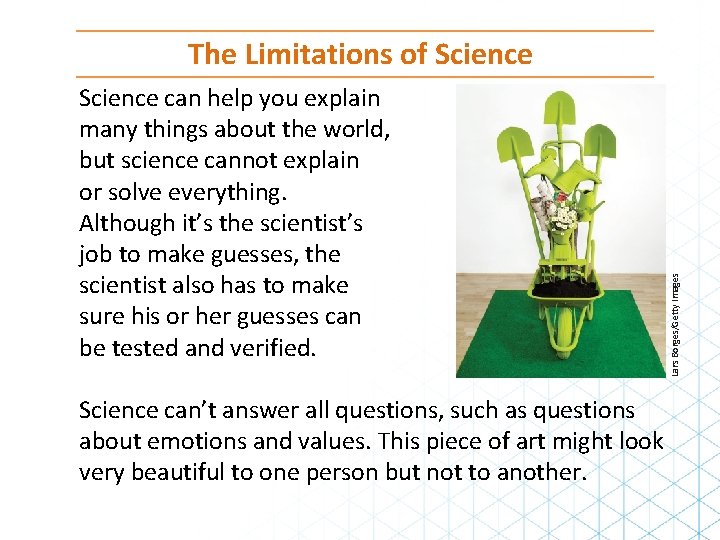
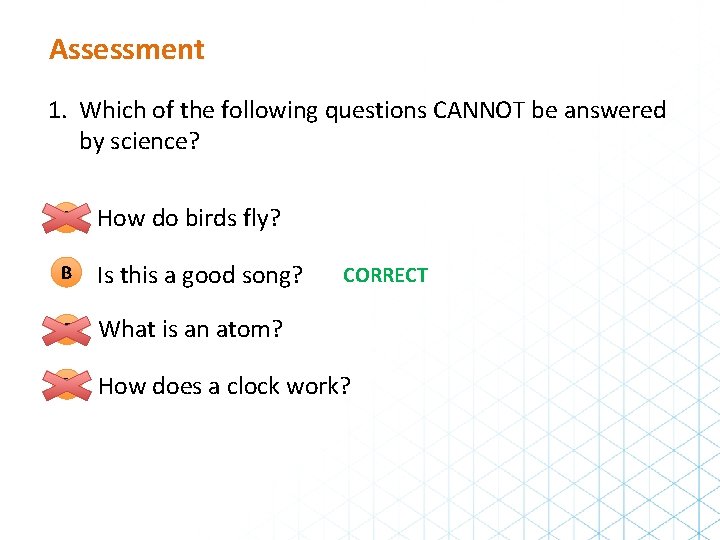
Science can help you explain many things about the world, but science cannot explain or solve everything. Although it’s the scientist’s job to make guesses, the scientist also has to make sure his or her guesses can be tested and verified. Science can’t answer all questions, such as questions about emotions and values. This piece of art might look very beautiful to one person but not to another. Lars Borges/Getty Images The Limitations of Science
Assessment 1. Which of the following questions CANNOT be answered by science? A How do birds fly? B Is this a good song? C What is an atom? D How does a clock work? CORRECT