
Section 1 The History of Classification Biologists use
Section 1: The History of Classification Biologists use a system of classification to organize information about the diversity of living things. K What I Know W What I Want to Find Out L What I Learned
Essential Questions • • • What are the similarities and differences between Aristotle’s and Linnaeus’s methods of classification? Using binomial nomenclature, how are scientific names written? What are the categories used in biological classification? Copyright © Mc. Graw-Hill Education The History of Classification
Vocabulary Review New • • • • morphology Copyright © Mc. Graw-Hill Education classification taxonomy binomial nomenclature taxon genus family order class phylum division kingdom domain The History of Classification
Early Systems of Classification • Classification is the grouping of objects or organisms based on a set of criteria. • Biologists use a system of classification to organize information about the diversity of living things. Copyright © Mc. Graw-Hill Education The History of Classification

Early Systems of Classification Aristotle’s system • More than 2, 000 years ago, Greek philosopher Aristotle developed the first widely accepted classification system. • Classified organisms as plants or animals • Animals divided into “red blooded” and “bloodless”, then by habitat • Plants divided by average size and structure Copyright © Mc. Graw-Hill Education The History of Classification
Aristotle’s Classification System Interactive Table FPO Add link to interactive table from page 484 (table 1) here. Copyright © Mc. Graw-Hill Education The History of Classification
Early Systems of Classification Linnaeus’s system • Linnaeus’s system of classification was based on observations of morphology and habitat. • The Linnaean system was the first formal system of taxonomy – the discipline of identifying, naming, and classifying organisms. Copyright © Mc. Graw-Hill Education The History of Classification
Early Systems of Classification Binomial nomenclature • Linnaeus’s method of naming organisms, called binomial nomenclature, gives each species a scientific name with two parts. • The first part is the genus name, and the second part is the specific epithet, or specific name, that identifies the species. • Biologists use scientific names for species because common names vary in their use. Copyright © Mc. Graw-Hill Education The History of Classification
Early Systems of Classification Binomial nomenclature • When writing a scientific name, scientists use these rules: • The first letter of the genus name always is capitalized, but the rest of the genus name and all letters of the specific epithet are lowercase. • If a scientific name is written in a printed book or magazine, it should be italicized. • When a scientific name is written by hand, both parts of the name should be underlined. • After the scientific name has been written completely, the genus name will be abbreviated to the first letter in later appearances (e. g. , C. cardinalis). Copyright © Mc. Graw-Hill Education The History of Classification
Early Systems of Classification Modern classification systems • Modern classification is rooted in the Linnaean system. • As the study of evolution grew, scientists began using evolutionary relationships in their classification systems. Copyright © Mc. Graw-Hill Education The History of Classification
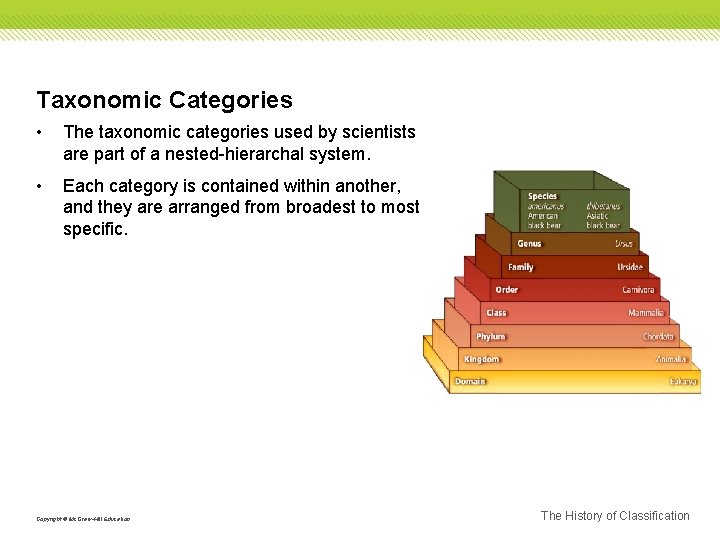
Taxonomic Categories • The taxonomic categories used by scientists are part of a nested-hierarchal system. • Each category is contained within another, and they are arranged from broadest to most specific. Copyright © Mc. Graw-Hill Education The History of Classification
Taxonomic Categories Species and genus • A named group of organisms is called a taxon. • A genus is a group of species that are closely related and share a common ancestor. Family • A family is the next higher taxon, consisting of similar, related genera. Copyright © Mc. Graw-Hill Education The History of Classification
Taxonomic Categories Higher taxa • An order contains related families. • A class contains related orders. • A phylum or division contains related classes. • A kingdom contains related phyla. • The domain is the broadest of all the taxa and contains one or more kingdoms. Copyright © Mc. Graw-Hill Education The History of Classification
Systematics applications • Taxonomy is part of a larger branch of biology called systematics. • Systematics is the study of biological diversity with an emphasis on evolutionary history. • Taxonomists can produce detailed guides to identify different organisms. • Through the use of dichotomous keys, which provide a series of choices between alternate characteristics, users can identify organisms they encounter. Copyright © Mc. Graw-Hill Education The History of Classification
Review Essential Questions • • • What are the similarities and differences between Aristotle’s and Linnaeus’s methods of classification? Using binomial nomenclature, how are scientific names written? What are the categories used in biological classification? Vocabulary • • classification taxonomy binomial nomenclature taxon Copyright © Mc. Graw-Hill Education • • genus family order class • • phylum division kingdom domain The History of Classification
- Slides: 15