
Section 1 The Church in the Early Christian
- Slides: 11
Section 1 The Church in the Early Christian Centuries
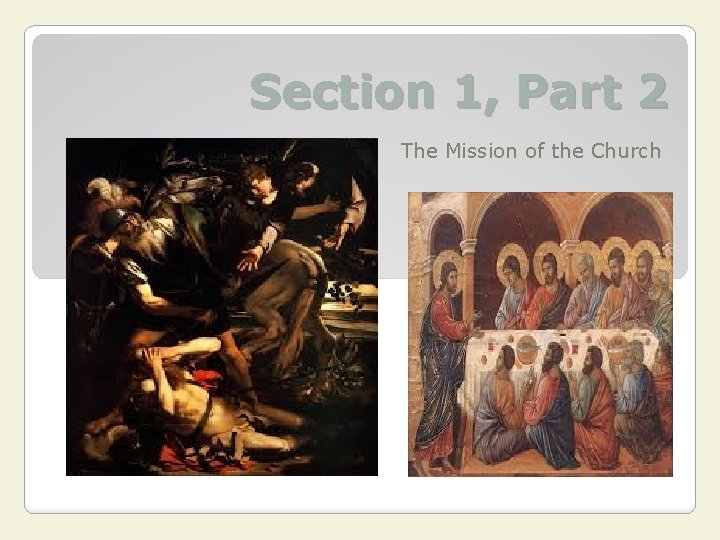
Section 1, Part 2 The Mission of the Church
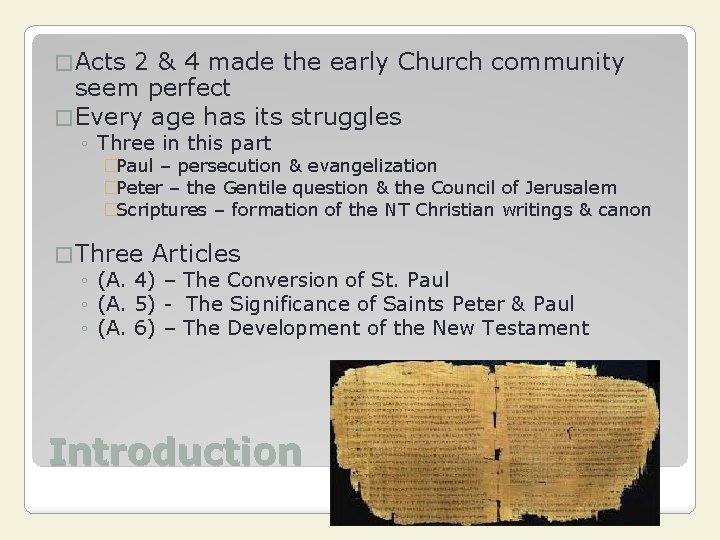
� Acts 2 & 4 made the early Church community seem perfect � Every age has its struggles ◦ Three in this part �Paul – persecution & evangelization �Peter – the Gentile question & the Council of Jerusalem �Scriptures – formation of the NT Christian writings & canon � Three Articles ◦ (A. 4) – The Conversion of St. Paul ◦ (A. 5) - The Significance of Saints Peter & Paul ◦ (A. 6) – The Development of the New Testament Introduction
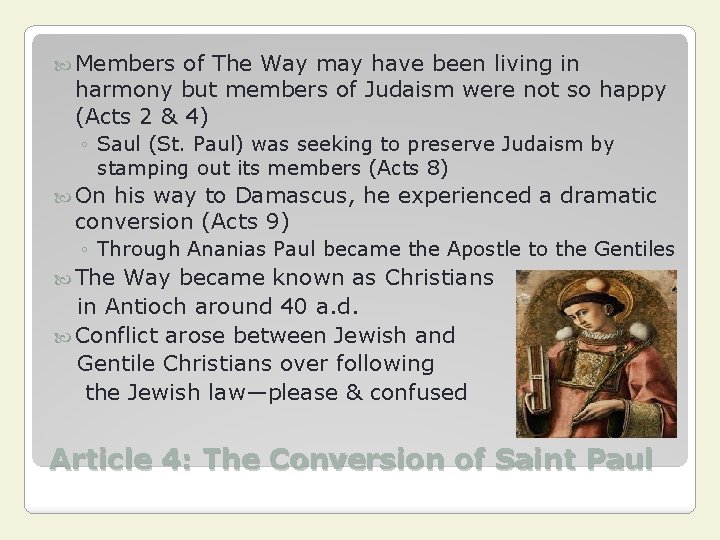
Members of The Way may have been living in harmony but members of Judaism were not so happy (Acts 2 & 4) ◦ Saul (St. Paul) was seeking to preserve Judaism by stamping out its members (Acts 8) On his way to Damascus, he experienced a dramatic conversion (Acts 9) ◦ Through Ananias Paul became the Apostle to the Gentiles The Way became known as Christians in Antioch around 40 a. d. Conflict arose between Jewish and Gentile Christians over following the Jewish law—please & confused Article 4: The Conversion of Saint Paul
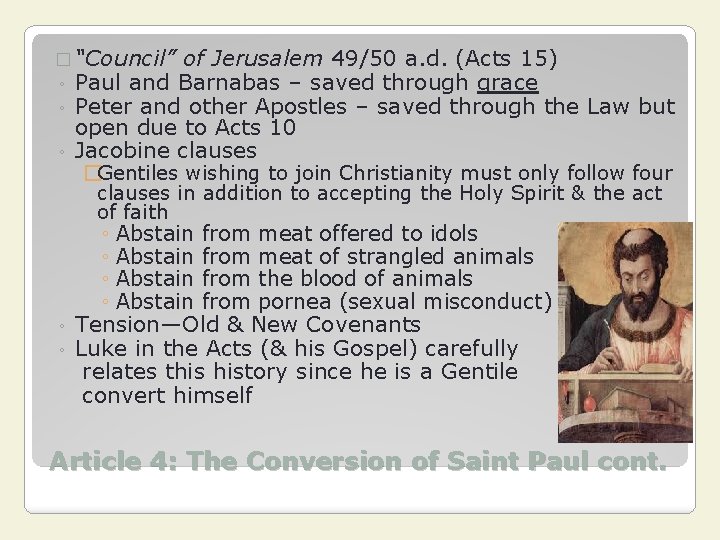
� “Council” of Jerusalem 49/50 a. d. (Acts 15) ◦ Paul and Barnabas – saved through grace ◦ Peter and other Apostles – saved through the open due to Acts 10 ◦ Jacobine clauses Law but �Gentiles wishing to join Christianity must only follow four clauses in addition to accepting the Holy Spirit & the act of faith ◦ Abstain from meat offered to idols ◦ Abstain from meat of strangled animals ◦ Abstain from the blood of animals ◦ Abstain from pornea (sexual misconduct) ◦ ◦ Tension—Old & New Covenants Luke in the Acts (& his Gospel) carefully relates this history since he is a Gentile convert himself Article 4: The Conversion of Saint Paul cont.
� 1. 2 Review questions 1 -3 �Read AA. 5 -6 �Looking Ahead ◦ Section 1, Part 2 HW 1 -7 due Monday ◦ Section 1, Part 2 Quiz Wednesday on AA. 4 -6 and Paul the Apostle video Homework
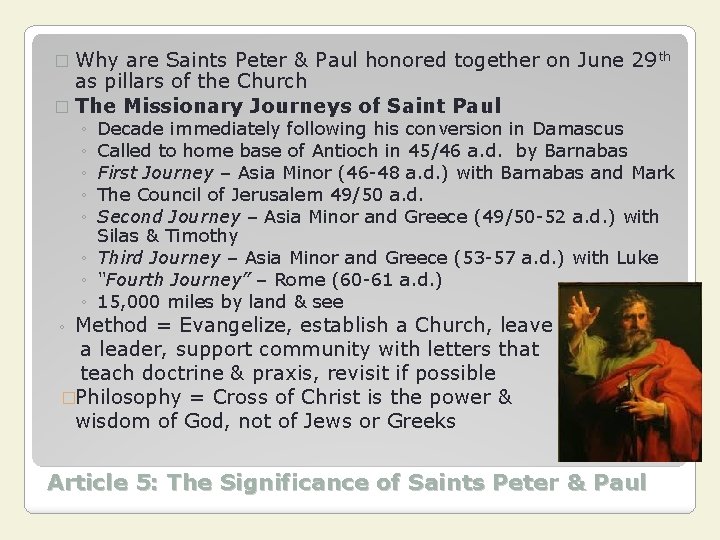
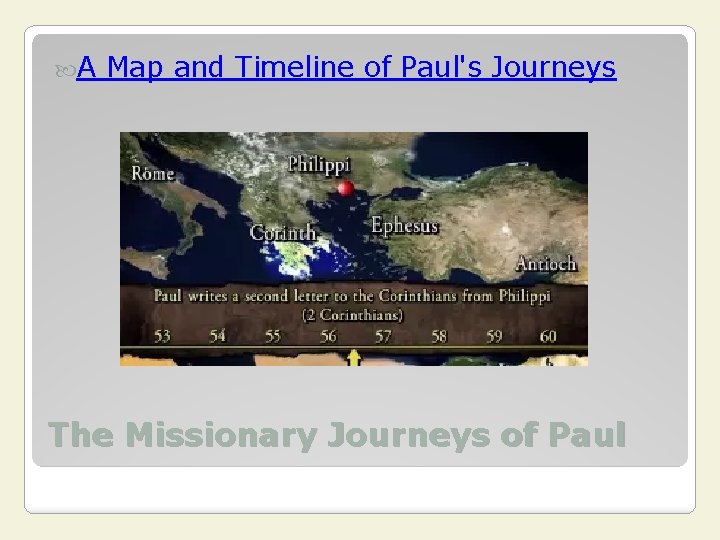
� Why are Saints Peter & Paul honored together on June 29 th as pillars of the Church � The Missionary Journeys of Saint Paul ◦ ◦ ◦ Decade immediately following his conversion in Damascus Called to home base of Antioch in 45/46 a. d. by Barnabas First Journey – Asia Minor (46 -48 a. d. ) with Barnabas and Mark The Council of Jerusalem 49/50 a. d. Second Journey – Asia Minor and Greece (49/50 -52 a. d. ) with Silas & Timothy ◦ Third Journey – Asia Minor and Greece (53 -57 a. d. ) with Luke ◦ “Fourth Journey” – Rome (60 -61 a. d. ) ◦ 15, 000 miles by land & see Method = Evangelize, establish a Church, leave a leader, support community with letters that teach doctrine & praxis, revisit if possible �Philosophy = Cross of Christ is the power & wisdom of God, not of Jews or Greeks ◦ Article 5: The Significance of Saints Peter & Paul
A Map and Timeline of Paul's Journeys The Missionary Journeys of Paul
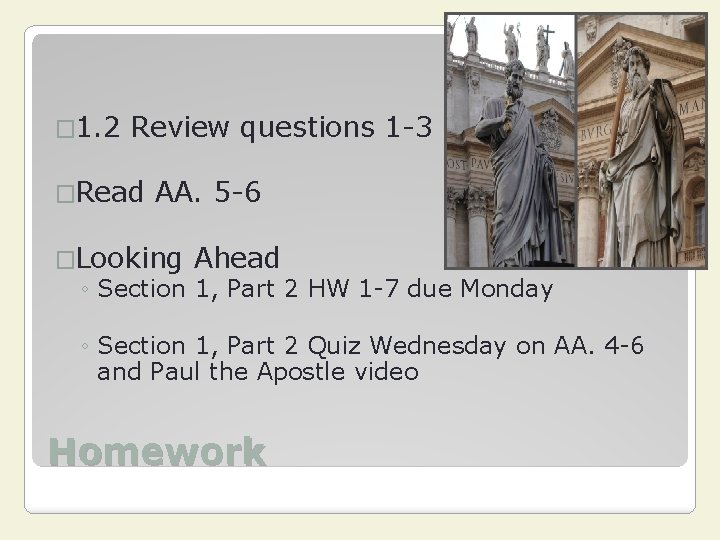
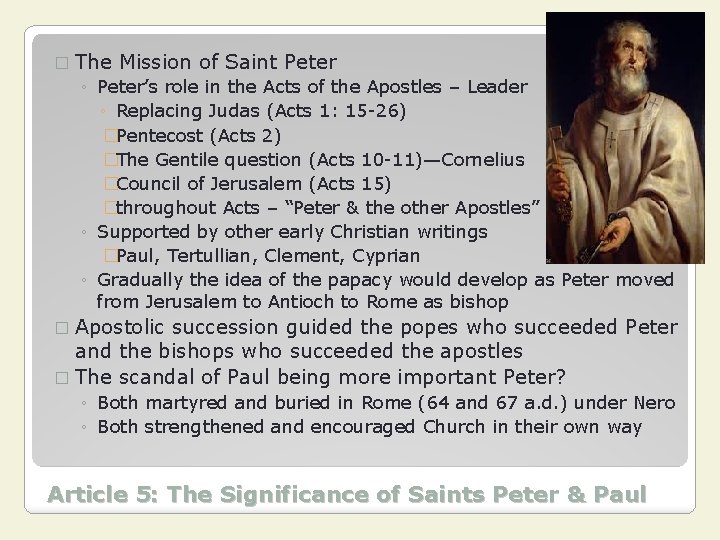
� The Mission of Saint Peter ◦ Peter’s role in the Acts of the Apostles – Leader ◦ Replacing Judas (Acts 1: 15 -26) �Pentecost (Acts 2) �The Gentile question (Acts 10 -11)—Cornelius �Council of Jerusalem (Acts 15) �throughout Acts – “Peter & the other Apostles” ◦ Supported by other early Christian writings �Paul, Tertullian, Clement, Cyprian ◦ Gradually the idea of the papacy would develop as Peter moved from Jerusalem to Antioch to Rome as bishop � Apostolic succession guided the popes who succeeded Peter and the bishops who succeeded the apostles � The scandal of Paul being more important Peter? ◦ Both martyred and buried in Rome (64 and 67 a. d. ) under Nero ◦ Both strengthened and encouraged Church in their own way Article 5: The Significance of Saints Peter & Paul
� During the missionary activity of Peter, Paul, & the other apostles NT did not exist; only OT Hb. /Jewish Scriptures ◦ OT was read at liturgies, Psalms were prayed daily (basis of Divine Office later on) ◦ Stories and teachings of Jesus were passed down orally �People of the time were more practiced and guided by the HS � NT was formed in three broad stages � The Formation of the NT canon (200, 400 a. d. ) ◦ Words & Deeds of Jesus from birth to Ascension (3 b. c. -30 a. d. ) ◦ Oral tradition by apostles and disciples in synagogues 1 st then marketplaces, and liturgies (30 -50 a. d. ) ◦ Written tradition by evangelists and biblical authors under the inspiration of the Holy Spirit (50 -100 a. d. ) ◦ Divine Revelation, Deposit of Faith, Sacred Tradition, Sacred Scripture (46+27), Magisterium, Apostolic Succession—definitions & relations �Early bishops or episcope (apostolic tradition) decided if apostolic, communally accepted (Jerusalem, Antioch, Rome, Alexandria, Constantinople), liturgical, & consistent; if so added to canon Article 6: The Development of the New Testament
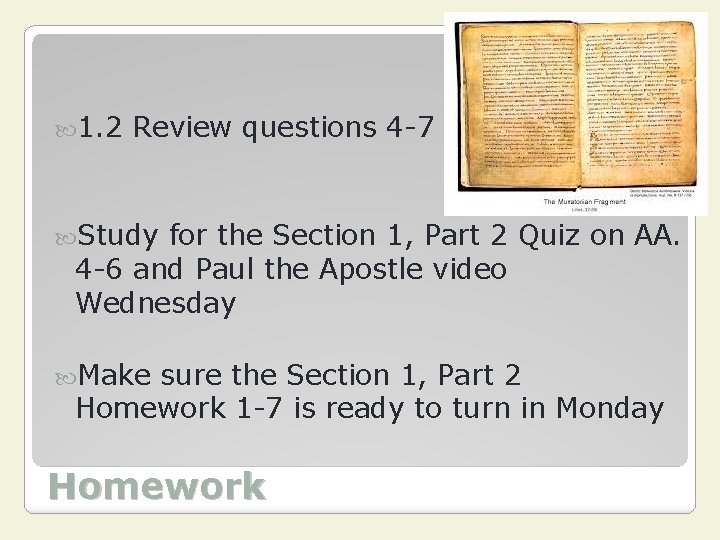
1. 2 Review questions 4 -7 Study for the Section 1, Part 2 Quiz on AA. 4 -6 and Paul the Apostle video Wednesday Make sure the Section 1, Part 2 Homework 1 -7 is ready to turn in Monday Homework