
Section 1 Structure of the Atom Scientific Shorthand
- Slides: 20
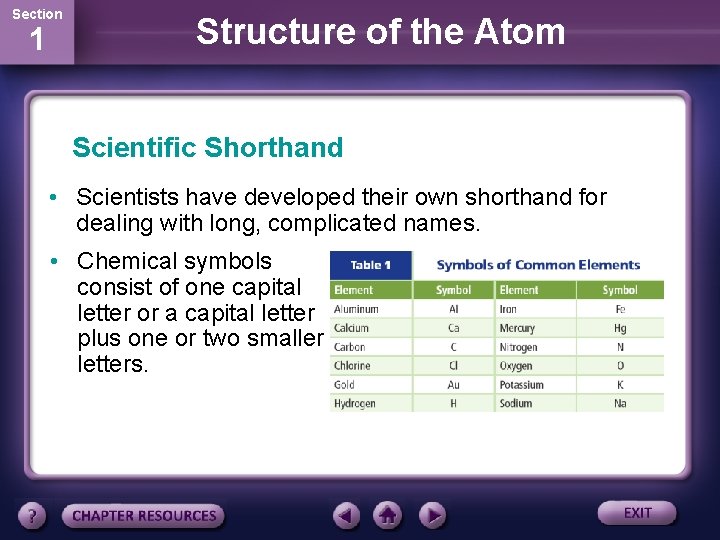
Section 1 Structure of the Atom Scientific Shorthand • Scientists have developed their own shorthand for dealing with long, complicated names. • Chemical symbols consist of one capital letter or a capital letter plus one or two smaller letters.
Section 1 Structure of the Atom Scientific Shorthand • For some elements, the symbol is the first letter of the element's name. • For other elements, the symbol is the first letter of the name plus another letter from its name. • Because scientists worldwide use this system, everyone understands what the symbols mean.
Section 1 Structure of the Atom Subatomic Particles • An element is matter that is composed of one type of atom, which is the smallest piece of matter that still retains the property of the element. • Atoms are composed of particles called protons, neutrons, and electrons. Click image to view movie
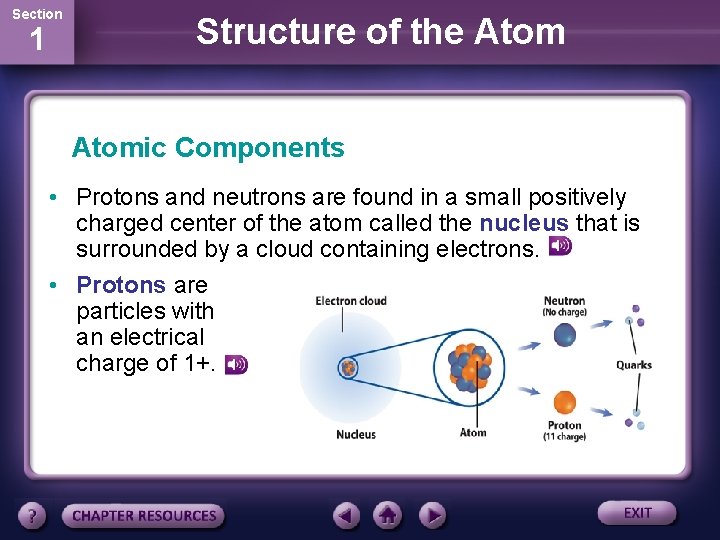
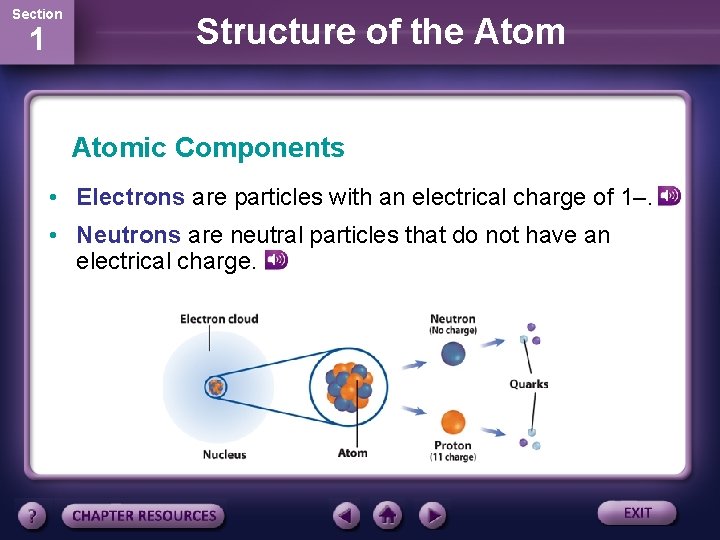
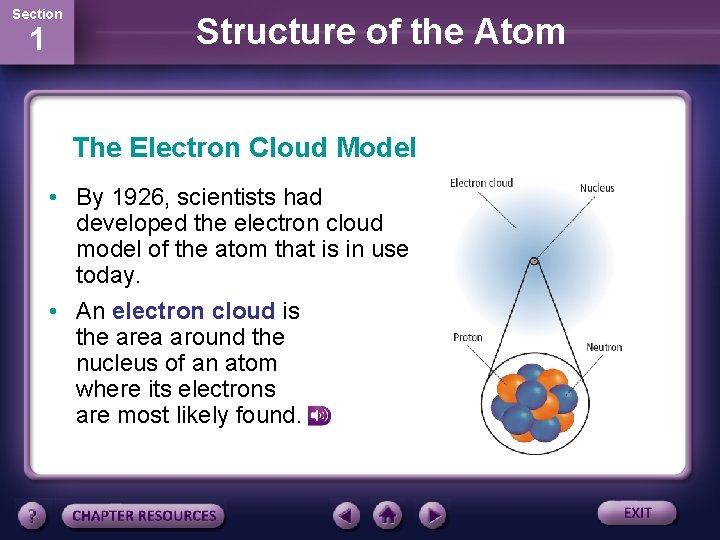
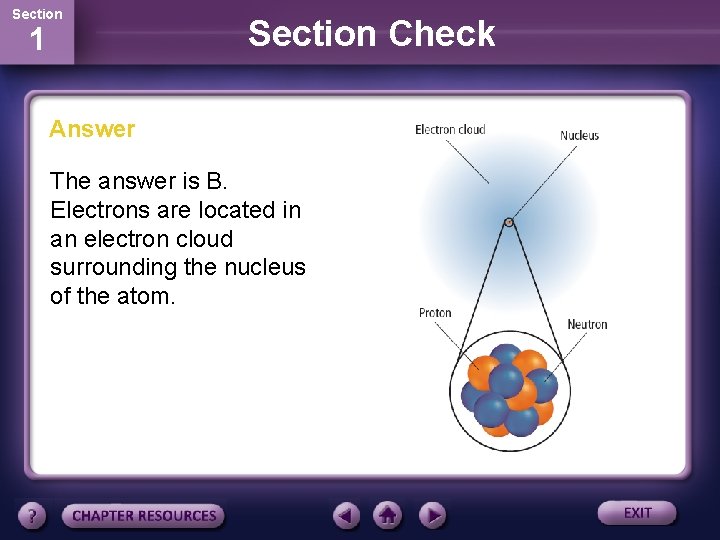
Section 1 Structure of the Atomic Components • Protons and neutrons are found in a small positively charged center of the atom called the nucleus that is surrounded by a cloud containing electrons. • Protons are particles with an electrical charge of 1+.
Section 1 Structure of the Atomic Components • Electrons are particles with an electrical charge of 1–. • Neutrons are neutral particles that do not have an electrical charge.
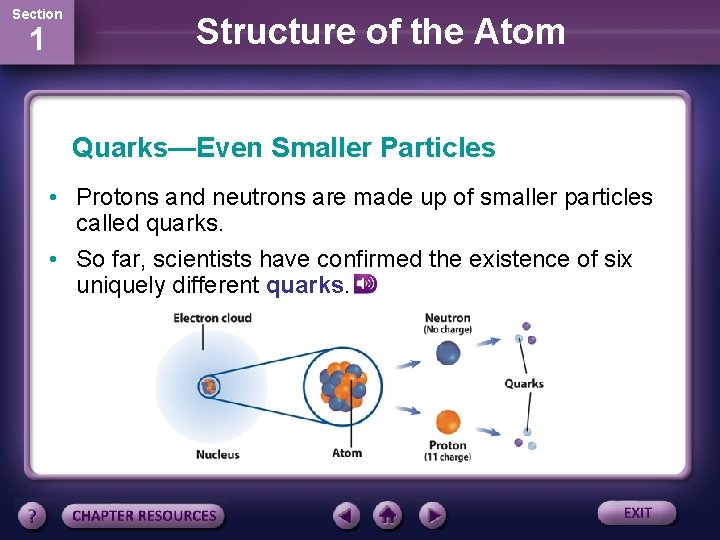
Section 1 Structure of the Atom Quarks—Even Smaller Particles • Protons and neutrons are made up of smaller particles called quarks. • So far, scientists have confirmed the existence of six uniquely different quarks.
Section 1 Structure of the Atom Quarks—Even Smaller Particles • Scientists theorize that an arrangement of three quarks held together with the strong nuclear force produces a proton. • Another arrangement of three quarks produces a neutron
Section 1 Structure of the Atom The Search for Quarks • To study quarks, scientists accelerate charge particles to tremendous speeds and then force them to collide with—or smash into—protons. This collision causes the proton to break apart. • The particles that result from the collision can be detected by various collection devises.
Section 1 Structure of the Atom The Sixth Quark • Scientists found five quarks and hypothesized that a sixth quark existed. However, it took a team of nearly 450 scientists from around the world several years to find the sixth quark. • The tracks of the sixth quark were hard to detect because only about one billionth of a percent of the proton collisions performed shows a presence of a sixth quark.
Section 1 Structure of the Atom Models—Tools for Scientists • Scientists and engineers use models to represent things that are difficult to visualize—or picture in your mind. • Scaled-down models allow you to see either something too large to see all at once, or something that has not been built yet. • Scaled-up models are often used to visualize things that are too small to see.
Section 1 Structure of the Atom Models—Tools for Scientists • To study the atom, scientists have developed scaledup models that they can use to visualize how the atom is constructed. • For the model to be useful, it must support all of the information that is known about matter and the behavior of atoms.
Section 1 Structure of the Atom The Atomic Model • In the 1800 s, John Dalton, an English scientist, was able to offer proof that atoms exist. • Another famous Greek philosopher, Aristotle, disputed Democritus's theory and proposed that matter was uniform throughout and was not composed of smaller particles.
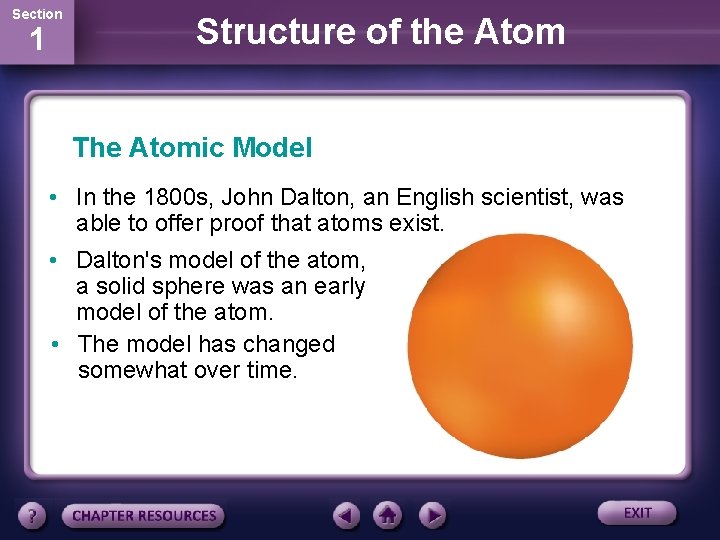
Section 1 Structure of the Atom The Atomic Model • In the 1800 s, John Dalton, an English scientist, was able to offer proof that atoms exist. • Dalton's model of the atom, a solid sphere was an early model of the atom. • The model has changed somewhat over time.
Section 1 Structure of the Atom The Electron Cloud Model • By 1926, scientists had developed the electron cloud model of the atom that is in use today. • An electron cloud is the area around the nucleus of an atom where its electrons are most likely found.
Section 1 Structure of the Atom The Electron Cloud Model • The electron cloud is 100, 000 times larger than the diameter of the nucleus. • In contrast, each electron in the cloud is much smaller than a single proton. • Because an electron's mass is small and the electron is moving so quickly around the nucleus, it is impossible to describe its exact location in an atom.
Section 1 Section Check Question 1 Which is the smallest piece of matter that still retains the property of the element? A. atom B. quark C. neutron D. proton
Section 1 Section Check Answer The answer is A. An atom is the smallest piece of matter that still retains the property of the element.
Section 1 Section Check Question 2 What particles are found in the nucleus of an atom? A. protons and electrons B. protons and neutrons C. neutrons and electrons D. quarks and electrons
Section 1 Section Check Answer The answer is B. Electrons are located in an electron cloud surrounding the nucleus of the atom.
Section 1 Section Check Question 3 What is the name of the small particles that make up protons and neutrons? Answer Protons and neutrons are made of smaller particles called quarks.