
Section 1 Planetary Motion and Gravitation The gravitational
- Slides: 12
Section 1: Planetary Motion and Gravitation The gravitational force between two objects is proportional to the product of their masses divided by the square of the distance between them. . K W L What I Know What I Want to Find Out What I Learned
Essential Questions • • What is the relationship between a planet’s orbital radius and period? What is Newton’s law of universal gravitation, and how does it relate to Kepler’s laws? • Why was Cavendish’s investigation important? Copyright © Mc. Graw-Hill Education Planetary Motion and Gravitation
Vocabulary Review New • • • Newton’s third law Copyright © Mc. Graw-Hill Education Kepler’s first law Kepler’s second law Kepler’s third law gravitational force law of universal gravitation Planetary Motion and Gravitation
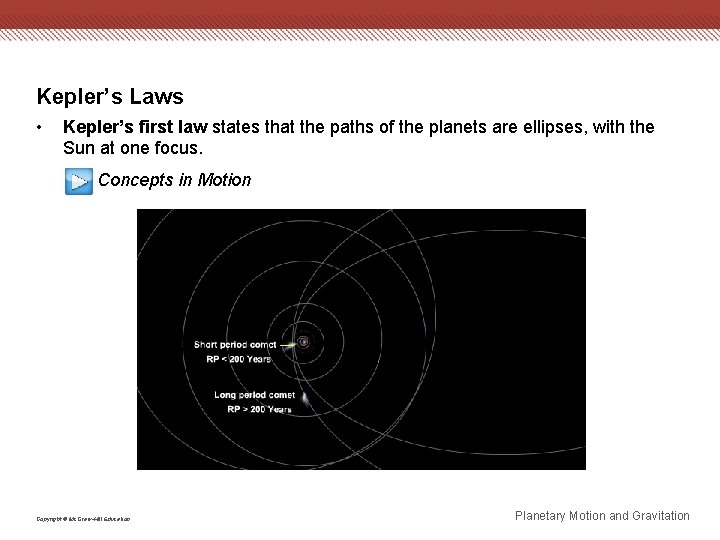
Kepler’s Laws • Kepler’s first law states that the paths of the planets are ellipses, with the Sun at one focus. Concepts in Motion Copyright © Mc. Graw-Hill Education Planetary Motion and Gravitation
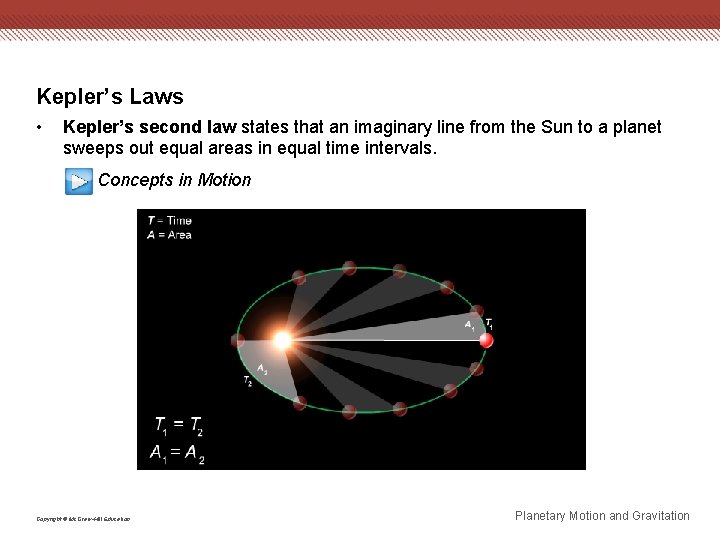
Kepler’s Laws • Kepler’s second law states that an imaginary line from the Sun to a planet sweeps out equal areas in equal time intervals. Concepts in Motion Copyright © Mc. Graw-Hill Education Planetary Motion and Gravitation
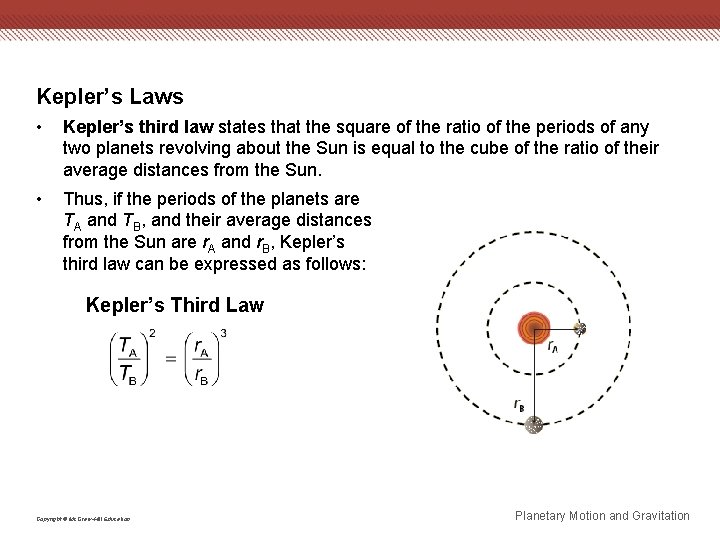
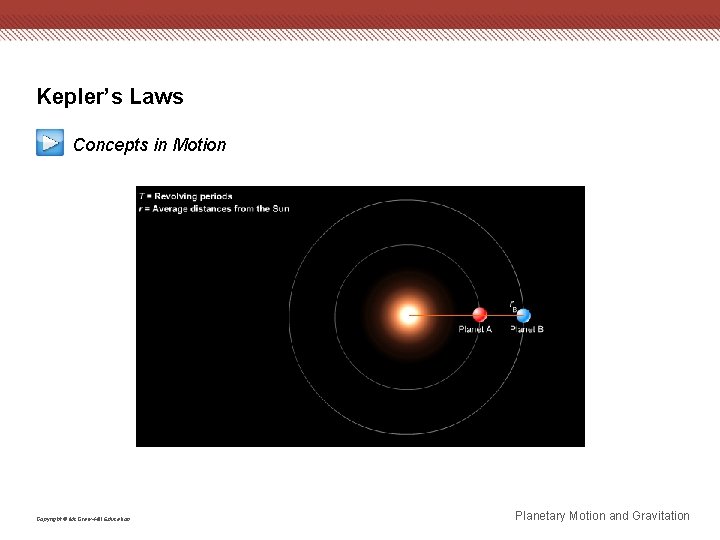
Kepler’s Laws • Kepler’s third law states that the square of the ratio of the periods of any two planets revolving about the Sun is equal to the cube of the ratio of their average distances from the Sun. • Thus, if the periods of the planets are TA and TB, and their average distances from the Sun are r. A and r. B, Kepler’s third law can be expressed as follows: Kepler’s Third Law Copyright © Mc. Graw-Hill Education Planetary Motion and Gravitation
Kepler’s Laws Concepts in Motion Copyright © Mc. Graw-Hill Education Planetary Motion and Gravitation
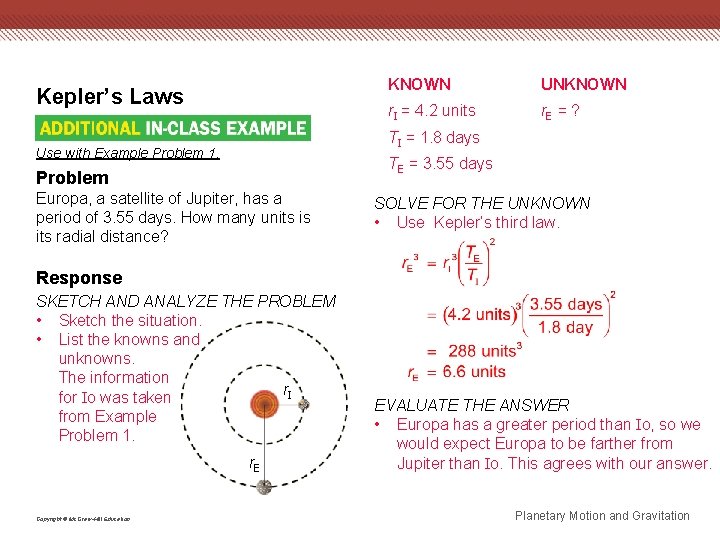
Kepler’s Laws KNOWN UNKNOWN r. I = 4. 2 units r. E = ? TI = 1. 8 days Use with Example Problem 1. TE = 3. 55 days Problem Europa, a satellite of Jupiter, has a period of 3. 55 days. How many units is its radial distance? SOLVE FOR THE UNKNOWN • Use Kepler’s third law. Response SKETCH AND ANALYZE THE PROBLEM • Sketch the situation. • List the knowns and unknowns. The information r. I for Io was taken from Example Problem 1. r. E Copyright © Mc. Graw-Hill Education EVALUATE THE ANSWER • Europa has a greater period than Io, so we would expect Europa to be farther from Jupiter than Io. This agrees with our answer. Planetary Motion and Gravitation
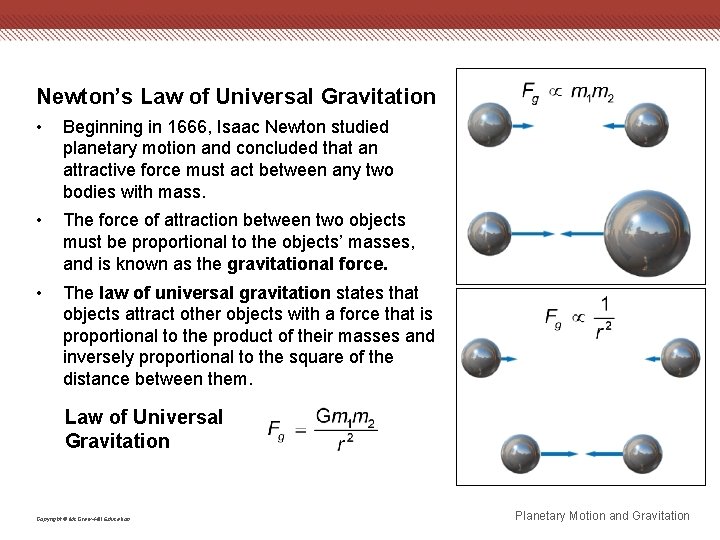
Newton’s Law of Universal Gravitation • Beginning in 1666, Isaac Newton studied planetary motion and concluded that an attractive force must act between any two bodies with mass. • The force of attraction between two objects must be proportional to the objects’ masses, and is known as the gravitational force. • The law of universal gravitation states that objects attract other objects with a force that is proportional to the product of their masses and inversely proportional to the square of the distance between them. Law of Universal Gravitation Copyright © Mc. Graw-Hill Education Planetary Motion and Gravitation
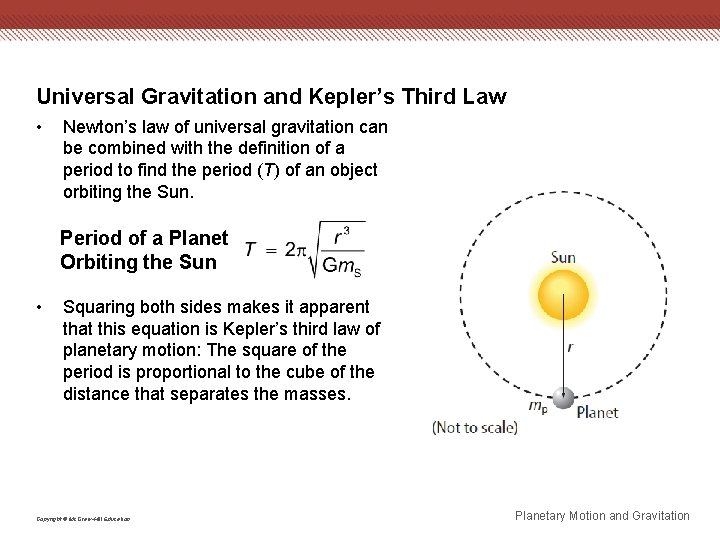
Universal Gravitation and Kepler’s Third Law • Newton’s law of universal gravitation can be combined with the definition of a period to find the period (T) of an object orbiting the Sun. Period of a Planet Orbiting the Sun • Squaring both sides makes it apparent that this equation is Kepler’s third law of planetary motion: The square of the period is proportional to the cube of the distance that separates the masses. Copyright © Mc. Graw-Hill Education Planetary Motion and Gravitation
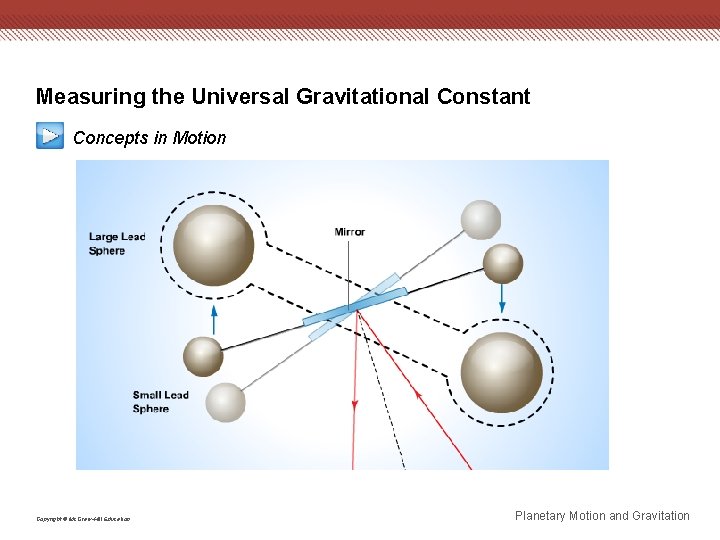
Measuring the Universal Gravitational Constant Concepts in Motion Copyright © Mc. Graw-Hill Education Planetary Motion and Gravitation
Review Essential Questions • • • What is the relationship between a planet’s orbital radius and period? What is Newton’s law of universal gravitation, and how does it relate to Kepler’s laws? Why was Cavendish’s investigation important? Vocabulary • • Kepler’s first law Kepler’s second law Copyright © Mc. Graw-Hill Education • • Kepler’s third law gravitational force • law of universal gravitation Planetary Motion and Gravitation