
Section 1 Introduction and Background 1 4 Guiding
Section 1. Introduction and Background 1. 4. Guiding Frameworks – Sustainable Development & Ethics USAID LEAF Regional Climate Change Curriculum Development Module: Social and Environmental Soundness (SES)
Social and Environmental Soundness (SES) Module Development Team Acknowledgements Name Affiliation Kasetsart University, Surin Onprom; Co-Lead Thailand Penporn Janekarnkij; Co-Lead Kasetsart University, Thailand Name Affiliation Tran Thi Thu Ha Vietnam Forestry University Nguyen Dinh Hai Vietnam Forestry University Rejani Kunjappan; Co-Lead RECOFTC Thailand Vo Mai Anh Vietnam Forestry University Claudia Radel; Co-Lead Utah State University Tran Tuan Vietnam Forestry University Sarah Hines; Co-Lead US Forest Service Cao Tien Trung Vinh University, Vietnam Sidthinat Prabudhanitisarn Chiang Mai University, Thailand Nguyen T. Trang Thanh Vinh University, Vietnam Sharifah Zarina Syed Zakaria University Kebangsaan Malaysia Nguyen Thu Ha USAID Vietnam Forests & Deltas Mohd Rusli Yacob University Putra Malaysia Maeve Nightingale IUCN MFF Kaisone Phengspha National University of Laos Guada Lagrada PACT MPE Phansamai Phengspha National University of Laos Le Van Trung DARD Lam Dong Kethsa Nanthavongduangsy National University of Laos Nguyen Thi Kim Oanh AIT Thailand Freddie Alei University of Papua New Guinea David Ganz USAID LEAF Bangkok Chay Kongkruy Royal University of Agriculture, Cambodia Kalpana Giri USAID LEAF Bangkok Soreivathanak Reasey Hoy Royal University of Phnom Penh, Cambodia Chi Pham Project Coordinator USAID LEAF Bangkok
Social and Environmental Soundness (SES) Module I. INTRODUCTION AND BACKGROUND 1. 1. Introduction to Climate Change 1. 2. The Climate Change Mitigation & Adaptation Context 1. 3. Introduction to Social and Environmental Soundness (SES) 1. 4. Guiding Frameworks – Sustainable Development & Ethics II. WHAT SOCIAL AND ENVIRONMENTAL ISSUES EXIST: STRENGHENING DESIGN AND IMPLEMENTATION OF REDD 2. 1. Environmental Co-benefits: Introduction to Biodiversity and Ecosystem Services 2. 1. 1. Carbon/REDD+ Project Accounting, Carbon Monitoring & MRV 2. 2. Governance 2. 2. 1. Regulatory Framework, Forest Tenure, and Carbon Rights 2. 3. Stakeholder Participation 2. 3. 1. FPIC 2. 4. Social Co-benefits 2. 5. Gender Equity and Women’s Empowerment 2. 5. 1. Gender Analysis Tools 2. 5. 2. Women’s Empowerment in Agriculture Index 2. 6. Indigenous Peoples and their Empowerment 2. 7. Local Livelihoods: An Introduction 2. 7. 1 Livelihoods impact Case Study: April Salumei, PNG 2. 8. REDD+ Benefits Sharing 2. 9. Economic and Financial Viability and Sustainability III. STATE OF THE ART IN ACTION: BRINGING THE PIECES TOGETHER 3. 1. Safeguard Mechanisms in REDD+ Programs 3. 2. Streamlining of Safeguards and Standards 3. 3. Developing National Level Safeguards
Learning Objectives At the end of this section, learners will be able to: § Identify the principles of sustainable development linked to social, economic and environmental issues § Describe the concept of environmental ethics and the essential features of moral or ethical thinking § Identify how a human-rights-based approach can arise from an ethics framework § Relate and develop the skills to recognize and apply moral discourse for leadership in environmental fields, including in climate change mitigation
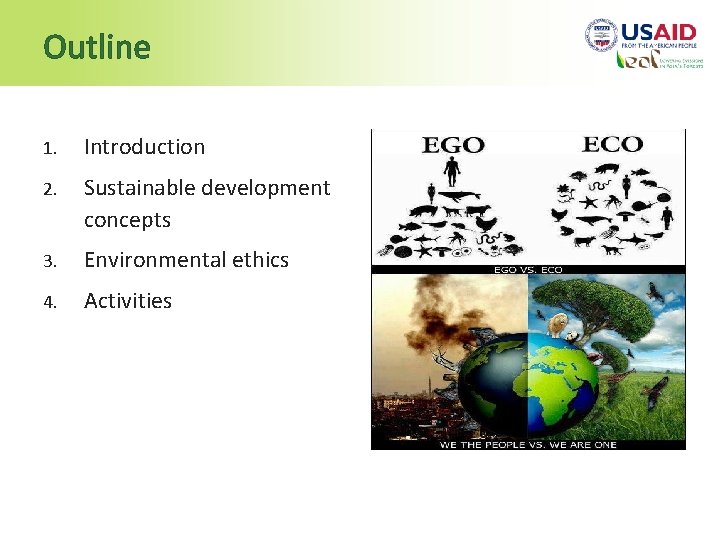
Outline 1. Introduction 2. Sustainable development concepts 3. Environmental ethics 4. Activities
Methodology § Lecture § § presentation of concepts and information Class discussion § decision making § identifying issues
Pre-Class Preparation Read: § The concept of sustainable development published in “Our Common Future” report in 1987 (The Brundtland Report) § Kortenkamp, K & Moore, C. F. 2001. Ecocentrism and Anthropocentrism: Moral Reasoning About Ecological Commons Dilemmas. Journal of Environmental Psychology 21, 000 -000. (http: //www. idealibrary. com)
Introduction This module section: § Examines in detail the applicability of the sustainable development concept as the framework for REDD+ § Relates the use of ethical frameworks for decision making
Sustainable Development (SD) Framework consists of three pillars: § Economic (Goal: Growth? ) § Environment (Goal: Conservation? ) § Social/Livelihood (Goal: Equity? ) We then also add a fourth consideration: § Governance/Political (political process and how decisions are made)
Economic Commonly accepted considerations: § Maximize human well-being. § Ensure efficient use of all resources, natural and otherwise, by maximizing rents. § Seek to identify and internalize environmental and social costs. § Maintain and enhance the conditions for viable enterprise.
Environmental Commonly accepted considerations: § Promote responsible stewardship of natural resources and the environment, including remediation of past damage. § Minimize waste and environmental damage along the whole of the supply chain. § Exercise prudence where impacts are unknown or uncertain. § Operate within ecological limits and protect critical natural capital.
Social Commonly accepted considerations: Ensure a fair distribution of the costs and benefits of development for all those alive today. § Respect and reinforce the fundamental rights of human beings, including civil and political liberties, cultural autonomy, social and economic freedoms, and personal security. § Seek to sustain improvements over time; ensure that depletion of natural resources will not deprive future generations through replacement with other forms of capital. §
Governance / Political Commonly accepted considerations: § Support representative democracy, including participatory decisionmaking. § Encourage free enterprise within a system of clear and fair rules and incentives. § Avoid excessive concentration of power through appropriate checks and balances. § Ensure transparency through providing all stakeholders with access to relevant and accurate information. § Ensure accountability for decisions and actions, which are based on comprehensive and reliable analysis. § Encourage cooperation in order to build trust and shared goals and values. § Ensure that decisions are made at the appropriate level, adhering to the principle of subsidiarity where possible.
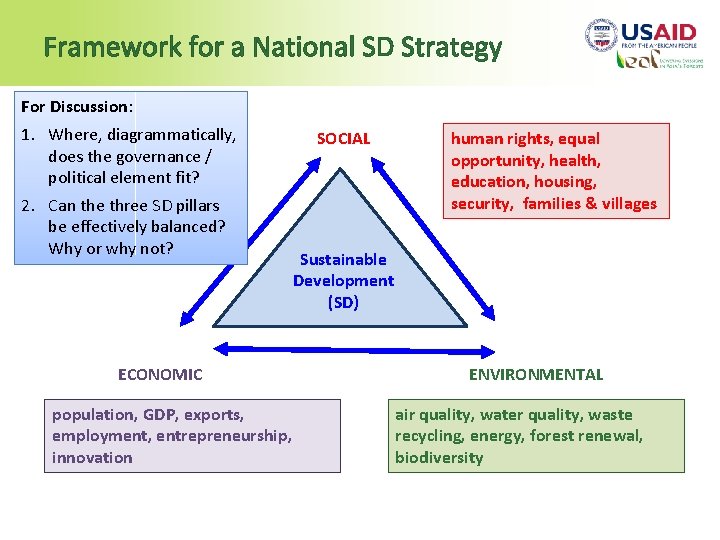
Framework for a National SD Strategy For Discussion: 1. Where, diagrammatically, does the governance / political element fit? 2. Can the three SD pillars be effectively balanced? Why or why not? ECONOMIC population, GDP, exports, employment, entrepreneurship, innovation SOCIAL human rights, equal opportunity, health, education, housing, security, families & villages Sustainable Development (SD) ENVIRONMENTAL air quality, water quality, waste recycling, energy, forest renewal, biodiversity
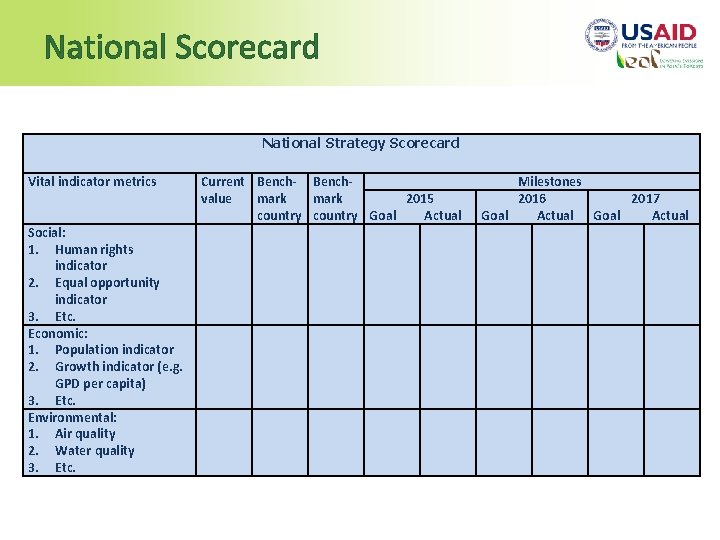
National Scorecard National Strategy Scorecard Vital indicator metrics Social: 1. Human rights indicator 2. Equal opportunity indicator 3. Etc. Economic: 1. Population indicator 2. Growth indicator (e. g. GPD per capita) 3. Etc. Environmental: 1. Air quality 2. Water quality 3. Etc. Current Bench- Benchvalue mark 2015 country Goal Actual Milestones 2016 2017 Goal Actual
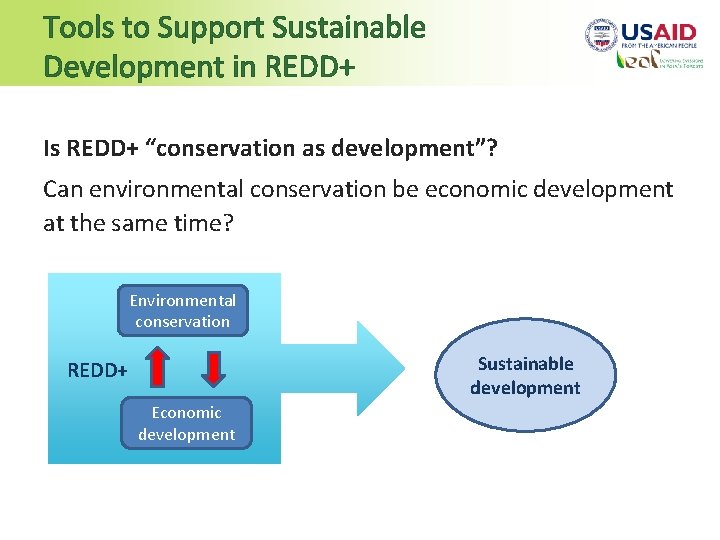
Tools to Support Sustainable Development in REDD+ Is REDD+ “conservation as development”? Can environmental conservation be economic development at the same time? Environmental conservation Sustainable development REDD+ Economic development
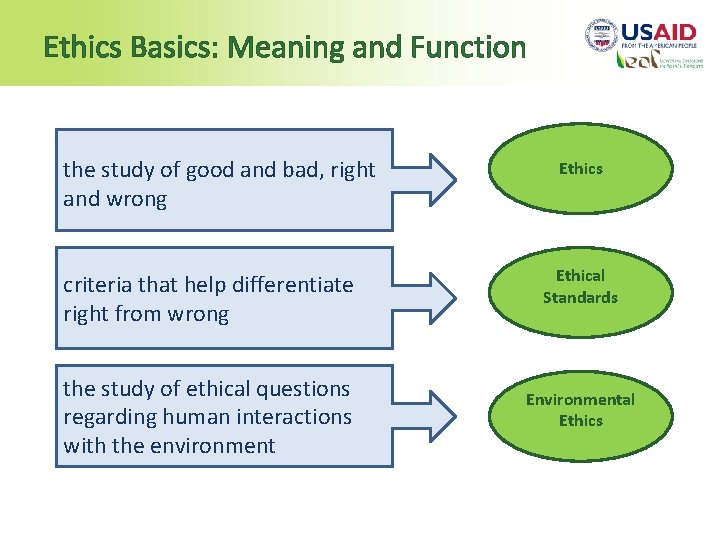
Ethics Basics: Meaning and Function the study of good and bad, right and wrong criteria that help differentiate right from wrong the study of ethical questions regarding human interactions with the environment Ethics Ethical Standards Environmental Ethics
What is Environmental Ethics? Environmental ethics: § guides humans behavior and relations with nature and other species on earth. § deals with the moral relationships between humans, nature and other species on earth. § addresses the ethical dimensions of humans’ relations with and behavior towards nature and other species on earth more generally.
Environmental Ethics Encompasses: § Understanding human ethical attitudes towards themselves and nature. § Understanding how environmental exploitation affects livelihoods (social/economic/political) § Understanding how conduct of social/economic/ political activities affects the environment. § Understanding how technologies affect the environment, livelihood, social well-being and nature. § In the context of this course: understanding, from an ethics perspective, the role of REDD+ in addressing both conservation and development.
Differing Environmental Ethics Perspectives Environmental ethicists define three value systems that differ sharply with regards to on whom the ethics are centered: 1. Anthropocentrism – Human-centered § considers the effects of environmental actions on humans only § humans as more important than any other species 2. Biocentrism – Life-centered § considers the effects of environmental actions on all living things § all species are important elements in a system of interdependence 3. Ecocentrism – Ecosystem-centered § considers the effects of environmental actions on all components of our environment, both living and nonliving § totality is more important than individuality
What obligation do humans have…? § to other humans? § to other living things? § to other species? § to non-living things? § to future human generations? The recognition of values or importance can strengthen relations within all living, non-living, humans and other species as a moral obligation and responsibility.
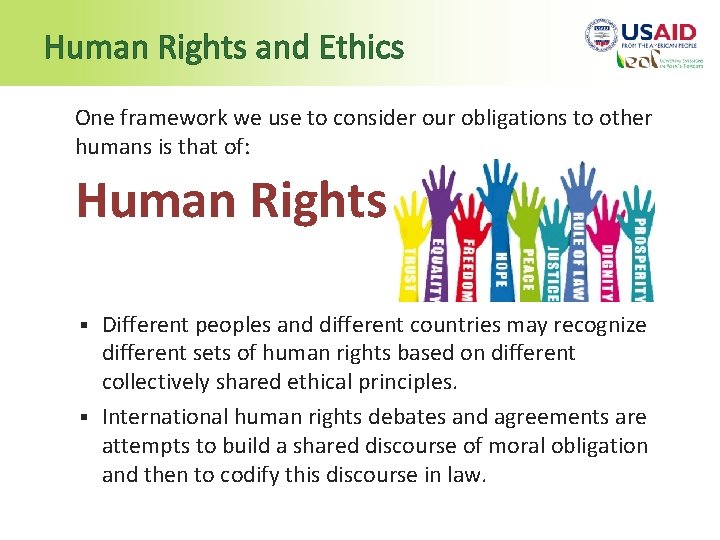
Human Rights and Ethics One framework we use to consider our obligations to other humans is that of: Human Rights Different peoples and different countries may recognize different sets of human rights based on different collectively shared ethical principles. § International human rights debates and agreements are attempts to build a shared discourse of moral obligation and then to codify this discourse in law. §
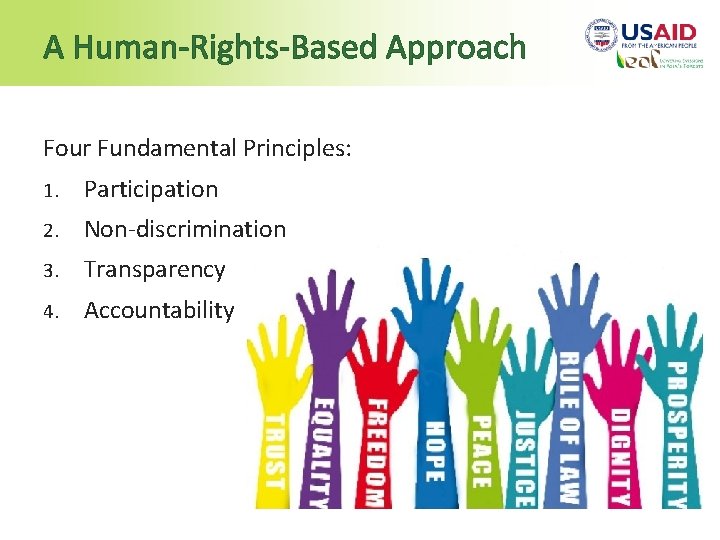
A Human-Rights-Based Approach Four Fundamental Principles: 1. Participation 2. Non-discrimination 3. Transparency 4. Accountability

Ethical Principles participation and stakeholder engagement social benefits and co-benefits local livelihoods environmental benefits and co-benefits governance, tenure, legal processes Do we need ethical principles that constrain and guide our actions? Do we need guiding frameworks? economic / financial viability and sustainability indigenous empowerment gender equity and women’s empowerment
Activity A: Judging Actions Consider the following: “A farmer has to clear land by cutting trees / forests to feed and support his or her family“ What do we need to include in our consideration of the farmer’s actions? 1. Identify arguments for and against the farmer’s actions based on the SD framework: § conservation perspectives (environment) § economic perspectives (economy) § humanity perspectives (social / political) 2. Identify arguments for the “rightness” or “wrongness” of the farmer’s actions based on environmental ethics perspectives (anthropocentrism, biocentrism, ecocentrism). 3. Now consider the impact of processes at broader scales: Why might the farmer clear forest to farm? (consider the potential roles of national policies, legal frameworks, markets, etc. in shaping the farmer’s actions) Does this change our judgment of the farmer’s actions?
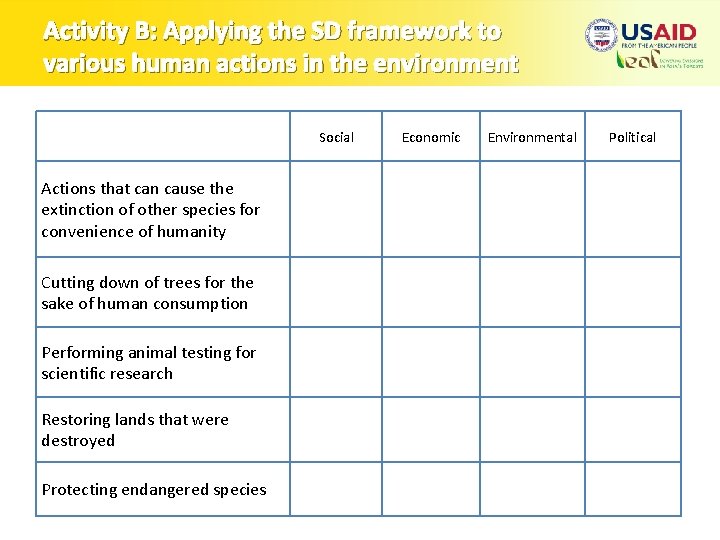
Activity B: Applying the SD framework to various human actions in the environment Social Actions that can cause the extinction of other species for convenience of humanity Cutting down of trees for the sake of human consumption Performing animal testing for scientific research Restoring lands that were destroyed Protecting endangered species Economic Environmental Political
TAKE HOME MESSAGE (1) § The sustainable development framework can be a tool to support decision-making to address multiple policy aspects: social, economic, environmental, and political. § Environmental ethics are the constraining and guiding value perspectives which shape the intention and purpose for conservation and development actions.
TAKE HOME MESSAGE (2) § The framework of human rights is a key system of ethical thinking that positions obligation to other humans in terms of “rights. ” A human-rights-based approach can provide ethical guidance to projects design and implementation. § By providing frameworks for development of ethical decisions, these theories strengthen our ability to reach balanced and insightful judgments and to clarify and communicate the bases for those judgments.
References 1. 2. 3. 4. 5. 6. 7. World Commission on Environment and Development. 1987. Our Common Future. London: Oxford University Press. (The Brundtland Report) Corbera, E. , Schroeder, H. 2010. Governing and implementing REDD+. Environ. Sci. Policy, doi: 10. 1016/j. envsci. 2010. 11. 002. Clugston R. 2011. Ethical Framework for a Sustainable World. Journal of Education for Sustainable Development. 5, September: 173 -176. Gary W. Luck, Kai M. A. Chan, Uta Eser, Erik Gómez-Baggethun, Bettina Matzdorf, Bryan Norton, & Marion B. Potschin. 2012. Ethical Considerations in On-Ground Applications of the Ecosystem Services Concept. Bio. Science. Vol. 62, No. 12, December. Jagger P. , Sills E. O. , Lawlor, K. and Sunderlin, W. D. 2010. A guide to learning about livelihood impacts of REDD+ projects. Occasional paper 56. CIFOR, Bogor, Indonesia. Rolston. H. 2003. Environmental Ethics. In The Blackwell Companion to Philosophy, 2 nd ed. Bunnin. N and Tsui-James. E. P (eds), Oxford: Blackwell Publishing. Ulvin, Peter. 2007. From the right to development to the rights-based approach: how ‘human rights’ entered development. Development in Practice 17(4 -5): 597606.
- Slides: 29