
Section 1 Human Origins in Africa Fossil evidence
- Slides: 22
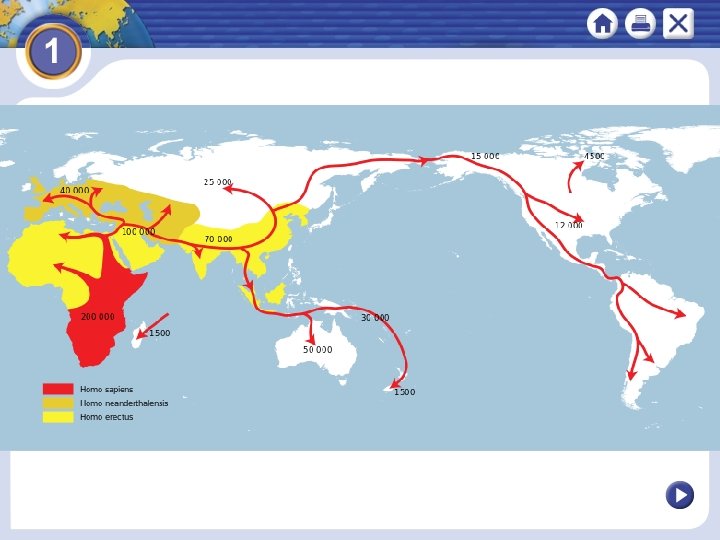
Section 1 Human Origins in Africa Fossil evidence shows that the earliest humans originate in Africa and spread across the globe. NEXT
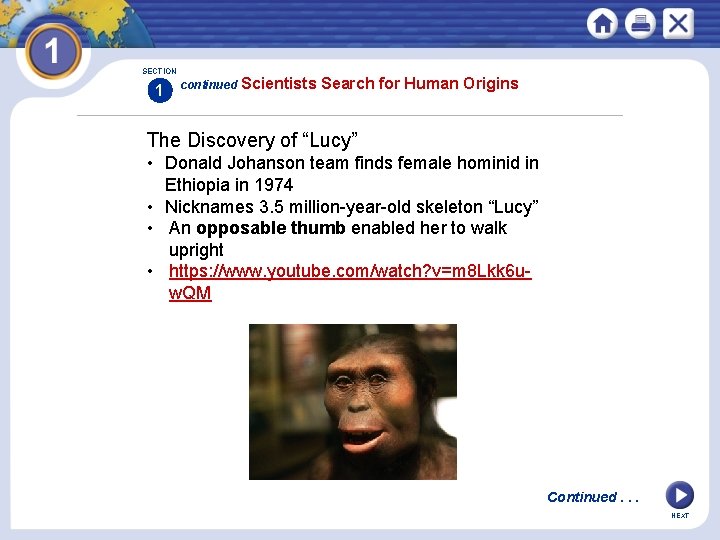
SECTION 1 continued Scientists Search for Human Origins The Discovery of “Lucy” • Donald Johanson team finds female hominid in Ethiopia in 1974 • Nicknames 3. 5 million-year-old skeleton “Lucy” • An opposable thumb enabled her to walk upright • https: //www. youtube. com/watch? v=m 8 Lkk 6 uw. QM Continued. . . NEXT
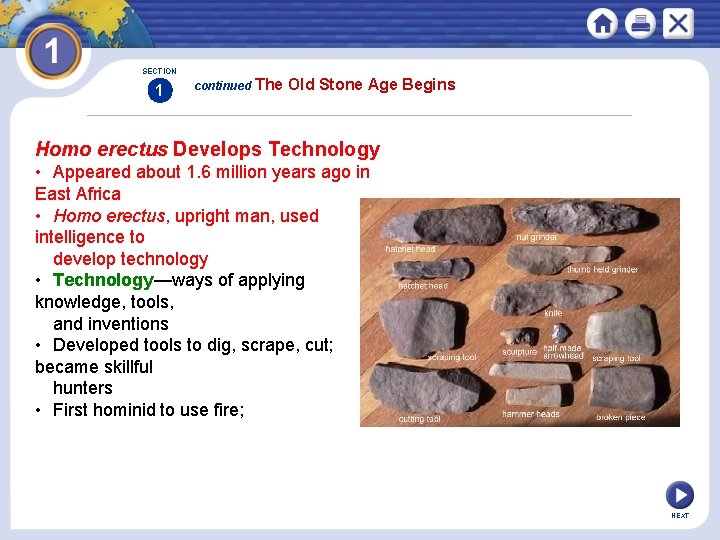
SECTION 1 continued The Old Stone Age Begins Homo erectus Develops Technology • Appeared about 1. 6 million years ago in East Africa • Homo erectus, upright man, used intelligence to develop technology • Technology—ways of applying knowledge, tools, and inventions • Developed tools to dig, scrape, cut; became skillful hunters • First hominid to use fire; NEXT
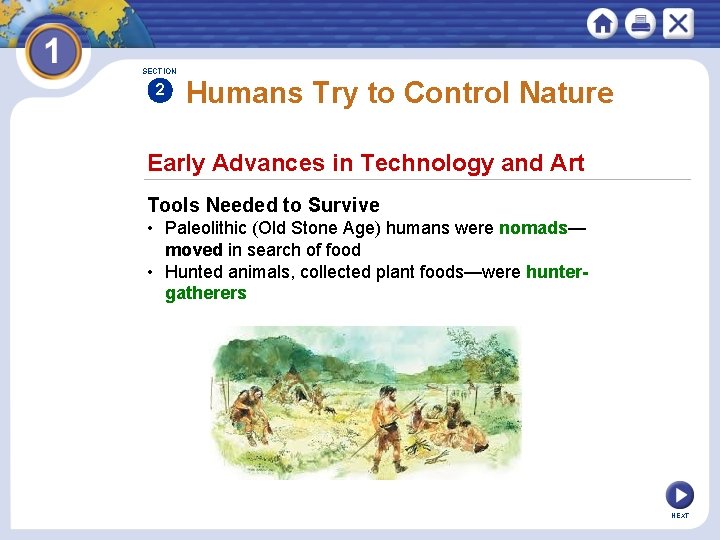
SECTION 2 Humans Try to Control Nature Early Advances in Technology and Art Tools Needed to Survive • Paleolithic (Old Stone Age) humans were nomads— moved in search of food • Hunted animals, collected plant foods—were huntergatherers NEXT
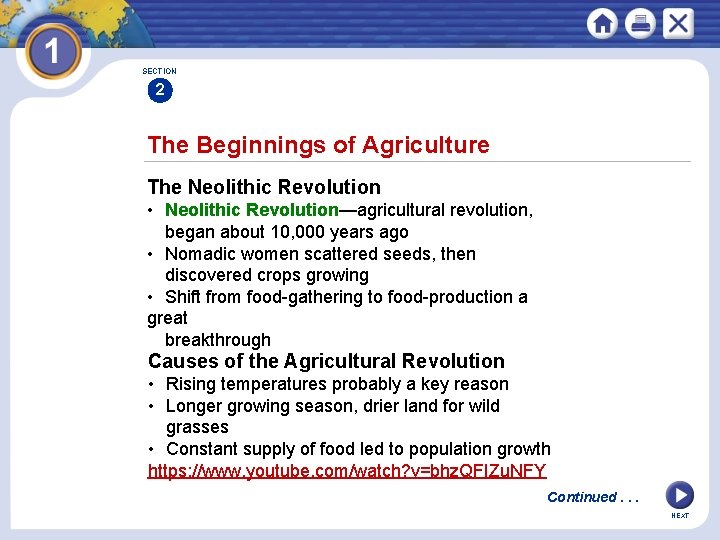
SECTION 2 The Beginnings of Agriculture The Neolithic Revolution • Neolithic Revolution—agricultural revolution, began about 10, 000 years ago • Nomadic women scattered seeds, then discovered crops growing • Shift from food-gathering to food-production a great breakthrough Causes of the Agricultural Revolution • Rising temperatures probably a key reason • Longer growing season, drier land for wild grasses • Constant supply of food led to population growth https: //www. youtube. com/watch? v=bhz. QFIZu. NFY Continued. . . NEXT
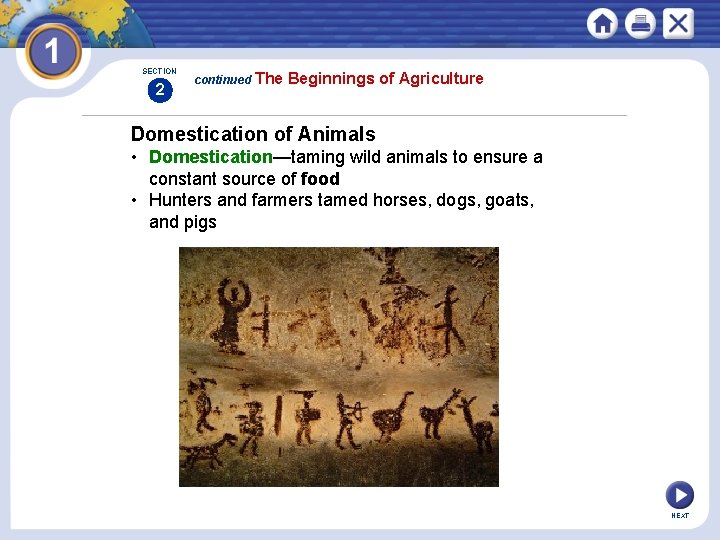
SECTION 2 continued The Beginnings of Agriculture Domestication of Animals • Domestication—taming wild animals to ensure a constant source of food • Hunters and farmers tamed horses, dogs, goats, and pigs NEXT
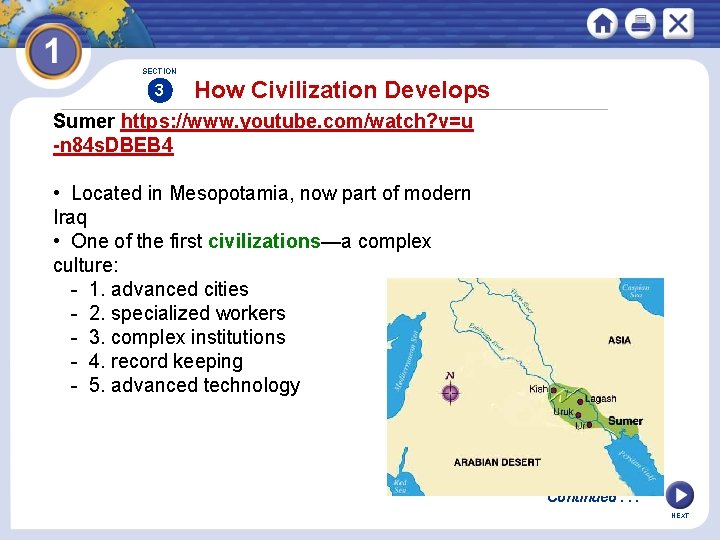
SECTION 3 How Civilization Develops Sumer https: //www. youtube. com/watch? v=u -n 84 s. DBEB 4 • Located in Mesopotamia, now part of modern Iraq • One of the first civilizations—a complex culture: - 1. advanced cities - 2. specialized workers - 3. complex institutions - 4. record keeping - 5. advanced technology Continued. . . NEXT
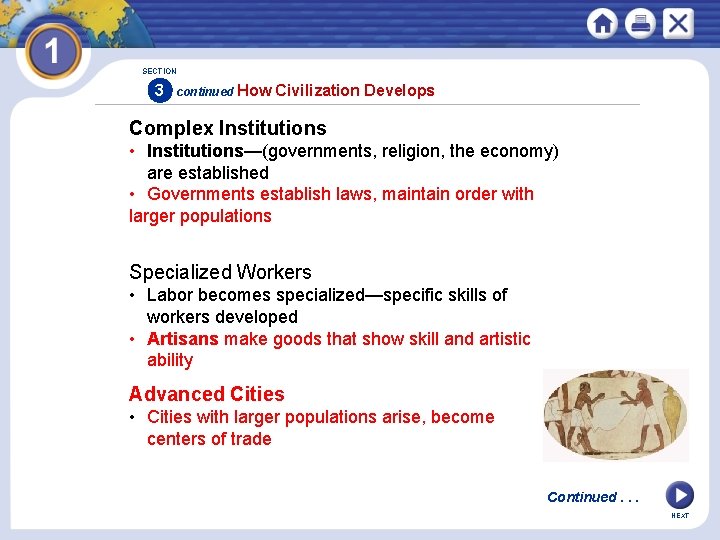
SECTION 3 continued How Civilization Develops Complex Institutions • Institutions—(governments, religion, the economy) are established • Governments establish laws, maintain order with larger populations Specialized Workers • Labor becomes specialized—specific skills of workers developed • Artisans make goods that show skill and artistic ability Advanced Cities • Cities with larger populations arise, become centers of trade Continued. . . NEXT
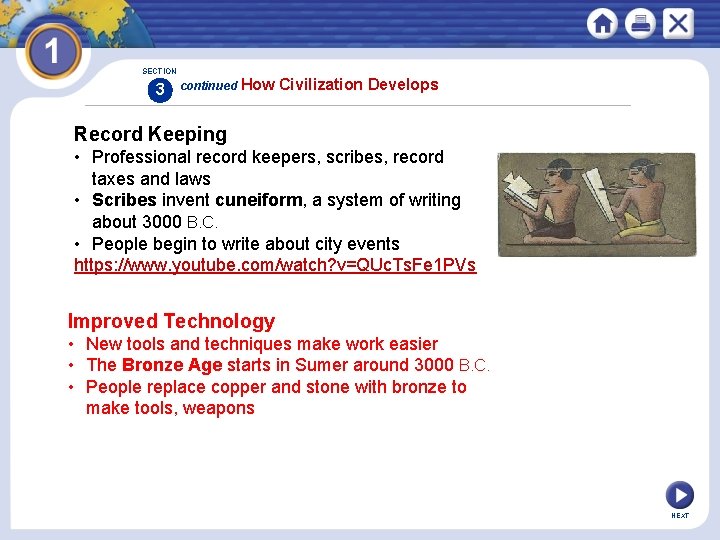
SECTION 3 continued How Civilization Develops Record Keeping • Professional record keepers, scribes, record taxes and laws • Scribes invent cuneiform, a system of writing about 3000 B. C. • People begin to write about city events https: //www. youtube. com/watch? v=QUc. Ts. Fe 1 PVs Improved Technology • New tools and techniques make work easier • The Bronze Age starts in Sumer around 3000 B. C. • People replace copper and stone with bronze to make tools, weapons NEXT
Section 1 City-States in Mesopotamia The earliest civilization in Asia rises in Mesopotamia and organizes into city-states. NEXT
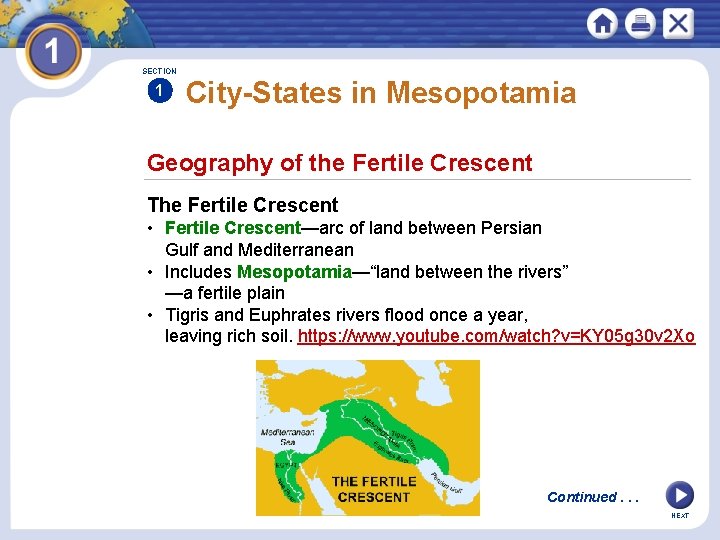
SECTION 1 City-States in Mesopotamia Geography of the Fertile Crescent The Fertile Crescent • Fertile Crescent—arc of land between Persian Gulf and Mediterranean • Includes Mesopotamia—“land between the rivers” —a fertile plain • Tigris and Euphrates rivers flood once a year, leaving rich soil. https: //www. youtube. com/watch? v=KY 05 g 30 v 2 Xo Continued. . . NEXT
SECTION 1 continued Geography of the Fertile Crescent Environmental Challenges • Around 3300 B. C. Sumerians begin farming southern Mesopotamia • Environment poses three disadvantages: - floods are unpredictable; sometimes no rain - land offers no barriers to invasion - land has few natural resources; building materials scarce Continued. . . NEXT
SECTION 1 continued Geography of the Fertile Crescent Solving Problems Through Organization • Sumerians worked together; find solutions to environmental challenges: - build irrigation ditches to control water, produce crops - build walled cities for defense - trade grain, cloth, and tools for raw materials—stone, wood metal • Organization, leadership, and laws are beginning of civilization NEXT
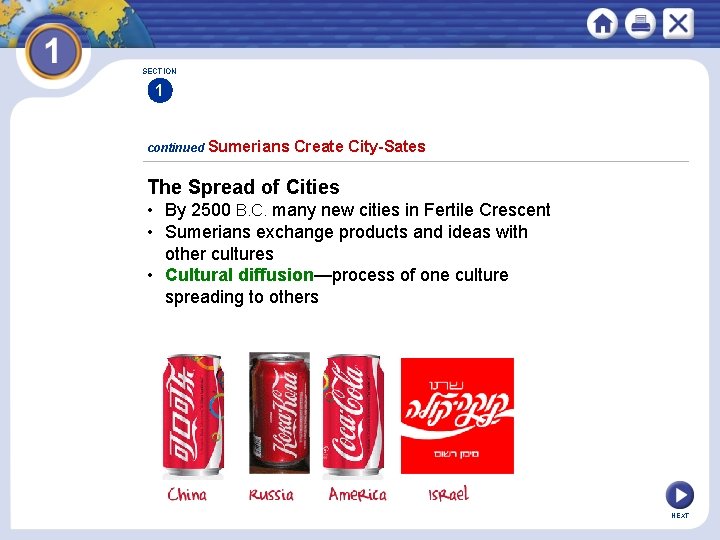
SECTION 1 continued Sumerians Create City-Sates The Spread of Cities • By 2500 B. C. many new cities in Fertile Crescent • Sumerians exchange products and ideas with other cultures • Cultural diffusion—process of one culture spreading to others NEXT
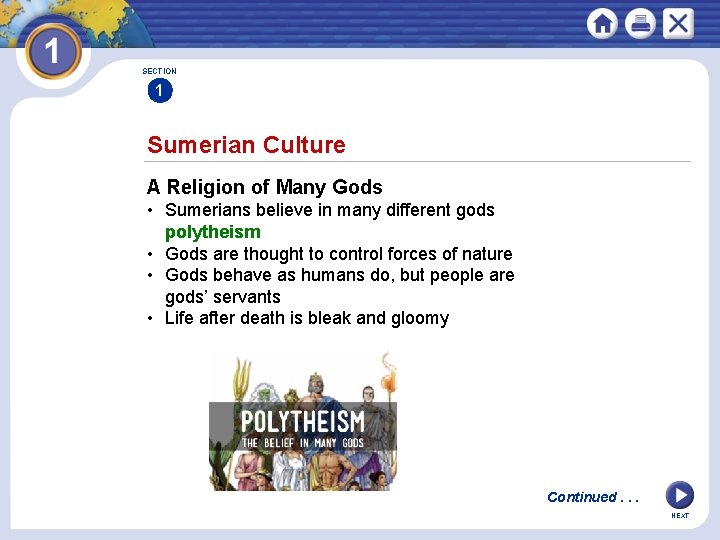
SECTION 1 Sumerian Culture A Religion of Many Gods • Sumerians believe in many different gods polytheism • Gods are thought to control forces of nature • Gods behave as humans do, but people are gods’ servants • Life after death is bleak and gloomy Continued. . . NEXT
SECTION 1 continued The First Empire Builders Hammurabi’s Code • Hammurabi creates a code of laws for the Babylonian Empire • 282 laws on all aspects of life; engraved in stone and made public • Set different punishments depending on social class, gender • Goal for government to take responsibility for order, justice • Amorite rule for Fertile Crescent ends 200 years after Hammurabi NEXT
Section 4 River Dynasties in China Early rulers introduce ideas about government and society that shape Chinese civilization. NEXT
SECTION 4 River Dynasties in China The Geography of China Barriers Isolate China • Ocean, mountains, deserts isolate China from other areas River Systems • Huang He (“Yellow River”) in north, Yangtze in south • Huang He leaves loess—fertile silt—when it floods Environmental Challenges • Huang He floods can devour whole villages • Geographic isolation means lack of trade; must be self-sufficient China’s Heartland • North China Plain, area between two rivers, center of civilization NEXT
SECTION 4 The Development of Chinese Culture Chinese Civilization • Sees China as center of world; views others as uncivilized • The group is more important than the individual Family • Family is central social institution; respect for parents a virtue • Elder males control family property • Women expected to obey all men, even sons Social Classes • King and warrior-nobles lead society and own the land Continued. . . NEXT
SECTION 4 continued The Development of Chinese Culture Development of Writing • Writing system uses symbols to represent syllables; not ideas • People of different languages can use same system • Huge number of characters make system difficult to learn NEXT
SECTION 4 Zhou and the Dynastic Cycle The Zhou Take Control • In 1027 B. C. , Zhou Dynasty takes control of China Mandate of Heaven • Mandate of Heaven—the belief that a just ruler had divine approval • Developed as justification for change in power to Zhou • Dynastic cycle—pattern of the rise and decline of dynasties Continued. . . NEXT