
SECTION 1 GEOGRAPHY AND THE FERTILE CRESCENT CHAPTER


- Slides: 13
SECTION 1 – GEOGRAPHY AND THE FERTILE CRESCENT CHAPTER 3 – MESOPOTAMIA AND THE FERTILE CRESCENT
WORDS TO KNOW • Fertile Crescent • silt • irrigation • canals • surplus • division of labor
YOU WILL KNOW • The rivers of Southwest Asia support the growth of civilization • New farming techniques led to the world’s first civilizations.
IF YOU WERE THERE…… • You are a farmer in Southwest Asia about 6, 000 years ago. You live near a slow-moving river with many shallow lakes and marshes. The river makes the land in the valley rich and fertile so you can grow wheat and dates. But in the spring, raging floods spill over the riverbanks, destroying your fields. In the hot summer, you are often short of water. How can you control the waters of the river? Discuss at your tables and share responses
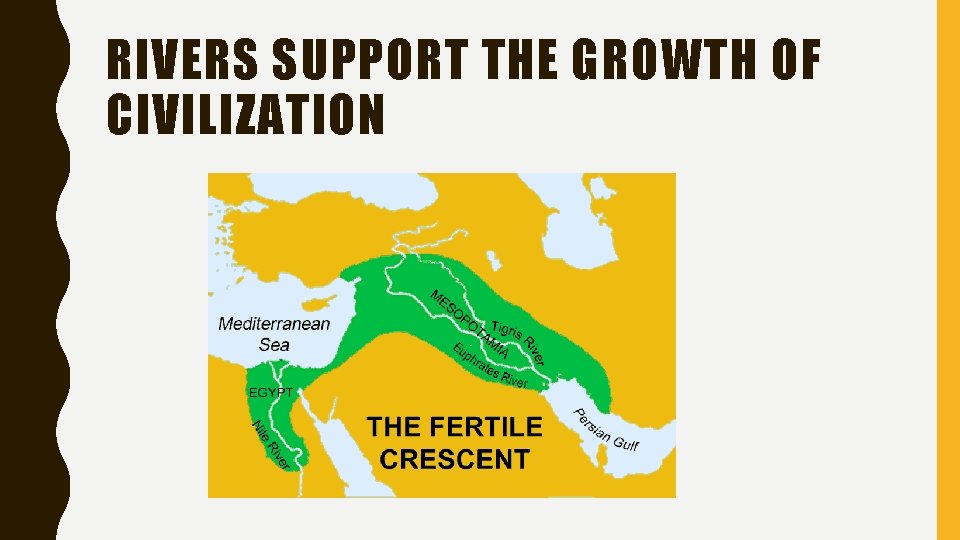
RIVERS SUPPORT THE GROWTH OF CIVILIZATION
RIVERS SUPPORT THE GROWTH OF CIVILIZATION • Early people settled near rivers where water was available, regular floods made the soil rich, and where crops would grow. • The Tigris and Euphrates rivers are the most important physical features of the region. • Mesopotamia means “between the rivers” in Greek • Hunter-gatherer groups first settled in Mesopotamia more than 12, 000 years ago. • Over time they learned how to grow food and plant crops • The first farm settlements formed in Mesopotamia as early as 7000 BC. Farmers grew barley, wheat and other types of grains. • Livestock, birds, and fish were also good sources for food.
FARMING AND CITIES • Farming wasn’t easy. • little rain - when water levels were too low crops dried up • Floods destroyed livestock and washed away homes. • Early farmers needed to learn ways to control the flow of river water to their fields in both rainy and dry seasons.
CONTROLLING WATER • used irrigation, a way of supplying water to an area of land. • dug out large storage basins to hold water • dug canals that connected these basins to a network of ditches. • With irrigation, the people of Mesopotamia were able to grow more food. • https: //www. youtube. com/watch? v=5 RP 2 Kfewi. JA
FOOD SURPLUS • Irrigation increased the amount of food • Fewer people needed to farm which allowed others to take on different jobs. • New occupations: crafters, religious leaders, and government workers.
THE APPEARANCE OF CITIES • Mesopotamian settlements grew in size and complexity. • Cities developed between 4000 and 3000 BC • Society in Mesopotamia was still based on agriculture. • Cities became important places where people traded goods and provided leaders with power bases.
LET’S REVIEW • What made civilization possible in Mesopotamia? • Why did the Mesopotamians create irrigation systems? • How did the Fertile Crescent get its name? • In what ways did the division of labor contribute to the growth of Mesopotamian civilization? • What was the most important factor in making Mesopotamia’s farmland fertile?
LINKING TO TODAY • Irrigation is still a necessary part of farming. In fact, over 50% of all farmers today use some form of irrigation for their crops. While many farmers still use canals to direct water onto their fields, they use many other methods as well…. Discuss at your tables what you think some of these other methods may include and share with the class.