
Section 1 Fourteenth Amendment All persons born or
Section 1, Fourteenth Amendment All persons born or naturalized in the United States and subject to the jurisdiction thereof, are citizens of the United States and of the States wherein they reside. No State shall make or enforce any law which shall abridge the privileges or immunities of citizens of the United States; nor shall any State deprive any person of life, liberty, or property, without due process of law; nor deny to any person within its jurisdiction the equal protection of the law.
Privileges or Immunities Clause No State shall make or enforce any law which shall abridge the privileges or immunities of citizens of the United States;
COMPARISON 14 th Amendment, Privileges or Immunities Clause 1 st Amendment, Freedom of Religion Clause No State shall make or enforce any law which shall abridge the privileges or immunities of citizens of the United States; Congress shall make no law respecting an establishment of religion, or prohibiting the free exercise thereof;
Privileges or Immunities Clause No State shall make or enforce any law which shall abridge the privileges or immunities of citizens of the United States;
Due Process Clause. . . nor shall any State deprive any person of life, liberty, or property, without due process of law;
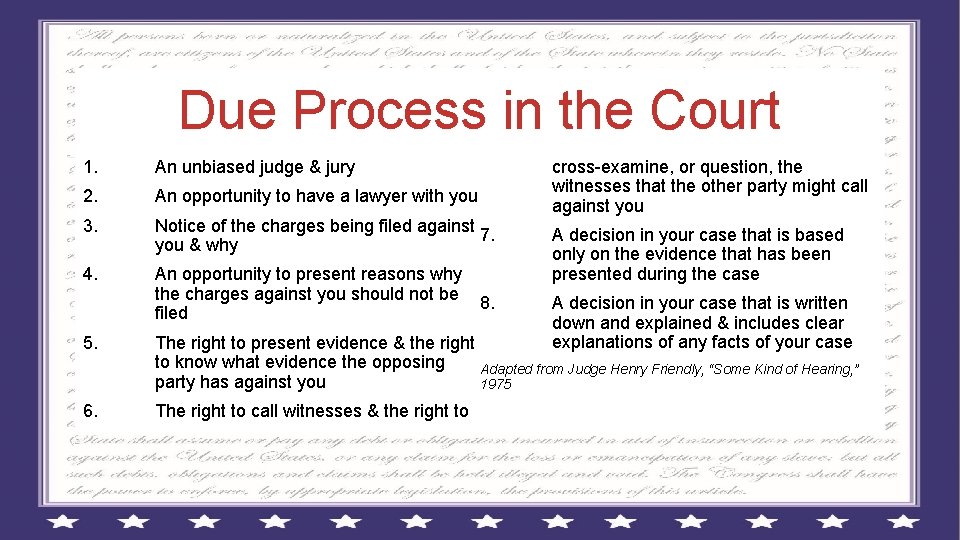
Due Process in the Court 1. An unbiased judge & jury 2. An opportunity to have a lawyer with you 3. Notice of the charges being filed against 7. you & why 4. An opportunity to present reasons why the charges against you should not be 8. filed cross-examine, or question, the witnesses that the other party might call against you A decision in your case that is based only on the evidence that has been presented during the case A decision in your case that is written down and explained & includes clear explanations of any facts of your case 5. The right to present evidence & the right to know what evidence the opposing Adapted from Judge Henry Friendly, “Some Kind of Hearing, ” party has against you 1975 6. The right to call witnesses & the right to
Equal Protection Clause. . . nor deny to any person within its jurisdiction the equal protection of the law.
“State Actor” Only a State or Federal Actor is capable of violating your enumerated rights. Who is a State Actor? Who is a Private Actor?
Section 1, Fourteenth Amendment All persons born or naturalized in the United States and subject to the jurisdiction thereof, are citizens of the United States and of the States wherein they reside. No State shall make or enforce any law which shall abridge the privileges or immunities of citizens of the United States; nor shall any State deprive any person of life, liberty, or property, without due process of law; nor deny to any person within its jurisdiction the equal protection of the law.
Scenario #1 I am a male senior admitted to attend Hastings College next year. The College has a program called Women’s Studies that I was interested in. When I started looking into the program I loved learning about its history and success of its many graduates. Then, I learned that the program is only open to women. I spoke with an admission counselor and they recommended that I major in Gender Studies. The Gender Studies major is open to all students, but it’s less established. The Gender Studies major does not have the number of classes or the reputation that the Women’s Studies program has.
Section 1, Fourteenth Amendment All persons born or naturalized in the United States and subject to the jurisdiction thereof, are citizens of the United States and of the States wherein they reside. No State shall make or enforce any law which shall abridge the privileges or immunities of citizens of the United States; nor shall any State deprive any person of life, liberty, or property, without due process of law; nor deny to any person within its jurisdiction the equal protection of the law.
Scenario #2 I am in the Future Teacher class at my high school and twice a week I go to an elementary school to help in a classroom as part of this class. Last week I was told that I had to help read to the kids from “Donde Viven Los Monsturos” the Spanish language version of “Where the Wild Things Are. ” I am now worried because I heard that State Senator Bill Smith had proposed a new law that would make it a crime for anyone to teach a foreign language to children who have not passed eighth grade. I went ahead and read the book to the class, but am still worried. Could that really become the law?
Section 1, Fourteenth Amendment All persons born or naturalized in the United States and subject to the jurisdiction thereof, are citizens of the United States and of the States wherein they reside. No State shall make or enforce any law which shall abridge the privileges or immunities of citizens of the United States; nor shall any State deprive any person of life, liberty, or property, without due process of law; nor deny to any person within its jurisdiction the equal protection of the law.
Scenario #3 My grandpa is a farmer out in Western Nebraska. When I visited him last summer he told me about the Keystone Pipeline and how it had the potential to damage his farm and the water I drink if it were to break or spill. I’ve heard of a lot of people protesting it and told a few of my friends. We decided to wear blue armbands and carry special blue water bottles to support keeping our water clean and Canadian oil out of our state. I guess someone in administration found out because there was an announcement that anyone wearing a blue armband or carrying the water bottle would have to stop and if we didn’t we would be suspended. I didn’t think they would seriously suspend us, I mean; people wear “Make America Great Again” hats at school and t-shirts that say “Save the Whales” – so why would this be such a big deal? A few of us went ahead with the plan and ended up getting suspended. We didn’t cause any problems – a few people tried arguing with us, but most people just wanted to know why we were doing it.
Other Interesting Cases Brown v. Board of Education (1954): Segregation of public education based solely on race violates the Equal Protection Clause of the Fourteenth Amendment In re Gault (1967): Held proceedings for juveniles had to comply with the requirements of the Fourteenth Amendment. Goss v. Lopez (1975): School suspension without a hearing violates the Due Process Clause of the Fourteenth Amendment
Section 1, Fourteenth Amendment All persons born or naturalized in the United States and subject to the jurisdiction thereof, are citizens of the United States and of the States wherein they reside. No State shall make or enforce any law which shall abridge the privileges or immunities of citizens of the United States; nor shall any State deprive any person of life, liberty, or property, without due process of law; nor deny to any person within its jurisdiction the equal protection of the law.
- Slides: 17