
Section 1 Early Ideas About Matter The ancient
Section 1: Early Ideas About Matter The ancient Greeks tried to explain matter, but the scientific study of the atom began with John Dalton in the early 1800 s. K What I Know W What I Want to Find Out L What I Learned
Essential Questions • What are the similarities and differences of the atomic models of Democritus, Aristotle, and Dalton? • How was Dalton’s theory used to explain the conservation of mass? Copyright © Mc. Graw-Hill Education Early Ideas About Matter
Vocabulary Review New • theory • Dalton’s atomic theory Copyright © Mc. Graw-Hill Education Early Ideas About Matter
The Roots of Atomic Theory • Many ancient scholars believed matter was composed of such things as earth, water, air, and fire. • Many believed matter could be endlessly divided into smaller and smaller pieces. Copyright © Mc. Graw-Hill Education Early Ideas About Matter
Greek Philosophers • Democritus (460– 370 B. C. ) was the first person to propose the idea that matter was not infinitely divisible, but made up of individual particles called atomos, from which the English word atom is derived. • Aristotle (484– 322 B. C. ) disagreed with Democritus because he did not believe empty space could exist. • Aristotle’s views went unchallenged for 2, 000 years until science developed methods to test the validity of his ideas. Copyright © Mc. Graw-Hill Education Early Ideas About Matter
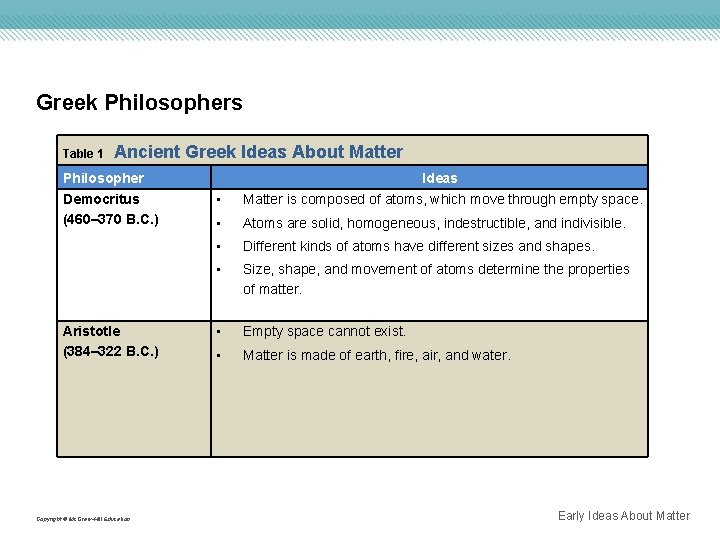
Greek Philosophers Table 1 Ancient Greek Ideas About Matter Philosopher Democritus (460– 370 B. C. ) Aristotle (384– 322 B. C. ) Copyright © Mc. Graw-Hill Education Ideas • Matter is composed of atoms, which move through empty space. • Atoms are solid, homogeneous, indestructible, and indivisible. • Different kinds of atoms have different sizes and shapes. • Size, shape, and movement of atoms determine the properties of matter. • Empty space cannot exist. • Matter is made of earth, fire, air, and water. Early Ideas About Matter
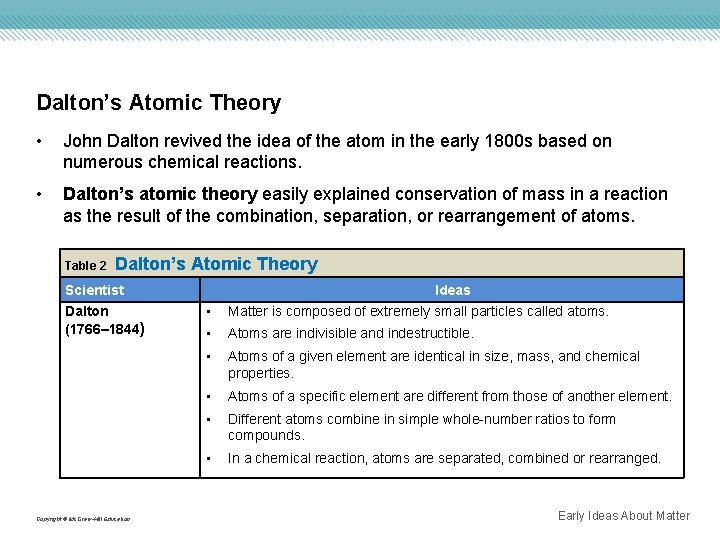
Dalton’s Atomic Theory • John Dalton revived the idea of the atom in the early 1800 s based on numerous chemical reactions. • Dalton’s atomic theory easily explained conservation of mass in a reaction as the result of the combination, separation, or rearrangement of atoms. Table 2 Dalton’s Atomic Theory Scientist Dalton (1766– 1844) Copyright © Mc. Graw-Hill Education • Ideas Matter is composed of extremely small particles called atoms. • Atoms are indivisible and indestructible. • Atoms of a given element are identical in size, mass, and chemical properties. • Atoms of a specific element are different from those of another element. • Different atoms combine in simple whole-number ratios to form compounds. • In a chemical reaction, atoms are separated, combined or rearranged. Early Ideas About Matter
Review Essential Questions • What are the similarities and differences of the atomic models of Democritus, Aristotle, and Dalton? • How was Dalton’s theory used to explain the conservation of mass? Vocabulary • Dalton’s atomic theory Copyright © Mc. Graw-Hill Education Early Ideas About Matter
- Slides: 8