
SECTION 1 5 COLLECTING SAMPLE DATA Key Concept


- Slides: 36
SECTION 1 -5 COLLECTING SAMPLE DATA
Key Concept v If sample data are not collected in an appropriate way, the data may be so completely useless that no amount of statistical torturing can salvage them. v Method used to collect sample data influences the quality of the statistical analysis. v Of particular importance is simple random sample.
Basics of Collecting Data Statistical methods are driven by the data that we collect. We typically obtain data from two distinct sources: observational studies and experiment.
Observational Study Observational study observing and measuring specific characteristics without attempting to modify the subjects being studied.
Experiment apply some treatment and then observe its effects on the subjects; (subjects in experiments are called experimental units).
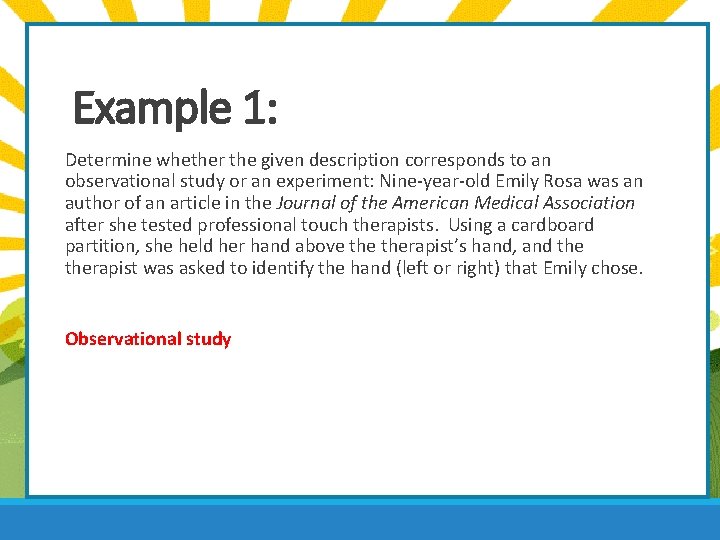
Example 1: Determine whether the given description corresponds to an observational study or an experiment: Nine-year-old Emily Rosa was an author of an article in the Journal of the American Medical Association after she tested professional touch therapists. Using a cardboard partition, she held her hand above therapist’s hand, and therapist was asked to identify the hand (left or right) that Emily chose. Observational study
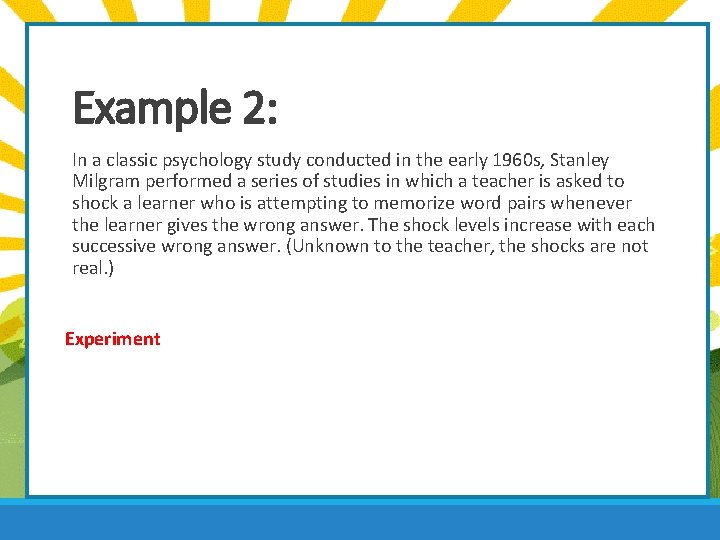
Example 2: In a classic psychology study conducted in the early 1960 s, Stanley Milgram performed a series of studies in which a teacher is asked to shock a learner who is attempting to memorize word pairs whenever the learner gives the wrong answer. The shock levels increase with each successive wrong answer. (Unknown to the teacher, the shocks are not real. ) Experiment
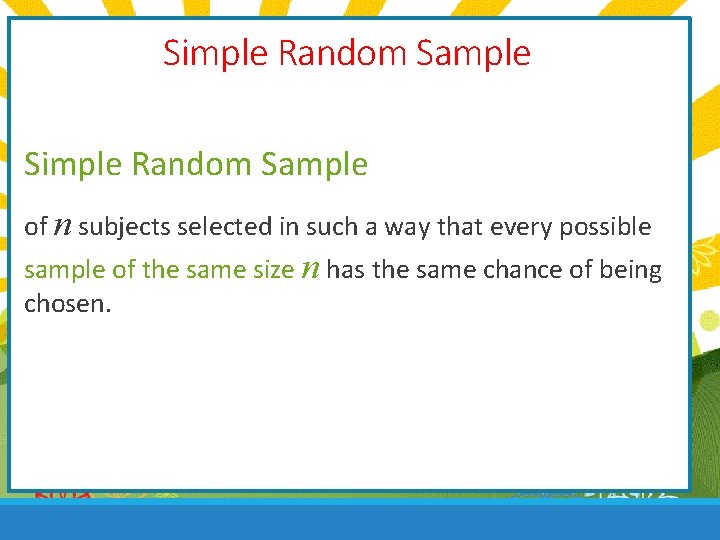
Simple Random Sample of n subjects selected in such a way that every possible sample of the same size n has the same chance of being chosen.
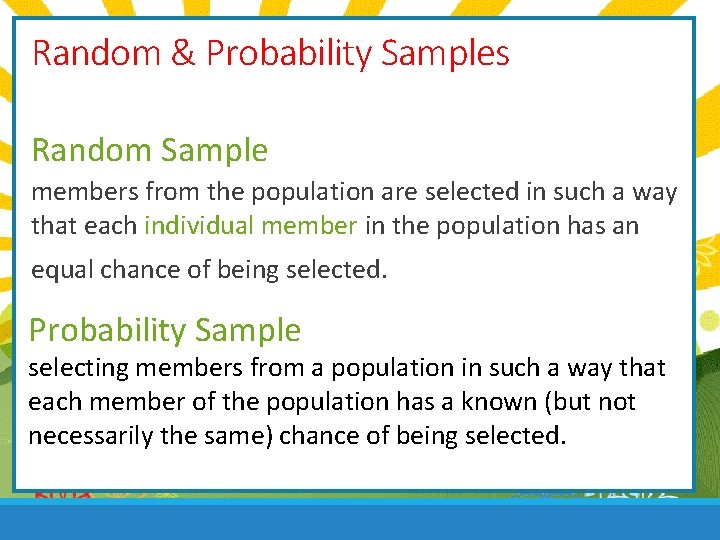
Random & Probability Samples Random Sample members from the population are selected in such a way that each individual member in the population has an equal chance of being selected. Probability Sample selecting members from a population in such a way that each member of the population has a known (but not necessarily the same) chance of being selected.
Example 3: Pharmacists typically fill prescriptions by scooping a sample of pills from a larger batch that is in stock. A pharmacist thoroughly mixes a large batch of Lipitor pills, then selects 30 of them. Random Sample: all pills have same chance of being chosen Simple Random Sample: all samples of size 30 have the same chance of being chosen
Example 4: In order to test for a gender gap at a large corporation, the CEO polls exactly 750 men and 750 women randomly selected from adults in the United States. (Assume that the numbers of adult men and adult women are the same. ) Random Sample: all adults have same chance of being chosen, assuming there is an equal # of each gender NOT a Simple Random Sample: not all sample sizes of 1500 are possible. For example, 900 men and 600 women would violate the 750 men and 750 women requirement.
Example 5: A classroom consists of 25 students seated in five different rows, with five students in each row. The instructor randomly determines a row, then randomly selects a student in the row. This process is repeated until a sample of 5 students is obtained. Random Sample: each student has same chance of being chosen Simple Random Sample: every sample size of 5 has the same chance of being chosen
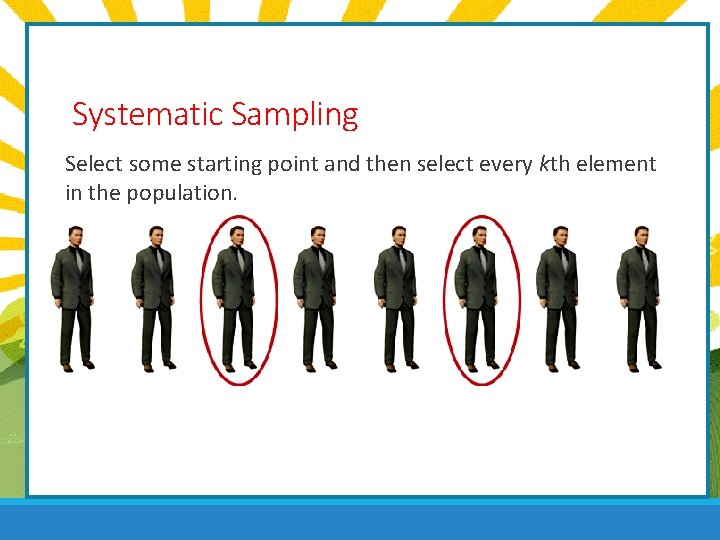
Systematic Sampling Select some starting point and then select every kth element in the population.
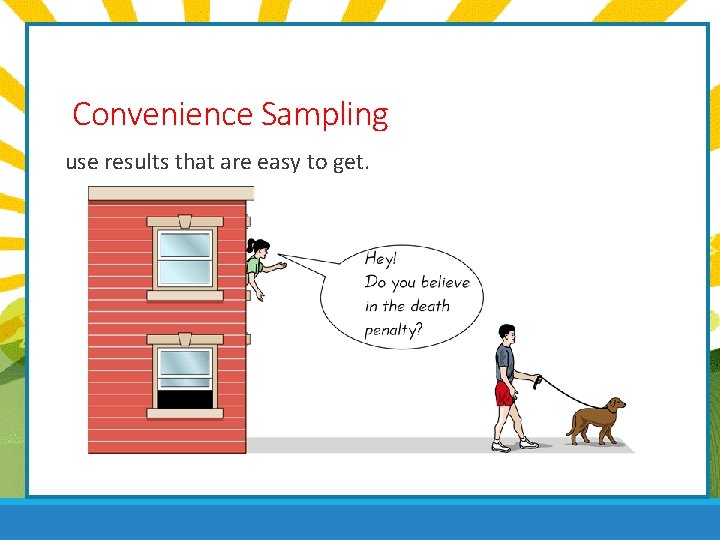
Convenience Sampling use results that are easy to get.
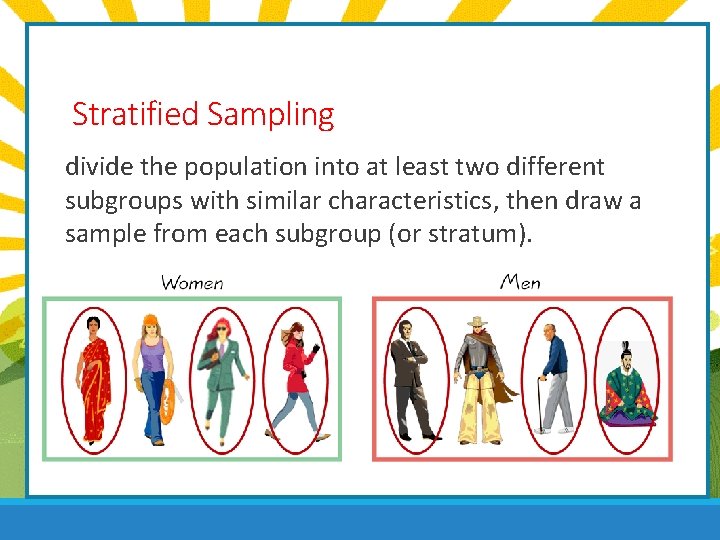
Stratified Sampling divide the population into at least two different subgroups with similar characteristics, then draw a sample from each subgroup (or stratum).
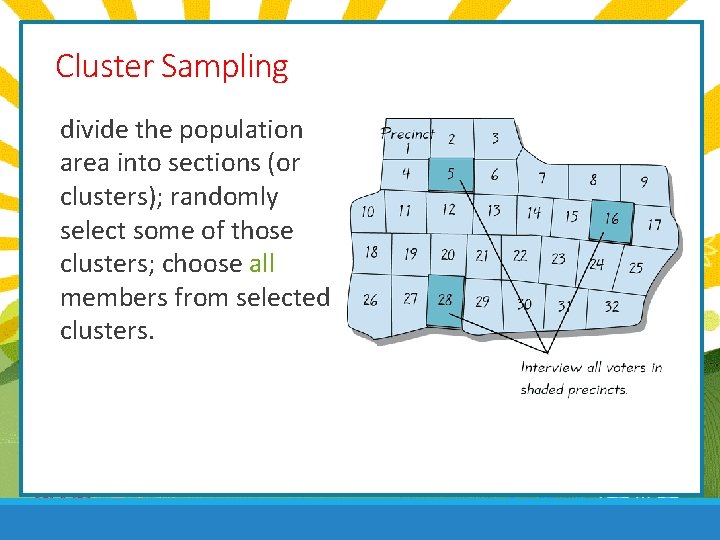
Cluster Sampling divide the population area into sections (or clusters); randomly select some of those clusters; choose all members from selected clusters.
Multistage Sampling Collect data by using some combination of the basic sampling methods. In a multistage sample design, pollsters select a sample in different stages, and each stage might use different methods of sampling.
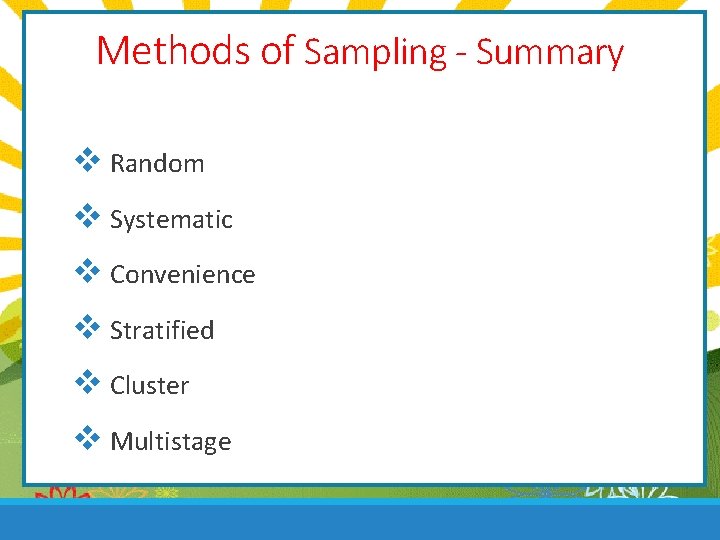
Methods of Sampling - Summary v Random v Systematic v Convenience v Stratified v Cluster v Multistage
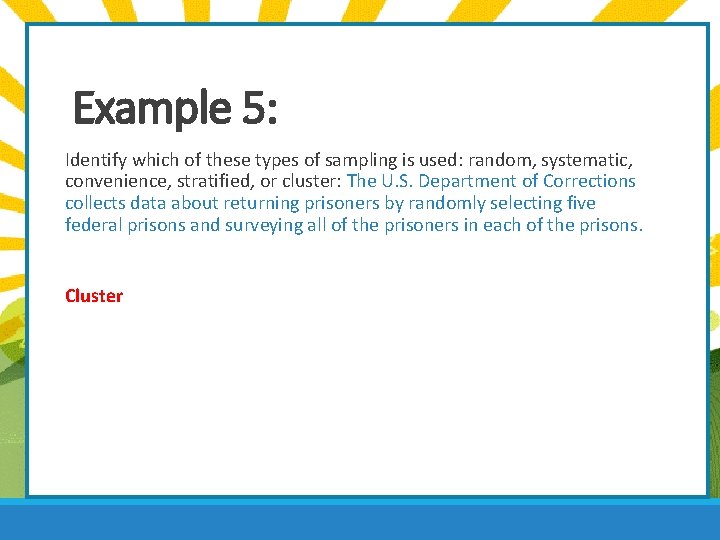
Example 5: Identify which of these types of sampling is used: random, systematic, convenience, stratified, or cluster: The U. S. Department of Corrections collects data about returning prisoners by randomly selecting five federal prisons and surveying all of the prisoners in each of the prisons. Cluster
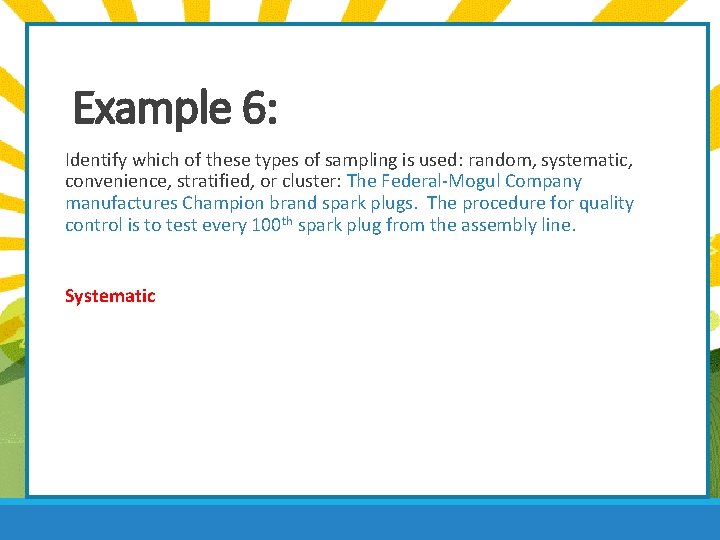
Example 6: Identify which of these types of sampling is used: random, systematic, convenience, stratified, or cluster: The Federal-Mogul Company manufactures Champion brand spark plugs. The procedure for quality control is to test every 100 th spark plug from the assembly line. Systematic
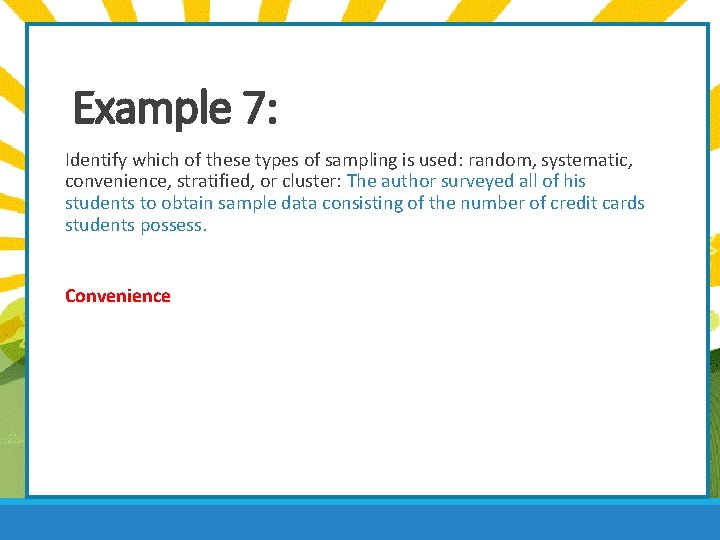
Example 7: Identify which of these types of sampling is used: random, systematic, convenience, stratified, or cluster: The author surveyed all of his students to obtain sample data consisting of the number of credit cards students possess. Convenience
Example 8: Identify which of these types of sampling is used: random, systematic, convenience, stratified, or cluster: The author once experienced a tax audit by a representative from the New York State Department of Taxation and Finance, which claimed that the author was randomly selected as part of a “statistical” audit. The representative was a very nice person and a credit to humankind. Random
Example 9: Identify which of these types of sampling is used: random, systematic, convenience, stratified, or cluster: In a study of college programs, 820 students are randomly selected from those majoring in communications, 1, 463 students are randomly chosen from those majoring in business, and 760 students are randomly selected from those majoring in history. Stratified
Types of Studies Cross sectional study: data are observed, measured, and collected at one point in time. Retrospective (or case control) study: data are collected from the past by going back in time (examine records, interviews, …). Prospective (or longitudinal or cohort) study: data are collected in the future from groups sharing common factors (called cohorts).
Example 10: Identify the type of observational study (cross-sectional, retrospective, prospective). The Nielsen Media Research Company uses people meters to record the viewing habits of about 5000 households, and today those meters will be used to determine the proportion of households tuned to CBS Evening News. Cross-sectional
Example 11: Identify the type of observational study (cross-sectional, retrospective, prospective). Physicians at the Mount Sinai Medical Center studied New York City residents with and without respiratory problems. They went back in time to determine how those residents were involved in the terrorist attacks in New York City on September 11, 2001. Retrospective
Example 12: Identify the type of observational study (cross-sectional, retrospective, prospective). Physicians at the Mount Sinai Medical Center plan to study emergency personnel who worked at the site of the terrorist attacks in New York City on September 11, 2001. They plan to study these workers from now until several years into the future. Prospective
Grey’s Anatomy Article
Randomization is used when subjects are assigned to different groups through a process of random selection. The logic is to use chance as a way to create two groups that are similar.
Replication is the repetition of an experiment on more than one subject. Use a sample size that is large enough to let us see the true nature of any effects, and obtain the sample using an appropriate method, such as one based on randomness.
Blinding is a technique in which the subject doesn’t know whether he or she is receiving a treatment or a placebo. **Blinding allows us to determine whether the treatment effect is significantly different from a placebo effect, which occurs when an untreated subject reports improvement in symptoms.
Double Blind Double-Blinding occurs at two levels: Neither the subject nor the experimenter know what they are receiving, treatment or placebo.
Example 13: A study funded by the National Center for Complementary and Alternative Medicine found that echinacea was not an effective treatment for colds in children. The experiment involved echinacea treatments and placebos, and blinding was used. Why was blinding important in this experiment? It is important to use blinding so that results are not distorted because of a placebo effect, where subjects may think that they experience improvements simply because they were treated.
Confounding when the experimenter is not able to distinguish between the effects of different factors. Try to plan the experiment so that confounding does not occur.
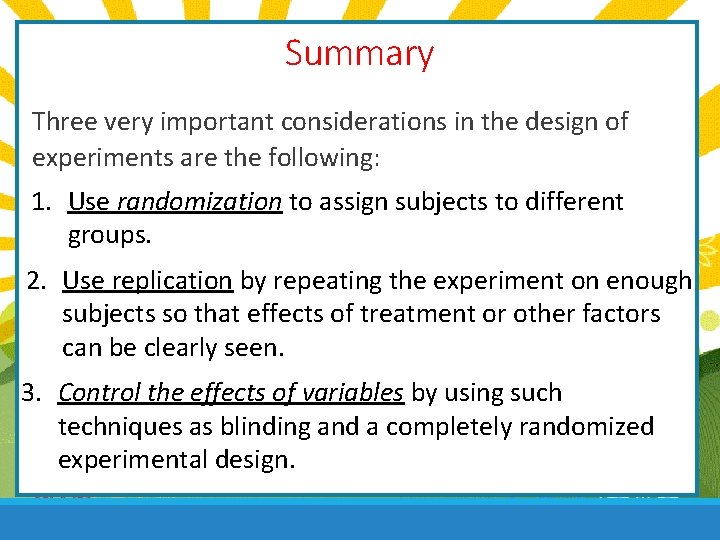
Summary Three very important considerations in the design of experiments are the following: 1. Use randomization to assign subjects to different groups. 2. Use replication by repeating the experiment on enough subjects so that effects of treatment or other factors can be clearly seen. 3. Control the effects of variables by using such techniques as blinding and a completely randomized experimental design.
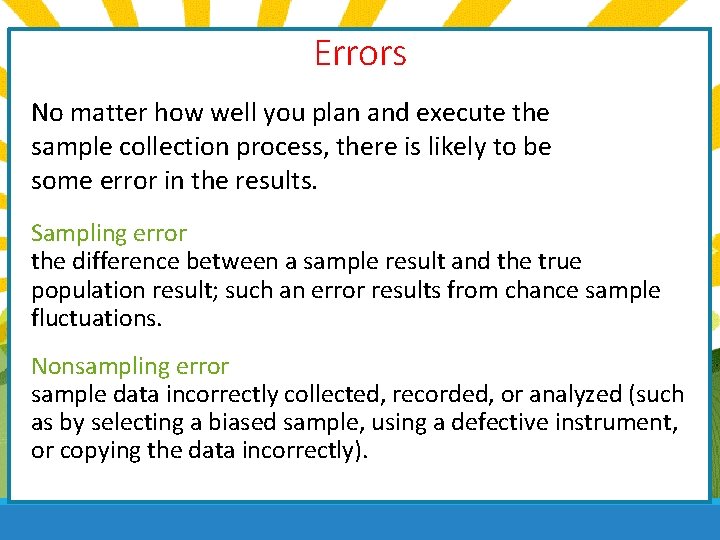
Errors No matter how well you plan and execute the sample collection process, there is likely to be some error in the results. Sampling error the difference between a sample result and the true population result; such an error results from chance sample fluctuations. Nonsampling error sample data incorrectly collected, recorded, or analyzed (such as by selecting a biased sample, using a defective instrument, or copying the data incorrectly).