
SECTION 1 4 SURFACE AREAS OF OTHER COMPOSITE
- Slides: 10
SECTION 1. 4 SURFACE AREAS OF OTHER COMPOSITE SOLIDS Copyright All Rights Reserved Homework Depot at www. BCMath. ca
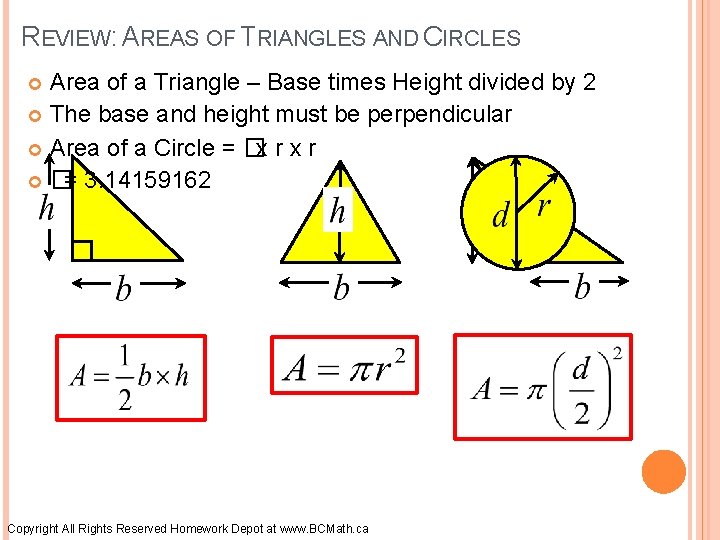
REVIEW: AREAS OF TRIANGLES AND CIRCLES Area of a Triangle – Base times Height divided by 2 The base and height must be perpendicular Area of a Circle = � xrxr � = 3. 14159162 Copyright All Rights Reserved Homework Depot at www. BCMath. ca
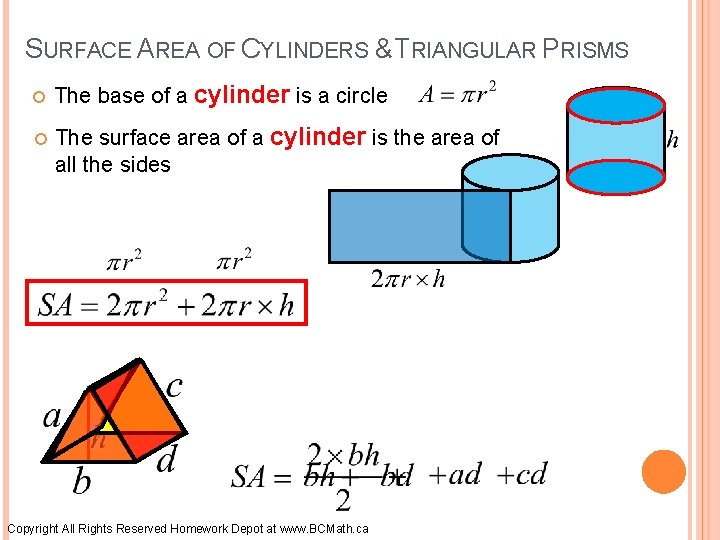
SURFACE AREA OF CYLINDERS & TRIANGULAR PRISMS The base of a cylinder is a circle The surface area of a cylinder is the area of all the sides Copyright All Rights Reserved Homework Depot at www. BCMath. ca
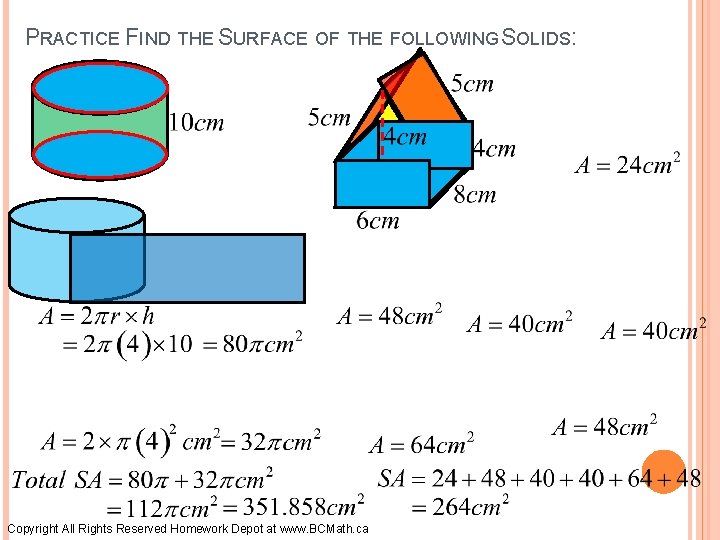
PRACTICE FIND THE SURFACE OF THE FOLLOWING SOLIDS: Copyright All Rights Reserved Homework Depot at www. BCMath. ca
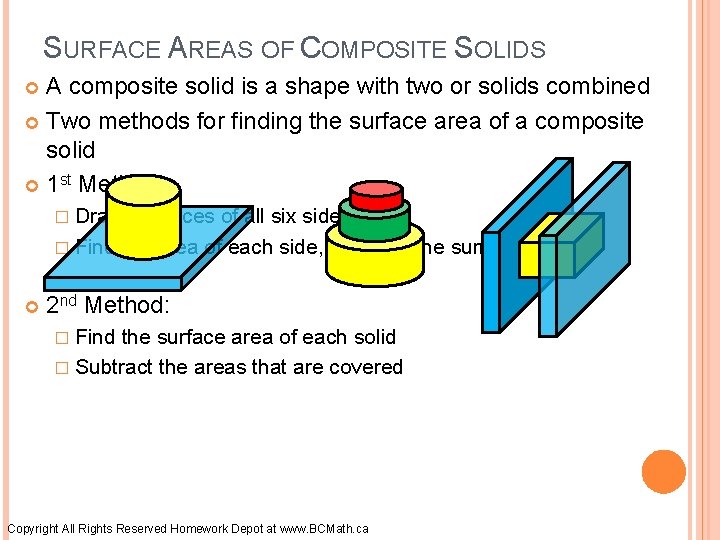
SURFACE AREAS OF COMPOSITE SOLIDS A composite solid is a shape with two or solids combined Two methods for finding the surface area of a composite solid 1 st Method: � Draw the faces of all six sides � Find the area of each side, then find the sum 2 nd Method: � Find the surface area of each solid � Subtract the areas that are covered Copyright All Rights Reserved Homework Depot at www. BCMath. ca
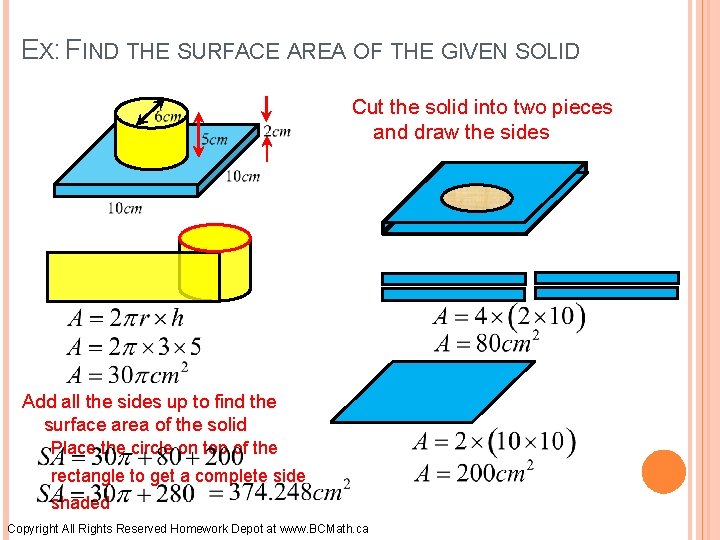
EX: FIND THE SURFACE AREA OF THE GIVEN SOLID Cut the solid into two pieces and draw the sides Add all the sides up to find the surface area of the solid Place the circle on top of the rectangle to get a complete side shaded Copyright All Rights Reserved Homework Depot at www. BCMath. ca
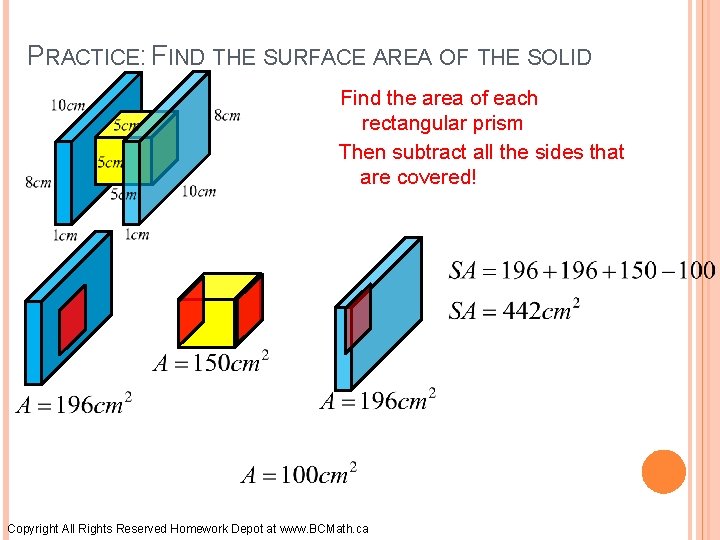
PRACTICE: FIND THE SURFACE AREA OF THE SOLID Find the area of each rectangular prism Then subtract all the sides that are covered! Copyright All Rights Reserved Homework Depot at www. BCMath. ca
HOMEWORK: P 40, 41 #3, 4, 5, 8, 9 Copyright All Rights Reserved Homework Depot at www. BCMath. ca
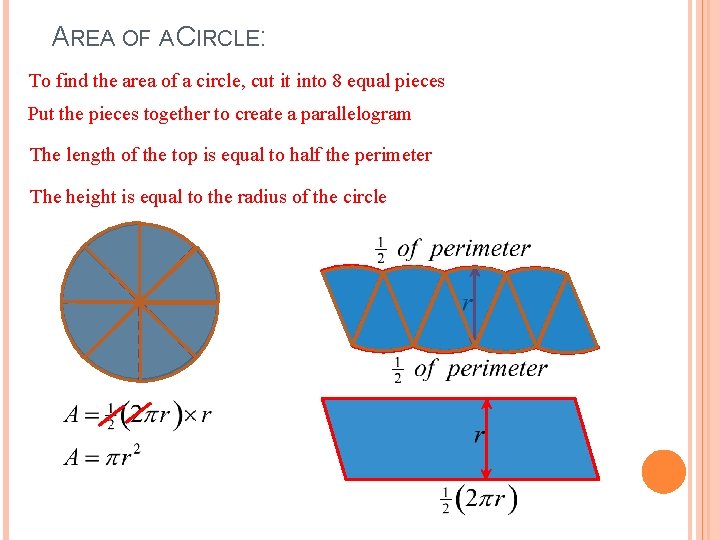
AREA OF A CIRCLE: To find the area of a circle, cut it into 8 equal pieces Put the pieces together to create a parallelogram The length of the top is equal to half the perimeter The height is equal to the radius of the circle
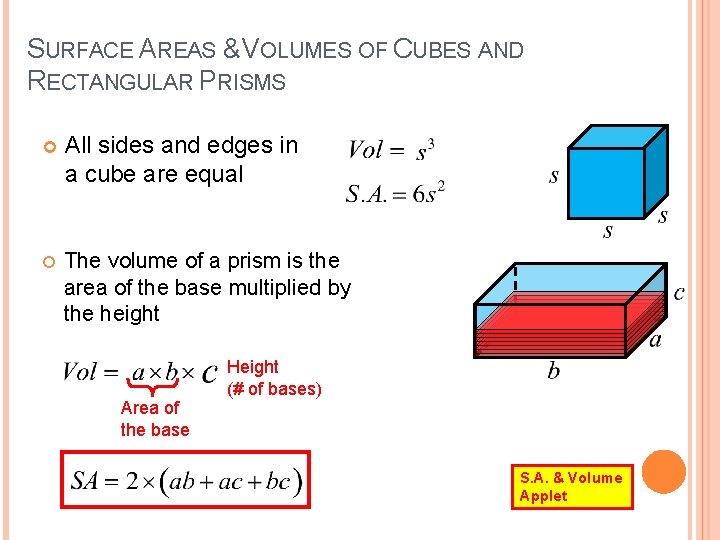
SURFACE AREAS & VOLUMES OF CUBES AND RECTANGULAR PRISMS All sides and edges in a cube are equal The volume of a prism is the area of the base multiplied by the height Area of the base Height (# of bases) S. A. & Volume Applet