
Section 1 3 Ordered Structures Tuples Have order


- Slides: 4
Section 1. 3 Ordered Structures Tuples: Have order and can have repetitions. For example, (6, 7, 6) is a 3 -tuple and ( ) is the empty tuple. We write (x 1, …, xn) = (y 1, …, yn) to mean xi = yi for 1 ≤ i ≤ n. Cartesian Product: A B = {(x, y) | x A and y B}. The definition extends to more than two sets. For example, A B C = {(x, y, z) | x A, y B, z C}. • Notation: A 0 = {( )}, A 1 = {(x) | x A}, and in general, An = {(x 1, …, xn) | xi A}. Quiz (1 minute). Does (A B) C = A (B C)? Lists: Are like tuples but there is no random access. For example, a, b, a, c is a list with 4 elements and is the empty list. • The operations on lists are head, tail, and cons. For example, head( a, b, a, c ) = a, tail( a, b, a, c ) = b, a, c , cons(a, b, a, c ) = a, b, a, c. • The set of lists whose elements are in A is denoted by lists(A). Quiz (1 minute). For L = a , b, c, d , find head(L) and tail(L). Strings: Are like lists, but are represented as juxtaposed elements from a given alphabet. For example, if A = {a, b}, then some strings over A are: a, b, aa, ab, ba, bb, aaa, bbb. • The empty string is denoted by L. • The concatenation of two strings is their juxtaposition. For example, the concatenation of ab and bab is abbab. • For any string s we have s. L = Ls = s. • If s is a string, sn denotes the concatenation of s with itself n times. Also s 0 = L. For 1 example, (ab)3 = ababab.
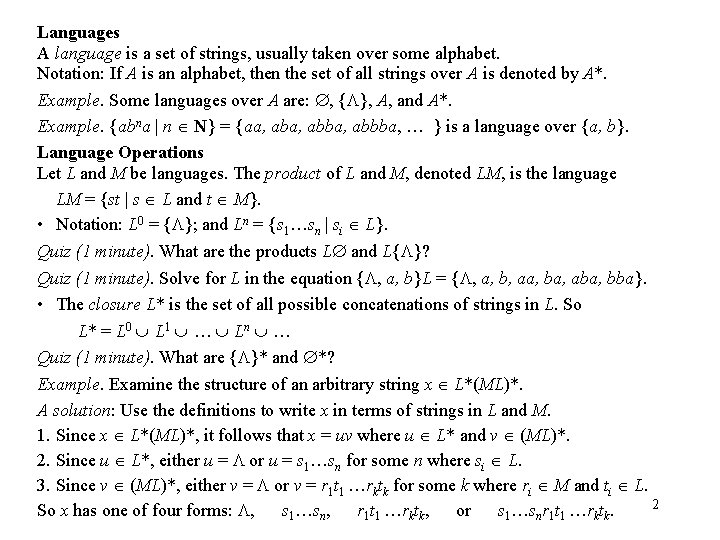
Languages A language is a set of strings, usually taken over some alphabet. Notation: If A is an alphabet, then the set of all strings over A is denoted by A*. Example. Some languages over A are: , {L}, A, and A*. Example. {abna | n N} = {aa, abba, abbba, … } is a language over {a, b}. Language Operations Let L and M be languages. The product of L and M, denoted LM, is the language LM = {st | s L and t M}. • Notation: L 0 = {L}; and Ln = {s 1…sn | si L}. Quiz (1 minute). What are the products L and L{L}? Quiz (1 minute). Solve for L in the equation {L, a, b}L = {L, a, b, aa, ba, aba, bba}. • The closure L* is the set of all possible concatenations of strings in L. So L* = L 0 L 1 … Ln … Quiz (1 minute). What are {L}* and *? Example. Examine the structure of an arbitrary string x L*(ML)*. A solution: Use the definitions to write x in terms of strings in L and M. 1. Since x L*(ML)*, it follows that x = uv where u L* and v (ML)*. 2. Since u L*, either u = L or u = s 1…sn for some n where si L. 3. Since v (ML)*, either v = L or v = r 1 t 1 …rktk for some k where ri M and ti L. 2 So x has one of four forms: L, s 1…sn, r 1 t 1 …rktk, or s 1…snr 1 t 1 …rktk.
Relations. A relation is a set of tuples. If R is a relation and (x 1, …, xn) R, we write R(x 1, …, xn). We can usually represent a relation as a subset of some cartesian product. Example. Let R = {(0, 0), (1, 1), (4, 2), (9, 3), …, (n 2, n), …} = {(n 2, n) | n N}. We might call R the “is square of” relation on N. Notice also that R N N. Notation: If R is binary, we can use infix to represent pairs in R. For example, from the previous example, we have (9, 3) R. So we can also write R(9, 3) or 9 R 3 or 9 is square of 3. Relational Databases A relational database is a relation where the indexes of a tuple have associated names called attributes. Example. Let Students = {(x, y, z) | x is a Name, y is a Major, and z is Credits}. Who are the people majoring in CS? {x | (x, CS, z) Students, for some z}. Note: We need “for some z” to indicate that z is a variable. How many math majors are upper division students? | {x | (x, math, z) Students and z ≥ 90} |. What is the major of Abe. Lincoln? {y | (Abe. Lincoln, y, z) Students, for some z}. What is the history department database of names and their credits? 3 {(x, z) | (x, history, z) Students}.
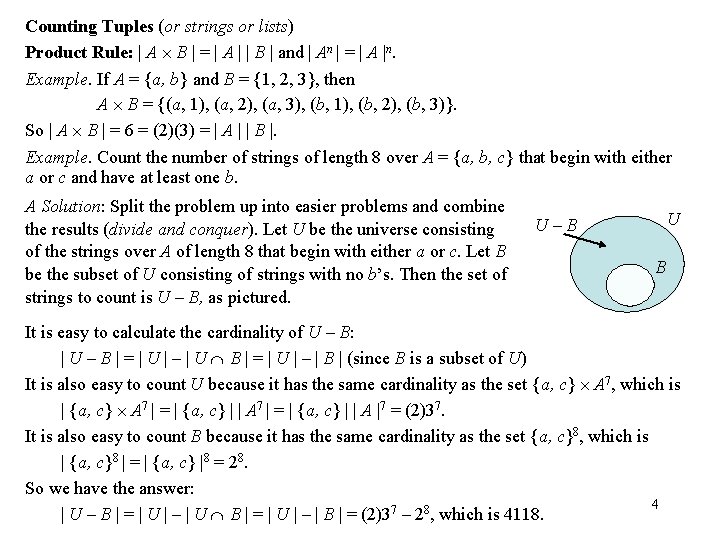
Counting Tuples (or strings or lists) Product Rule: | A B | = | A | | B | and | An | = | A |n. Example. If A = {a, b} and B = {1, 2, 3}, then A B = {(a, 1), (a, 2), (a, 3), (b, 1), (b, 2), (b, 3)}. So | A B | = 6 = (2)(3) = | A | | B |. Example. Count the number of strings of length 8 over A = {a, b, c} that begin with either a or c and have at least one b. A Solution: Split the problem up into easier problems and combine the results (divide and conquer). Let U be the universe consisting of the strings over A of length 8 that begin with either a or c. Let B be the subset of U consisting of strings with no b’s. Then the set of strings to count is U – B, as pictured. U U–B B It is easy to calculate the cardinality of U – B: | U – B | = | U | – | U B | = | U | – | B | (since B is a subset of U) It is also easy to count U because it has the same cardinality as the set {a, c} A 7, which is | {a, c} A 7 | = | {a, c} | | A |7 = (2)37. It is also easy to count B because it has the same cardinality as the set {a, c}8, which is | {a, c}8 | = | {a, c} |8 = 28. So we have the answer: 4 | U – B | = | U | – | U B | = | U | – | B | = (2)37 – 28, which is 4118.