
Section 1 3 Electrical Safety Short Circuit an


- Slides: 7
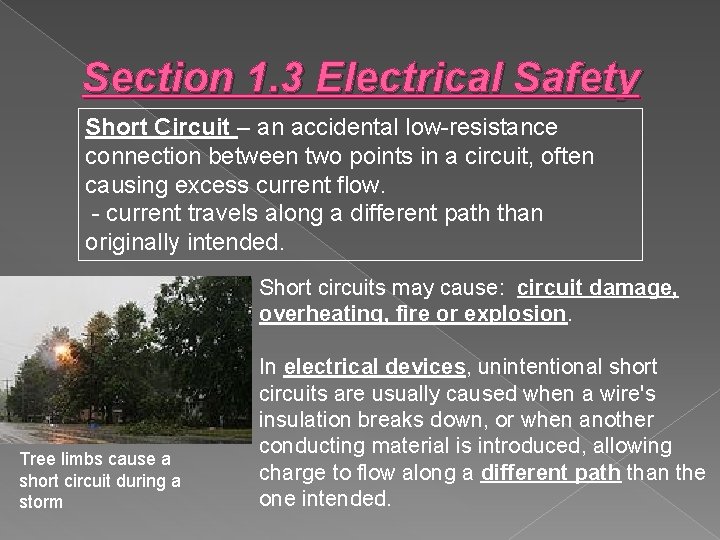
Section 1. 3 Electrical Safety Short Circuit – an accidental low-resistance connection between two points in a circuit, often causing excess current flow. - current travels along a different path than originally intended. Short circuits may cause: circuit damage, overheating, fire or explosion. Tree limbs cause a short circuit during a storm In electrical devices, unintentional short circuits are usually caused when a wire's insulation breaks down, or when another conducting material is introduced, allowing charge to flow along a different path than the one intended.
Electrical Shock � When wondering how dangerous a current flowing through your body may be, you have to consider 2 aspects of electricity: › Voltage › Amperage High voltage is more dangerous than low voltage � Number of Amps is more important when assess for potential danger. Too much electricity flowing through a persons body can cause burns, damage to the heart, and can be fatal. Current as low as 0. 1 A can be fatal. �
Electrical Shock Con’t The danger of electrical shock varies, depending on the situation. Insulator – current does not flow through easily. Such as wood, rubber, and air • Every plug-in device sold in Canada must have a label listing what voltage it requires and the maximum current it uses. • Why would the Canadian government make this a regulation? _______________________ ___ • The Amp rating does not have to be high for you to get a shock. If there is a short circuit, or if the insulation is damaged, you can get a shock before the electricity goes
Electrical Safety pointers See page 285 Read together
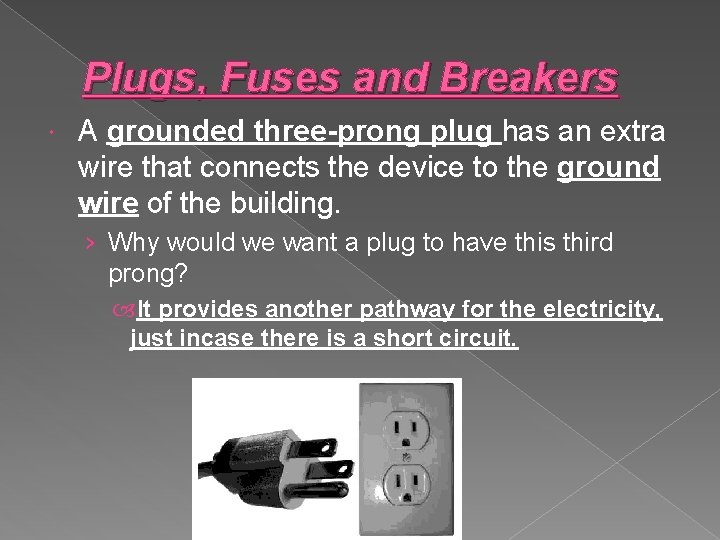
Plugs, Fuses and Breakers A grounded three-prong plug has an extra wire that connects the device to the ground wire of the building. › Why would we want a plug to have this third prong? It provides another pathway for the electricity, just incase there is a short circuit.
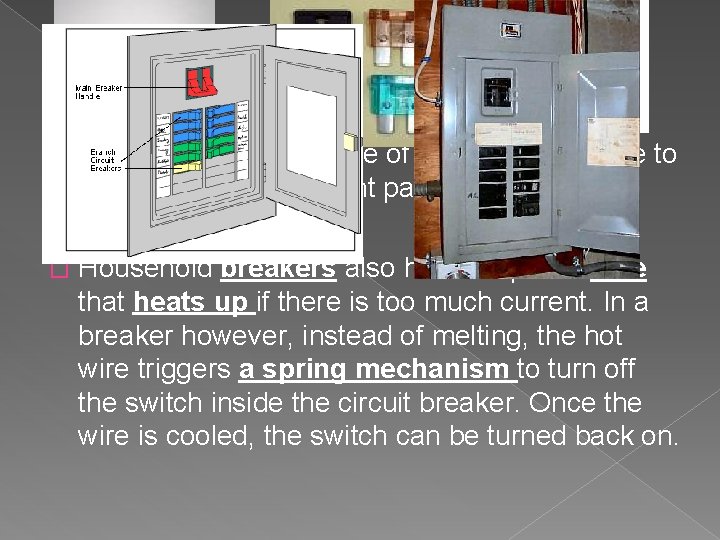
� Fuses and circuit breakers interrupt a circuit when too much current is flowing through it. � Fuses have a thin piece of metal that is made to melt if too much current passing through it. � Household breakers also have a special wire that heats up if there is too much current. In a breaker however, instead of melting, the hot wire triggers a spring mechanism to turn off the switch inside the circuit breaker. Once the wire is cooled, the switch can be turned back on.
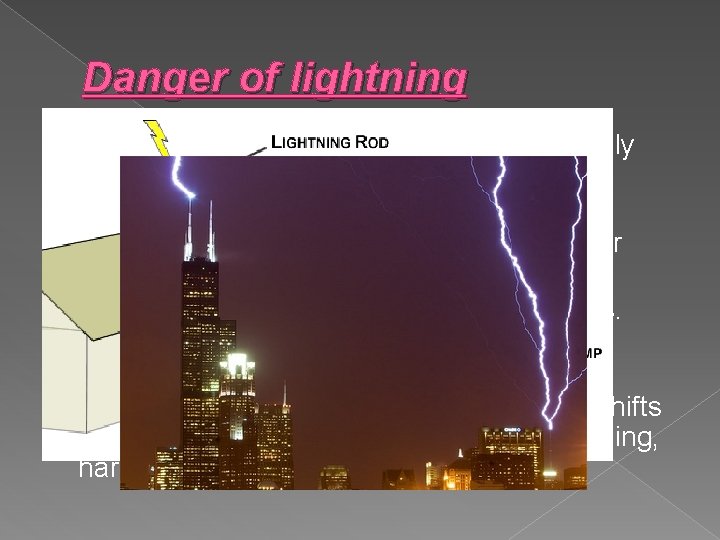
Danger of lightning Lightning can strike up to 30 000 A, definitely enough to kill a person. � You can survive if: the full current travels through only part or over the surface of your body. � Tall buildings are a natural target for strikes. Why? � Therefore they have lightning rods that are connected to the ground with a wire. This shifts the electrical discharge away from the building, harmlessly to the ground. �