
Section 1 2 Bacteria are singlecelled organisms without
Section 1. 2 Bacteria are single-celled organisms without nuclei • 1. Bacteria and archaea are the smallest living things. • Archaea and bacteria are both single-celled with no nuclei but are different chemically.
Bacteria – Bacteria are the simplest kind of life. – roles of bacteria • Producers: bacteria that transform energy from sunlight into energy that be used by cells. They are a food source for organisms that cannot make their own food. • Decomposers: get energy by breaking down materials in dead or decaying organisms. • Parasites: organisms that harm their hosts. – Draw a picture of bacteria using the picture on page 17 – Look at three bacteria on page 19
There are three kinds of bacteria • Spiral-shaped bacteria occur in single strands • Rod-Shaped bacteria may occur singly or in chains • Round-shaped bacteria may occur singly or in pairs, chains or clusters • Pictures on page 17
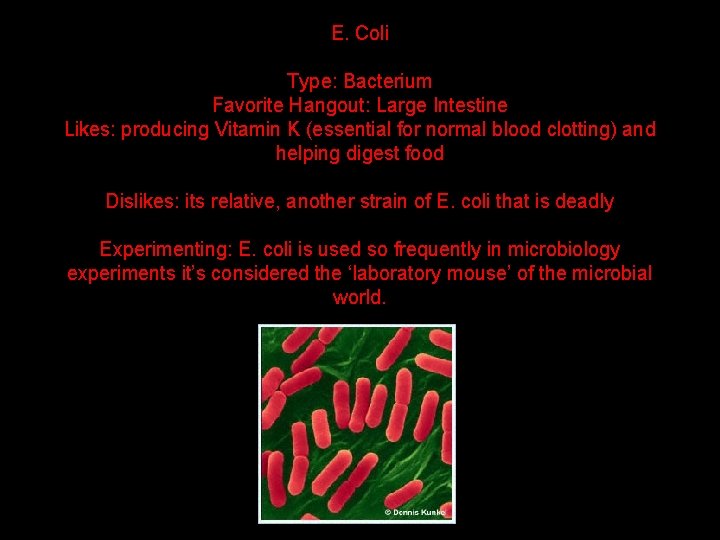
E. Coli Type: Bacterium Favorite Hangout: Large Intestine Likes: producing Vitamin K (essential for normal blood clotting) and helping digest food Dislikes: its relative, another strain of E. coli that is deadly Experimenting: E. coli is used so frequently in microbiology experiments it’s considered the ‘laboratory mouse’ of the microbial world.
Archaea • scientists often group Archaea according to where they live… • Methanogens: produce natural gas. Live in dense swamps, in guts of animals • Halophiles live in very salty lakes and ponds. Live only with water but can survive drying and begin dividing again as soon as water is back • Thermophiles live in extreme heat or cold. Can live near hot vents deep in the sea, or buried meters below ice
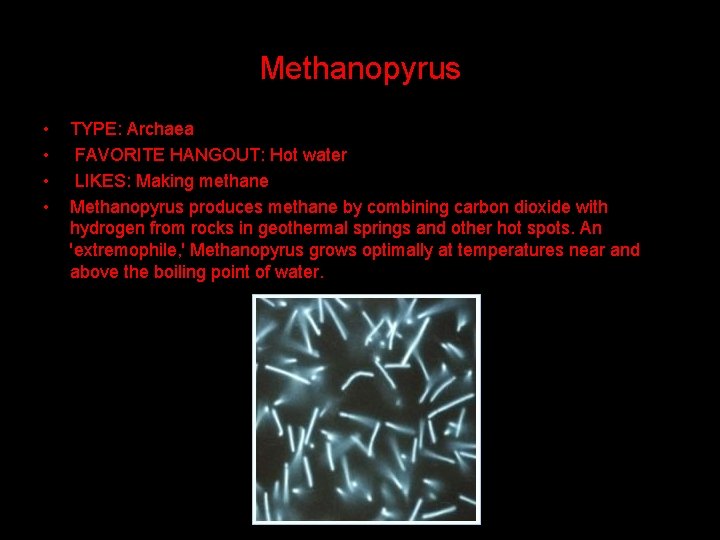
Methanopyrus • • TYPE: Archaea FAVORITE HANGOUT: Hot water LIKES: Making methane Methanopyrus produces methane by combining carbon dioxide with hydrogen from rocks in geothermal springs and other hot spots. An 'extremophile, ' Methanopyrus grows optimally at temperatures near and above the boiling point of water.
Charmed, I? m Sure. Between the 1200 s and 1700 s, the bubonic plague regularly struck the cities of Europe and killed an estimated 20 percent of the population. Because no one knew what caused the plague? or more importantly, how to prevent or cure it? people relied on potions and magic charms. Pretend a mysterious illness has hit your school. Decide what its symptoms are, and give it a name. Then, keeping the disease? s symptoms in mind, design a magic charm that people can wear for protection.
- Slides: 7