
Section 1 1 What Is Health Health Education
- Slides: 61
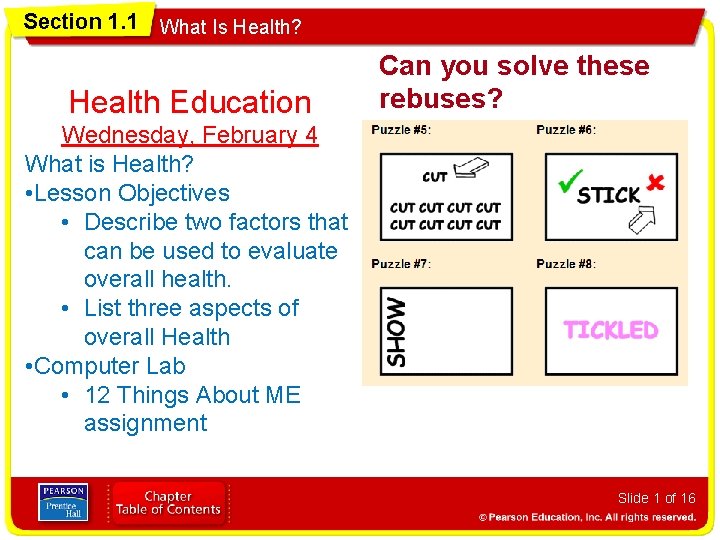
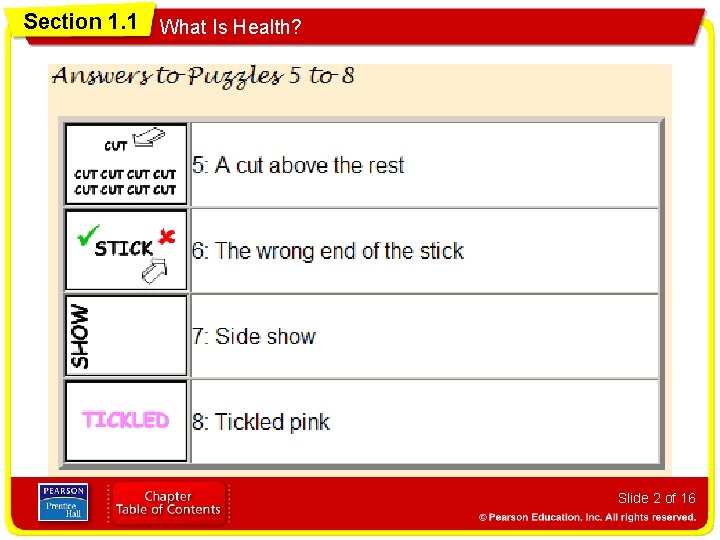
Section 1. 1 What Is Health? Health Education Can you solve these rebuses? Wednesday, February 4 What is Health? • Lesson Objectives • Describe two factors that can be used to evaluate overall health. • List three aspects of overall Health • Computer Lab • 12 Things About ME assignment Slide 1 of 16
Section 1. 1 What Is Health? Slide 2 of 16
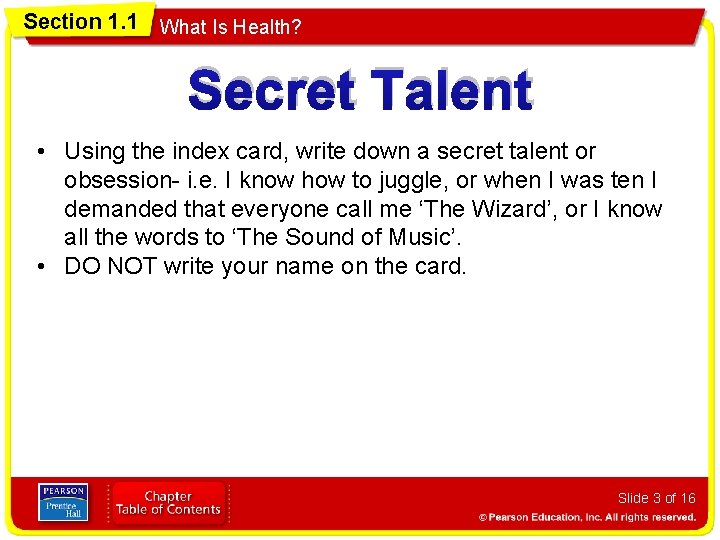
Section 1. 1 What Is Health? Secret Talent • Using the index card, write down a secret talent or obsession- i. e. I know how to juggle, or when I was ten I demanded that everyone call me ‘The Wizard’, or I know all the words to ‘The Sound of Music’. • DO NOT write your name on the card. Slide 3 of 16
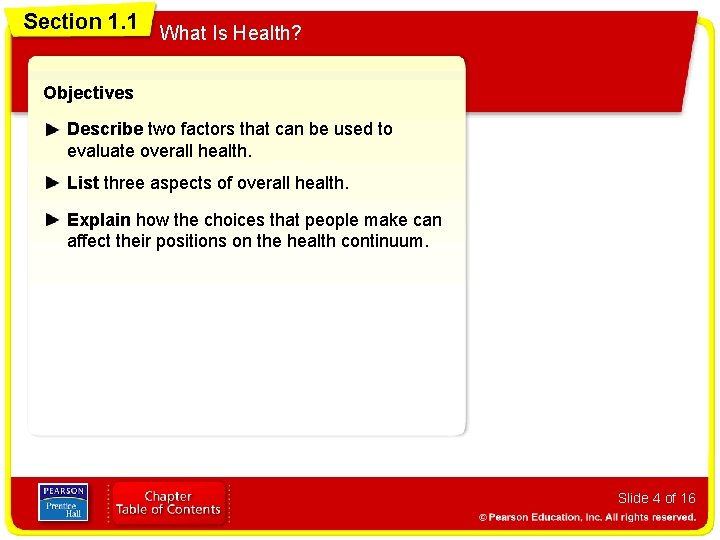
Section 1. 1 What Is Health? Objectives Describe two factors that can be used to evaluate overall health. List three aspects of overall health. Explain how the choices that people make can affect their positions on the health continuum. Slide 4 of 16
Section 1. 1 What Is Health? What is your definition of Health? Use your whiteboard to write your responses. • As a group, come up with a definition of “Health. ” • How has the term “Health” changed over the past 50 years? Slide 5 of 16
Section 1. 1 What Is Health? What is Health? Student Perspectives http: //safeshare. tv/w/HXs. UJFLRzd What is Health? Global Perspectives http: //safeshare. tv/w/Qq. Vww. Buion • At your table, discuss the similarities and differences between the two perspectives on “What is Health” • Write 2 similarities and 2 differences between the two videos. Slide 6 of 16
Section 1. 1 What Is Health? Life Expectancy & Quality of Life • As a group, come up with your definition of “Life Expectancy” and “Quality of Life” • Write your definitions on your whiteboard Slide 7 of 16
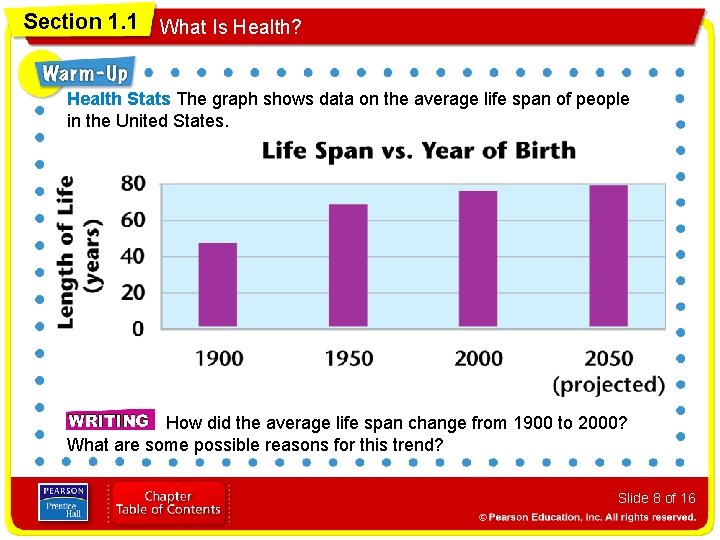
Section 1. 1 What Is Health? Health Stats The graph shows data on the average life span of people in the United States. How did the average life span change from 1900 to 2000? What are some possible reasons for this trend? Slide 8 of 16
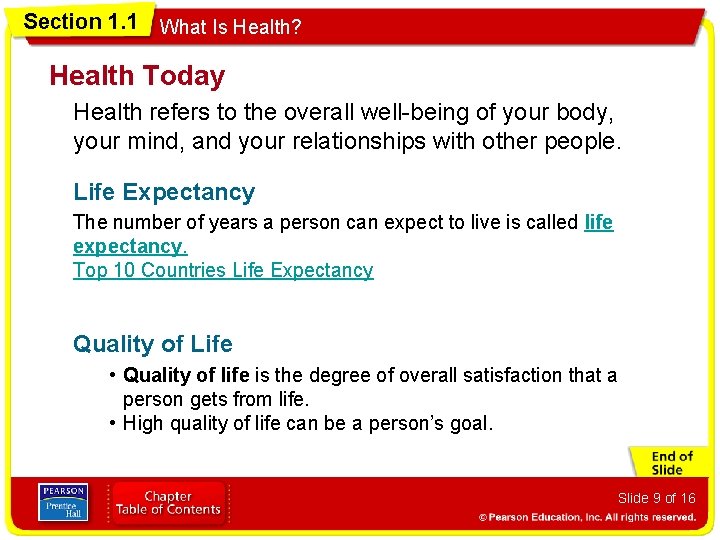
Section 1. 1 What Is Health? Health Today Health refers to the overall well-being of your body, your mind, and your relationships with other people. Life Expectancy The number of years a person can expect to live is called life expectancy. Top 10 Countries Life Expectancy Quality of Life • Quality of life is the degree of overall satisfaction that a person gets from life. • High quality of life can be a person’s goal. Slide 9 of 16
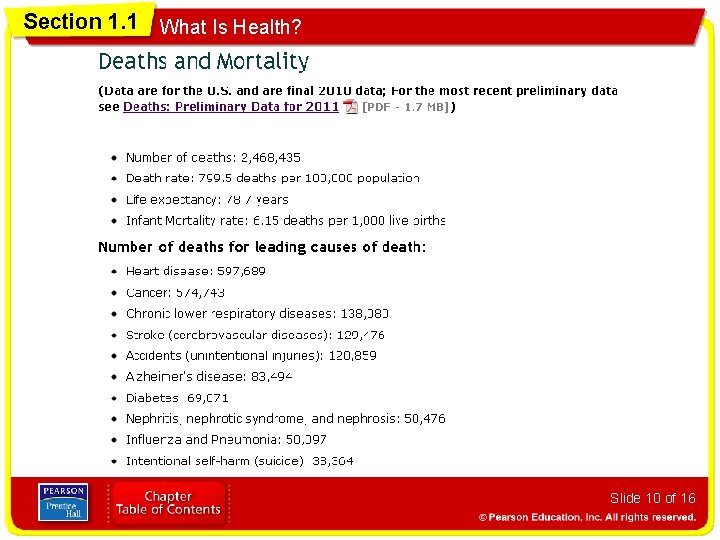
Section 1. 1 What Is Health? Slide 10 of 16
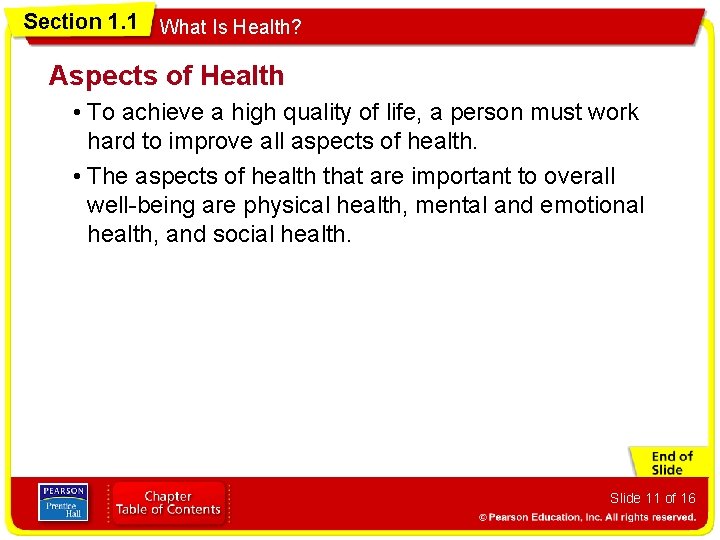
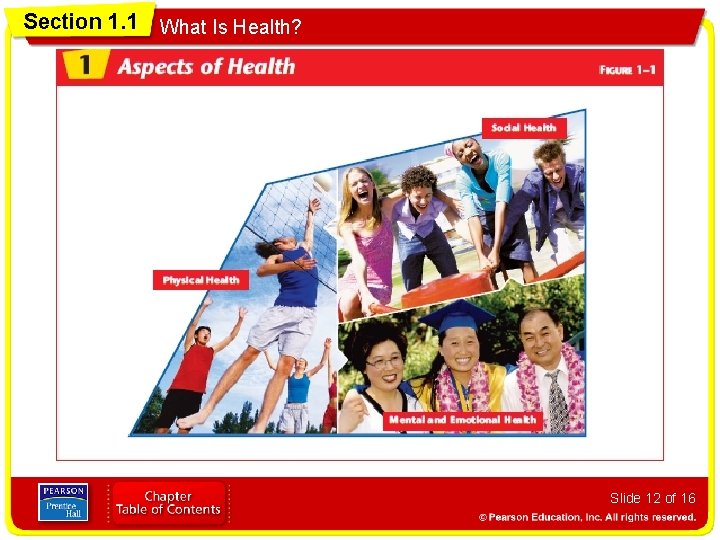
Section 1. 1 What Is Health? Aspects of Health • To achieve a high quality of life, a person must work hard to improve all aspects of health. • The aspects of health that are important to overall well-being are physical health, mental and emotional health, and social health. Slide 11 of 16
Section 1. 1 What Is Health? Slide 12 of 16
Section 1. 1 What Is Health? 12 Things About Me Presentations Assignment You will be using pictures and phrases to create a presentation that represents your personality and life (who you are/what you represent, likes/dislikes, your future goals, your passions, etc. ). This activity will allow you to reflect on your life as well as introduce yourself to your classmates and teacher. You can use Prezi, Power. Point or Google Slides to create your presentation. Your finished product should be saved to the S: drive. Slide 13 of 16
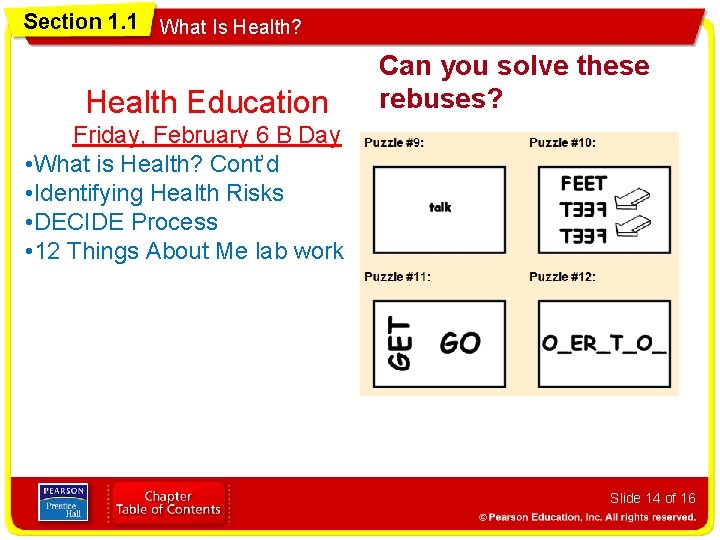
Section 1. 1 What Is Health? Health Education Can you solve these rebuses? Friday, February 6 B Day • What is Health? Cont’d • Identifying Health Risks • DECIDE Process • 12 Things About Me lab work Slide 14 of 16
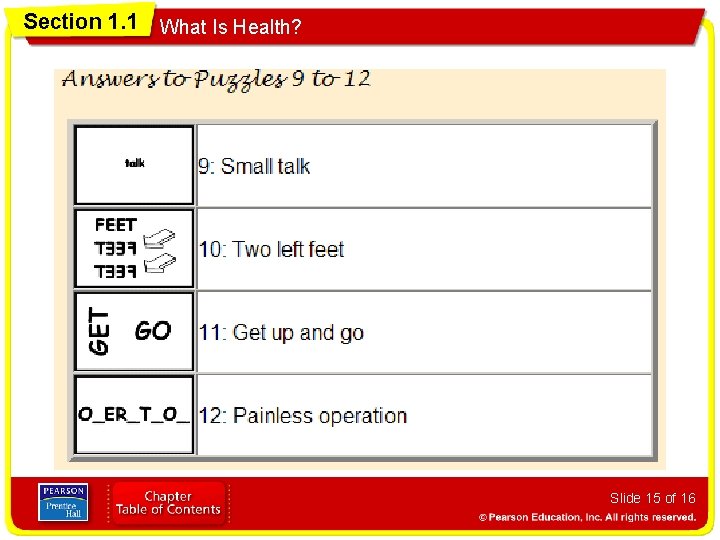
Section 1. 1 What Is Health? Slide 15 of 16
Section 1. 1 What Is Health? Secret Talent • You will receive an index card with a student talent written on the card. • Your task is to find the person in the class who wrote the talent. • Once you find the person who the talent belongs to, stand with that person. • Each person will be responsible for introducing the match to their index card by telling the class their name and the talent they have. Slide 16 of 16
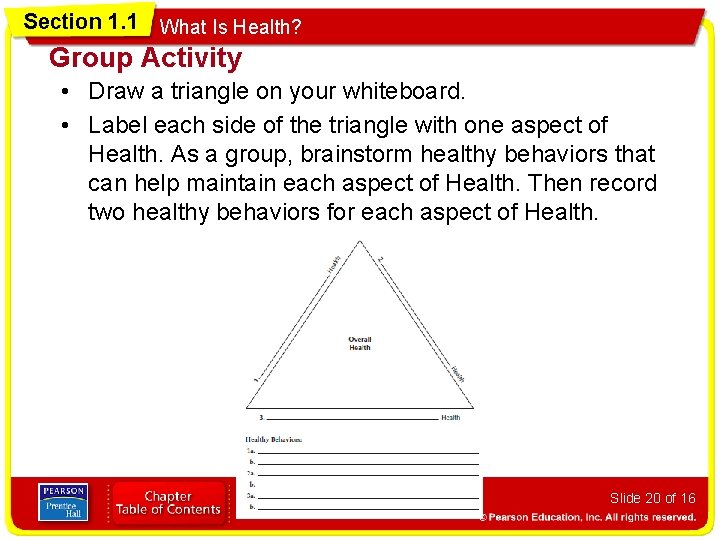
Section 1. 1 What Is Health? Group Activity • Draw a triangle on your whiteboard. • Label each side of the triangle with one aspect of Health. As a group, brainstorm healthy behaviors that can help maintain each aspect of Health. Then record two healthy behaviors for each aspect of Health. Slide 20 of 16
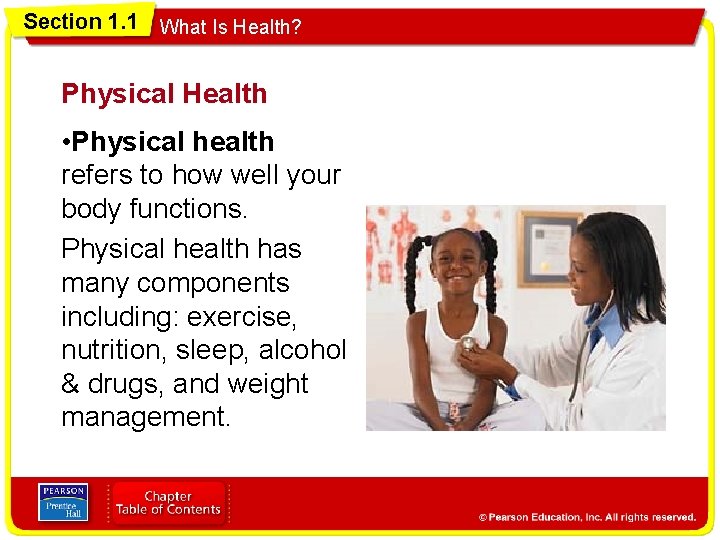
Section 1. 1 What Is Health? Physical Health • Physical health refers to how well your body functions. Physical health has many components including: exercise, nutrition, sleep, alcohol & drugs, and weight management.
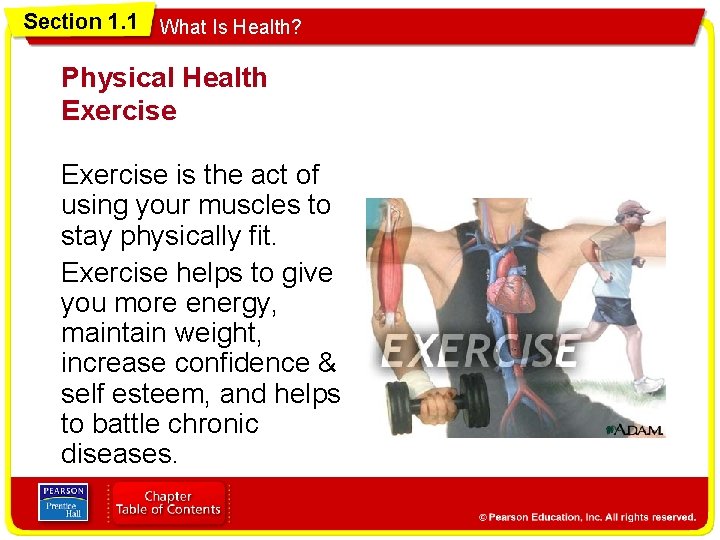
Section 1. 1 What Is Health? Physical Health Exercise is the act of using your muscles to stay physically fit. Exercise helps to give you more energy, maintain weight, increase confidence & self esteem, and helps to battle chronic diseases.
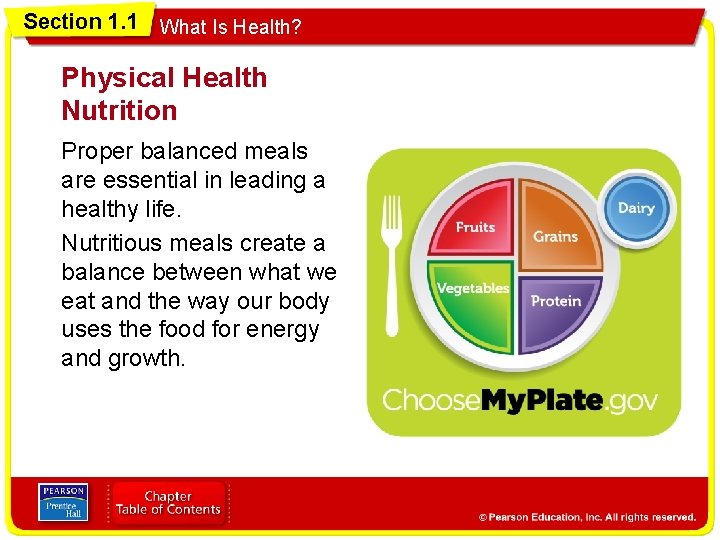
Section 1. 1 What Is Health? Physical Health Nutrition Proper balanced meals are essential in leading a healthy life. Nutritious meals create a balance between what we eat and the way our body uses the food for energy and growth.
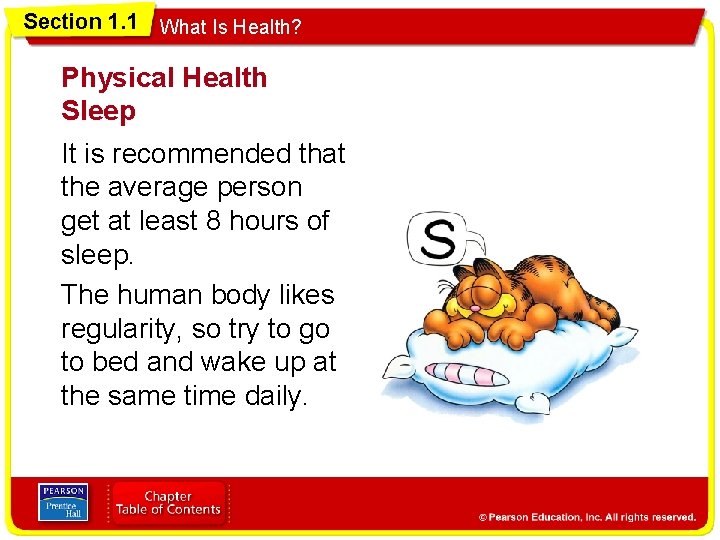
Section 1. 1 What Is Health? Physical Health Sleep It is recommended that the average person get at least 8 hours of sleep. The human body likes regularity, so try to go to bed and wake up at the same time daily.
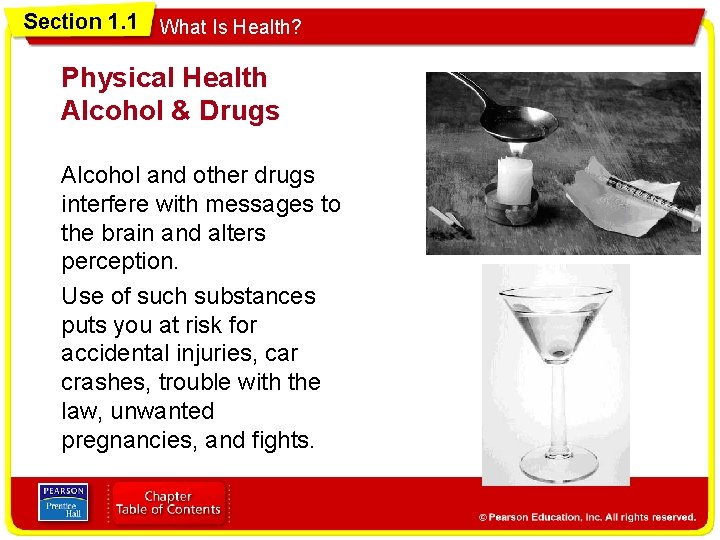
Section 1. 1 What Is Health? Physical Health Alcohol & Drugs Alcohol and other drugs interfere with messages to the brain and alters perception. Use of such substances puts you at risk for accidental injuries, car crashes, trouble with the law, unwanted pregnancies, and fights.
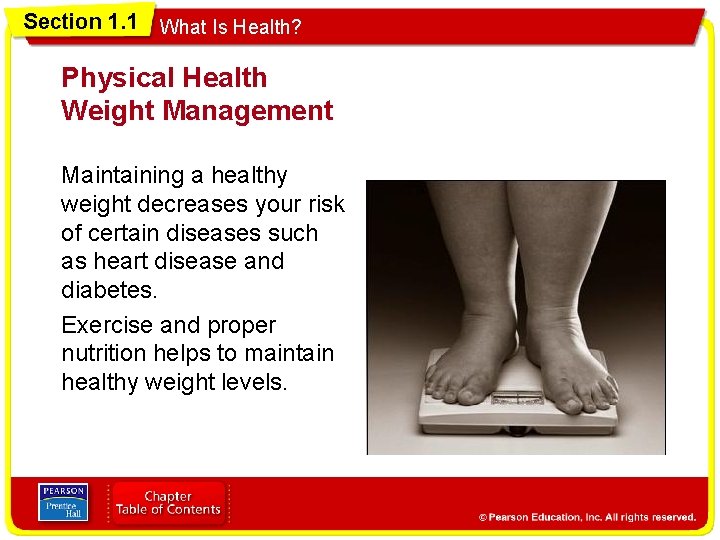
Section 1. 1 What Is Health? Physical Health Weight Management Maintaining a healthy weight decreases your risk of certain diseases such as heart disease and diabetes. Exercise and proper nutrition helps to maintain healthy weight levels.
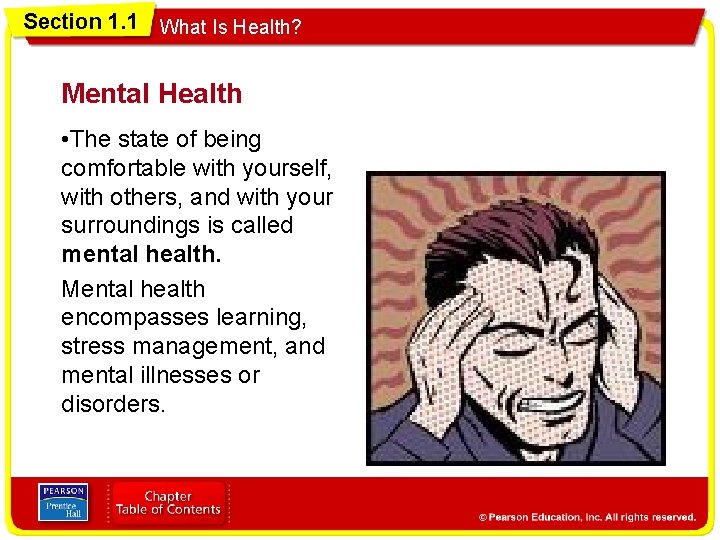
Section 1. 1 What Is Health? Mental Health • The state of being comfortable with yourself, with others, and with your surroundings is called mental health. Mental health encompasses learning, stress management, and mental illnesses or disorders.
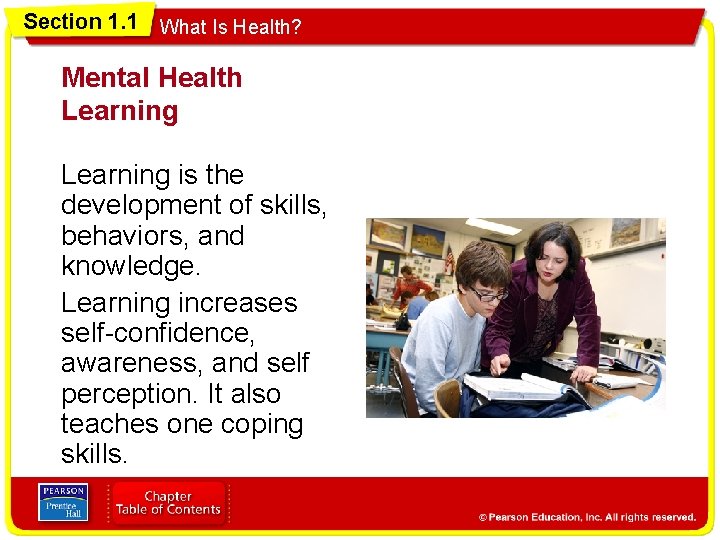
Section 1. 1 What Is Health? Mental Health Learning is the development of skills, behaviors, and knowledge. Learning increases self-confidence, awareness, and self perception. It also teaches one coping skills.
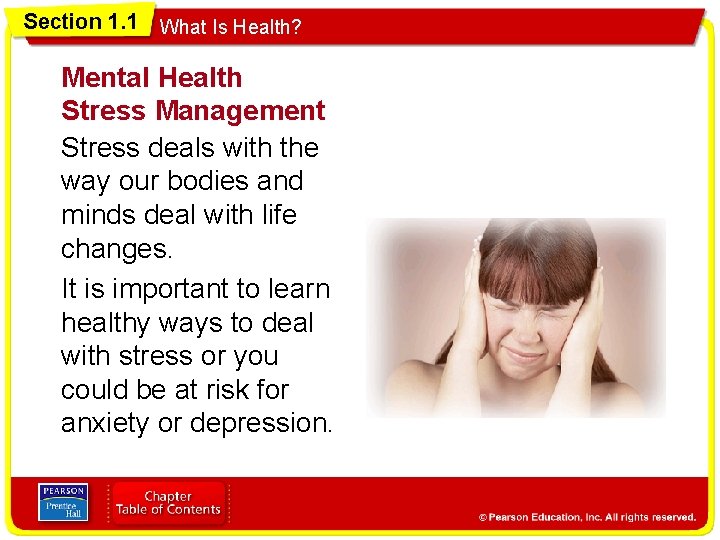
Section 1. 1 What Is Health? Mental Health Stress Management Stress deals with the way our bodies and minds deal with life changes. It is important to learn healthy ways to deal with stress or you could be at risk for anxiety or depression.
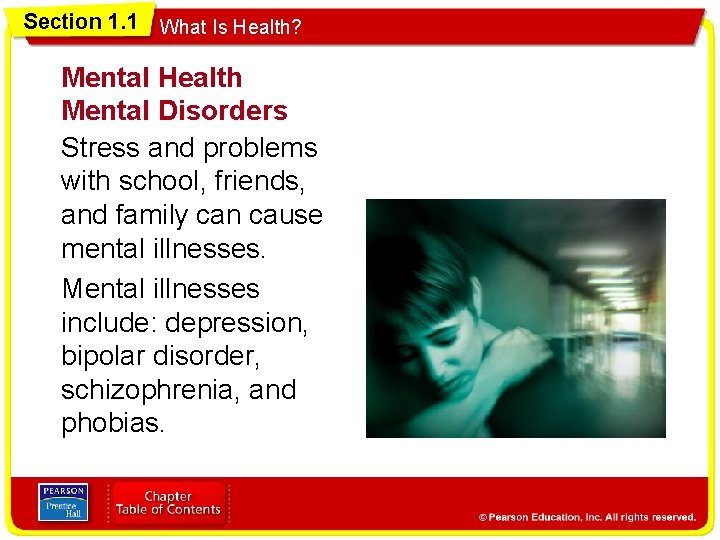
Section 1. 1 What Is Health? Mental Health Mental Disorders Stress and problems with school, friends, and family can cause mental illnesses. Mental illnesses include: depression, bipolar disorder, schizophrenia, and phobias.
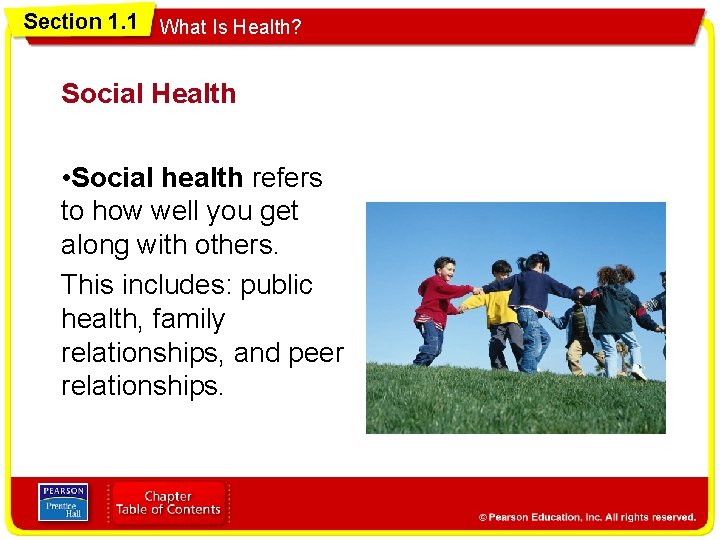
Section 1. 1 What Is Health? Social Health • Social health refers to how well you get along with others. This includes: public health, family relationships, and peer relationships.
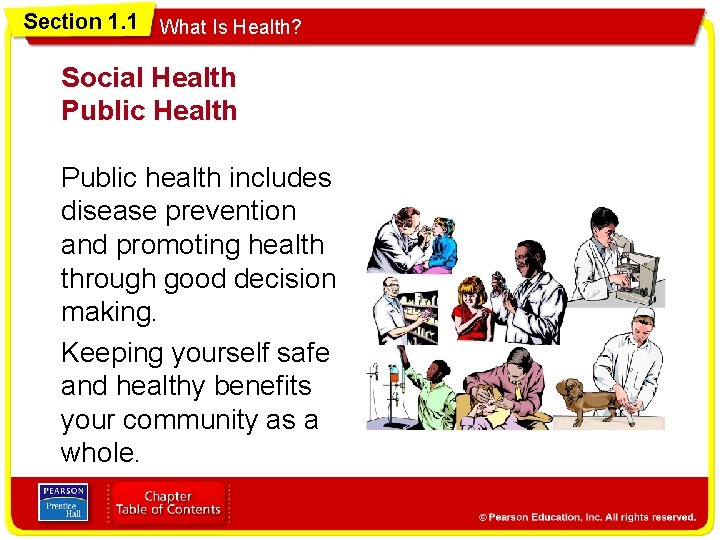
Section 1. 1 What Is Health? Social Health Public health includes disease prevention and promoting health through good decision making. Keeping yourself safe and healthy benefits your community as a whole.
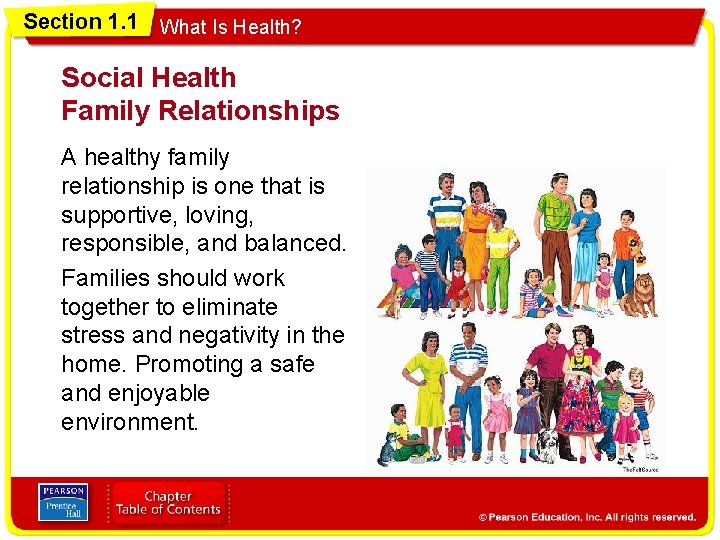
Section 1. 1 What Is Health? Social Health Family Relationships A healthy family relationship is one that is supportive, loving, responsible, and balanced. Families should work together to eliminate stress and negativity in the home. Promoting a safe and enjoyable environment.
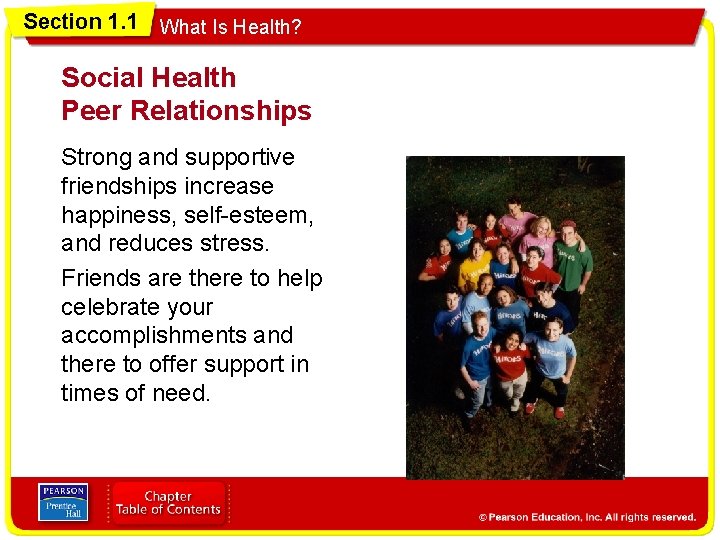
Section 1. 1 What Is Health? Social Health Peer Relationships Strong and supportive friendships increase happiness, self-esteem, and reduces stress. Friends are there to help celebrate your accomplishments and there to offer support in times of need.
Section 1. 1 What Is Health? Emotional Health • Emotional health refers to how you react to events in your life. • To maintain your emotional health, take time to relax and you need to share your feelings with others. Slide 35 of 16
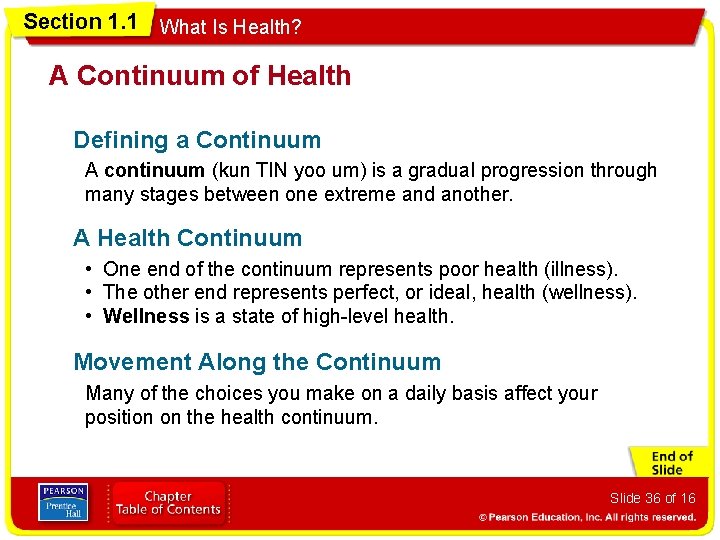
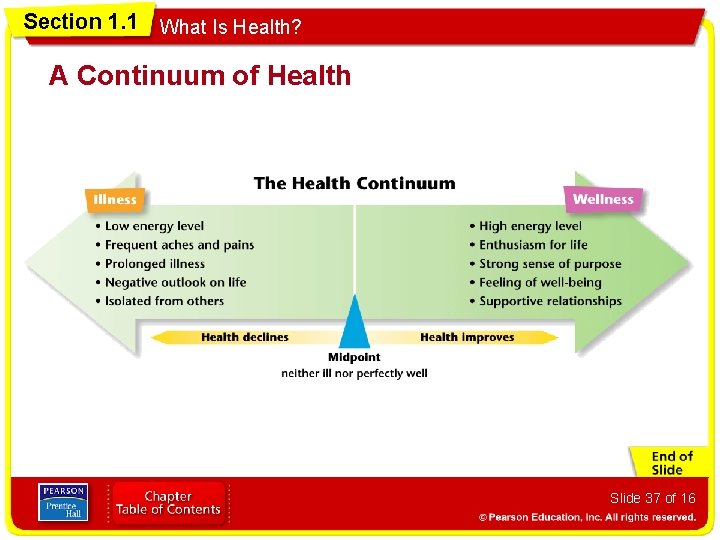
Section 1. 1 What Is Health? A Continuum of Health Defining a Continuum A continuum (kun TIN yoo um) is a gradual progression through many stages between one extreme and another. A Health Continuum • One end of the continuum represents poor health (illness). • The other end represents perfect, or ideal, health (wellness). • Wellness is a state of high-level health. Movement Along the Continuum Many of the choices you make on a daily basis affect your position on the health continuum. Slide 36 of 16
Section 1. 1 What Is Health? A Continuum of Health Slide 37 of 16
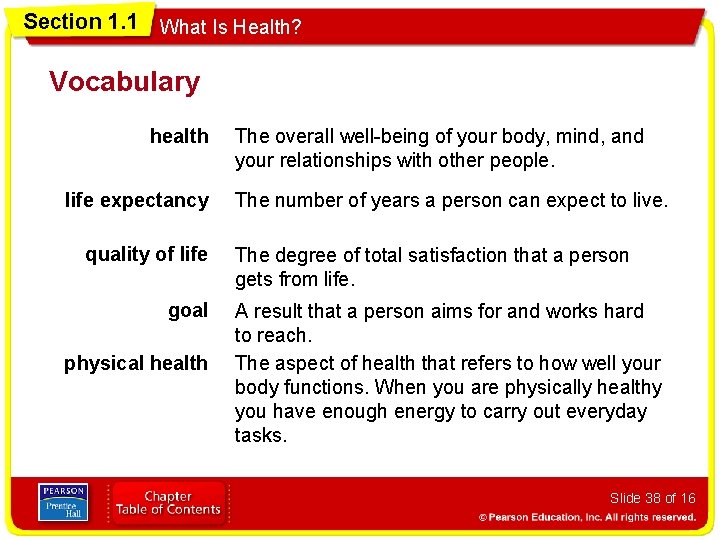
Section 1. 1 What Is Health? Vocabulary health life expectancy quality of life goal physical health The overall well-being of your body, mind, and your relationships with other people. The number of years a person can expect to live. The degree of total satisfaction that a person gets from life. A result that a person aims for and works hard to reach. The aspect of health that refers to how well your body functions. When you are physically healthy you have enough energy to carry out everyday tasks. Slide 38 of 16
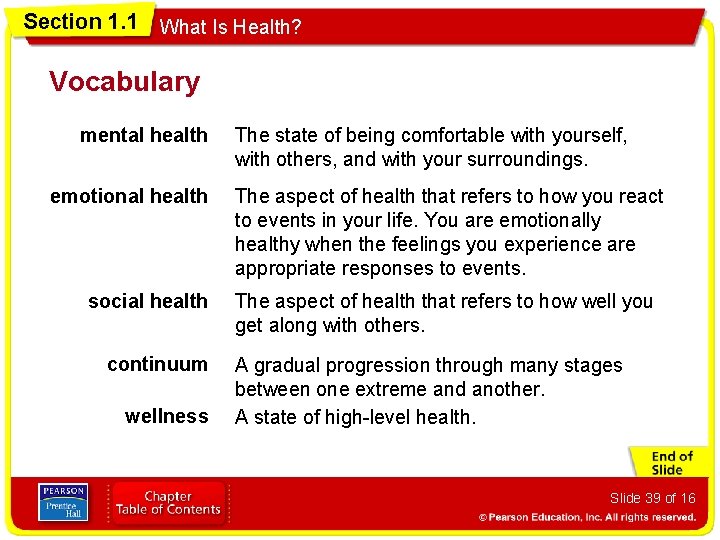
Section 1. 1 What Is Health? Vocabulary mental health emotional health social health continuum wellness The state of being comfortable with yourself, with others, and with your surroundings. The aspect of health that refers to how you react to events in your life. You are emotionally healthy when the feelings you experience are appropriate responses to events. The aspect of health that refers to how well you get along with others. A gradual progression through many stages between one extreme and another. A state of high-level health. Slide 39 of 16
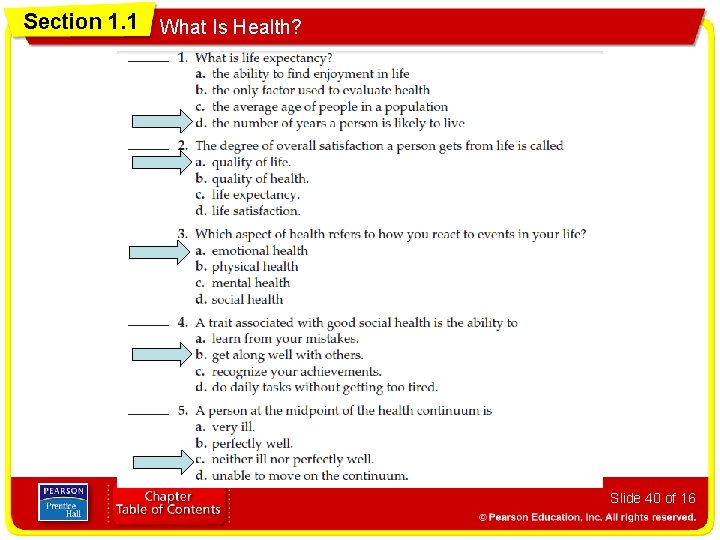
Section 1. 1 What Is Health? Slide 40 of 16
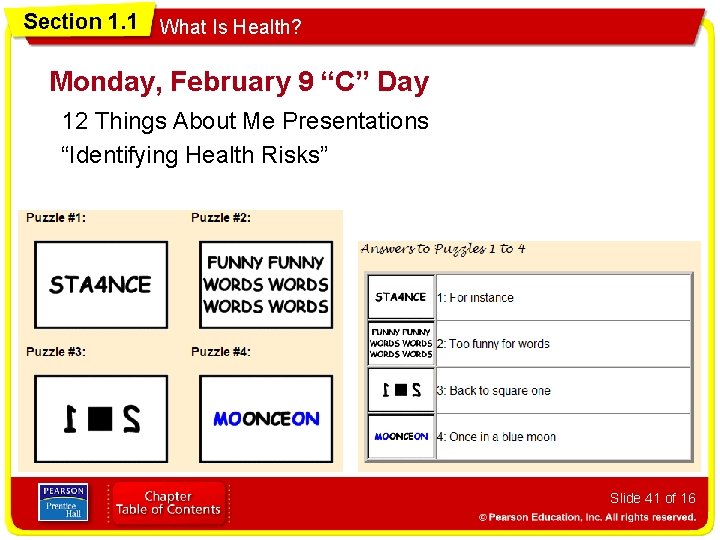
Section 1. 1 What Is Health? Monday, February 9 “C” Day 12 Things About Me Presentations “Identifying Health Risks” Slide 41 of 16
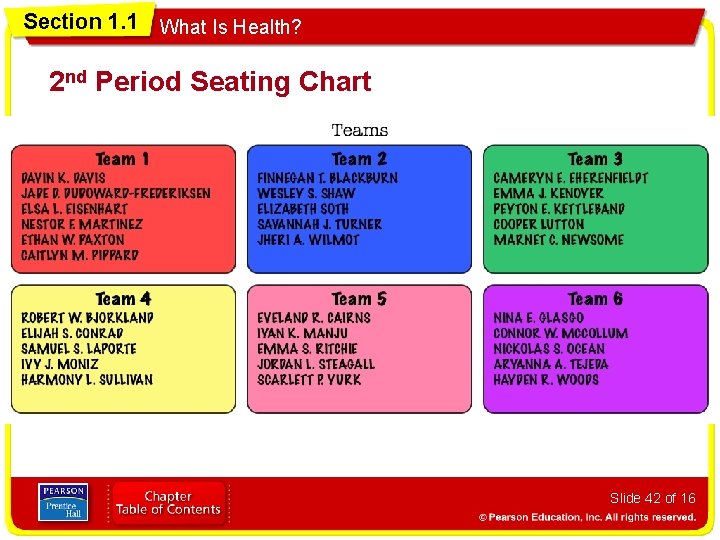
Section 1. 1 What Is Health? 2 nd Period Seating Chart Slide 42 of 16
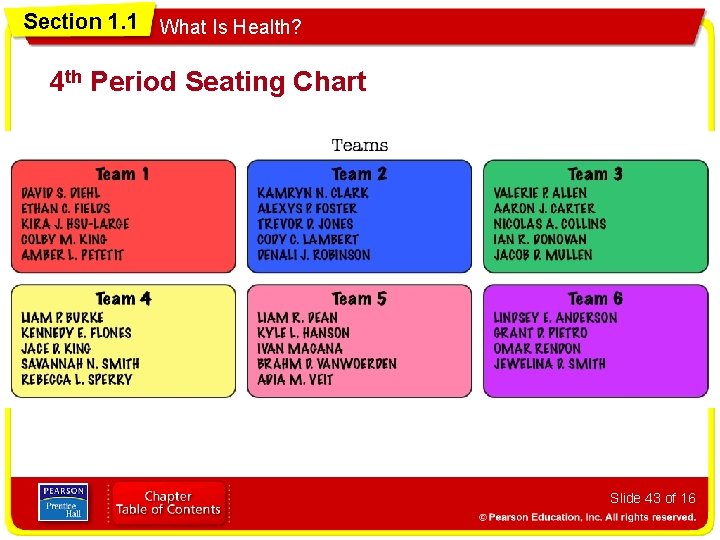
Section 1. 1 What Is Health? 4 th Period Seating Chart Slide 43 of 16
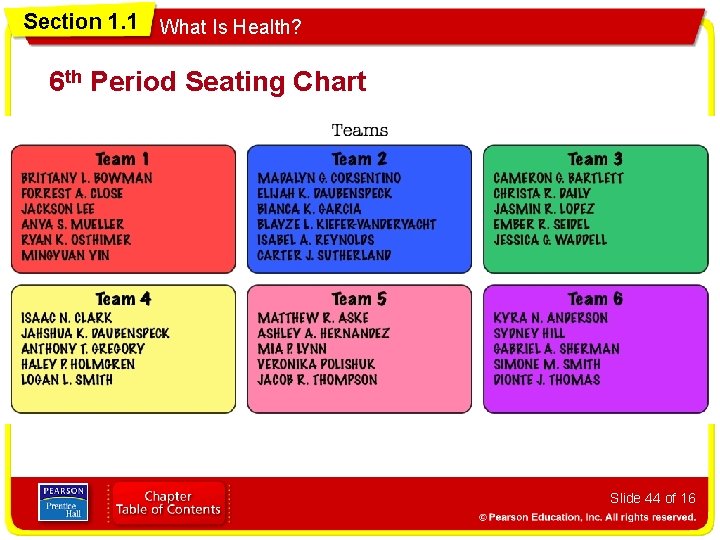
Section 1. 1 What Is Health? 6 th Period Seating Chart Slide 44 of 16
Section 1. 2 1. 1 What Is Health? Identifying Health Risks Objectives Identify factors that can influence a person’s health. Describe three strategies you can use to evaluate risk factors. Slide 45 of 21
Section 1. 1 What Is Health? Identify factors that can influence a person’s health. • Respond at Poll. Ev. com/nolan OR • Text NOLAN to 37607 once to join, then text your message Slide 46 of 16
Section 1. 1 What Is Health?
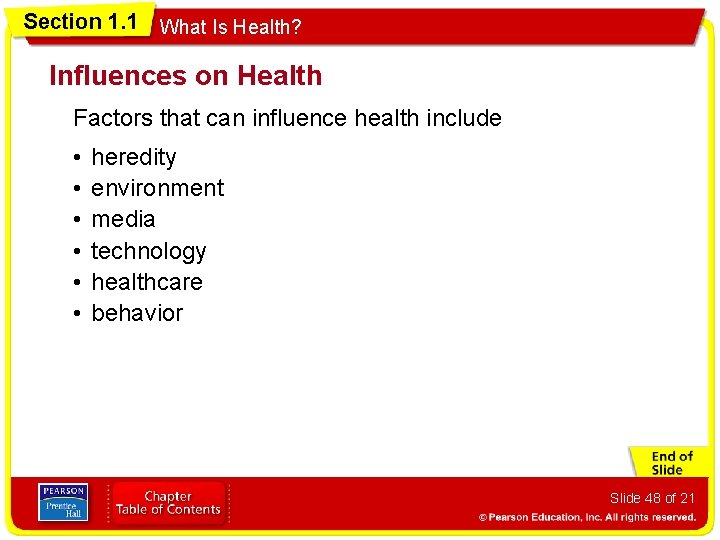
Section 1. 1 What Is Health? Influences on Health Factors that can influence health include • • • heredity environment media technology healthcare behavior Slide 48 of 21
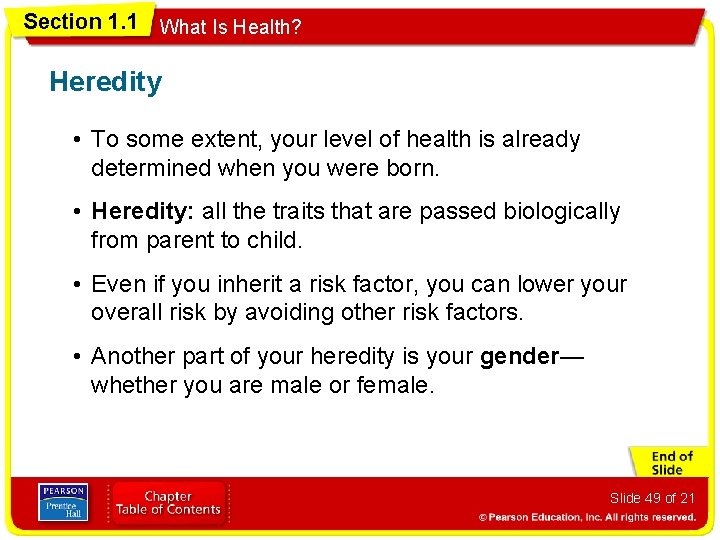
Section 1. 1 What Is Health? Heredity • To some extent, your level of health is already determined when you were born. • Heredity: all the traits that are passed biologically from parent to child. • Even if you inherit a risk factor, you can lower your overall risk by avoiding other risk factors. • Another part of your heredity is your gender— whether you are male or female. Slide 49 of 21
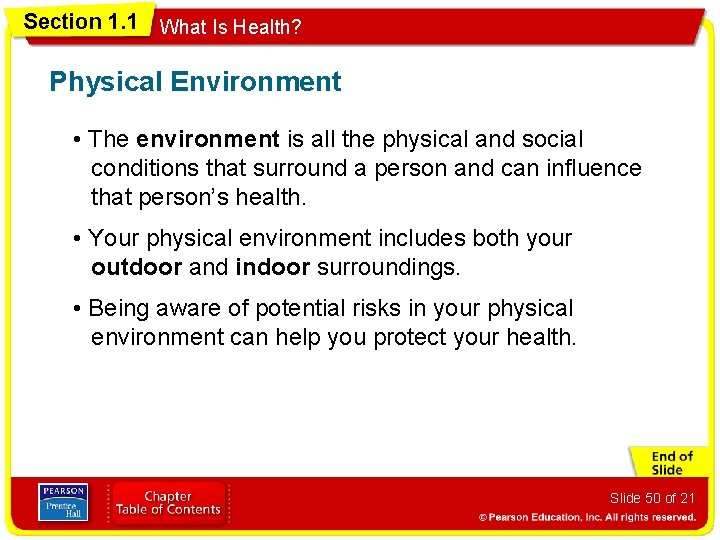
Section 1. 1 What Is Health? Physical Environment • The environment is all the physical and social conditions that surround a person and can influence that person’s health. • Your physical environment includes both your outdoor and indoor surroundings. • Being aware of potential risks in your physical environment can help you protect your health. Slide 50 of 21
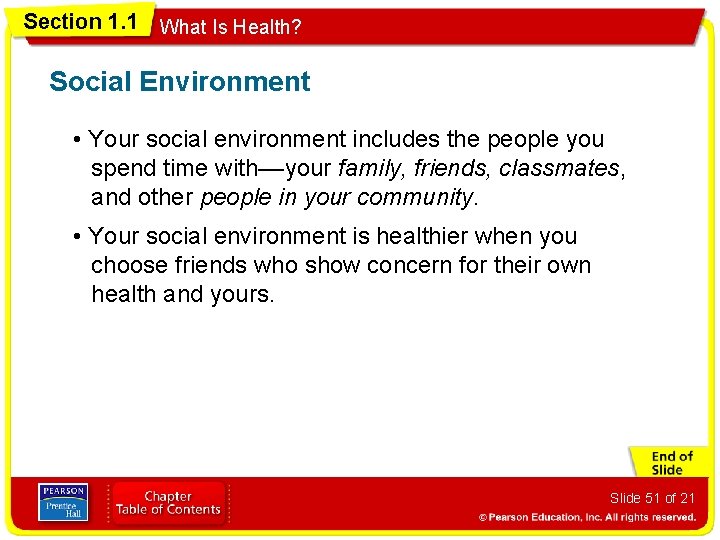
Section 1. 1 What Is Health? Social Environment • Your social environment includes the people you spend time with––your family, friends, classmates, and other people in your community. • Your social environment is healthier when you choose friends who show concern for their own health and yours. Slide 51 of 21
Section 1. 1 What Is Health? Culture • Culture is the beliefs and patterns of behavior that are shared by a group of people and passed from generation to generation. • In some cultures, public displays of emotion are typical. • In other cultures people tend to keep their emotions private. • Guides to cultures, customs & etiquette. Slide 52 of 21
Section 1. 1 What Is Health? Media • Media are forms of communication that provide news and entertainment. • Media can have a positive or negative influence on your health. • You might receive useful information from a public service announcement or from a news report on a health topic. • Some characters on television shows may be poor role models who indulge in risky behavior. Slide 53 of 21
Section 1. 1 What Is Health? Technology • Advances in technology help doctors to detect health problems sooner and improve the quality of life for patients. • Some Web sites provide accurate information about health. • Others are filled with misleading or self-serving information. • Be sure to consider the source of the information on a Web site and the purpose of the site. Slide 54 of 21
Section 1. 1 What Is Health? Healthcare • Healthcare includes the medical services provided by doctors, nurses, dentists, and therapists. • Healthcare also includes the places these people work, such as clinics and hospitals. Slide 55 of 21
Section 1. 1 What Is Health? Evaluating Health Risks A risk factor is any action or condition that increases the likelihood of injury, disease, or other negative outcome. • Consider both short- and long-term consequences. • Decide whether you can control the risk factor. • Analyze the possible benefits and risks of a decision. Slide 56 of 21
Section 1. 1 What Is Health? Short- and Long-Term Consequences • Some behaviors can have an immediate effect on your health. • With some risky behaviors, the consequences are not immediate. • It can be very difficult to change habits that have existed for years. Even if you do change your risky behaviors later in life, you may not be able to repair the damage you may have done to your body. Slide 57 of 21
Section 1. 1 What Is Health? Risk Factors You Cannot Control • You can’t control the color of your skin or other risk factors that are part of your heredity. • Nor can you control all the risk factors in your environment. Slide 58 of 21
Section 1. 1 What Is Health? Risk Factors You Can Control You can control these risk factors that are related to your behavior. • your level of physical activity • your intake of fat, sugar, or salt • your use of tobacco, alcohol, and other drugs • your use to protective gear, such as seat belts • your choice of friends Slide 59 of 21
Section 1. 1 What Is Health? Analyzing Benefits and Risks • Without taking risks and trying new things, it would be impossible to grow as a person. • You need to weigh the risks of an action against the possible benefits. Slide 60 of 21
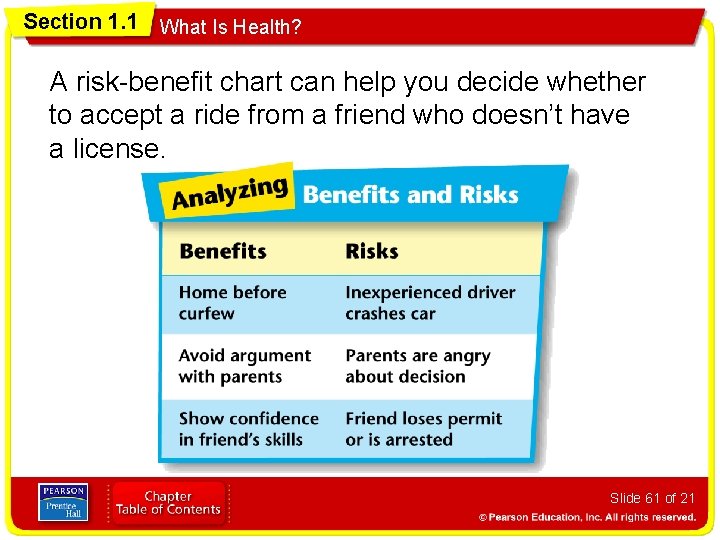
Section 1. 1 What Is Health? A risk-benefit chart can help you decide whether to accept a ride from a friend who doesn’t have a license. Slide 61 of 21
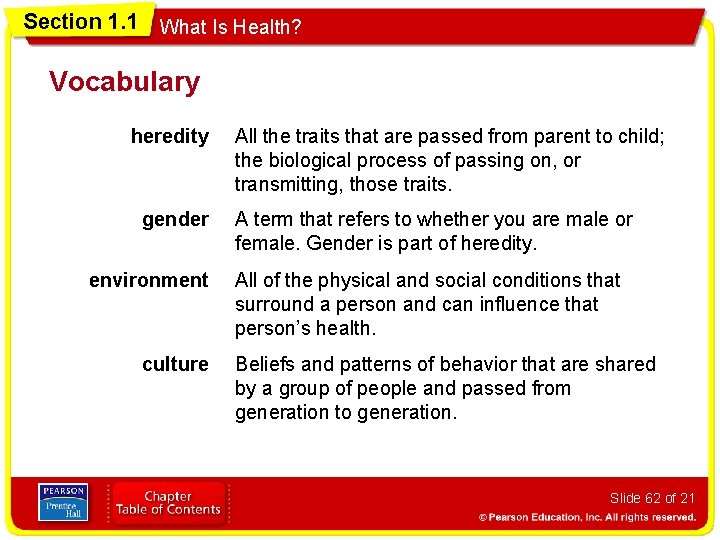
Section 1. 1 What Is Health? Vocabulary heredity gender environment culture All the traits that are passed from parent to child; the biological process of passing on, or transmitting, those traits. A term that refers to whether you are male or female. Gender is part of heredity. All of the physical and social conditions that surround a person and can influence that person’s health. Beliefs and patterns of behavior that are shared by a group of people and passed from generation to generation. Slide 62 of 21
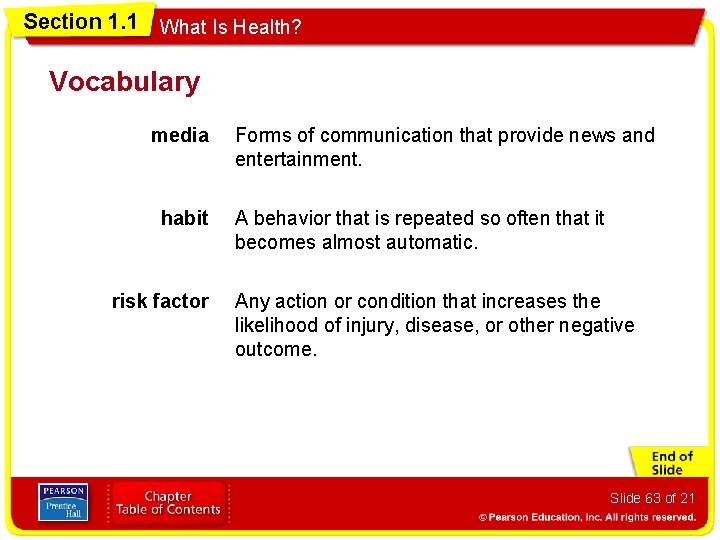
Section 1. 1 What Is Health? Vocabulary media habit risk factor Forms of communication that provide news and entertainment. A behavior that is repeated so often that it becomes almost automatic. Any action or condition that increases the likelihood of injury, disease, or other negative outcome. Slide 63 of 21
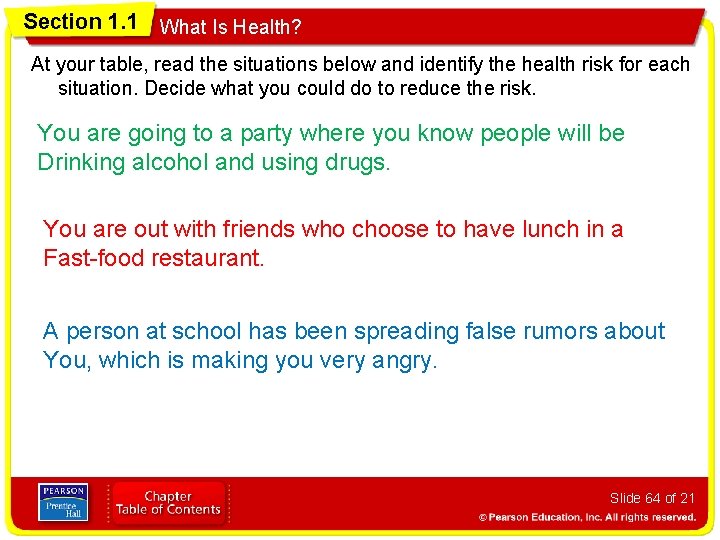
Section 1. 1 What Is Health? At your table, read the situations below and identify the health risk for each situation. Decide what you could do to reduce the risk. You are going to a party where you know people will be Drinking alcohol and using drugs. You are out with friends who choose to have lunch in a Fast-food restaurant. A person at school has been spreading false rumors about You, which is making you very angry. Slide 64 of 21