
Section 04 Adiabatic Processes and Stability Lessons 12
Section 04 Adiabatic Processes and Stability Lessons 12 & 13
Adiabatic Process • An adiabatic process is one which involves no transfer of heat or mass across an imaginary boundary. • An air parcel is said to cool or warm adiabatically under these conditions.
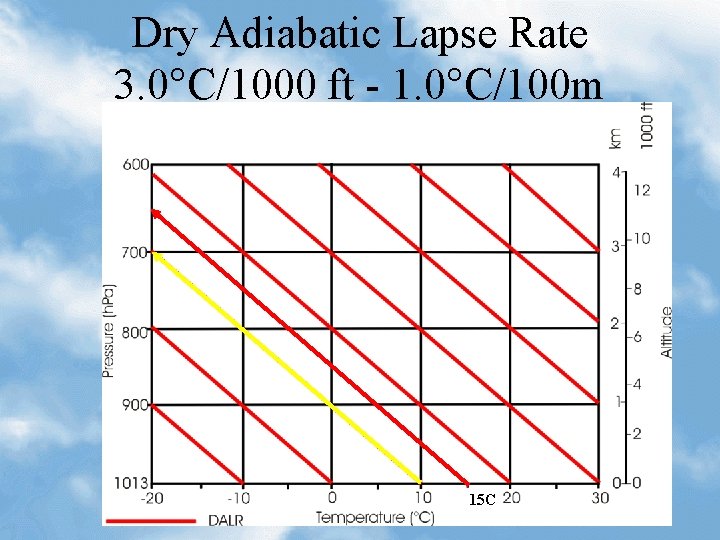
Dry Adiabatic Lapse Rate 3. 0°C/1000 ft - 1. 0°C/100 m 15 C
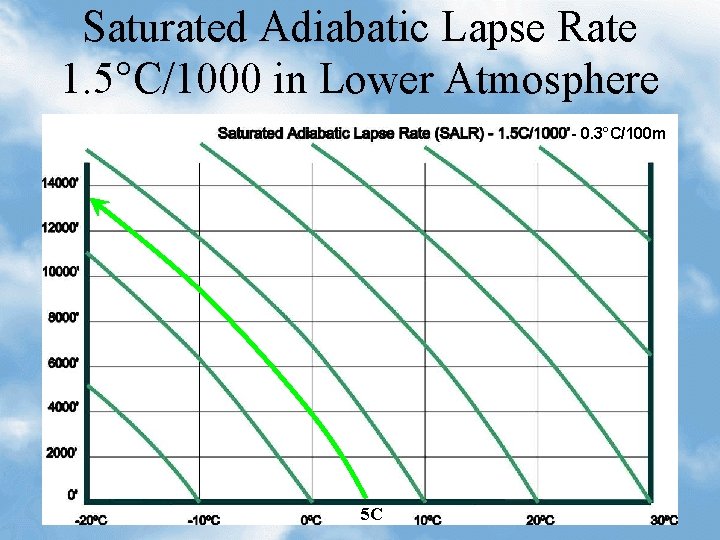
Saturated Adiabatic Lapse Rate 1. 5°C/1000 in Lower Atmosphere - 0. 3°C/100 m 5 C
Dew Point Lapse Rate • The Dew Point Lapse Rate (DPLR) is the rate at which the dew point inside a rising air parcel decreases due to the decreasing atmospheric pressure. – It has a value of 0. 5°C/1000 feet – 0. 13 °C/100 m
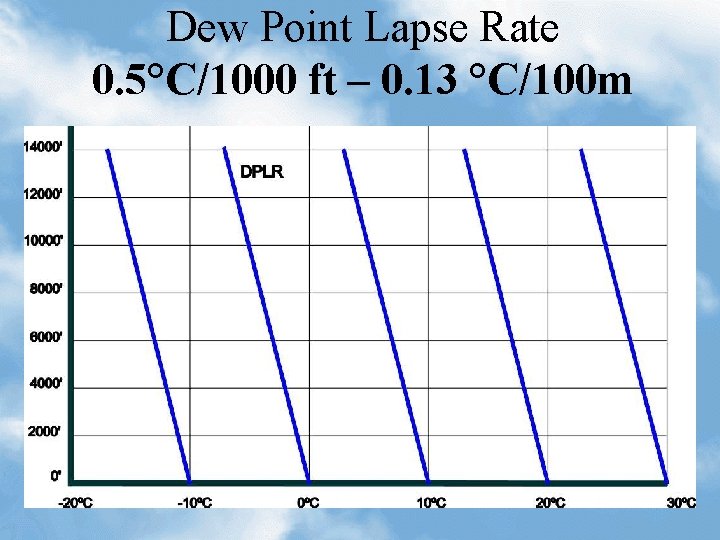
Dew Point Lapse Rate 0. 5°C/1000 ft – 0. 13 °C/100 m

Upper Air Sounding
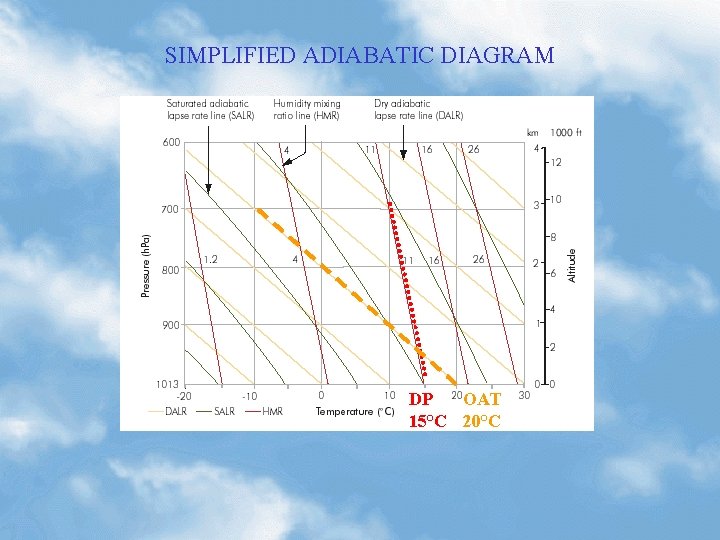
SIMPLIFIED ADIABATIC DIAGRAM DP OAT 15°C 20°C
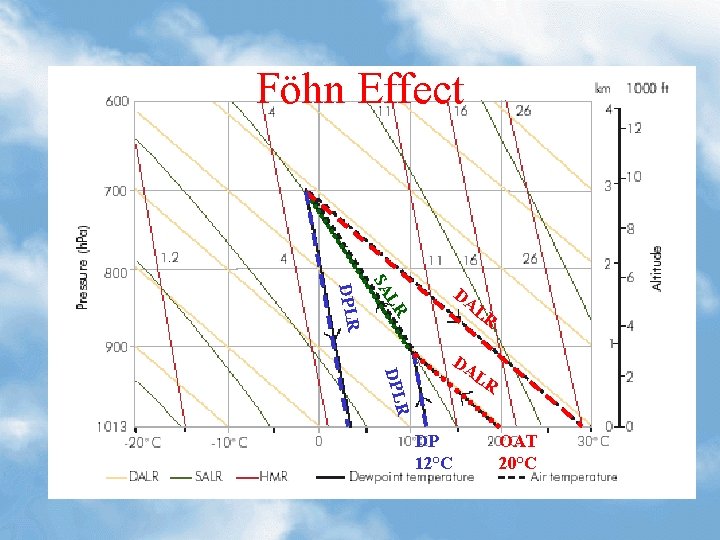
Föhn Effect LR SA DPLR DA L R R DPL DA LR DP 12°C OAT 20°C
Atmospheric Stability/Instability • Stability discourages vertical motion. • Instability encourages vertical motion; • The degree of stability/instability depends on the environmental lapse rate (ELR) and moisture content.
Atmospheric Stability/Instability • Stability/Instability of air determines the weather – Unstable air gives: • Cumuliform cloud • Rain showers and good visibility – Stable air gives: • Fine hazy weather, moderate to poor visibility or • Layer cloud or fog
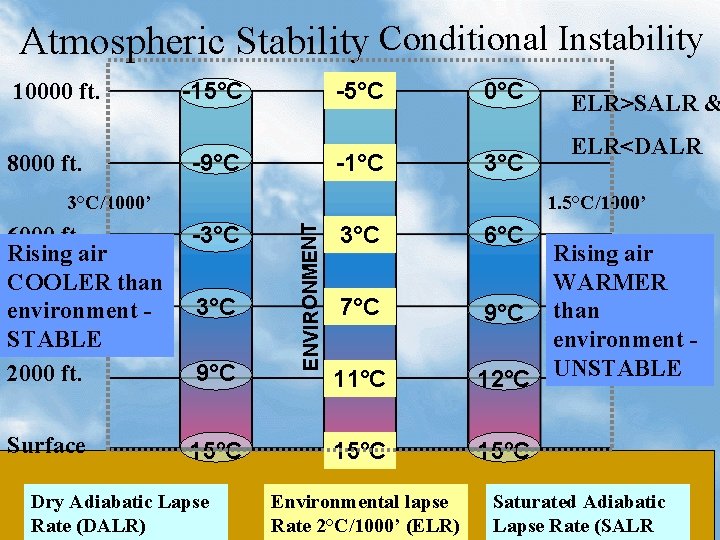
Atmospheric Stability Conditional Instability 10000 ft. 8000 ft. -15°C -9°C -1°C 0°C 3°C ELR<DALR 1. 5°C/1000’ 6000 ft. Rising air COOLER than 4000 ft. environment STABLE 2000 ft. -3°C Surface 15°C 3°C 9°C Dry Adiabatic Lapse Rate (DALR) ENVIRONMENT 3°C/1000’ ELR>SALR & 3°C 6°C 11°C Rising air WARMER 9°C than environment 12°C UNSTABLE 15°C 7°C Environmental lapse Rate 2°C/1000’ (ELR) Saturated Adiabatic Lapse Rate (SALR
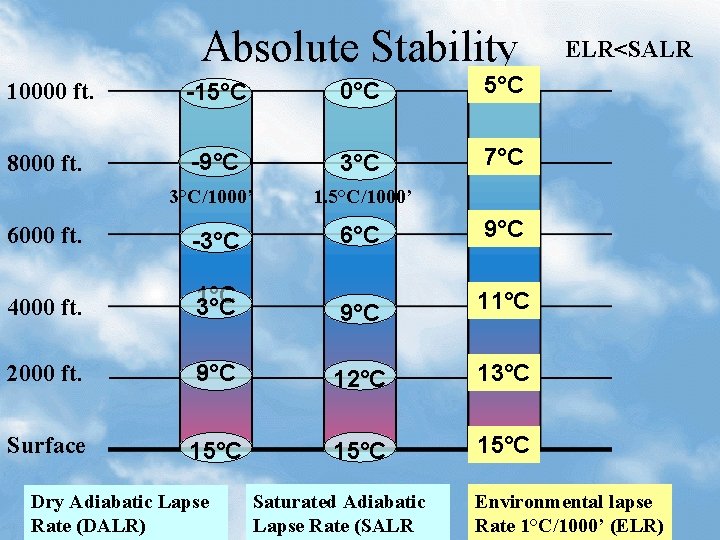
Absolute Stability 10000 ft. -15°C 0°C -5°C 8000 ft. -9°C 3°C -1°C 7°C 3°C/1000’ 1. 5°C/1000’ 6000 ft. -3°C 6°C 3°C 9°C 4000 ft. 1°C 3°C 9°C 11°C 7°C 2000 ft. 8°C 9°C 12°C 11°C 13°C Surface 15°C Dry Adiabatic Lapse Rate (DALR) Saturated Adiabatic Lapse Rate (SALR ELR<SALR Environmental lapse Rate 1°C/1000’ (ELR)
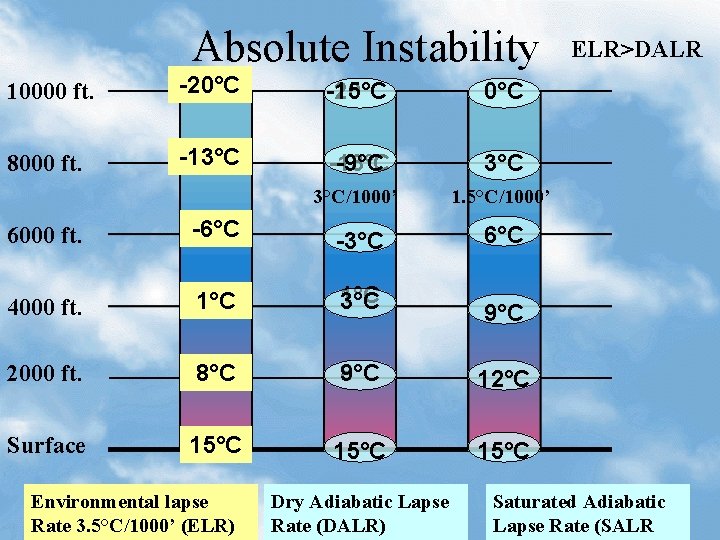
Absolute Instability 10000 ft. -20°C -15°C 0°C 8000 ft. -13°C -9°C 3°C/1000’ 1. 5°C/1000’ -3°C 6000 ft. -6°C 4000 ft. 1°C 3°C 9°C 2000 ft. 8°C 9°C 12°C Surface 15°C Environmental lapse Rate 3. 5°C/1000’ (ELR) Dry Adiabatic Lapse Rate (DALR) ELR>DALR Saturated Adiabatic Lapse Rate (SALR
Lapse Rates • The Environmental Lapse Rate (ELR) is the rate at which the unlifted surrounding air layers cool. • The Dry Adiabatic Lapse Rate (DALR) is the rate at which a parcel of dry or unsaturated air cools as it rises or warms as it sinks. • The Saturated Adiabatic Lapse Rate (SALR) is the rate at which a parcel of saturated air cools as it rises. – The DALR is modified to this value by the release of Latent Heat of Condensation in the rising air parcel.

ELR<SALR (or SALR>ELR)
– – – – Absolute Stability The ELR is less than the SALR (ELR<SALR); A rising saturated air parcel would cool at 1. 5°C/1000 feet (SALR); It would be cooler than it’s surroundings and sink back A dry or unsaturated air parcel would cool at 3°C/1000 feet (DALR); It would still be cooler than it’s surroundings and sink back. The ELR is therefore described as as absolutely stable. It can also be described as a shallow lapse rate.

ELR > DALR (or DALR < ELR)
Absolute Instability – – – – If the ELR is greater than 3°C/1000 feet (ELR >DALR); Rising saturated air will cool at 1. 5°C/1000 ft (SALR); It will be warmer than it’s surroundings at all levels and keep rising. Rising dry or unsaturated air will cool at 3°C/1000 ft (DALR); It will be warmer at all levels than it’s surroundings and keep rising. Such an ELR is described as absolutely unstable. Such “steep” ELR’s occur very rarely.
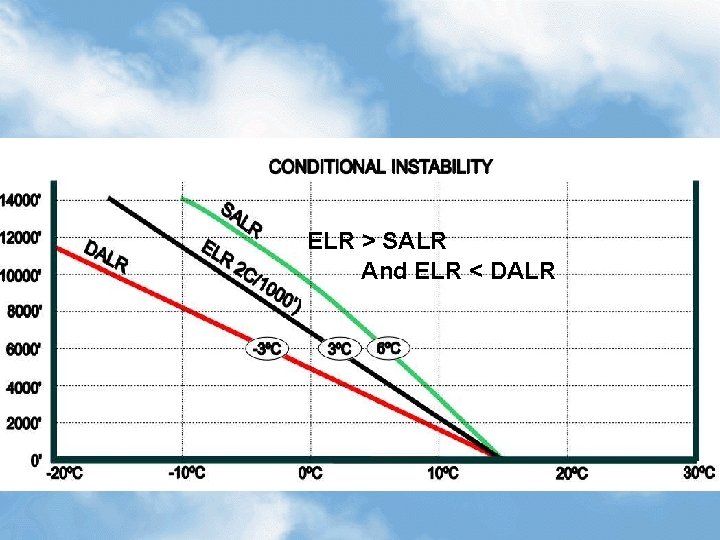
ELR > SALR And ELR < DALR
Conditional Instability • Conditional Instability – Is the most usual state of the atmosphere. – If the rising air parcel is dry or unsaturated, it cools at the DALR of 3°C/1000 feet if forced to rise. – At all altitudes it is cooler than it’s surroundings and would sink back. – If the parcel is saturated, however, it would cool at the SALR of 1. 5°C/1000 feet if forced to rise. – At all altitudes it is warmer than it’s surroundings and would keep rising
Conditional Instability (Cont. ) • ELRs lying between the DALR and the SALR are therefore generally described as being conditionally unstable; • The condition for instability being that: – the air is saturated, or will become saturated through cooling by lifting at some low level. • If the air parcel is initially dry or unsaturated it is stable. • If it is initially saturated it will be unstable.
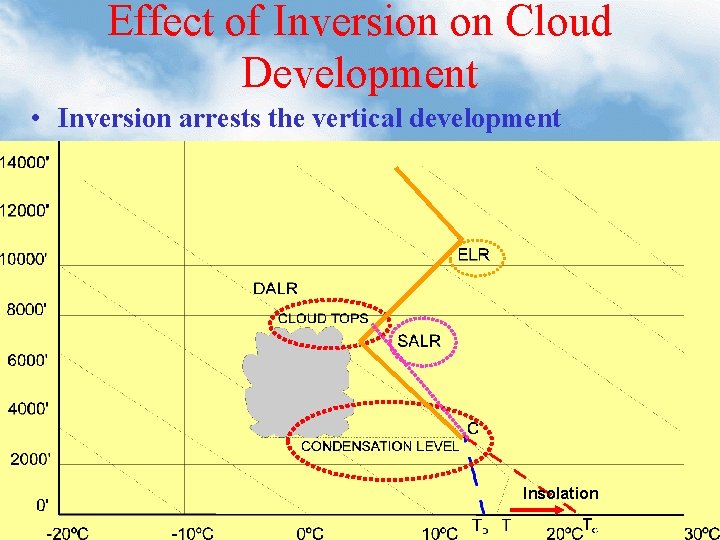
Effect of Inversion on Cloud Development • Inversion arrests the vertical development Insolation
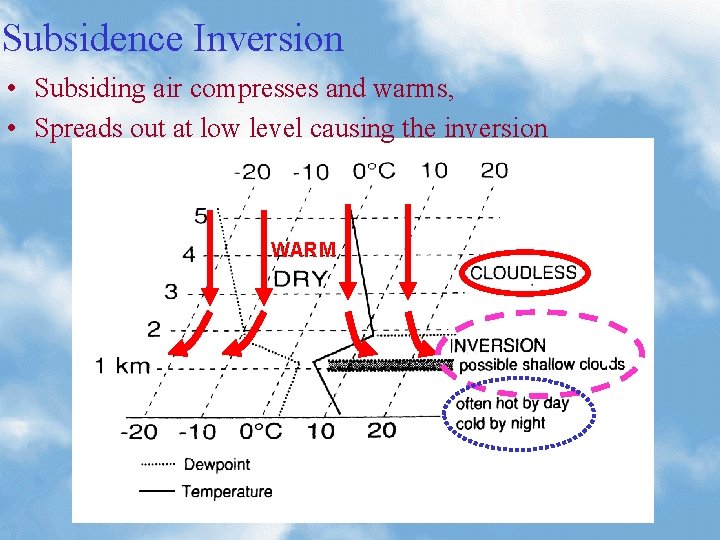
Subsidence Inversion • Subsiding air compresses and warms, • Spreads out at low level causing the inversion WARM
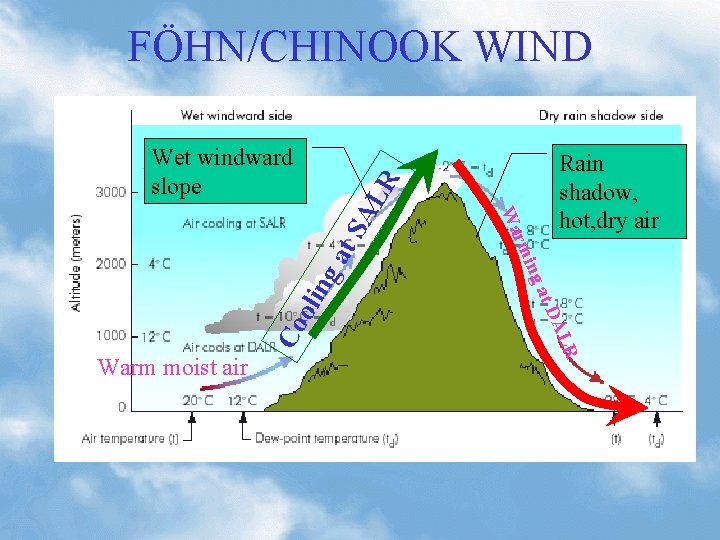
FÖHN/CHINOOK WIND R AL at ng oli Co Rain shadow, hot, dry air at D Warm moist air ing rm Wa SA LR Wet windward slope
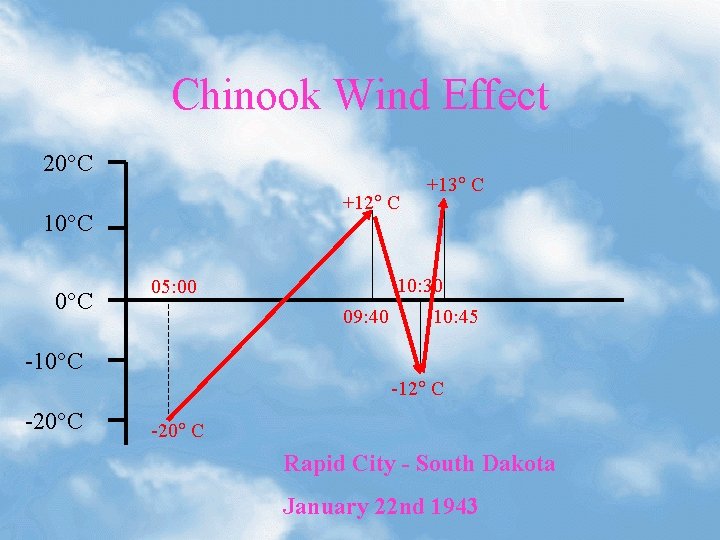
Chinook Wind Effect 20 C +12 C 10 C +13 C 10: 30 05: 00 09: 40 10: 45 -10 C -12 C -20 C Rapid City - South Dakota January 22 nd 1943
Effect on Stability of Cold/Warm Advection – Advection of warm air over a cold surface: • Cooled in the boundary layer. • The boundary layer mixing also modifies the lapse rate and produces an inversion at the top of the mixing layer. • This will further stabilise the air in addition to the cooling caused by the cold surface.
• Advection of cold air aloft over warm air at the surface: – This will steepen the lapse rate considerably aloft causing extreme instability and severe thunderstorms. – A classic example of this is warm tropical maritime air moving north over the central plains of the USA. If cold dry air from the NW advects aloft over the warm air it will produce the extreme unstable conditions for supercell thunderstorms.
– Advection of cold air over a warm surface: • Warmer surface will steepen the lapse rate in the lower layers due to the turbulent mixing and thermal activity and increase the instability.
• Advection of warmer air aloft: – Generally increases stability due to the formation of an inversion at the interface between the cold and the warm air. – However the degree of instability will ultimately depend on the environmental lapse rate in the air aloft.
- Slides: 30