
Section 0 1 Before Calculus Functions All graphics
Section 0. 1 “Before Calculus” Functions
All graphics are attributed to: � Calculus, 10/E by Howard Anton, Irl Bivens, and Stephen Davis Copyright © 2009 by John Wiley & Sons, Inc. All rights reserved.
Definition of a Function � You may remember from earlier courses that a function exists when each x value has one y value. � You can also recognize a function from the graph by using the vertical line test. � Remember, x is always the independent variable (values make up the domain) and y is the dependent variable (values make up the range).
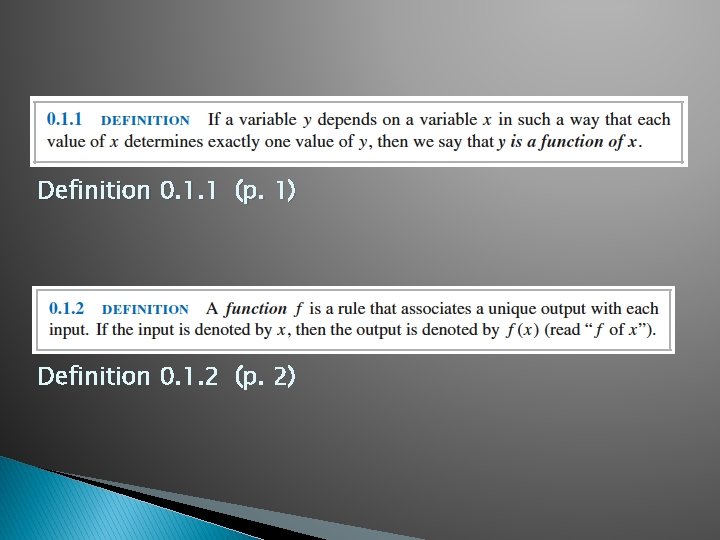
Definition 0. 1. 1 (p. 1) Definition 0. 1. 2 (p. 2)

The following are all functions
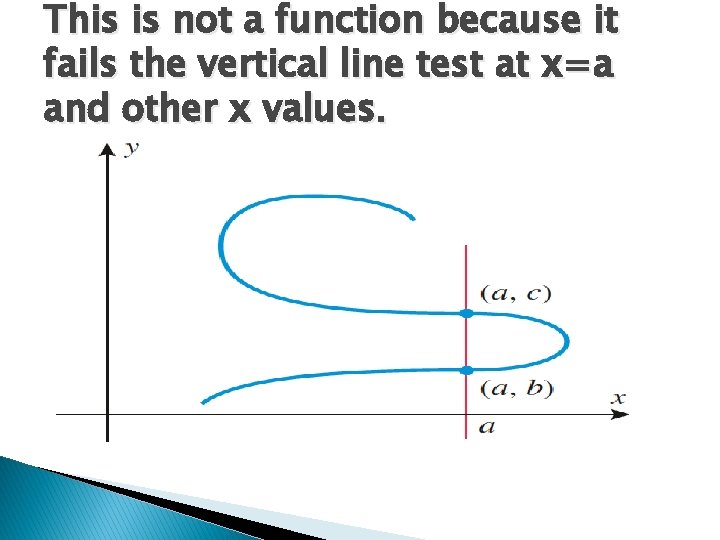
This is not a function because it fails the vertical line test at x=a and other x values.
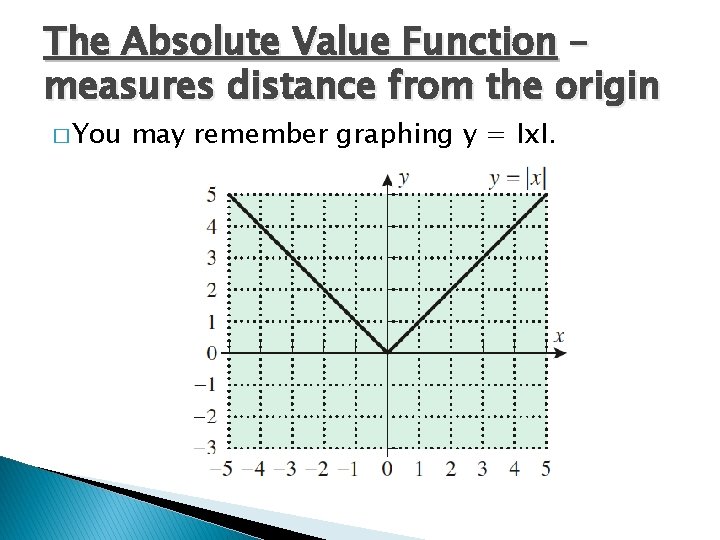
The Absolute Value Function – measures distance from the origin � You may remember graphing y = ІxІ.
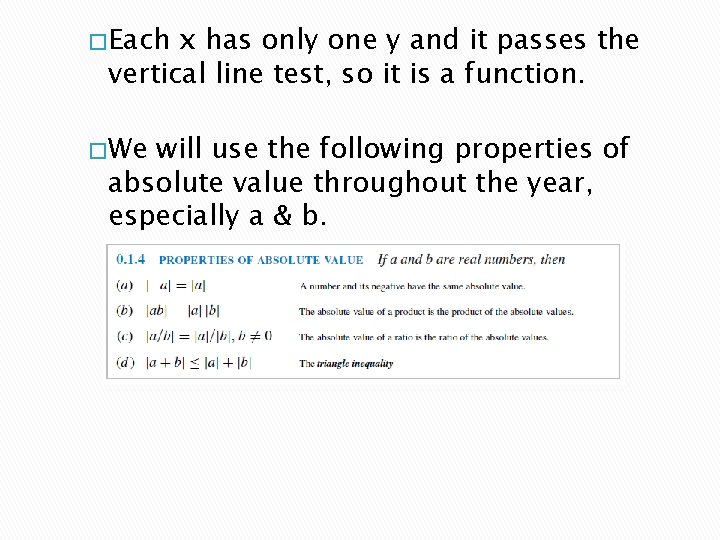
� Each x has only one y and it passes the vertical line test, so it is a function. � We will use the following properties of absolute value throughout the year, especially a & b.
Piecewise-Defined Functions � The absolute value function f(x) = ІxІ or y = ІxІ is an example of a piecewise function because the formula changes depending upon the value of x. On the left side, the equation is y = -x where x < 0. On the right side, the equation is y = x where x > 0. They are pieces of two functions combined together in your graph with a breakpoint at x=0. � See page 6 in your book for more examples.
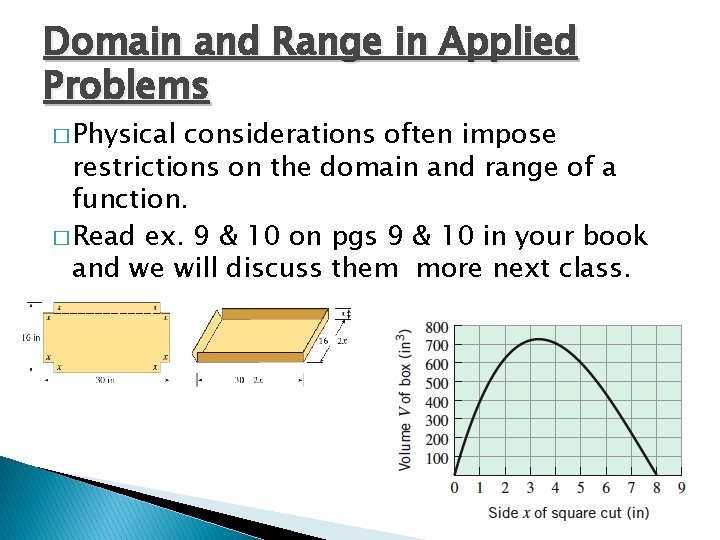
Domain and Range in Applied Problems � Physical considerations often impose restrictions on the domain and range of a function. � Read ex. 9 & 10 on pgs 9 & 10 in your book and we will discuss them more next class.
- Slides: 10