Sect 6 3 Gravity Near Earths Surface g
- Slides: 10
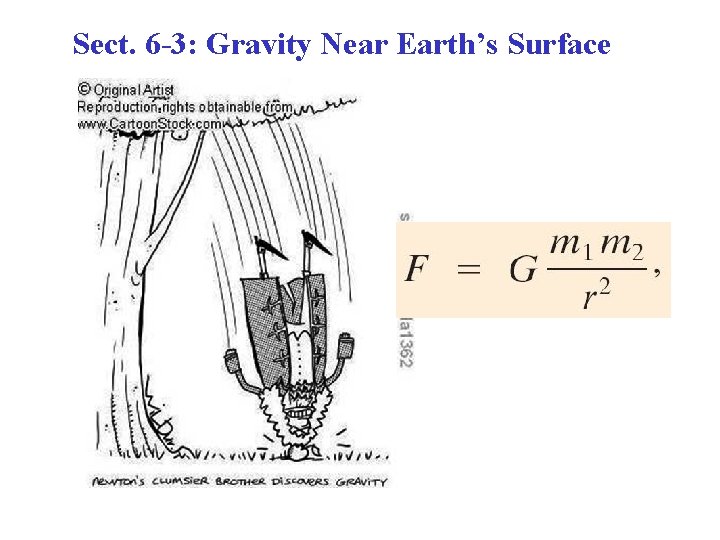
Sect. 6 -3: Gravity Near Earth’s Surface
g & The Gravitational Constant G
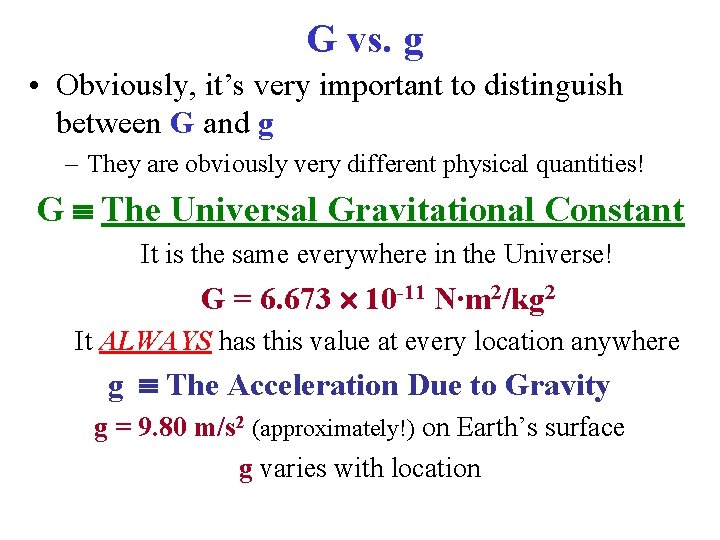
G vs. g • Obviously, it’s very important to distinguish between G and g – They are obviously very different physical quantities! G The Universal Gravitational Constant It is the same everywhere in the Universe! G = 6. 673 10 -11 N∙m 2/kg 2 It ALWAYS has this value at every location anywhere g The Acceleration Due to Gravity g = 9. 80 m/s 2 (approximately!) on Earth’s surface g varies with location
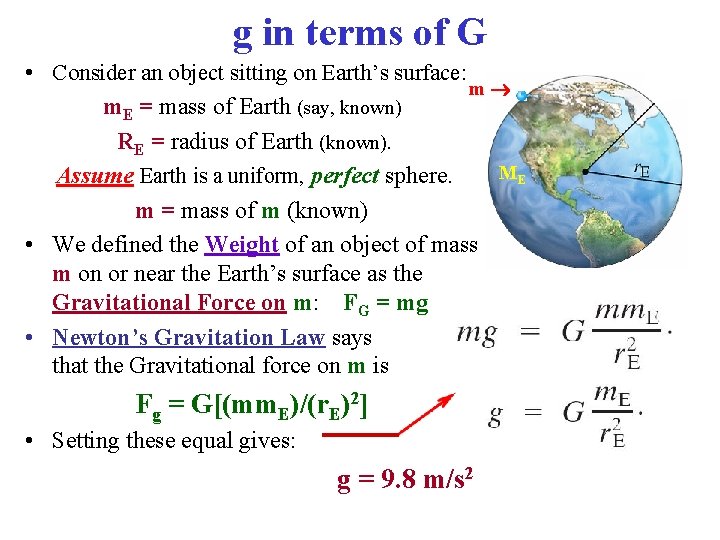
g in terms of G • Consider an object sitting on Earth’s surface: m m. E = mass of Earth (say, known) RE = radius of Earth (known). ME Assume Earth is a uniform, perfect sphere. m = mass of m (known) • We defined the Weight of an object of mass m on or near the Earth’s surface as the Gravitational Force on m: FG = mg • Newton’s Gravitation Law says that the Gravitational force on m is Fg = G[(mm. E)/(r. E)2] • Setting these equal gives: g = 9. 8 m/s 2
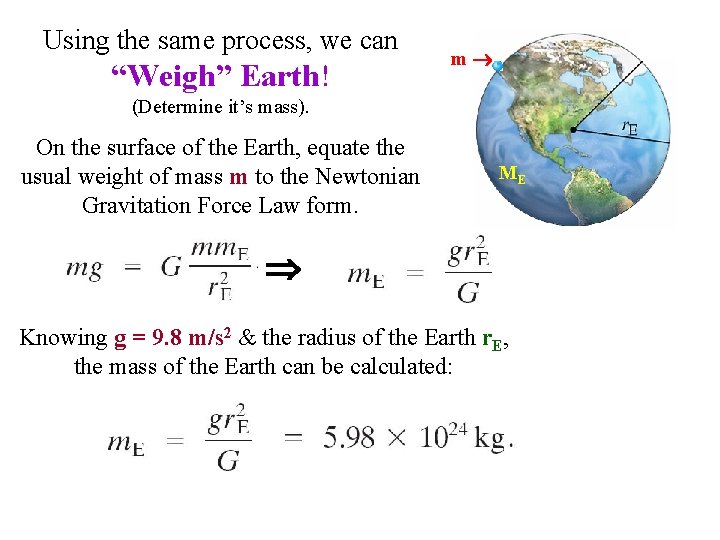
Using the same process, we can “Weigh” Earth! m (Determine it’s mass). On the surface of the Earth, equate the usual weight of mass m to the Newtonian Gravitation Force Law form. ME Knowing g = 9. 8 m/s 2 & the radius of the Earth r. E, the mass of the Earth can be calculated:
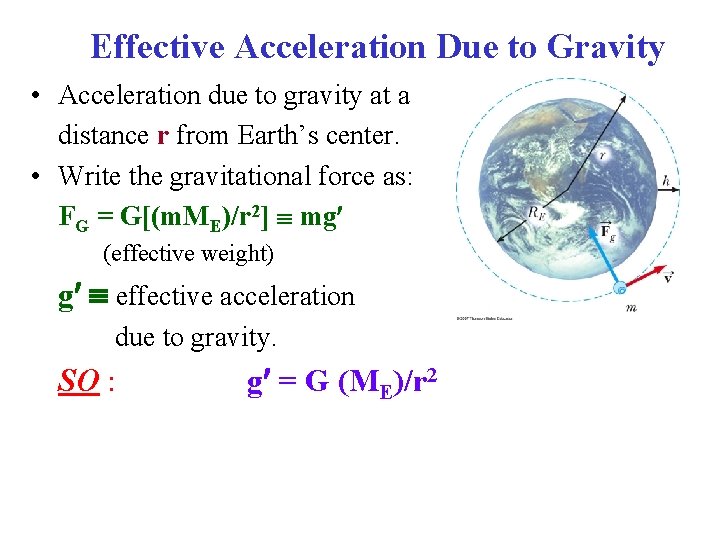
Effective Acceleration Due to Gravity • Acceleration due to gravity at a distance r from Earth’s center. • Write the gravitational force as: FG = G[(m. ME)/r 2] mg (effective weight) g effective acceleration due to gravity. SO : g = G (ME)/r 2
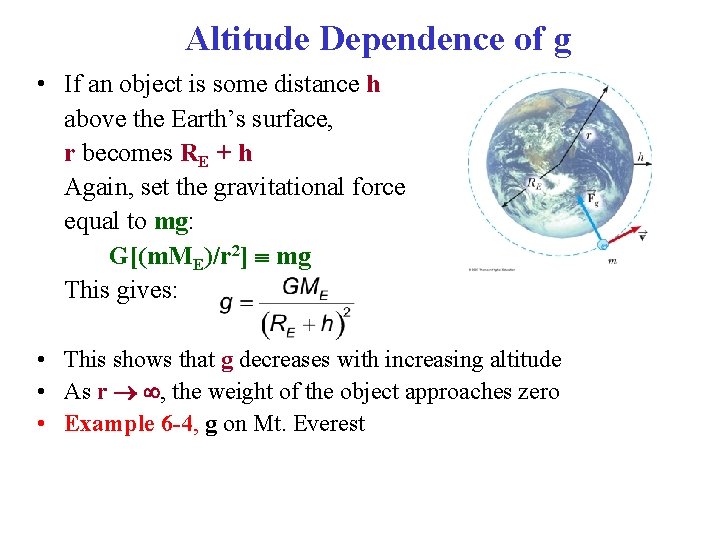
Altitude Dependence of g • If an object is some distance h above the Earth’s surface, r becomes RE + h Again, set the gravitational force equal to mg: G[(m. ME)/r 2] mg This gives: • This shows that g decreases with increasing altitude • As r , the weight of the object approaches zero • Example 6 -4, g on Mt. Everest
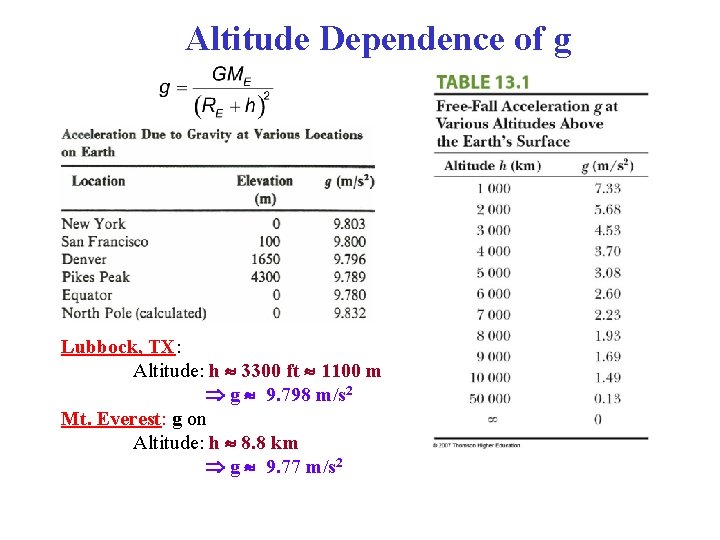
Altitude Dependence of g Lubbock, TX: Altitude: h 3300 ft 1100 m g 9. 798 m/s 2 Mt. Everest: g on Altitude: h 8. 8 km g 9. 77 m/s 2
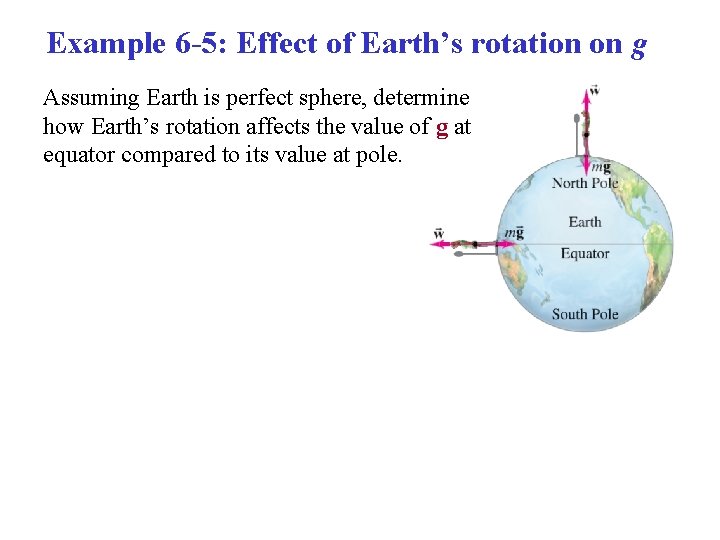
Example 6 -5: Effect of Earth’s rotation on g Assuming Earth is perfect sphere, determine how Earth’s rotation affects the value of g at equator compared to its value at pole.
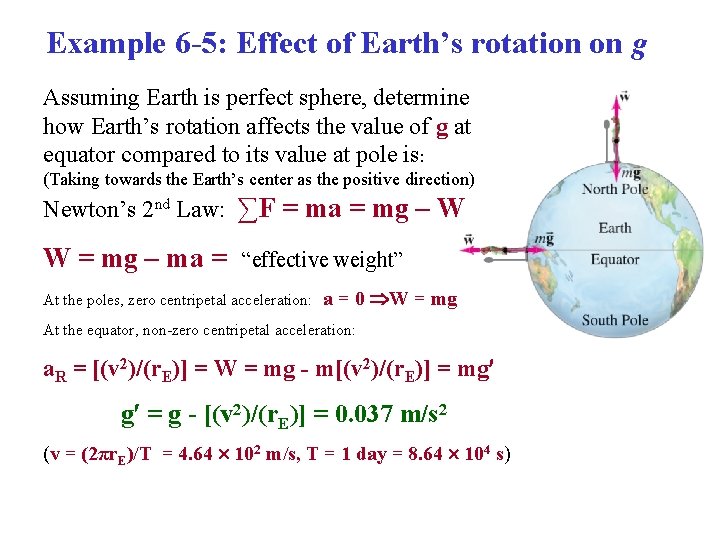
Example 6 -5: Effect of Earth’s rotation on g Assuming Earth is perfect sphere, determine how Earth’s rotation affects the value of g at equator compared to its value at pole is: (Taking towards the Earth’s center as the positive direction) Newton’s 2 nd Law: ∑F = ma = mg – W W = mg – ma = “effective weight” At the poles, zero centripetal acceleration: a = 0 W = mg At the equator, non-zero centripetal acceleration: a. R = [(v 2)/(r. E)] = W = mg - m[(v 2)/(r. E)] = mg g = g - [(v 2)/(r. E)] = 0. 037 m/s 2 (v = (2πr. E)/T = 4. 64 102 m/s, T = 1 day = 8. 64 104 s)